

Let’s face it—job boards are hot business. In 2025, with more people working remotely, switching careers, or looking for gig work, the demand for smart job-matching platforms is exploding. No wonder so many startups are jumping to build an Indeed clone. The logic is sound: replicate what works, add a twist, and you’ve got yourself a winner, right? Well… not exactly. Building a job portal that actually succeeds is way trickier than it looks.
I still remember consulting with a fledgling startup last year. They poured thousands into a job board platform, modeled it closely after Indeed, but somehow ended up with tumbleweeds instead of traffic. What went wrong? Turns out, a lot. And they’re not alone—these missteps are way more common than you’d think. From neglecting employer needs to underestimating algorithm power, the traps are real and easy to fall into.
This blog dives into five major mistakes startups make when trying to clone Indeed. We’re talking real issues—poor UX decisions, missed monetization opportunities, technical blunders, and even marketing misfires. If you’re dreaming of launching the next big job search platform, this read will save you time, money, and possibly your whole venture.
So grab your coffee (or chai), because we’re about to dig deep. Avoid these five traps, and you’ll have a way better shot at building something people will actually use—and pay for.
Planning to build in this space? Miracuves offers a ready-made job portal platform that you can launch under your own brand.
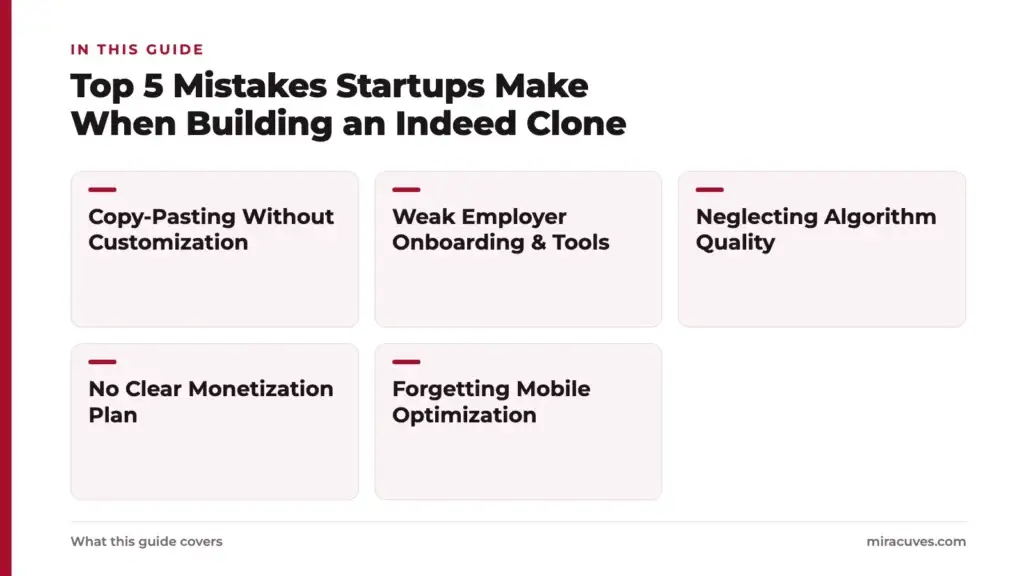
1. Copy-Pasting Without Customization
Too many startups try to mimic Indeed pixel by pixel. That’s a shortcut to mediocrity. Just cloning features without adapting them to a specific niche or audience doesn’t create value—it creates noise. You need to think: what’s your angle?
For example, are you targeting freelance creatives? Healthcare professionals? Blue-collar workers? Each audience needs a different UX, different filters, different onboarding flows. Job seekers looking for remote writing gigs don’t want to wade through corporate job descriptions. A generic clone won’t cut it.
2. Weak Employer Onboarding & Tools
Let’s talk about the money side. Employers fund the job board ecosystem—but startups often give them second-class treatment. If your platform doesn’t make it effortless for employers to post jobs, review applications, and communicate with candidates, they’ll bounce. Worse, they’ll stick with LinkedIn or Indeed. According to TechCrunch, modern recruiting tools are evolving fast, and platforms that don’t keep up risk falling behind.
Give them dashboards that actually make hiring easier. Offer automation tools for shortlisting, templates for outreach, and analytics that show post performance. Bonus: these can be monetized later.
3. Neglecting Algorithm Quality
A job board without a smart matching algorithm is like a dating app without filters—just chaos. Users will bounce if they’re shown irrelevant jobs. Likewise, recruiters get frustrated seeing unqualified applicants.
You don’t need AI that rivals Google, but you do need a solid search + recommendation engine. Relevance matters. NLP for parsing resumes and job descriptions, location filters, and user behavior tracking should all feed into the engine.
4. No Clear Monetization Plan
Free platforms are great—until your runway disappears. Many startups delay thinking about revenue models until it’s too late. Ads, premium listings, subscription models for employers, resume boosters for seekers—there are multiple ways to monetize.
The mistake? Not testing these from day one. You need to find out early what people are willing to pay for, or you risk building a platform nobody funds.
5. Forgetting Mobile Optimization
It’s 2025. Job seekers aren’t logging in from desktop—they’re swiping through openings on their phones between meetings or while commuting. A poorly optimized mobile experience = massive bounce rates.
Your Indeed clone needs to feel like a mobile-native app. Responsive design, quick filters, tap-to-apply features, push notifications—it’s all crucial. Mobile isn’t an option. It’s the main arena.
Conclusion: What You Should Do Instead
Building an Indeed clone isn’t a bad idea—it’s just a complex one. You can’t simply repackage the same features and hope to win. Think about your niche. Prioritize employer experience. Invest in search quality. Monetize smartly. And always—always—optimize for mobile.
If you’re serious about building a job board that scales, sidestepping these five traps could be the best decision you make this year.
Future trends? Expect more platforms integrating AI for matching, voice-based job applications, and social referral systems. The job hunt is going social, fast.
If you’re looking to build such a platform or need strategic help, don’t hesitate to contact the experts at Miracuves.
FAQs
Q1. Is it legal to build an Indeed clone?
Yep, as long as you’re not copying code, brand names, or trademarks. The concept of a job board isn’t owned by anyone.
Q2. How much does it cost to develop an Indeed clone?
An Indeed Clone App from Miracuves costs around $2,499, including setup, customization, and deployment — all delivered within 6 days for a quick market launch.
Q3. What tech stack is ideal?
React or Vue for frontend, Node.js or Laravel for backend, PostgreSQL or MongoDB for database, and ElasticSearch for job matching.
Q4. How can I attract users to my job board?
Start with a niche, offer incentives to early adopters, use SEO-rich landing pages, and run employer-outreach campaigns.
Q5. Should I start with a web or mobile app?
Start with web (responsive) to test traction. Once you get user data and feedback, expand to native apps.
Q6. How do I make my job board stand out?
Innovate in features: video resumes, chat-based interviews, personality quizzes, or blockchain-based credentialing.
Miracuves is an independent software development company. We are not affiliated with, connected to, sponsored by, or endorsed by any company or product named in this article.
Terms such as “X Clone” are used descriptively. It is how the software industry refers to building a platform with functionality comparable to a known service, and how clients search for it.
The entire design and codebase of our products is built by our own team. Our products contain no code, design, graphics, or content originating from any third-party website or applications.
All third-party names and marks referenced in this article are the property of their respective owners, referenced solely to identify the services discussed.