


Key Takeaways
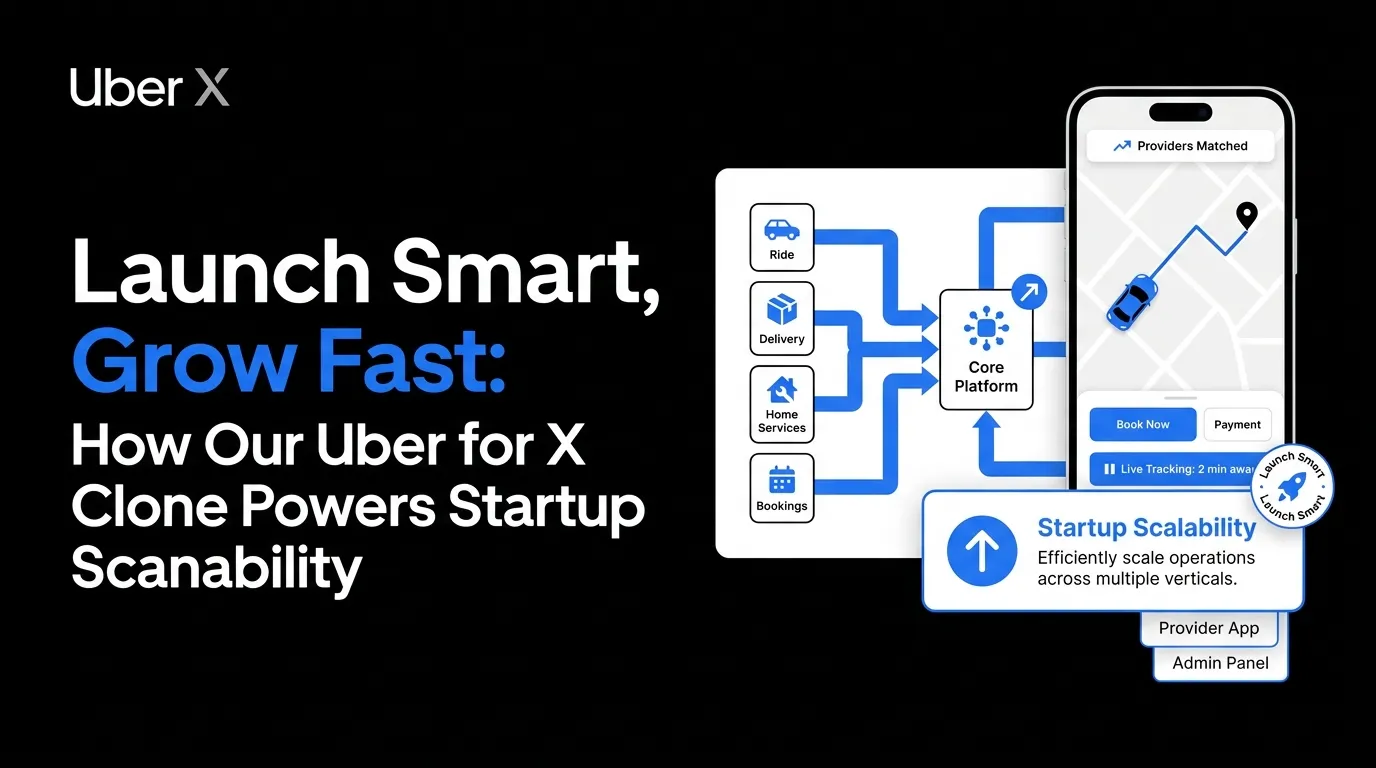
- An Uber-for-X clone helps startups launch on-demand service marketplaces faster across multiple industries.
- Customers, service providers, dispatch teams, payment partners, and admins need connected platform workflows.
- Booking, provider matching, real-time tracking, payments, reviews, and admin control are core features.
- Scaling depends on service category logic, provider availability, location accuracy, pricing rules, and operational control.
- A ready-made Uber-for-X platform can reduce launch time while supporting faster marketplace expansion.
Scale Signals
- Customers need simple onboarding, service search, instant booking, secure checkout, live tracking, and support access.
- Providers need profiles, job requests, availability control, route details, earnings tracking, and payout visibility.
- Admins need control over users, providers, services, commissions, disputes, payments, zones, and reports.
- Backend systems need dispatch logic, location services, pricing rules, notifications, secure APIs, and scalable infrastructure.
- Real-time alerts keep customers, providers, and admins updated on bookings, arrivals, cancellations, payments, and job completion.
Real Insights
- An Uber-for-X app succeeds when demand, provider supply, pricing, and fulfillment work together smoothly.
- Weak provider matching can increase delays, cancellations, poor reviews, and customer drop-off.
- Clear pricing, service details, ETA updates, and provider verification help users trust the marketplace.
- Founders should validate one high-demand service category before expanding into multiple verticals.
- Miracuves builds Uber-for-X Clone apps with booking workflows, provider management, dispatch logic, payments, tracking, and admin control.
If you are planning to launch an on-demand service app, the challenge is rarely just building the first version. The harder question is whether your platform can handle real bookings, provider onboarding, payments, tracking, disputes, service categories, and growth without becoming operationally messy.
That is where the Uber like X model becomes useful for founders. It gives startups a proven service-booking structure that can be adapted for home services, healthcare appointments, pet care, tutoring, beauty services, logistics, field services, and many other local or niche marketplaces.
Instead of treating the idea as “just another app,” founders should think of it as a complete service marketplace. A scalable platform needs customer apps, provider workflows, admin controls, secure payments, booking logic, real-time communication, and monetization options working together. For teams that want a faster starting point, Miracuves offers a white-label on-demand service clone through its Uber for X solution.
This article explains how an Uber-like app can scale faster, what product layers matter most, and how founders can avoid building every module from zero while still keeping room for customization.
Why Feature-Rich from Day One Is a Growth Advantage
Founders Cannot Wait 12 Months to Validate Demand
Startup timelines have become shorter because users now expect convenience from the first interaction. Whether they are booking a ride, hiring a cleaner, scheduling a tutor, or requesting a technician, they expect the platform to feel reliable from day one.
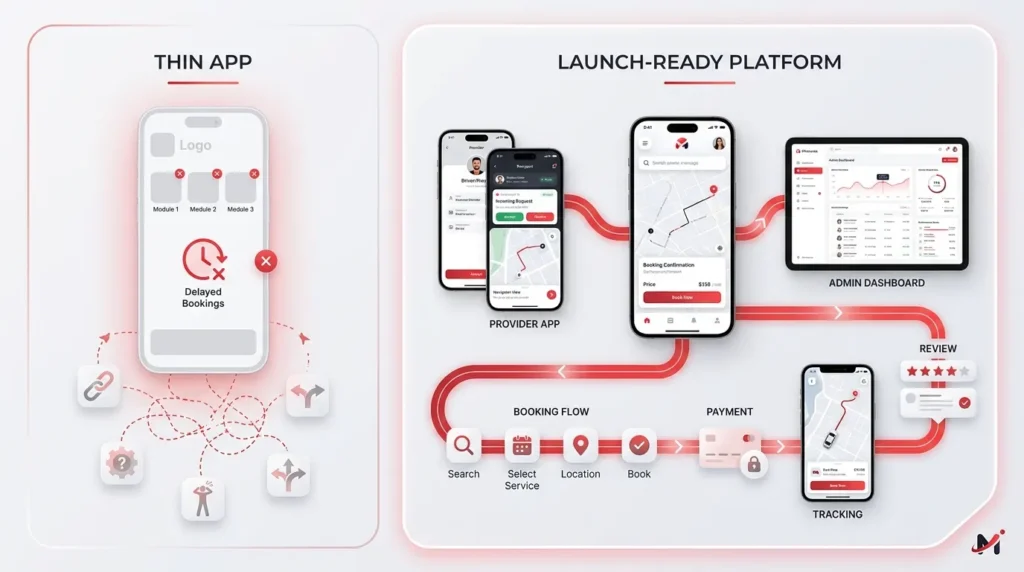
That does not mean founders need to overbuild. It means the first market version should include the essential service marketplace flows needed to create trust: booking, provider discovery, payments, tracking, ratings, notifications, and admin management.
A thin app may look faster to build, but it can create a weak first impression if users cannot complete bookings smoothly. A scalable Uber-like app should help founders test real demand, not just test whether the app opens.
Every Delay Can Become a Missed Booking
In an on-demand marketplace, convenience is the product. If users cannot find providers, confirm bookings, make payments, receive updates, or get support, they may leave before the platform gets a second chance.
For founders, speed-to-market matters because early traction depends on execution. A ready-made foundation can help reduce development friction, but the platform still needs to be customized around the niche, geography, pricing model, and provider operations.
An Uber-like app should not only launch quickly. It should help the founder learn quickly.
Read More: How to Build an App Like Uber for X – Developer’s Full-Stack Guide
The Psychology Behind Instant Utility
People trust platforms that feel complete. That trust is not only about design. It comes from functional cues such as verified providers, clear availability, ratings, reviews, payment options, booking confirmations, timely notifications, and visible support flows.
A user may not understand the backend architecture, but they immediately notice whether the platform feels organized. If the service booking process is confusing, if provider information looks incomplete, or if payment and cancellation rules are unclear, trust drops.
For service marketplaces, trust is the foundation of retention. Users are not simply buying a digital product. They are allowing a provider into their home, office, clinic, vehicle, or personal schedule. That makes verification, communication, and accountability more important than in a basic content or ecommerce app.
Anticipating User and Provider Behavior
A strong on-demand service clone must be designed around the behavior of every major participant in the marketplace. Users expect fast discovery, clear pricing, trusted providers, smooth booking, and convenient service completion. Providers need steady job visibility, fair payout flows, simple scheduling, direct communication, and predictable workflows that help them manage daily operations without confusion.
For the platform operator, the admin layer is equally important. Admins need control over service categories, pricing rules, commissions, cancellations, disputes, provider quality, user activity, and revenue performance. This control layer decides whether the marketplace can operate smoothly as demand grows.
When users, providers, and admins are supported together, the platform becomes easier to scale. When any one layer is weak, growth becomes expensive because the founder has to solve avoidable operational problems manually.
Read More: Uber for X Features That Drive Success
Built-In Features That Actually Matter
Real-Time Tracking and Geolocation
From rides to repairs, users expect visibility. Real-time tracking helps users understand provider movement, arrival time, and service progress. It also reduces uncertainty, which can lower support queries and improve booking confidence.
For founders, tracking is not only a user-experience feature. It helps improve operational visibility, especially in service categories where timing, location, and provider arrival affect satisfaction.
Seamless Payment Gateway Integration
Payments should be smooth, secure, and flexible enough for the target market. Depending on the business model, an Uber-like app may need card payments, wallet options, local payment gateways, split payments, refunds, commissions, payout tracking, and invoice records.
Payment logic should be planned early because it affects revenue collection, provider trust, refund handling, dispute management, and reporting.
Multi-Service Booking Framework
A single-service app may be easier to launch, but many founders eventually want to expand into related categories. A service booking platform should support category management, provider mapping, pricing rules, service availability, and multi-location expansion.
For example, a home service app may begin with cleaning and repairs, then expand into pest control, appliance maintenance, painting, and salon-at-home services. The platform should make this expansion possible without forcing the founder to rebuild from zero.
Admin Dashboard Control That Helps Founders Scale Operations
An admin dashboard is not just a backend screen. It is the control center of the entire service marketplace.
For an Uber-like app, the admin panel should help the platform owner manage users, providers, service categories, pricing rules, commissions, bookings, cancellations, payouts, disputes, promo codes, and performance reports.
Without this control layer, founders may need developer support for every operational change, which slows down growth.
A strong admin dashboard helps the business operator answer practical questions quickly:
- Which services are getting the most demand?
- Which providers are underperforming?
- Where are bookings getting cancelled?
- Which locations need more supply?
- Which revenue streams are working?
- Which users or providers need support or review?
This is why admin control should be treated as a business-growth feature, not just a technical feature.
Feature Priorities That Support Business Growth
| Feature Layer | Why It Matters | Founder Impact |
|---|---|---|
| Service Booking Flow | Helps users find, schedule, and confirm services with fewer steps. | Improves conversion from visitor to booking. |
| Provider App | Allows service providers to accept jobs, update availability, communicate, and track earnings. | Improves supply-side reliability. |
| Real-Time Tracking | Gives users visibility into provider arrival and service status. | Builds trust and reduces support queries. |
| Secure Payments | Supports card, wallet, or local payment gateway integrations depending on the market. | Creates smoother transactions and clearer payout records. |
| Ratings and Reviews | Helps users choose providers and helps admins monitor quality. | Builds marketplace trust. |
| Admin Dashboard | Centralizes user, provider, booking, pricing, payout, and dispute management. | Gives founders operational control. |
| Notifications | Keeps users and providers updated about bookings, reminders, cancellations, and payments. | Reduces missed bookings and confusion. |
| Analytics | Shows booking trends, service demand, cancellation patterns, and revenue performance. | Helps founders make better growth decisions. |
For founders comparing product options, the goal is not to collect the longest feature list. The goal is to identify the features that directly improve booking completion, provider supply, customer trust, and monetization.
Speed-to-Market Means Faster Market Learning
Time matters in the Uber for X business model because service demand is often local, competitive, and timing-sensitive. A founder who spends too long building the first version may miss the chance to test pricing, provider supply, user behavior, and local marketing channels.
With a ready-made solution from Miracuves, founders can reduce development time and move toward launch faster, especially when the core workflows are already available and only need customization for the niche, brand, and operating model.
Real Feedback, Real Fast
With a launch-ready app foundation, founders can test business assumptions instead of only testing technology.
Early launch can help founders understand:
- Which services users request most often
- Which locations show stronger demand
- Which providers respond reliably
- Which pricing models work
- Which booking steps cause drop-offs
- Which channels bring qualified users
- Which monetization model feels natural for the niche
This kind of feedback is difficult to get from a pitch deck or prototype alone. Real bookings create real learning.
How an Uber-Like App Can Make Money
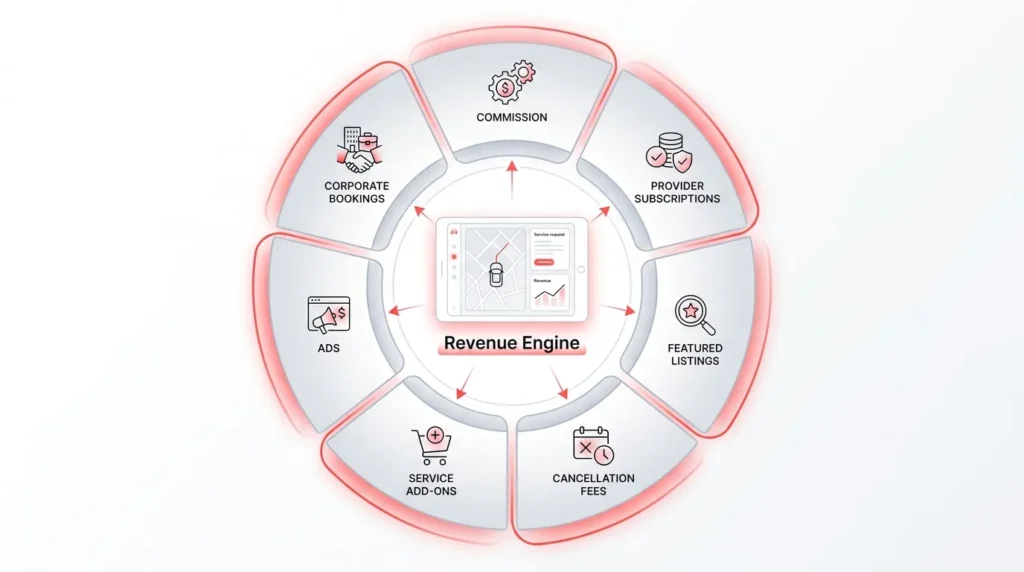
A service booking platform becomes more attractive when the monetization model is clear from the beginning. Founders should not wait until after launch to decide how the platform will generate revenue.
Common monetization models include:
- Commission per booking: The platform earns a percentage from each completed service.
- Provider subscriptions: Service providers pay for access, visibility, or premium tools.
- Featured listings: Providers pay to appear higher in search results or category pages.
- Surge or dynamic pricing: Pricing changes based on demand, location, or availability.
- Cancellation fees: The platform protects provider time and reduces unserious bookings.
- Service add-ons: Users pay extra for urgent service, premium support, or extended service time.
- Advertising and promotions: Local providers or partner brands pay for visibility.
- Corporate or bulk bookings: Businesses pay for recurring service access or managed bookings.
The right model depends on the niche. A home services app may depend heavily on commissions and provider subscriptions, while a healthcare or consultation platform may need appointment fees, provider plans, and secure record handling.
The goal is to connect the revenue model to real user behavior, not simply copy what another platform does.
What Affects the Cost of Launching an On-Demand Service Clone?
The cost of launching an on-demand service clone depends on the business model, number of apps, service categories, design changes, integrations, payment gateways, admin controls, and custom workflows.
A founder launching a single-category home service app will usually have a different scope from a business building a multi-service marketplace across multiple cities. The more complex the booking rules, provider verification, payout logic, language support, and third-party integrations, the more planning is needed before launch.
Key cost factors include:
- Customer app requirements
- Provider app requirements
- Admin panel complexity
- Web panel or landing page needs
- Service category structure
- Payment gateway integrations
- Map and location services
- Notification and communication tools
- Branding and UI customization
- Provider verification workflows
- Reporting and analytics needs
- Post-launch support expectations
For founders comparing custom development with a ready-made foundation, the real question is not only “What does it cost?” but “How quickly can we launch, test demand, and improve based on real bookings?”
Built for Local Launch, Regional Growth, and Multi-Service Expansion
Most on-demand service platforms start with one market, one niche, or one high-demand service category. That is usually the smarter path because it helps founders control quality, understand provider behavior, and test pricing before expanding.
Once the first market starts showing traction, the platform can grow into new areas through multi-location support, additional service categories, local payment integrations, language preferences, and region-specific operating rules.
For example, a home services platform may begin with cleaning and repairs in one city, then expand into beauty services, appliance support, pest control, and recurring maintenance. A healthcare service booking app may begin with appointment scheduling and later add virtual consultations, prescription uploads, or provider verification workflows.
The foundation should be flexible enough to support this growth without forcing the founder to rebuild the product every time the business model expands.
Read More: Best Uber for X Clone script in 2026: Features & Pricing Compared
Use Cases That Scale Naturally
Tutors, Mechanics, Doctors, and More
An Uber-like service booking platform can support many industries because the core logic stays similar: a user requests a service, a provider accepts or is assigned, the job is completed, and the platform manages payments, reviews, and operational control.
Common use cases include:
- Doctor-on-call or healthcare appointment platforms
- Beauty service booking apps
- Home cleaning and repair services
- Tutoring and coaching marketplaces
- Pet care and dog walking platforms
- Handyman and technician booking apps
- Local logistics and pickup services
- Field service management platforms
- Professional consultation platforms
- Multi-service local marketplaces
B2B Extension
Some on-demand service marketplaces can also expand into B2B workflows. For example, property managers may need recurring cleaning or maintenance bookings. Clinics may need appointment scheduling. Schools may need tutor or transport coordination. Enterprises may need verified local service providers.
B2B extensions can include company dashboards, bulk service ordering, managed provider lists, recurring bookings, invoicing, and priority support.
Best-Fit Use Cases for an Uber-Like Service Booking Platform
An Uber-like app works best when there is a clear service request, a user who needs help, a provider who can fulfill the job, and a platform owner who manages trust, pricing, and service quality.
The important decision is not simply which niche sounds popular. Founders should evaluate service frequency, provider availability, average order value, repeat usage, local competition, and operational complexity before choosing the first launch category.
For niche-specific inspiration, related Miracuves solutions such as Thumbtack Clone, Rover Clone, and Practo Clone can help founders understand how different service marketplaces adapt the same on-demand model.
Security, Verification, and Trust Controls Founders Should Plan Early
Trust is one of the biggest growth barriers in any service marketplace. Users want to know that providers are verified, payments are secure, bookings are trackable, and disputes can be handled fairly.
A stronger on-demand service platform should support:
- User and provider verification
- Secure payment gateway integration
- Role-based admin access
- Booking history and activity logs
- Provider document checks where required
- Ratings and review moderation
- Refund and cancellation workflows
- Abuse reporting and dispute handling
- Admin controls for suspicious activity
- Privacy-conscious data handling
Security should not be treated as a final add-on. It should be part of the platform foundation because marketplace trust affects retention, provider quality, payment confidence, and long-term brand reputation.
Final compliance requirements depend on the target country, service category, legal review, payment providers, and operating model.
Integrations That Can Make the Platform More Useful
Once the core booking flow works, integrations can help the platform become more efficient and easier to operate. The right integrations depend on the niche and launch market.
Useful integration areas include:
- Maps and route tracking
- Payment gateways and wallets
- SMS, email, and push notifications
- Calendar scheduling
- CRM or helpdesk tools
- Provider verification tools
- Analytics and reporting
- Marketing automation
- Customer support chat
AI can also support areas such as provider matching, support automation, demand forecasting, and personalized recommendations. However, founders should first make sure the core marketplace flow works: users can book, providers can accept jobs, payments can be completed, and admins can manage operations.
Launch Process for Founders Building an Uber-Like App
A clear launch process helps founders avoid wasting time on unnecessary features before the market is ready.
Step 1: Choose the First Service Category
Start with a service niche where demand is visible, providers are available, and users already spend money. Home services, repairs, pet care, tutoring, healthcare appointments, and beauty services are common starting points.
Step 2: Define the User, Provider, and Admin Workflows
Map how users book, how providers accept or reject jobs, how payments happen, and how admins resolve issues. This should happen before design and development decisions.
Step 3: Decide the Monetization Model
Choose whether the platform will earn through commission, subscription, listing fees, surge pricing, add-ons, advertising, or a hybrid model.
Step 4: Customize the Brand and User Experience
The platform should feel like your business, not a generic clone. Branding, service categories, onboarding, language, payment options, and support flows should match the launch market.
Step 5: Onboard Providers Before Launch
User demand only matters if providers can fulfill bookings. Build provider onboarding, verification, training, payout rules, and availability planning before the public launch.
Step 6: Launch in One Focused Market
A focused launch gives the founder cleaner data. It becomes easier to measure user acquisition, booking completion, cancellation rates, provider response times, and revenue per service category.
Step 7: Improve Based on Real Booking Data
After launch, growth should be guided by real usage. Track which services perform, where users drop off, how providers respond, and which marketing channels convert into actual bookings.
Final Thoughts: Scale Faster Without Losing Operational Control
The real value of an Uber-like app is not simply copying Uber’s interface. It is using a proven service-booking model to launch faster, manage operations better, and validate demand with less avoidable development risk.
Founders should focus on the parts that actually decide marketplace success: service availability, booking completion, provider quality, payment trust, admin control, monetization clarity, and user retention.
A ready-made foundation can help reduce launch friction, but the strongest results come when the platform is customized around a real niche, a clear operating model, and a practical growth plan.
If you are planning to launch a service booking platform, Miracuves can help you evaluate the fastest path from idea to launch using a white-label, customizable Uber for X app foundation.
FAQs
How much does it cost to build a food delivery app like Uber Eats?
The cost depends on the number of apps, features, technology stack, payment gateway, delivery tracking, restaurant management, admin dashboard, customization, and launch scope. A custom build usually costs more because every workflow is developed from scratch. A ready-made UberEats-style solution can reduce development effort because the core customer, restaurant, delivery, and admin modules are already available.
How long does it take to launch a food delivery app like Uber Eats?
Launch time depends on whether you choose custom development or a ready-made solution. Custom development can take longer because it involves planning, design, development, testing, integrations, and deployment. With Miracuves, a ready-made food delivery app foundation can be launched faster, with final timing depending on branding, payment setup, app store approval, integrations, and customization.
What features should a food delivery app like Uber Eats include?
A food delivery app should include customer registration, restaurant listings, menu management, cart and checkout, secure payments, live order tracking, delivery partner app, push notifications, ratings, reviews, promo codes, refunds, and an admin dashboard. For business control, the admin panel should also manage users, restaurants, delivery partners, commissions, reports, disputes, and support requests.
What is the difference between a custom food delivery app and a Ubereats Clone App?
A custom food delivery app is built from the ground up based on unique business requirements. A Ubereats Clone App uses a ready-made delivery app foundation inspired by proven food ordering workflows. The clone route is usually faster for founders who want to launch, test demand, and customize branding, payments, delivery zones, and restaurant operations without building every module from zero.
Is a Ubereats Clone Script enough to launch a real business?
A Ubereats Clone Script can be useful only if it includes complete business workflows, secure code, admin controls, payment integration, delivery partner management, restaurant panels, and customization support. Founders should avoid choosing a basic script that only looks like a food ordering app but lacks operational depth, support, scalability, and security controls.
How does a food delivery app like Uber Eats make money?
A food delivery app can earn through restaurant commissions, delivery fees, service charges, promoted listings, subscription plans, priority delivery, advertising, cancellation charges, and partner promotions. The right revenue model depends on the target market, restaurant margins, customer behavior, delivery costs, and local competition.
Why is the admin dashboard important in a food delivery app?
The admin dashboard controls the business behind the app. It helps the platform owner manage restaurants, customers, delivery partners, orders, payments, refunds, commissions, offers, reports, and disputes. Without a strong admin dashboard, the business may struggle with order delays, payment confusion, restaurant issues, and weak operational visibility.
Can I customize a ready-made food delivery app for my brand?
Yes. A ready-made food delivery app can be customized with your brand name, logo, colors, payment gateway, delivery zones, restaurant categories, commission setup, promotional offers, and business rules. The goal is not to launch a generic copy, but to use a proven foundation and adapt it for your market.