

Key Takeaways
What You’ll Learn
- Zappos’ revenue model is built around customer-focused online retail generating revenue primarily through footwear, apparel, accessories, and fashion product sales.
- The company strengthens revenue through customer loyalty and retention by offering premium customer service, easy returns, and fast delivery experiences.
- Operational efficiency is a major profitability driver because fulfillment speed, inventory management, and logistics directly impact eCommerce performance.
- Brand trust improves long-term customer value through reliable shopping experiences, responsive support, and customer-centric business operations.
- The biggest takeaway for founders is that customer experience can become a scalable competitive advantage when combined with strong logistics, digital commerce, and retention-focused operations.
Stats That Matter
- The article positions Zappos as a customer-centric eCommerce retailer focused on footwear, apparel, fashion accessories, and service-driven online shopping.
- Core revenue comes from direct online product sales including shoes, clothing, sportswear, handbags, and lifestyle fashion categories.
- Customer retention significantly improves repeat revenue because buyers continue purchasing from platforms that offer convenient shopping and reliable service.
- The platform benefits from increasing online retail adoption as consumers prefer digital shopping experiences supported by fast delivery and easy return systems.
- Zappos’ operational strategy supports long-term scalability through fulfillment efficiency, inventory optimization, customer support, and streamlined logistics infrastructure.
Real Insights
- Zappos succeeds because it treats customer satisfaction as a growth strategy rather than only focusing on short-term transactions and pricing competition.
- The strongest growth driver is repeat customer behavior because positive shopping experiences improve loyalty, retention, and long-term revenue stability.
- Logistics and fulfillment directly affect revenue performance since delivery speed, return management, and inventory reliability strongly influence online retail trust.
- Customer service creates long-term differentiation because support quality and frictionless shopping experiences improve brand reputation in competitive eCommerce markets.
- For entrepreneurs, the biggest lesson is to build a Zappos-style eCommerce business around customer loyalty, reliable logistics, scalable digital retail infrastructure, and retention-driven revenue growth.
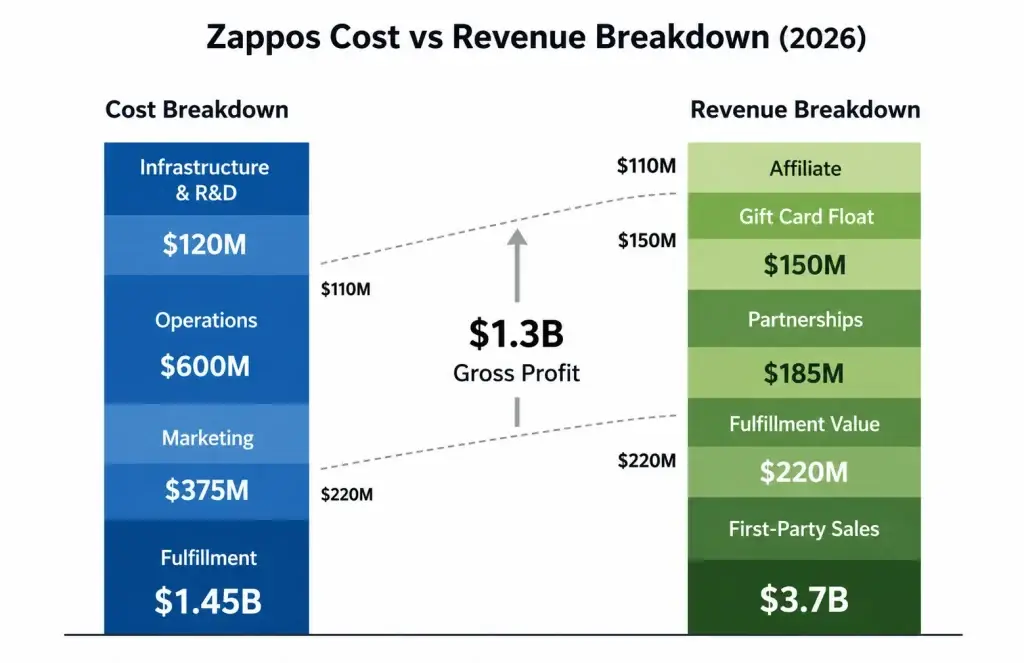
Zappos closed 2026 with approximately $3.7 billion in revenue, maintaining its position as one of the most profitable footwear-focused eCommerce brands globally. This performance highlights strong repeat purchase behavior, deep customer trust, and the effectiveness of focusing on a single core category rather than spreading across unrelated verticals.
Unlike pure marketplaces, Zappos built scale through inventory ownership, customer obsession, and lifetime value optimization. By controlling inventory, Zappos ensures consistent product quality and availability, while its legendary customer service and free returns strategy significantly increase repeat buying and long-term customer value.
For founders, Zappos is a masterclass in how service-driven eCommerce can outperform price-led competition. It demonstrates that investing in experience, retention, and brand loyalty can create defensible advantages and sustainable profitability, even in markets crowded with discount-focused competitors.
Zappos Revenue Overview – The Big Picture
- 2026 Revenue: ~$3.7B
- Valuation (internal estimate): ~$10–12B (Amazon subsidiary benchmark)
- YoY Growth: ~6%
- Revenue by Region:
- United States: ~92%
- International: ~8%
- Average Gross Margin: ~34–36%
- Competition Benchmark: Nike DTC, Foot Locker, Amazon Fashion
Read More: What is Zappos and How Does It Work?

Primary Revenue Streams Deep Dive
Revenue Stream #1: Direct Product Sales
Zappos primarily sells footwear and apparel through a direct-to-consumer model.
- Pricing: MSRP-driven with seasonal discounts
- Revenue share: ~82%
- Strong margin control due to owned inventory
Revenue Stream #2: Premium Fulfillment & Shipping
Fast shipping and free returns are embedded into pricing.
- Revenue share: ~6%
- Higher AOV offsets logistics cost
Revenue Stream #3: Brand Partnerships & Exclusives
Limited editions and exclusive brand collaborations.
- Revenue share: ~5%
- Improves conversion and retention
Revenue Stream #4: Gift Cards & Store Credit Float
Unused balances and delayed redemptions generate float income.
- Revenue share: ~4%
Revenue Stream #5: Affiliate & Cross-Brand Sales
Traffic monetization via Amazon ecosystem integrations.
- Revenue share: ~3%
Revenue Streams Percentage Breakdown
| Revenue Stream | % Share |
|---|---|
| Direct Product Sales | 82% |
| Fulfillment & Shipping Value | 6% |
| Brand Partnerships & Exclusives | 5% |
| Gift Cards & Store Credit Float | 4% |
| Affiliate & Cross-Brand Sales | 3% |
The Fee Structure Explained
- Customer-side pricing:
- Product price includes shipping & returns
- Premium products priced 12–18% higher than average retail
- Supplier-side economics:
- Wholesale pricing contracts
- Volume-based procurement discounts
- Hidden revenue layers:
- Breakage from gift cards
- Data-driven assortment optimization
- Regional pricing variation:
- Minor price differences due to tax and logistics
Complete Fee Structure by User Type
| User Type | Fee Type | Typical Range |
|---|---|---|
| Buyer | Product Price Markup | 25–40% GM |
| Buyer | Express Delivery | Bundled |
| Brand | Wholesale Discount | 30–55% |
| Platform | Gift Card Breakage | 2–4% revenue |
How Zappos Maximizes Revenue Per User
Zappos focuses heavily on lifetime customer value, not single transactions.
- Segmentation: Repeat buyers vs first-time buyers
- Upselling: Premium materials and branded collections
- Cross-selling: Accessories bundled with footwear
- Dynamic pricing: Seasonal demand-based adjustments
- Retention monetization: Loyalty-driven reorders
- LTV optimization: Repeat customers spend ~3× more
- Psychological pricing: Free returns reduce purchase friction
- Real data example: Over 60% of revenue comes from repeat buyers
Cost Structure & Profit Margins
- Infrastructure: Warehousing, ERP, cloud platforms
- CAC & marketing: ~9–11% of revenue
- Operations: Fulfillment, returns, customer service
- R&D: Personalization, logistics optimization
- Unit economics: Profitable by second purchase
- Margin optimization: Scale-driven procurement savings
- Profitability path: High-margin loyalty flywheel
Read More: Best Zappos Clone Scripts 2025: Footwear Marketplace
Future Revenue Opportunities & Innovations
- AI-driven size and fit recommendations
- Subscription footwear essentials
- Private-label brand expansion
- B2B corporate footwear programs
- Trends (2026–2027): Faster delivery, predictive buying
- Risks: Inventory exposure, fashion volatility
- Opportunities: Vertical footwear marketplaces
Lessons for Entrepreneurs & Your Opportunity
What works
- Customer experience as a growth engine
- Inventory-led margin control
What to replicate
- Free returns baked into pricing
- Loyalty-first monetization
Market gaps
- Regional footwear specialists
- Sustainable footwear platforms
Founder improvements
- Faster fulfillment tech
- AI-based demand forecasting
Miracuves Zappos-Like Ecommerce Platform Solution Cost and Tech Stack
Miracuves Pricing for a Zappos-Like Ecommerce Platform developed using JavaScript architecture starts at $3,999. Final pricing depends on ecommerce workflows, inventory management systems, customer experience features, payment integrations, scalability requirements, AI-powered recommendation systems, and deployment scope. Estimated delivery timeline: 15-30 days, extending to 45-60 days for larger scope. For custom architecture planning, enterprise ecommerce workflows, and feature-specific pricing — Contact us.
Get a fully developed, custom ecommerce platform modeled around Zappos-style customer-first online retail experiences. Built on a modern JavaScript foundation, this solution can be customized for ecommerce startups, footwear brands, fashion retailers, lifestyle marketplaces, D2C businesses, online shopping platforms, and enterprise retail operations.
- Core Workflows: Product catalog management, customer accounts, shopping cart systems, order processing, inventory tracking, payment handling, returns management, customer support workflows, personalized recommendations, and loyalty systems.
- Built-in Revenue Logic: Product sales, premium memberships, marketplace commissions, featured brand placements, advertising systems, subscription models, loyalty-driven retention systems, and white-label ecommerce monetization.
- Management Hub: Admin dashboard, inventory management, customer analytics, order monitoring, payment reporting, promotion management, product moderation, customer support controls, and ecommerce analytics.
- AI-Ready Architecture: Prepared for AI product recommendations, smart search optimization, customer behavior analytics, personalized shopping experiences, automated inventory insights, scalable ecommerce infrastructure, and enterprise-grade scalability.
Why Does a Zappos-Like Platform Require JavaScript Architecture?
A modern ecommerce platform requires more than a basic online store. It handles customer engagement, inventory synchronization, payment processing, product discovery, loyalty systems, recommendation engines, support workflows, and scalable ecommerce operations. A modern JavaScript architecture helps manage these highly interactive ecommerce experiences smoothly across customers, admins, support teams, and retail systems.
We recommend JavaScript architecture for this type of platform because:
- Built for Interactive Ecommerce Experiences: JavaScript supports real-time product browsing, smooth checkout systems, instant inventory updates, live order tracking, and dynamic shopping experiences.
- Advanced Frontend Experience: React.js or similar JavaScript frameworks can power modern storefronts, recommendation panels, customer dashboards, analytics systems, loyalty programs, and admin controls.
- Scalable Backend Logic: JavaScript-based backend systems can efficiently manage transactions, inventory operations, customer sessions, analytics workflows, API traffic, and high-volume ecommerce requests.
- Flexible Integration Layer: The platform can connect with payment gateways, logistics providers, CRM systems, analytics platforms, AI recommendation tools, cloud infrastructure, customer support systems, and third-party ecommerce services.
You get a scalable ecommerce platform designed for customer engagement, recurring revenue growth, ecommerce automation, and long-term retail scalability.
Tech Stack
We preferably will be using JavaScript for building the entire solution (Node.js/Nest.js/Next.js for the web backend + frontend) and Flutter / React Native for mobile apps, considering scalability, ecommerce workflow efficiency, customer experience optimization, and the advantage of one codebase serving multiple platforms.
Note: Final pricing depends on selected ecommerce modules, AI capabilities, scalability goals, payment systems, infrastructure requirements, security layers, and custom feature development.
If you want to launch sooner, our ready-made fashion and footwear marketplace app starts at $2,799 and is delivered in 6 days. Each colour and size is tracked as its own unit, and returns handling is built in, which matters for a returns-led model like this one. It is not a copy of Zappos.
Final Thought
Zappos proves that exceptional service can be a revenue strategy, not just a cost center. By prioritizing fast shipping, hassle-free returns, and responsive customer support, the company reduces purchase friction and builds trust that directly translates into higher conversion rates and repeat sales.
Its model shows how customer loyalty compounds margins over time. As repeat buyers return with lower acquisition costs and higher average order values, profitability improves naturally, allowing Zappos to reinvest in service quality without sacrificing margins.
For founders, this approach serves as a clear roadmap to sustainable eCommerce profitability. It highlights how long-term thinking, customer-first design, and retention-focused monetization can create resilient businesses that grow steadily even in competitive markets.
FAQs
1. How much does Zappos make per transaction?
Around 30–35% gross margin per order.
2. What’s Zappos’ most profitable revenue stream?
Repeat direct product sales.
3. How does Zappos’ pricing compare to competitors?
Slightly higher, offset by free shipping and returns.
4. What percentage margin does Zappos earn?
Roughly 34–36% gross margin.
5. How has Zappos’ revenue model evolved?
From discount retail to loyalty-led DTC.
6. Can small platforms use similar models?
Yes, especially in niche categories.
7. What’s the minimum scale for profitability?
After consistent repeat purchases.
8. How to implement similar revenue models?
Bundle service costs into pricing.
9. What are alternatives to Zappos’ model?
Marketplace or subscription footwear models.
Miracuves is an independent software development company. We are not affiliated with, connected to, sponsored by, or endorsed by any company or product named in this article.
Terms such as “X Clone” are used descriptively. It is how the software industry refers to building a platform with functionality comparable to a known service, and how clients search for it.
The entire design and codebase of our products is built by our own team. Our products contain no code, design, graphics, or content originating from any third-party website or applications.
All third-party names and marks referenced in this article are the property of their respective owners, referenced solely to identify the services discussed.