


Key Takeaways
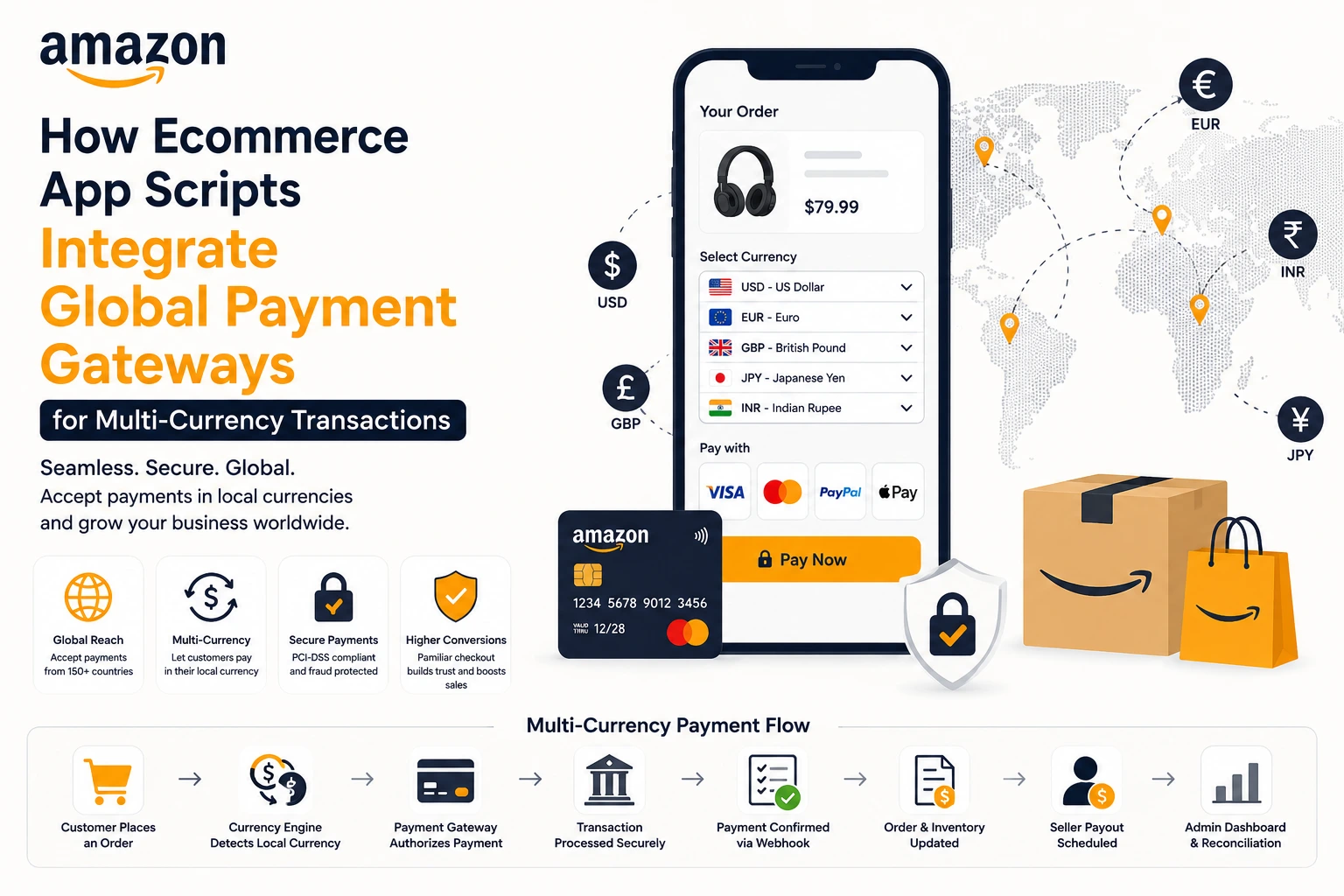
- An ecommerce app script needs global payment gateway integration to accept payments from customers across different countries, currencies, and payment preferences.
- Multi-currency transactions require more than currency display; the backend must manage exchange rates, checkout currency, payment authorization, settlement, refunds, and reporting.
- Popular gateways like Stripe, PayPal, Adyen, Razorpay, and local wallets help ecommerce platforms support international buyers with trusted payment options.
- A strong payment system improves checkout confidence, reduces cart abandonment, and helps marketplace owners expand beyond one region.
- Founders should plan payment architecture early because gateway rules, taxes, seller payouts, chargebacks, and compliance can affect long-term scalability.
Payment Integration Signals
- Currency conversion logic should support real-time or scheduled exchange rates, localized pricing, gateway-supported currencies, and transparent checkout totals.
- The payment gateway layer should manage cards, wallets, bank transfers, UPI, BNPL options, subscriptions, refunds, failed payments, and fraud checks.
- Marketplace payment flows must handle split payments, seller payouts, commissions, escrow logic, platform fees, and country-wise settlement rules.
- Security features such as PCI-compliant gateways, tokenized card storage, 3D Secure, fraud detection, and transaction monitoring are essential.
- Admin dashboards should provide currency-wise revenue reports, gateway status, refund logs, payout tracking, failed transaction records, and payment analytics.
Real Insights
- Global payment integration is not only a checkout feature; it directly affects trust, conversion rate, seller operations, and international marketplace growth.
- Many ecommerce app scripts fail when they treat multi-currency as a frontend display feature instead of a complete transaction and settlement workflow.
- Founders should choose payment gateways based on target countries, supported currencies, transaction fees, payout timelines, fraud tools, and compliance requirements.
- For multi-vendor ecommerce platforms, seller payouts and platform commissions must be planned carefully before launching in multiple regions.
- The strongest ecommerce app scripts combine localized checkout, secure gateway APIs, multi-currency support, refund handling, payout automation, and clean admin reporting.
Global ecommerce is no longer limited to buyers who use the same currency, card network, bank, or payment habit. A customer in Dubai may want to pay in AED, a buyer in Germany may expect EUR, a shopper in the United States may prefer cards or PayPal, while a marketplace seller may need payouts in another currency altogether.
That is why modern Amazon clone Ecommerce App Scripts need more than a simple “pay now” button. They need a payment architecture that can support global payment gateways, multi-currency pricing, regional checkout preferences, seller commissions, refunds, settlement records, fraud checks, and admin-level payment control.
For founders, this matters because payment infrastructure directly affects conversion, trust, cash flow, and international scalability. A weak checkout system can create failed payments, confused buyers, seller payout disputes, and reconciliation issues. A strong ecommerce app script, on the other hand, gives the business a scalable payment foundation from the first market version.
Miracuves helps founders build ready-made, white-label ecommerce and marketplace platforms with source-code ownership, branded workflows, admin dashboards, and faster launch paths. For an Amazon-like marketplace, payment gateway architecture is one of the most important layers to get right early.
Why Multi-Currency Payments Matter in Amazon Clone Ecommerce App Scripts
An Amazon-like ecommerce marketplace has more complex payment requirements than a single-brand online store. A normal ecommerce store may accept one payment, ship one order, and settle funds into one merchant account. A marketplace has multiple buyers, multiple sellers, commissions, refunds, partial cancellations, split shipments, wallet credits, loyalty balances, and payout schedules.
Multi-currency support becomes important when the platform wants to serve buyers across countries. Buyers are more likely to trust checkout when they can view product prices, shipping charges, taxes, and final payment amounts in a familiar currency. Stripe notes that presenting prices in a customer’s native currency can help avoid currency conversion costs for customers and may improve conversion and authorization rates.
For founders, this creates a clear business decision. Multi-currency payments are not only a technical feature. They are part of international market readiness.
A strong ecommerce app script should support:
- Local currency display on product pages
- Currency-aware cart and checkout totals
- Payment gateway routing by country or currency
- Seller commission calculation across currencies
- Refunds in the original payment currency
- Admin reports for transaction currency and settlement currency
- Seller payout records and reconciliation
Without these layers, international expansion becomes operationally messy. The platform may show one price, charge another, settle in a third currency, and create disputes when sellers or buyers cannot understand the final amount.
How Global Payment Gateways Work Inside Ecommerce App Scripts
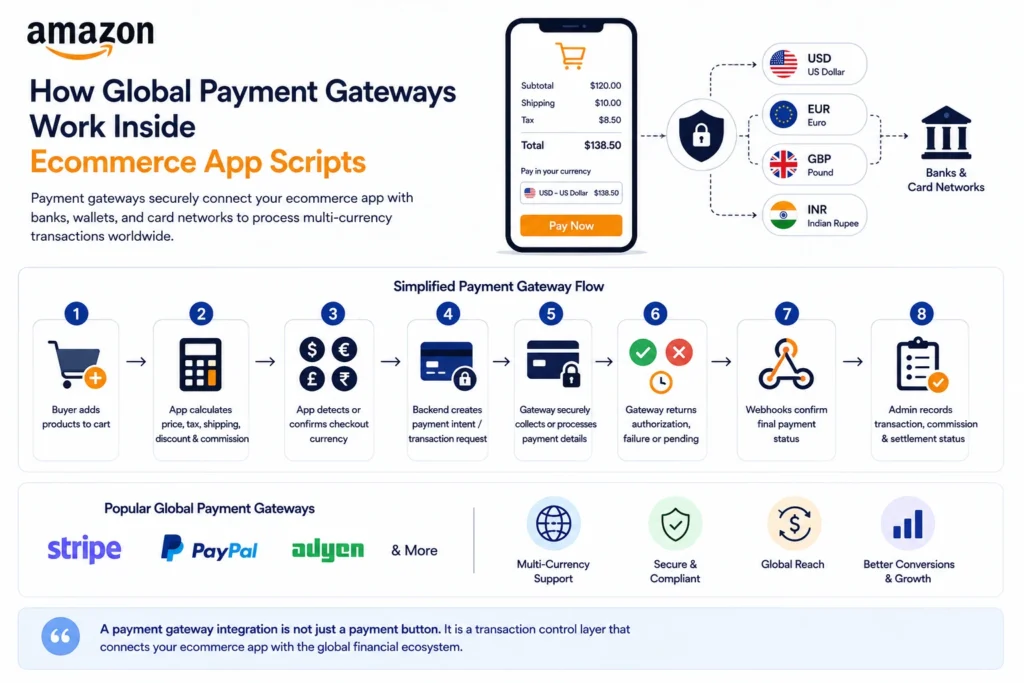
A global payment gateway connects the ecommerce app with card networks, banks, wallets, local payment methods, fraud tools, and settlement systems. In an ecommerce app script, the gateway is usually connected through APIs, SDKs, webhooks, and secure tokenized payment flows.
A simplified payment gateway flow looks like this:
- The buyer adds products to cart.
- The ecommerce app calculates product price, shipping, tax, discount, and commission.
- The app detects or confirms the buyer’s checkout currency.
- The backend creates a payment intent, order, or transaction request with the gateway.
- The gateway securely collects or processes payment details.
- The gateway returns authorization, failure, or pending status.
- The ecommerce backend updates the order status.
- Webhooks confirm final payment status asynchronously.
- The admin panel records the transaction, commission, refund eligibility, and seller settlement status.
Stripe supports processing charges in over 135 currencies, which makes it useful for ecommerce platforms that want localized currency presentment. PayPal supports payments and balances across supported currencies with country-specific restrictions, so an ecommerce app must validate whether the merchant account and buyer currency are supported before checkout. Adyen is often relevant for marketplace platforms because its platform documentation covers onboarding sellers, verifying users, accepting payments on behalf of users, splitting payments, deducting costs, and holding funds before payout.
The important point is this: a gateway integration is not just a payment button. It is a transaction control layer.
Payment Flow Architecture Inside Amazon-Like Ecommerce Platforms
Inside Amazon clone Ecommerce App Scripts, the payment layer should be modular. That means checkout, currency conversion, payment gateway communication, order management, seller settlement, and admin reporting should not be tightly mixed into one fragile code path.
A scalable architecture usually includes these components:
| Payment Layer | What It Does | Founder Impact |
|---|---|---|
| Currency Service | Detects buyer currency, stores FX rates, handles rounding logic | Improves international checkout clarity |
| Checkout Service | Calculates cart, tax, shipping, coupons, and final payable amount | Reduces pricing mismatch risk |
| Payment Gateway Adapter | Connects with Stripe, PayPal, Adyen, or local gateways | Allows gateway flexibility by region |
| Payment Orchestration Layer | Chooses gateway based on country, currency, method, or failure condition | Improves payment reliability |
| Webhook Handler | Updates order status after gateway confirmation | Prevents false paid or false failed orders |
| Seller Ledger | Tracks seller earnings, commission, refunds, and payout balance | Builds marketplace trust |
| Admin Payment Dashboard | Shows transactions, failures, refunds, disputes, and settlement records | Gives operators financial control |
A simple ecommerce store can survive with one payment gateway. A marketplace usually needs a more flexible setup because payment success depends on geography, currency support, fraud rules, local payment preferences, and seller payout requirements.
Stripe vs PayPal vs Adyen for Global Ecommerce Apps
The right gateway depends on the platform’s target countries, payment methods, seller model, compliance needs, and payout structure. A founder should not choose a gateway only because it is popular. The gateway should match the marketplace’s business model.
| Gateway | Strong Fit | Multi-Currency Strength | Marketplace Consideration |
|---|---|---|---|
| Stripe | Developer-friendly ecommerce checkout, SaaS commerce, international cards, wallets | Supports charges in 135+ currencies and multi-currency settlement options | Useful for platform models, but availability and features depend on region |
| PayPal | Buyer trust, PayPal wallet payments, broad global familiarity | PayPal is available in 200+ countries/regions and supports 25 currencies | Currency support depends on account setup and country-specific restrictions |
| Adyen | Enterprise ecommerce, marketplaces, local payment methods, platform payouts | Supports broad local and global payment methods across marketplace scenarios | Strong for seller onboarding, split payments, deductions, and payout control |
Stripe’s supported currency documentation is useful for ecommerce apps that need broad presentment currency support. PayPal’s global availability and supported-currency documentation is useful for platforms where buyer trust and wallet checkout matter. Adyen’s marketplace documentation is especially relevant when the ecommerce platform needs seller onboarding, split payments, deductions, and payout workflows.
For a founder building an Amazon-like marketplace, the strongest architecture is often gateway-flexible. Instead of locking the entire platform to one provider, the ecommerce app script can use a gateway adapter pattern so new gateways can be added as the business expands into new regions.
How Ecommerce Scripts Detect User Currency Automatically
Multi-currency checkout starts before payment. The app must decide what currency to show to the buyer and what currency to send to the payment gateway.
Modern ecommerce scripts can detect currency using several signals:
- Buyer’s selected country
- Shipping address
- Billing address
- Geo-IP location
- Browser locale
- Account preference
- Storefront region
- Manual currency switcher
The safest approach is not to rely on only one signal. For example, geo-IP may detect a traveler in Singapore while their shipping address is in India. Browser locale may show English-US while the buyer wants to pay in EUR. A mature ecommerce script should allow automatic detection and manual override.
The payment system should also distinguish between:
| Currency Type | Meaning |
|---|---|
| Display Currency | Currency shown on product and category pages |
| Cart Currency | Currency used for cart calculations |
| Transaction Currency | Currency charged through the gateway |
| Settlement Currency | Currency received by the platform’s merchant account |
| Seller Payout Currency | Currency used to pay marketplace sellers |
This distinction is critical. Many weak ecommerce scripts only convert the front-end price but fail to manage backend transaction records properly.
Multi-Currency Database Architecture Explained
A strong Amazon clone Ecommerce App Script should not store only one product price and convert it randomly at checkout. That creates audit, refund, and reporting problems.
A better structure uses a base currency and stores exchange-rate snapshots for every transaction.
Example database logic:
| Table / Module | Key Fields | Purpose |
|---|---|---|
| Products | base_price, base_currency | Stores the original product price |
| Currency Rates | from_currency, to_currency, rate, source, timestamp | Stores FX conversion rates |
| Cart | display_currency, converted_total, rate_snapshot_id | Preserves cart pricing logic |
| Orders | transaction_currency, paid_amount, base_amount, exchange_rate_used | Keeps final payment record clear |
| Payments | gateway, gateway_transaction_id, status, captured_amount | Tracks gateway status |
| Seller Ledger | seller_id, order_id, commission, seller_earning, payout_currency | Tracks seller earnings |
| Refunds | original_currency, refund_amount, gateway_refund_id | Supports accurate refund handling |
| Admin Reports | settlement_currency, gateway_fee, FX adjustment, net_received | Helps reconciliation |
The most important principle is rate locking. Once a buyer reaches checkout, the system should either lock the FX rate for a short period or recalculate transparently before payment confirmation. Otherwise, the buyer may see one amount and get charged another.
Handling Exchange Rates and FX Conversion in Real Time
Exchange-rate handling is one of the most misunderstood parts of multi-currency ecommerce. Founders often assume that the payment gateway will solve everything. In reality, the ecommerce platform still needs clear pricing, tax, refund, margin, and reporting logic.
A practical ecommerce app script should support:
- FX rate API integration
- Cached exchange rates
- Rate refresh schedules
- Currency rounding rules
- Zero-decimal currency handling
- Margin buffers for volatile currencies
- Rate snapshots per order
- Admin override for supported currencies
- Country-based currency availability
Stripe’s currency documentation notes support for zero-decimal and three-decimal currency handling, which is important because not all currencies behave the same way in payment APIs. PayPal also documents currency-specific restrictions and special handling for some currencies, so checkout validation should happen before payment is attempted.
For founders, the risk is not only failed payments. The bigger risk is financial confusion. If the order amount, gateway amount, seller earning, refund amount, and settlement amount do not reconcile, the marketplace operator loses trust with both buyers and sellers.
Regional Payment Methods and Localized Checkout UX
International ecommerce does not succeed only by adding USD, EUR, and GBP. Buyers in different regions prefer different payment methods.
A scalable ecommerce app script should be able to show payment methods based on country, device, currency, and gateway availability. Stripe groups supported payment methods into categories such as cards, bank debits, bank redirects, bank transfers, buy now pay later, real-time payments, vouchers, and wallets. Adyen’s marketplace payment method documentation includes global and regional methods such as cards, Apple Pay, Google Pay, iDEAL, Klarna, Bancontact, Alipay, and others.
For Amazon-like marketplaces, localized checkout can include:
- Card payments
- Digital wallets
- Bank redirects
- Local bank transfers
- Buy now, pay later methods
- Cash-on-delivery in selected regions
- Wallet balance or store credit
- Gift cards and promotional credits
The business value is simple: the more familiar the checkout feels, the less friction the buyer experiences. However, every payment method must still be connected to order status, refund logic, fraud checks, seller settlement, and admin reporting.
Read more : How Ecommerce Search Scripts Handle Million-Product Marketplace Queries
PCI DSS, Tokenization, and Payment Security
Payment security should be treated as a foundation, not a decorative feature. Ecommerce platforms handle sensitive buyer, seller, transaction, refund, and payout data. Even when the platform does not directly store raw card data, it still needs secure architecture around payment flows.
The PCI Security Standards Council develops and promotes standards and resources for safe payment data handling worldwide. PCI tokenization guidance focuses on replacing sensitive payment data with tokens so systems can reduce exposure to actual cardholder data.
A secure ecommerce app script should include:
- Encrypted data transfer
- Encrypted data storage for sensitive operational records
- Gateway-hosted or tokenized payment collection
- Secure API integration
- Webhook signature validation
- Role-based admin access control
- Activity logs and payment audit trails
- Fraud monitoring signals
- Refund and dispute permissions
- Admin approval controls for high-risk actions
It is important not to claim that any ecommerce script is automatically compliant everywhere. Final compliance depends on jurisdiction, payment provider setup, hosting, legal review, operating model, and security implementation.
Webhooks, Retry Systems, and Failed Payment Recovery
A payment can fail, remain pending, succeed after delay, or be reversed later. This is why ecommerce app scripts must rely on webhooks instead of only front-end payment responses.
A webhook is a server-to-server notification from the payment gateway to the ecommerce backend. It can confirm events such as:
- Payment succeeded
- Payment failed
- Payment pending
- Payment captured
- Refund created
- Chargeback opened
- Dispute updated
- Payout completed
A mature backend should validate webhook signatures, avoid duplicate processing, and update order status carefully. For example, if the same “payment succeeded” webhook arrives twice, the system should not create two orders or pay the seller twice.
Failed payment recovery should include:
| Failure Scenario | App Script Response |
|---|---|
| Card declined | Show alternate payment method |
| Gateway timeout | Keep order pending until webhook confirms status |
| Currency unsupported | Ask buyer to choose another currency or method |
| 3D Secure failure | Restart authentication flow |
| Duplicate webhook | Ignore duplicate using idempotency key |
| Pending bank redirect | Hold order until final payment confirmation |
| Refund failure | Notify admin and retry through gateway logic |
This is where many basic ecommerce scripts fail. They treat checkout as a single event instead of a transaction lifecycle.
Multi-Vendor Marketplace Payout Systems
Amazon-like platforms need seller payout architecture. The platform does not simply collect money and stop there. It must calculate seller earnings, platform commission, gateway fees, refunds, cancellation rules, tax records, and payout schedules.
A marketplace payout system should track:
- Gross order amount
- Product-level seller amount
- Platform commission
- Shipping fee allocation
- Discount responsibility
- Gateway processing fee
- Tax handling logic
- Refund deductions
- Chargeback adjustments
- Seller payout balance
- Payout status
Adyen’s platform documentation is relevant for marketplace-style models because it supports onboarding and verifying users, processing payments on behalf of users, splitting payments, deducting costs, holding funds, and payouts. Stripe also documents multi-currency support across charges, transfers, payouts, and application fees for connected-account models.
For founders, payout accuracy is a trust issue. Sellers will not stay on a marketplace if earnings are unclear, delayed without explanation, or affected by confusing currency conversion.
Checkout Optimization for International Conversion
Payment architecture also affects marketing performance. A founder can spend heavily on traffic, ads, influencers, and SEO, but a weak checkout flow can still lose the sale.
International checkout should be optimized for:
- Local currency visibility
- Transparent fees
- Clear tax and shipping breakdown
- Familiar payment methods
- Fast payment page loading
- Mobile-first checkout
- Low-friction authentication
- Smart error messages
- Saved address and wallet options
- Cart total consistency
A strong ecommerce app script should avoid surprising users at the last step. The buyer should not see a product in one currency, shipping in another, and a final gateway charge in a third currency without explanation.
AI-Powered Fraud Detection in Ecommerce Payments
Global ecommerce increases opportunity, but it also increases fraud exposure. Fraud patterns can vary by country, payment method, order value, device, shipping address, and buyer behavior.
An ecommerce payment system can use fraud signals such as:
- Unusual order value
- Multiple failed payment attempts
- Mismatch between billing and shipping country
- High-risk IP behavior
- Repeated card testing
- Suspicious refund patterns
- New account with high-value order
- Abnormal seller payout behavior
AI-powered fraud detection can support risk scoring, but founders should avoid treating AI as a magic shield. Fraud systems work best when combined with gateway risk tools, manual review queues, admin controls, identity checks, velocity rules, and transaction monitoring.
For marketplace operators, fraud detection must protect both sides: buyers from fake sellers and sellers from fraudulent buyers.
Founder Decision Signals
Founder Decision Signals
Speed
If you want to test cross-border ecommerce faster, a ready-made ecommerce app foundation can reduce the time spent building cart, checkout, admin, seller, and payment modules from zero.
Cost
Payment complexity increases when you add multiple gateways, currencies, sellers, refunds, and settlement workflows. The smarter cost decision is to define the required payment scope before development begins.
Scalability
A scalable Amazon-like marketplace should use modular payment adapters, webhook handling, seller ledgers, FX rate snapshots, and admin reconciliation tools.
Market Fit
Multi-currency checkout is most valuable when your buyer demand, seller base, or expansion roadmap crosses regions with different payment habits.
Mistakes Founders Should Avoid
Mistakes Founders Should Avoid
Treating multi-currency as only a front-end feature
Changing the displayed currency is not enough. The backend must track transaction currency, exchange rate, settlement currency, refund currency, and seller payout records.
Depending on only one payment gateway from day one
One gateway may not support every target country, local payment method, currency, or payout requirement. A gateway adapter structure gives the platform more flexibility.
Ignoring webhook reliability
Without secure webhook handling, orders may be marked paid too early, failed too late, or processed twice. Payment status should be confirmed through backend events, not only browser redirects.
Forgetting seller payout reconciliation
Multi-vendor ecommerce needs seller ledgers, commission records, refund adjustments, payout status, and admin reconciliation. Without this, marketplace trust becomes difficult to maintain.
How Miracuves Helps Build Global Ecommerce Platforms Faster
Building global ecommerce payment infrastructure from zero can take significant planning because the system must connect checkout, payment gateways, currency conversion, seller payouts, refunds, disputes, fraud checks, and admin reporting.
Miracuves helps founders launch ecommerce and marketplace platforms using ready-made, white-label, source-code-owned app foundations that can be customized around business model, branding, payment integrations, seller workflows, and admin control. For founders exploring Amazon clone Ecommerce App Scripts, this approach can reduce early product risk because the core marketplace structure does not need to be built from scratch.
A Miracuves ecommerce platform can be aligned around:
- Buyer app or storefront
- Seller/vendor dashboard
- Admin dashboard
- Product catalogue management
- Cart and checkout workflows
- Payment gateway integration
- Multi-currency configuration
- Commission and seller payout logic
- Refund and dispute workflows
- Order, shipment, and settlement reporting
The goal is not to copy Amazon blindly. The smarter founder decision is to use a proven ecommerce marketplace pattern, customize it for your region and category, and build the payment foundation with enough flexibility for future growth.
Final Thoughts: Global Payments Are a Marketplace Growth Layer
Multi-currency payment integration is not just a gateway setup task. It is a business infrastructure decision.
For Amazon clone Ecommerce App Scripts, the payment layer decides how smoothly buyers can check out, how clearly sellers can track earnings, how accurately the admin team can reconcile transactions, and how confidently the platform can expand into new regions.
The strongest ecommerce platforms do not treat payments as an afterthought. They design payment architecture around currency detection, gateway flexibility, seller payouts, refunds, fraud controls, settlement reporting, and localized checkout experiences.
For founders, the practical path is clear: build the ecommerce marketplace around a payment foundation that can support today’s launch and tomorrow’s international growth. Miracuves can help create that foundation with ready-made, white-label ecommerce app solutions built for faster validation, admin control, and source-code ownership.
FAQs
What are Amazon clone Ecommerce App Scripts?
Amazon clone Ecommerce App Scripts are ready-made ecommerce marketplace foundations designed to support buyer, seller, product, order, payment, and admin workflows similar to large marketplace platforms. The goal is not to copy Amazon exactly, but to use a proven marketplace structure that can be customized for a founder’s target category, region, and business model.
Which payment gateways are suitable for global ecommerce apps?
Stripe, PayPal, and Adyen are commonly used for global ecommerce payment flows. Stripe is strong for developer-friendly multi-currency card and wallet payments, PayPal is useful for buyer trust and wallet-based checkout, and Adyen is strong for marketplace, local payment method, split payment, and payout scenarios. Final gateway choice depends on target countries, currencies, seller model, and compliance requirements.
Is multi-currency checkout enough for international ecommerce?
No. Multi-currency checkout is only one part of international ecommerce. The platform also needs localized payment methods, tax handling, refund logic, seller payout workflows, fraud monitoring, settlement reports, and admin-level reconciliation.
Can Miracuves build an Amazon-like ecommerce app with global payments?
Yes. Miracuves helps founders build ready-made and white-label ecommerce marketplace solutions with source-code ownership, admin dashboards, branded workflows, and payment gateway integration. The final payment setup depends on required gateways, countries, currencies, seller payout needs, and customization scope.
How secure are payment gateway integrations in ecommerce app scripts?
Security depends on implementation. A secure ecommerce script should use tokenized payments, encrypted data transfer, webhook validation, role-based admin access, activity logs, fraud monitoring, and secure gateway APIs. Compliance readiness depends on the selected provider, hosting, jurisdiction, operating model, and legal/security review.