

Key Takeaways
- An ecommerce search script helps marketplaces manage millions of product searches with fast filtering, indexing, ranking, and query optimization.
- Large ecommerce platforms rely on technologies like Elasticsearch, caching, distributed indexing, and AI-powered relevance systems to deliver accurate search results instantly.
- Modern search infrastructure combines keyword matching, semantic search, autocomplete, typo tolerance, and personalization to improve product discovery.
- Search performance directly impacts conversions because slow or irrelevant results increase bounce rates and reduce buyer trust.
- Scalable ecommerce search systems require optimized indexing, inventory synchronization, ranking logic, analytics tracking, and high-performance backend architecture.
Marketplace Search Signals
- Search indexing systems organize product titles, descriptions, categories, tags, attributes, pricing, and inventory data for faster retrieval.
- Distributed search clusters help ecommerce marketplaces process thousands of concurrent queries across massive product catalogs.
- AI-driven ranking engines improve relevance by analyzing user behavior, clicks, conversions, purchase history, and search intent.
- Autocomplete, synonym handling, typo correction, and predictive search improve user experience and reduce failed searches.
- Performance depends on caching layers, query optimization, CDN delivery, inventory updates, database indexing, and real-time synchronization.
Real Insights
- An ecommerce search script is not just a search bar; it becomes the product discovery engine that drives engagement, retention, and revenue growth.
- Marketplaces with millions of SKUs cannot rely only on traditional database queries because scalability and response times become major challenges.
- Hybrid search models combining lexical and semantic search are becoming important for understanding buyer intent instead of exact keyword matching.
- As marketplaces scale, search analytics, clickstream tracking, recommendation systems, and AI personalization become essential for maintaining relevance.
- The strongest ecommerce platforms combine high-speed indexing, intelligent ranking, AI recommendations, distributed architecture, and real-time inventory visibility to create Amazon-like search experiences.
Search is one of the most important revenue engines inside an ecommerce marketplace.
When a customer types “running shoes under $100,” “wireless headphones for gym,” or “black office chair with lumbar support,” they are not browsing casually. They are telling the marketplace what they want to buy. The faster and more accurately your platform understands that intent, the higher the chance of conversion.
That is why a scalable ecommerce search scripts cannot work like a basic website search box. A marketplace with 10,000 products may survive with simple search logic. A marketplace with 1 million products needs a dedicated search architecture that can process keywords, categories, filters, pricing, inventory, personalization, ranking, seller rules, and sponsored placements in milliseconds.
Modern ecommerce search is not only about finding matching products. It is about deciding which products deserve visibility, which results are most relevant, which filters should appear, which items are in stock, and which offers are likely to convert.
For founders building large ecommerce platforms, this becomes a serious product decision. Poor search does not just create a bad user experience. It can reduce conversions, bury sellers, weaken ad monetization, and make the marketplace feel unreliable.
A scalable ecommerce marketplace needs search infrastructure that combines distributed indexing, caching, ranking logic, AI relevance, and real-time catalog updates.
Why Marketplace Search Becomes Difficult After 1 Million Products
A small ecommerce store can treat search as a feature. A large marketplace must treat search as infrastructure.
When the catalog crosses 1 million products, the search problem changes completely. The platform is no longer matching a query against a few product titles. It is searching across a living marketplace where vendors upload products, prices change, inventory moves, offers expire, reviews update, and new categories appear every day.
A million-product marketplace usually has several layers of complexity:
- Multiple sellers may list similar or duplicate products.
- Product titles may be inconsistent, incomplete, or keyword-stuffed.
- Users may search with typos, slang, short queries, or vague intent.
- Filters such as size, color, brand, rating, price, delivery speed, and availability must work instantly.
- Inventory may change every few seconds.
- Sponsored listings may need to appear without damaging organic relevance.
- Ranking must balance relevance, popularity, seller quality, margin, personalization, and freshness.
For example, a search for “iPhone charger” may need to evaluate product type, compatibility, brand, price, seller rating, delivery location, stock status, sponsored placement, and customer history before showing results.
That is why marketplace search is not a single database query. It is a sequence of search, ranking, filtering, personalization, and business rule decisions.
Why Traditional Database Search Fails at Scale
Many early ecommerce platforms start with SQL-based search. A basic query may use LIKE, full-text indexes, category joins, and product table filters.
That can work for small catalogs. But as the catalog grows, the database starts doing too much.
A traditional relational database is usually responsible for transactions, users, orders, payments, inventory, seller records, and product management. If the same database also handles complex text search, faceted filtering, sorting, and ranking across millions of products, performance can degrade quickly.
The major problems are:
| Search Challenge | Why Traditional SQL Struggles | Marketplace Impact |
|---|---|---|
| Text matching | LIKE queries scan large amounts of text unless carefully indexed | Slow search results |
| Multi-filter queries | Category, price, brand, rating, location, and stock filters require joins | Higher latency |
| Relevance ranking | SQL is not naturally built for advanced relevance scoring | Poor result quality |
| Typo tolerance | Misspellings require extra logic or fuzzy matching | Missed conversions |
| Autocomplete | Needs fast prefix matching at every keystroke | Weak search UX |
| Real-time updates | Frequent product and inventory changes stress indexes | Outdated results |
| Personalization | User-specific scoring adds more computation | Generic discovery |
The issue is not that SQL databases are weak. They are excellent for structured data and transactions. The issue is that marketplace search has different performance needs.
A scalable ecommerce search script separates transactional data from search-optimized data. The database remains the source of truth, while a dedicated search engine powers discovery.
The Core Architecture of Modern Ecommerce Search Engines
A modern marketplace search engine works as a pipeline.
When a customer searches, the system does not simply check the product table. It moves the query through multiple layers that clean the input, understand intent, retrieve candidates, rank products, apply filters, personalize results, and return a fast response.
A simplified ecommerce search architecture looks like this:
User Query → Search API → Query Parser → Tokenizer → Intent Analysis → Search Index → Ranking Engine → Filters → Personalization → Cache → Results Page
Here is what each layer does.
| Architecture Layer | What It Does | Why It Matters |
|---|---|---|
| Search API Layer | Receives search requests from web, mobile, or marketplace frontend | Keeps search separate from core ecommerce logic |
| Query Parser | Breaks the user query into meaningful parts | Understands product type, brand, size, color, price, or intent |
| Tokenizer and Analyzer | Normalizes words, removes noise, handles stemming and synonyms | Improves matching even when users type imperfect queries |
| Search Index | Stores product data in a search-optimized format | Enables fast lookup across millions of products |
| Distributed Cluster | Splits search workload across nodes and shards | Supports scale and high availability |
| Ranking Engine | Scores products based on relevance and business signals | Decides result order |
| Facet Engine | Calculates filters like price, brand, color, size, location, rating | Enables marketplace discovery |
| Cache Layer | Stores frequent query responses or filter results | Reduces repeated search load |
| Event Pipeline | Syncs product, inventory, pricing, and seller updates | Keeps search results fresh |
| Personalization Layer | Adjusts results based on behavior, location, preferences, and history | Improves conversion relevance |
For founders, the key point is simple: search must be designed as a system, not as a single feature.
A strong ecommerce search script includes the frontend search experience, the backend query service, the search index, event sync, caching, ranking rules, analytics, and admin controls.
How Elasticsearch Powers Million-Product Search Queries
Elasticsearch is widely used for large-scale search because it is built around full-text search, distributed indexing, relevance scoring, and fast data retrieval. Elastic describes Elasticsearch as a distributed search and analytics engine optimized for speed and relevance across production-scale workloads.
The reason Elasticsearch works well for ecommerce search starts with the inverted index.
Instead of scanning every product row one by one, an inverted index maps terms to the documents that contain them. Elastic describes inverted indexes as a structure designed for very fast full-text search.
For example:
| Term | Product IDs |
|---|---|
| wireless | 102, 221, 480, 992 |
| headphones | 102, 480, 701 |
| bluetooth | 102, 221, 701 |
| noise-cancelling | 480, 992 |
When a user searches “wireless headphones,” the engine can quickly find products connected to those terms rather than scanning the entire product catalog.
Shards and Replicas Help Distribute Search Load
At million-product scale, one index may be split into multiple shards. Each shard holds a portion of the data. Replica shards create copies for availability and read performance. Elastic’s shard and replica guidance explains that shards are fundamental to Elasticsearch cluster performance and stability.
For marketplace search, this matters because many users may search at the same time. The system must distribute work across nodes so one server does not become the bottleneck.
BM25 Helps Rank Product Relevance
Elasticsearch commonly uses BM25-style scoring for lexical search relevance. Elastic’s BM25 explanation describes it as a ranking algorithm that considers query terms, term frequency, inverse document frequency, and document length normalization.
A simplified BM25 formula is:BM25(q,d)=t∈q∑IDF(t)⋅f(t,d)+k1⋅(1−b+b⋅avgdl∣d∣)f(t,d)⋅(k1+1)
In founder-friendly terms, BM25 helps answer:
- Does the product contain the searched term?
- How important is that term?
- Is the term common or rare?
- Is the product title or description unusually long?
- How strongly should this product match the query?
However, BM25 alone is not enough for a marketplace. It is a strong base layer, but marketplace search also needs business ranking, personalization, availability, seller quality, and AI understanding.
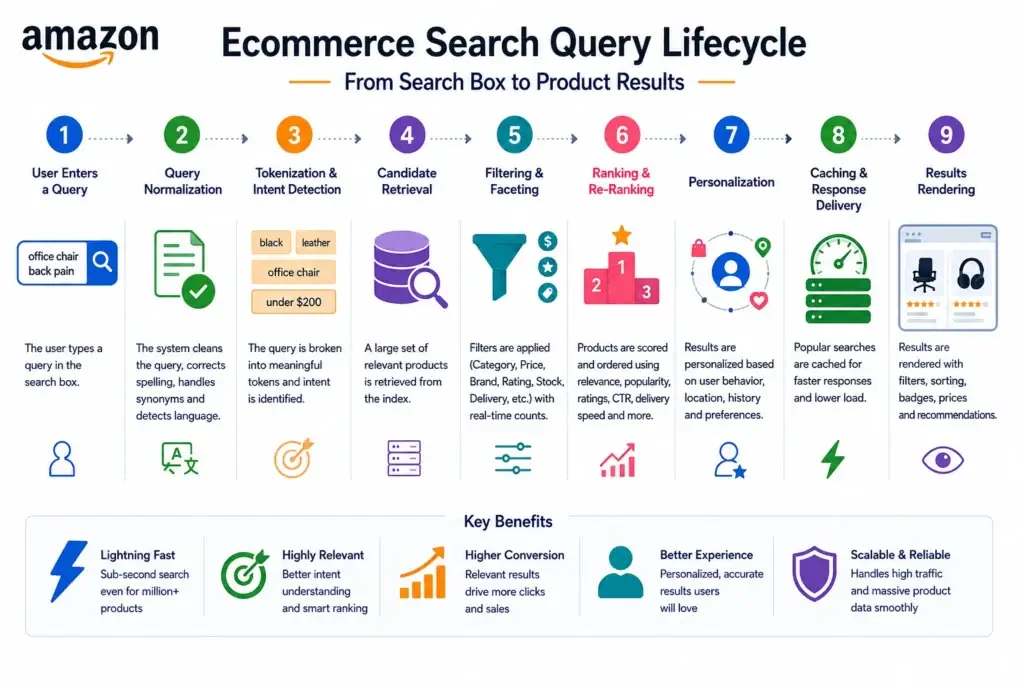
Ecommerce Search Query Lifecycle: From Search Box to Product Results
A million-product ecommerce search query usually moves through several steps before the user sees results.
1. User Enters a Query
The query may be exact, vague, misspelled, or exploratory.
Examples:
- “nike black shoes”
- “phone under 300”
- “gift for 5 year old”
- “noise cancelling headphone”
- “office chair back pain”
The search script must handle both product-specific and intent-based queries.
2. Query Normalization
The system cleans the query by lowercasing terms, removing unnecessary characters, correcting spelling, identifying synonyms, and detecting language.
For example:
- “headfone” may map to “headphone”
- “tv” may map to “television”
- “sofa” and “couch” may be connected
- “under 500” may be interpreted as a price filter
3. Tokenization and Intent Detection
The query is broken into useful parts.
For “black leather office chair under $200,” the system may identify:
- Color: black
- Material: leather
- Product type: office chair
- Price intent: under $200
This matters because the platform should not only match text. It should understand what the shopper means.
4. Candidate Retrieval
The search engine retrieves a large pool of potentially relevant products from the index.
At this stage, the system may use:
- Keyword matching
- Category matching
- Synonyms
- Fuzzy matching
- Vector retrieval
- Product attribute matching
5. Filtering and Faceting
The system applies filters such as:
- Category
- Price
- Brand
- Seller
- Rating
- Stock availability
- Delivery location
- Color
- Size
- Discount
- Return eligibility
Faceted filtering is one of the hardest parts of marketplace search because filters must update instantly while still reflecting accurate result counts.
6. Ranking and Re-Ranking
Products are scored and ordered.
Ranking may consider:
- Text relevance
- Product popularity
- Click-through rate
- Conversion rate
- Seller rating
- Product rating
- Stock status
- Freshness
- Delivery speed
- Sponsored placement
- Margin or commission logic
- User preference signals
Advanced ecommerce search systems may retrieve candidates first, then re-rank the top results using machine learning or AI models.
7. Personalization
Two users may search the same query and receive different results.
For example, “running shoes” may show trail shoes to one user, gym shoes to another, and budget sneakers to another based on browsing history, location, previous purchases, and price sensitivity.
8. Caching and Response Delivery
Popular searches are cached to reduce repeated search computation.
Examples:
- “iPhone case”
- “laptop bag”
- “wireless earbuds”
- “summer dress”
Caching can happen at different layers, including Redis, application cache, CDN-assisted frontend delivery, and precomputed facet caches.
9. Results Rendering
Finally, the frontend displays product cards, filters, sort options, sponsored listings, badges, stock status, delivery ETA, and recommendations.
The user experiences this as an instant search result. Behind the scenes, the marketplace has executed a complex distributed workflow.
How Amazon-Like Marketplaces Rank Products in Milliseconds
Large marketplaces do not rank products only by keyword match.
Amazon Science describes ecommerce search ranking as involving machine learning frameworks, NLP techniques, product-category logic, and blended rankings across product search.
An Amazon-like marketplace may use multiple ranking layers:
| Ranking Signal | What It Measures | Founder Impact |
|---|---|---|
| Text relevance | How closely the product matches the query | Prevents irrelevant results |
| Product popularity | Clicks, purchases, views, wishlist activity | Promotes proven products |
| Conversion probability | Likelihood that the user will buy | Improves revenue per search |
| Seller quality | Ratings, fulfillment reliability, cancellation rate | Protects marketplace trust |
| Inventory status | Whether the product is available | Avoids dead-end search results |
| Delivery speed | How fast the item can reach the user | Improves purchase confidence |
| User preference | Past browsing, cart, category interest | Personalizes discovery |
| Sponsored placement | Paid visibility rules | Enables ad monetization |
| Freshness | Recently added or trending products | Supports new sellers and inventory |
This is where marketplace search becomes a business engine.
A basic search script shows matching products. A scalable ecommerce search script decides which products should be seen first.
Handling Real-Time Inventory Across Millions of Products
Marketplace search becomes risky when search results show products that are out of stock, wrongly priced, unavailable in the buyer’s location, or no longer sold by the vendor.
This is why search infrastructure needs real-time or near-real-time sync.
A typical flow looks like this:
Product Update → Database → Event Queue → Indexing Worker → Search Index → Cache Refresh → Search Results
For example:
- A seller updates product stock.
- The main ecommerce database records the change.
- An event is pushed into a queue system such as Kafka or a similar message broker.
- A worker processes the update.
- The product document in the search index is updated.
- Cache entries may be refreshed or invalidated.
- New search results reflect the updated stock status.
This approach protects the marketplace from overloading the main database. Instead of rebuilding the entire search index every time something changes, the system updates affected product documents incrementally.
For founders, this is important because inventory accuracy affects trust. If users repeatedly click products that are unavailable, they stop trusting the marketplace.
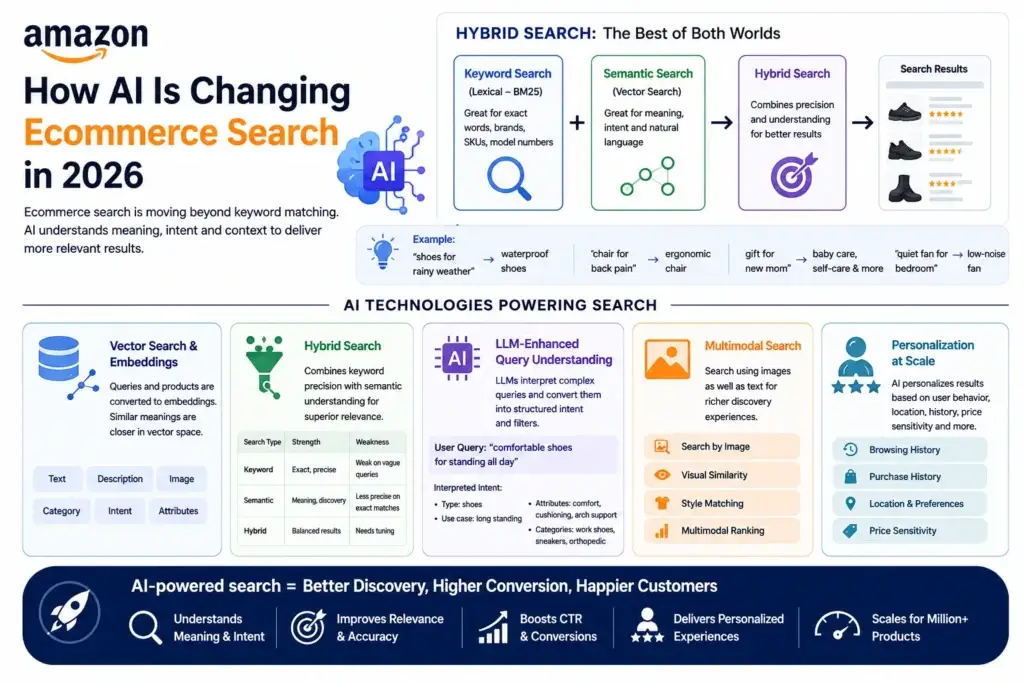
How AI Is Changing Ecommerce Search in 2026
Ecommerce search is moving beyond keyword matching.
Elastic explains hybrid search as a combination of lexical search, such as BM25, and semantic search into one ranked list. Semantic search uses vector representations that capture meaning, while hybrid search combines lexical and semantic retrieval.
This is important because shoppers often search by meaning, not exact words.
For example:
- “shoes for rainy weather” may mean waterproof shoes.
- “chair for back pain” may mean ergonomic chair.
- “gift for new mom” may mean baby care, self-care, or household products.
- “quiet fan for bedroom” may mean low-noise cooling appliance.
Traditional keyword search may miss these connections. AI-powered semantic search can understand the relationship between query intent and product meaning.
Vector Search and Embeddings
In vector search, queries and products are converted into mathematical representations called embeddings. Similar meanings are placed closer together in vector space.
This helps ecommerce platforms match:
- Query to product title
- Query to product description
- Query to image metadata
- Query to category
- Query to user intent
Hybrid Search
Hybrid search combines keyword precision with semantic understanding.
For ecommerce, this is often better than using only one method.
| Search Type | Strength | Weakness |
|---|---|---|
| Keyword Search | Strong for exact product names, brands, SKUs, model numbers | Weak for vague or intent-based queries |
| Semantic Search | Strong for meaning, discovery, and natural language | May be less precise for exact identifiers |
| Hybrid Search | Balances precision and intent understanding | Requires stronger ranking and tuning |
LLM-Enhanced Query Understanding
Large language models can help ecommerce search systems understand complex queries, generate attribute filters, improve synonyms, support conversational search, and rewrite vague queries into structured search intent.
For example:
User query: “comfortable shoes for standing all day”
Structured interpretation:
- Product type: shoes
- Use case: long standing
- Attributes: comfort, cushioning, arch support
- Possible categories: work shoes, sneakers, orthopedic footwear
Multimodal Search
Product search is also becoming visual. Research around shopping query image datasets shows growing interest in using product images alongside text for search and ranking.
This creates new marketplace experiences such as:
- Search by image
- Visual similarity search
- Style matching
- Product recommendation from uploaded photos
- Multimodal ranking using text and image data
For large marketplaces, AI search is becoming less of a future feature and more of a competitive discovery layer.
The Infrastructure Needed for 10M+ Product Search Systems
A marketplace with 10 million or more products needs search infrastructure designed for scale, reliability, and operational visibility.
The technical stack may include:
| Infrastructure Component | Role in Ecommerce Search |
|---|---|
| Elasticsearch or OpenSearch Cluster | Full-text search, indexing, filtering, ranking |
| Vector Database or Vector Search Layer | Semantic and AI-powered search |
| Redis Cache | Fast response for common queries and filters |
| Message Queue | Product, pricing, and inventory update sync |
| Search API Gateway | Controls frontend search requests |
| Ranking Service | Applies relevance, business, and personalization scoring |
| Recommendation Engine | Suggests related products and personalized items |
| Kubernetes or Container Orchestration | Supports deployment, scaling, and failover |
| Observability Stack | Tracks latency, error rates, slow queries, and cluster health |
| Analytics Pipeline | Measures search conversion, zero-result queries, and click behavior |
At this level, founders need to track not only whether search works, but how search performs.
Important metrics include:
- Search latency
- Zero-result rate
- Search-to-product-click rate
- Search-to-cart rate
- Search-to-purchase rate
- Filter usage
- Top failed queries
- Top converting queries
- Sponsored result performance
- Inventory mismatch rate
- Query cache hit rate
Search infrastructure should also include failure planning. If the ranking service slows down, the system may fall back to default relevance. If personalization is unavailable, the platform should still return usable results. If a node fails, replicas should keep search available.
Why Search Speed Directly Impacts Marketplace Revenue
Search performance affects marketplace revenue because high-intent users often use search before purchase.
Slow or irrelevant search creates several business problems:
- Users bounce before seeing results.
- Buyers cannot find products they are willing to purchase.
- Sellers lose visibility.
- Sponsored product campaigns perform poorly.
- Marketplace trust declines.
- Long-tail products remain undiscovered.
- Customer support receives more “I can’t find this” queries.
- Conversion rate drops.
Search also affects seller retention. In a marketplace, sellers care about visibility. If the search algorithm consistently buries relevant products or favors only a few listings, sellers may stop investing in the platform.
For marketplace operators, search is also a monetization layer. Sponsored listings, promoted products, featured placements, category boosts, and seller ads all depend on reliable search infrastructure.
A strong ecommerce search script should therefore support both user discovery and marketplace monetization.
Read more : How to Build an Ecommerce Marketplace Like Amazon
Key Features Every Scalable Ecommerce Search Script Should Include
A marketplace-ready ecommerce search script should include more than a search bar.
It should support product discovery, catalog growth, seller operations, buyer personalization, and admin control.
Scalable Ecommerce Search Features and Business Value
| Feature | Business Value | Founder Impact |
|---|---|---|
| Autocomplete | Helps users complete searches faster | Reduces friction and improves product discovery |
| Typo Tolerance | Handles misspelled product queries | Prevents lost conversions from imperfect search terms |
| Faceted Filtering | Lets users refine results by brand, price, rating, size, color, and stock | Improves navigation across large catalogs |
| Synonym Management | Connects related terms such as sofa/couch or TV/television | Improves search coverage across different user vocabularies |
| Personalized Ranking | Adjusts results based on user behavior and preferences | Supports higher relevance and repeat purchases |
| Sponsored Product Logic | Allows paid product visibility inside search | Creates marketplace ad monetization opportunities |
| Real-Time Inventory Sync | Keeps search results aligned with stock and availability | Protects user trust and reduces failed purchases |
| Search Analytics | Tracks failed searches, top queries, and conversion paths | Helps founders improve catalog strategy and product-market fit |
Common Mistakes Founders Make With Ecommerce Search
Mistakes Founders Should Avoid
Treating Search as a Basic Plugin
A plugin may work for a small store, but million-product marketplaces need dedicated indexing, ranking, filtering, caching, and analytics. Search should be part of the marketplace architecture from the start.
Ignoring Search Analytics
Zero-result queries, failed searches, and low click-through searches reveal product gaps and catalog issues. Without search analytics, founders lose one of the clearest signals of buyer demand.
Ranking Only by Keyword Match
Keyword relevance is useful, but marketplace ranking also needs stock status, seller quality, conversion signals, delivery speed, and user intent.
Not Planning for Real-Time Inventory Sync
If search results show unavailable or outdated products, users lose trust. Search indexes must stay connected to product, pricing, and inventory updates.
Adding AI Search Without Clean Product Data
AI search works better when product titles, descriptions, attributes, categories, images, and seller data are structured properly. Weak catalog data limits even advanced search models.
How Miracuves Builds Scalable Ecommerce Search Infrastructure
Miracuves helps founders build scalable ecommerce and marketplace platforms with product discovery, admin control, seller workflows, catalog management, and search-ready architecture. For ecommerce businesses planning Amazon-like discovery, the search layer can be designed with Elasticsearch-style indexing, AI recommendation logic, filtering, caching, and marketplace-specific ranking workflows.
The goal is not only to make search fast. The goal is to make search useful for buyers, fair for sellers, manageable for admins, and valuable for marketplace monetization.
A scalable ecommerce search foundation can include:
- Product indexing and search API workflows
- Multi-vendor catalog search
- Faceted filtering
- Autocomplete and typo tolerance
- Seller and product ranking signals
- Sponsored product placement logic
- Search analytics
- AI-powered recommendations
- Real-time inventory and pricing sync
- Admin dashboard controls
Final Thoughts: Ecommerce Search Is a Marketplace Growth Engine
An ecommerce search script is not just a technical module. At marketplace scale, it becomes one of the most important systems inside the business.
It decides how buyers discover products, how sellers gain visibility, how sponsored listings perform, how inventory appears, and how quickly users move from intent to purchase.
For a small store, search can be simple. For a million-product marketplace, search needs distributed indexing, relevance scoring, caching, real-time sync, AI-powered understanding, and admin-level control.
The strongest founders do not wait until search breaks to think about search architecture. They plan for scalable discovery early, because marketplace growth depends on helping users find the right products at the right moment.
FAQs
What is an ecommerce search script?
An ecommerce search script is the software logic that powers product search inside an online store or marketplace. It handles query processing, product lookup, filtering, ranking, autocomplete, typo tolerance, and result display. In large marketplaces, it may also include Elasticsearch, caching, AI search, personalization, and real-time inventory sync.
How does an ecommerce search script handle millions of products?
It usually separates search data from the main database, indexes product information in a search engine, distributes data across shards, uses cache layers for popular queries, applies filters and ranking rules, and syncs product updates through event pipelines.
How does search speed affect ecommerce revenue?
Search speed affects revenue because users who search often have strong buying intent. Slow results, irrelevant products, or unavailable items can reduce conversions, increase bounce rates, and weaken marketplace trust.
What features should a scalable ecommerce search script include?
A scalable ecommerce search script should include autocomplete, typo tolerance, faceted filters, synonym management, product ranking, seller ranking, real-time inventory sync, personalization, sponsored product logic, analytics, and admin controls.
What is AI ecommerce search?
AI ecommerce search uses technologies such as semantic search, embeddings, vector search, machine learning ranking, and recommendation engines to understand shopper intent beyond exact keyword matching. It helps users find products even when they search with vague, natural, or conversational queries.
Miracuves is an independent software development company. We are not affiliated with, connected to, sponsored by, or endorsed by any company or product named in this article.
Terms such as “X Clone” are used descriptively. It is how the software industry refers to building a platform with functionality comparable to a known service, and how clients search for it.
The entire design and codebase of our products is built by our own team. Our products contain no code, design, graphics, or content originating from any third-party website or applications.
All third-party names and marks referenced in this article are the property of their respective owners, referenced solely to identify the services discussed.