


Key Takeaways
- A white-label delivery app can reduce launch delays.
- Migration helps avoid a full code rebuild.
- Customer, vendor, driver, and admin flows must be checked.
- Data, payments, orders, and notifications need careful mapping.
- A 6-day launch works best with a focused migration scope.
Migration Signals
- Audit the current app before migration starts.
- Map old users, stores, drivers, and order data.
- Test payment, wallet, refund, and payout flows.
- Check real-time tracking and delivery assignment logic.
- Validate admin controls before going live.
Real Insights
- Rebuilding from zero is not always the fastest fix.
- Broken operations hurt more than missing features.
- Clean admin access helps teams recover faster.
- Technical debt should be controlled, not ignored.
- Miracuves helps delivery startups migrate faster with 6-day launch support.
Every startup has a moment when the founder knows the product is not moving fast enough.
For one delivery startup, that moment came after months of custom development, rising costs, unstable releases, delayed restaurant onboarding, and a backend that kept breaking every time the team tried to add a new operational flow.
The founder did not need another motivational article about how to start a delivery business. They needed a working product foundation.
That is the difference between building endlessly and reaching the market.
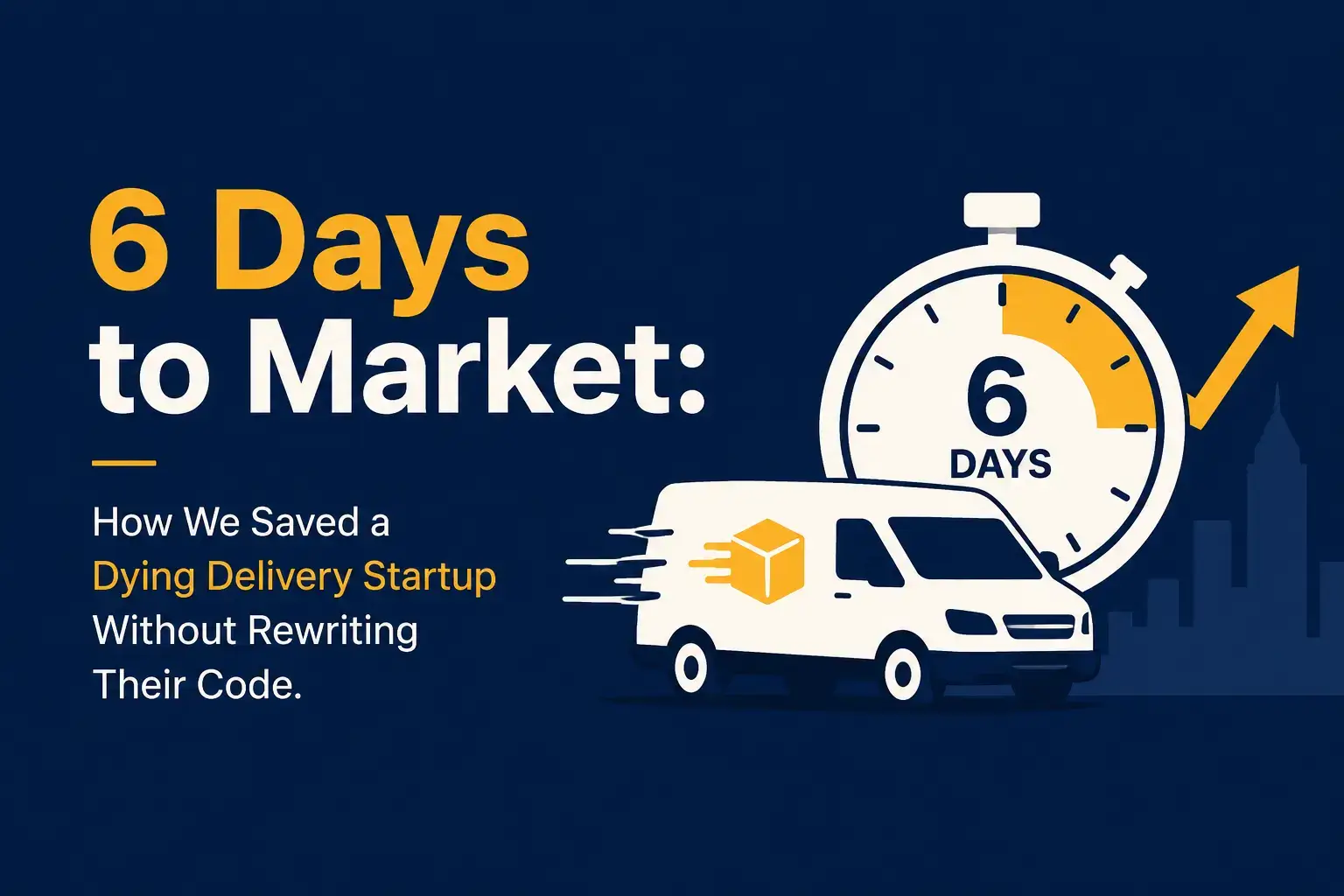
A white label delivery app can become a lifeline when the original custom build is too slow, too expensive, or too fragile to support real operations. In this anonymized operational narrative, we will break down how Miracuves helped move a struggling delivery startup toward launch using a ready-made delivery app engine, a focused 6-day migration protocol, and a practical decision: stop rewriting broken code and start moving customers, merchants, and drivers into a working ecosystem.
The Hidden Debt of “Custom” Builds
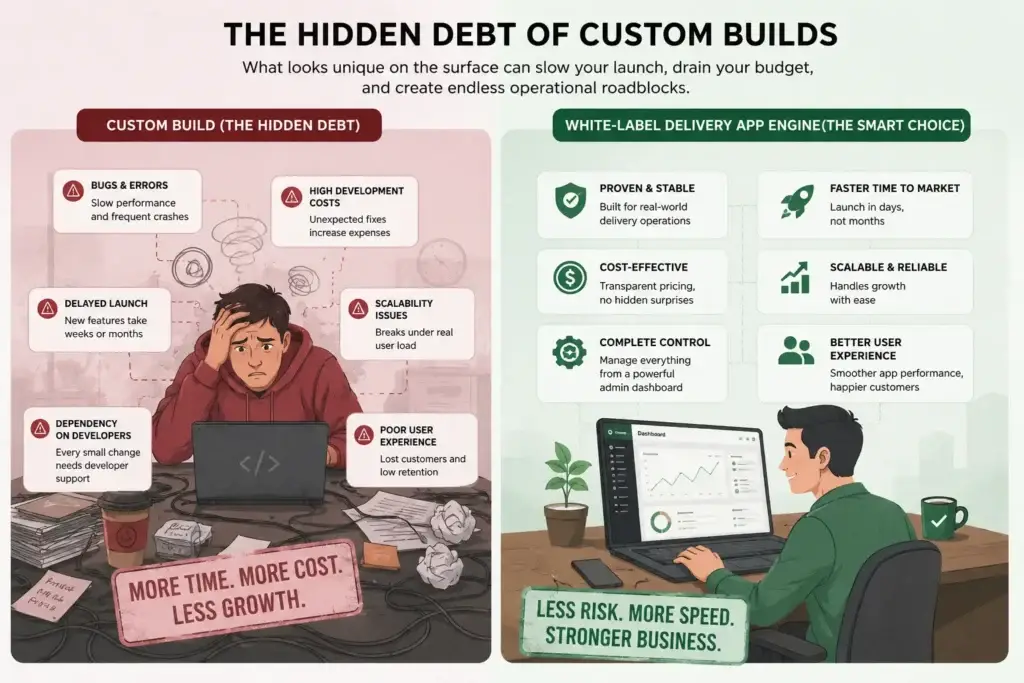
Custom development sounds powerful in the beginning.
A founder imagines full control, unique workflows, flexible design, and a product built exactly around the business idea. That can be the right path for some companies. But for an early-stage delivery startup, custom development can also create a dangerous form of hidden debt.
This debt does not always appear on the first invoice. It appears when the app cannot handle basic marketplace workflows smoothly.
The customer app looks ready, but checkout breaks under different delivery zones. The merchant panel exists, but restaurants cannot update menus without support. The driver app has tracking, but dispatch logic fails during peak orders. The admin panel shows data, but the operator still needs developers for refunds, commissions, disputes, and manual corrections.
At that point, the founder is no longer building a delivery startup. They are managing a software repair project.
Why Technical Debt Becomes Business Debt
For delivery businesses, every delay has a commercial cost.
Restaurants will not wait forever for onboarding. Drivers lose interest if there are no active orders. Customers do not give second chances to broken checkout flows. Investors and partners judge the business by execution speed, not by how much custom code exists behind the scenes.
A delivery platform has too many moving parts for a weak foundation:
| Product Layer | What Can Go Wrong in a Weak Custom Build | Business Impact |
|---|---|---|
| Customer app | Checkout errors, poor order tracking, slow browsing | Lower conversion and weak retention |
| Merchant panel | Menu updates fail, order acceptance is delayed | Restaurant frustration |
| Driver app | Poor assignment logic, tracking gaps, missed notifications | Delivery delays and cancellations |
| Admin dashboard | Limited control over commissions, refunds, users, and disputes | Operational dependency on developers |
| Payment flow | Failed transactions or poor reconciliation | Trust and revenue leakage |
| Delivery logic | Weak radius, ETA, and dispatch controls | Poor service reliability |
The issue is not that custom development is bad. The issue is that custom development without mature product architecture can trap founders in a cycle of fixes before the business has even reached the market.
Read More: The Role of Predictive Analytics in Modern Logistics and Delivery Apps
The Moment the Founder Had to Choose
The startup had already spent time and money on a custom build. Walking away from that code felt painful.
That is common.
Founders often continue funding a weak build because they feel they have already invested too much to stop. But the smarter question is not, “How much have we already spent?”
The smarter question is, “Will this foundation help us launch, operate, and learn fast enough?”
In this case, the answer was clear. The existing build had become a drag on the business. It was not giving the founder speed, stability, or operational control.
So the decision changed.
Instead of rewriting the old codebase line by line, the team shifted to a white-label delivery app foundation that already included the core flows needed for launch.
That is where the 6-day migration protocol began.
The 6-Day Migration Protocol
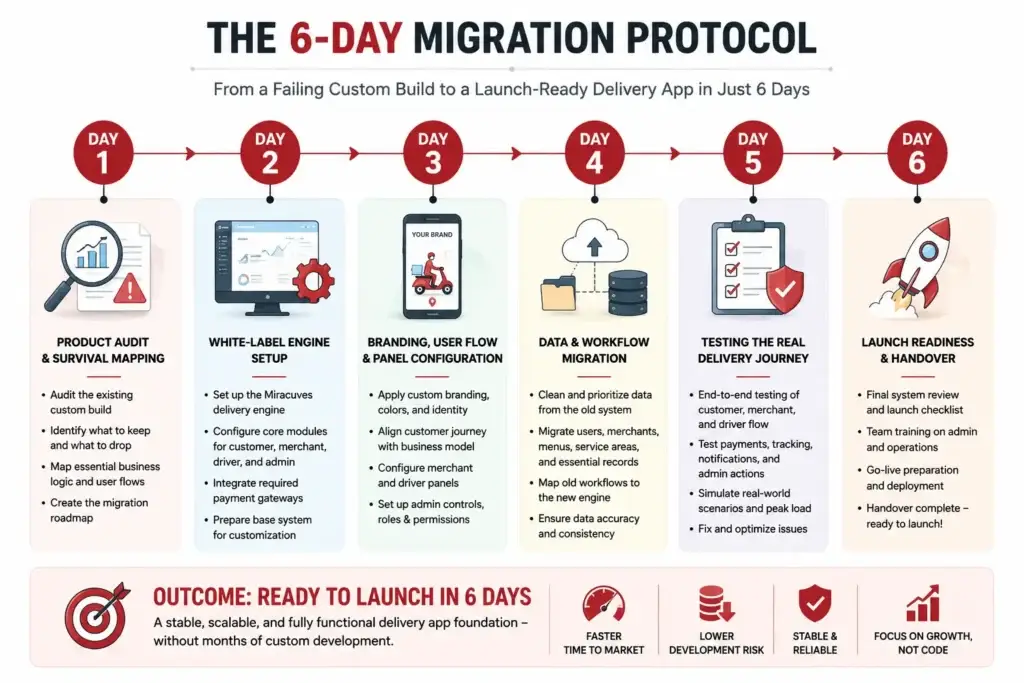
A fast migration does not mean rushing blindly.
It means reducing the scope to what matters most for launch: user journeys, operational control, branding, payment readiness, merchant onboarding, driver workflows, and admin visibility.
Miracuves approached the migration as a product rescue, not a vanity rebuild. The goal was not to preserve every broken feature from the old build. The goal was to protect the business model and move it into a stronger delivery engine.
Day 1: Product Audit and Survival Mapping
The first step was to separate what mattered from what was broken.
The team reviewed the existing product, founder goals, target market, delivery model, merchant workflow, driver flow, customer journey, and admin requirements. The key question was simple:
Which parts of the old product represented real business logic, and which parts were just technical noise?
This helped create a survival map.
The startup did not need every experimental feature. It needed the essential operating system for delivery:
- Customer ordering flow
- Merchant onboarding
- Menu and catalogue control
- Driver assignment
- Order tracking
- Payment workflow
- Commission handling
- Admin dashboard
- Notifications
- Basic dispute and support handling
This step prevented the migration from becoming another endless custom project.
Day 2: White-Label Engine Setup
The next move was to configure the ready-made delivery engine.
This is where a white label delivery app creates speed. The foundation already includes the core delivery marketplace structure, so the team can focus on branding, configuration, and operational fit instead of building every module from zero.
For the founder, this changed the conversation.
Instead of asking, “When will the developer finish the restaurant panel?” the question became, “How should restaurants be onboarded for our launch market?”
That shift matters.
A founder should be spending time on market entry, not chasing basic app modules.
Day 3: Branding, User Flow Alignment, and Panel Configuration
The platform was then aligned with the startup’s brand.
This included app identity, colors, content labels, launch-market configuration, customer flow review, merchant panel setup, delivery partner access, and admin dashboard controls.
The most important part was not cosmetic branding. It was operational fit.
A delivery founder needs control over:
- Service areas
- Restaurant or store onboarding
- Delivery partner availability
- Commission settings
- Order statuses
- Refund and cancellation handling
- Basic support workflows
- Payment and transaction visibility
A launch-ready delivery platform must make these controls accessible from the admin layer. Without that, the founder remains dependent on developers for daily business operations.
Day 4: Data and Workflow Migration
Not every old-code asset deserves to be migrated.
This is one of the hardest lessons for founders. A failing custom build often contains clutter: unused screens, half-built features, outdated workflows, duplicate logic, and unstable integrations.
The migration focused on useful business data and essential workflow continuity.
That may include items such as restaurant records, menu structures, user information, service zones, business rules, and launch-specific operational settings, depending on the old system’s condition and data quality.
The key principle was simple: migrate what supports launch, not what preserves technical debt.
Day 5: Testing the Real Delivery Journey
Testing was not treated as a checklist exercise.
The team tested the delivery journey the way a customer, merchant, driver, and admin would actually experience it.
A delivery app is not one app. It is an ecosystem.
The customer places an order. The merchant accepts it. The driver receives and completes the delivery. The admin monitors the transaction, handles exceptions, and controls the business rules.
If one layer fails, the entire experience feels broken.
That is why migration testing focused on ecosystem readiness rather than isolated screens.
Day 6: Launch Readiness and Founder Handover
By the final stage, the goal was operational confidence.
The founder needed to know how the admin dashboard worked, how merchants would be managed, how drivers would operate, and how the platform could support the first real users.
A 6-day launch does not mean every future feature is finished. It means the founder has a working, branded, launch-ready foundation that can support market validation faster than a broken custom build.
That is the competitive advantage.
Not perfection. Momentum.
Founder Decision Signals Speed
If your custom build is delaying launch by weeks or months, a ready-made delivery engine can help you move from development dependency to market action faster.
Cost
When development spend keeps increasing without a stable launch version, the issue is not only budget. It is poor capital efficiency.
Scalability
A delivery startup needs customer, merchant, driver, and admin workflows that can grow together instead of breaking every time volume increases.
Market Fit
The faster you launch a reliable first version, the faster you learn what customers, merchants, and delivery partners actually need.
Speed
If your custom build is delaying launch by weeks or months, a ready-made delivery engine can help you move from development dependency to market action faster.
Cost
When development spend keeps increasing without a stable launch version, the issue is not only budget. It is poor capital efficiency.
Scalability
A delivery startup needs customer, merchant, driver, and admin workflows that can grow together instead of breaking every time volume increases.
Market Fit
The faster you launch a reliable first version, the faster you learn what customers, merchants, and delivery partners actually need.
Read More: 10-minute delivery is a logistics war: Here is how to win it with tech
Why Our Engine Became a Plug-and-Play Lifeline
The reason a ready-made delivery engine works in a rescue scenario is not because it is basic.
It works because the repeatable parts of delivery apps are already known.
Most delivery startups need the same core infrastructure before they can differentiate:
| Module | Why It Matters |
|---|---|
| Customer app | Lets users browse, order, pay, track, and review |
| Merchant panel | Helps restaurants or stores manage menus, orders, availability, and earnings |
| Driver app | Enables delivery assignment, route visibility, status updates, and proof of completion |
| Admin dashboard | Gives the platform operator control over users, merchants, drivers, payments, commissions, and disputes |
| Payment integration | Supports transaction flow and platform monetization |
| Notification system | Keeps customers, merchants, and drivers aligned during order progress |
| Service zone logic | Helps define where the platform operates and how delivery availability works |
| Reporting layer | Gives founders visibility into orders, revenue, users, and operational bottlenecks |
A founder should not need to rebuild these fundamentals from scratch unless the business model truly requires a deeply custom architecture from day one.
For most early-stage delivery startups, the first competitive advantage is not technical originality. It is execution speed.
Custom Build vs White-Label Delivery App: The Founder’s Real Choice
The choice is not simply custom versus white-label.
The real choice is between control and delay.
A strong white-label delivery app can still support branding, configuration, admin control, and source-code ownership. The difference is that the founder starts from a proven product foundation rather than a blank technical canvas.
| Decision Area | Custom Build From Zero | White-Label Delivery App |
|---|---|---|
| Launch speed | Slower because core modules must be built and tested | Faster because essential workflows already exist |
| Early-stage risk | Higher if the team lacks delivery marketplace experience | Lower because common delivery flows are already structured |
| Founder focus | Often pulled into development management | More time for market, merchants, and operations |
| Cost control | Can expand as bugs and scope changes increase | More predictable when scope is clear |
| Differentiation | High flexibility, but slower execution | Faster launch with room for customization |
| Best for | Funded teams with complex unique requirements | Founders who need faster validation and operational readiness |
A white-label path does not mean the founder gives up ambition. It means the founder chooses a faster route to learning.
Speed-to-Market Is Not a Vanity Metric
Many founders underestimate the value of speed.
In delivery, timing affects everything. Restaurant partnerships, customer acquisition, local competition, driver supply, and investor confidence all depend on execution momentum.
A delayed product does not just arrive late. It enters the market weaker.
Competitors may lock in merchants. Users may move to other apps. Driver partners may lose interest. Marketing campaigns may stall because the product is not ready. The founder may keep spending without generating real market feedback.
That is why the 6-day launch variable is powerful.
It changes the founder’s operating posture from “we are still building” to “we are ready to test the market.”
What Founders Should Not Migrate From a Failing Build
A rescue migration is not a copy-paste exercise.
Some parts of the old build should be left behind.
Mistakes Founders Should Avoid Migrating Broken Logic Just Because It Already Exists
Old code should not be preserved if it creates operational friction. The goal is to protect the business model, not carry forward every technical mistake.
Rebuilding Every Custom Feature Before Launch
Founders often delay launch by trying to perfect secondary features. The smarter path is to launch the core delivery flow first, then improve based on real usage.
Ignoring the Admin Dashboard
A beautiful customer app will not save a delivery startup if the operator cannot manage merchants, drivers, payments, commissions, refunds, and disputes from the backend.
Treating Speed as Less Important Than Customization
Customization matters, but early-stage founders need market validation. A delayed custom build can become more damaging than a focused launch-ready product.
Migrating Broken Logic Just Because It Already Exists
Old code should not be preserved if it creates operational friction. The goal is to protect the business model, not carry forward every technical mistake.
Rebuilding Every Custom Feature Before Launch
Founders often delay launch by trying to perfect secondary features. The smarter path is to launch the core delivery flow first, then improve based on real usage.
Ignoring the Admin Dashboard
A beautiful customer app will not save a delivery startup if the operator cannot manage merchants, drivers, payments, commissions, refunds, and disputes from the backend.
Treating Speed as Less Important Than Customization
Customization matters, but early-stage founders need market validation. A delayed custom build can become more damaging than a focused launch-ready product.
Where Miracuves Fits Into the Rescue Path
Miracuves helps founders, startups, and agencies launch ready-made, white-label, source-code-owned app solutions with branding, admin control, and faster deployment. For delivery startups, that means the founder does not need to rebuild every customer, merchant, driver, and admin workflow from zero.
The Miracuves approach is especially useful when a founder already has:
- A delivery business idea
- A launch market
- Merchant or restaurant conversations
- A failed or delayed custom build
- A need for faster validation
- A limited window to prove traction
- A desire for source-code ownership and control
A ready-made delivery engine gives the founder a stronger product base. Customization can still happen, but the launch does not have to wait for every module to be invented again.
Final Thoughts: The Fastest Product Often Wins the First Market
The startup did not need more theory. It needed a working delivery platform.
That is the lesson for founders stuck in expensive custom development cycles. A custom build can be powerful, but only when it supports momentum. When it becomes a source of delay, bugs, and operational confusion, it stops being an asset.
The real decision is not whether custom code sounds impressive. The real decision is whether your product foundation helps you launch, learn, and grow.
A white label delivery app gives founders a faster route to market because the essential delivery workflows are already in place. With the right migration process, the founder can stop funding endless fixes and start testing the business where it matters: with real customers, merchants, and delivery partners.
For early-stage delivery startups, speed is not a shortcut.
Speed is survival.
FAQs
What is a white label delivery app?
A white label delivery app is a ready-made delivery platform that can be customized with a founder’s branding, business model, service areas, customer flows, merchant workflows, driver operations, and admin controls. It helps startups launch faster than building every module from scratch.
Can a white label delivery app replace a failed custom build?
Yes, when the current custom build is unstable, delayed, or too expensive to maintain, a white label delivery app can provide a stronger launch-ready foundation. The migration should focus on preserving useful business logic and essential data rather than copying broken code.
How does a 6-day delivery app migration work?
A 6-day migration usually includes product audit, white-label engine setup, branding, workflow configuration, useful data migration, ecosystem testing, and founder handover. Final scope depends on the condition of the existing product and customization requirements.
Is a white label delivery app only for food delivery?
No. A delivery app engine can often support food delivery, grocery delivery, pharmacy delivery, courier delivery, and hyperlocal delivery models, depending on the modules and configuration available.
What should founders check before choosing a white label delivery app?
Founders should check customer app quality, merchant panel control, driver app reliability, admin dashboard depth, payment readiness, order tracking, service zone logic, source-code ownership, customization support, and post-launch flexibility.
Is custom delivery app development still worth it?
Custom delivery app development can be worth it for businesses with highly unique workflows, large budgets, and longer timelines. For early-stage founders who need faster validation, a ready-made or white-label foundation is often more practical.
Why is admin control important in delivery app development?
Admin control allows the platform operator to manage users, merchants, drivers, orders, commissions, refunds, disputes, service zones, and reports. Without a strong admin dashboard, the founder may depend on developers for basic business operations.
Does Miracuves provide source code with delivery app solutions?
Miracuves positions its ready-made and white-label solutions around source-code ownership, branding, admin control, and faster launch for founders. Final scope should be confirmed based on the selected solution, modules, and customization requirements.