

Key Takeaways
- A marketplace MVP scope breakdown helps founders launch faster by focusing only on the features required to validate the business idea.
- The 144-hour development approach works best when the product uses pre-built modules, defined workflows, and limited launch-stage customization.
- An MVP should prioritize user onboarding, listings, search, transactions, payments, messaging, and admin visibility before advanced scaling features.
- The real goal of a marketplace MVP is not perfection; it is validating user demand, transaction flow, retention, and operational feasibility.
- Long-term success depends on launching quickly, collecting real feedback, improving workflows, and scaling after product-market validation.
MVP Development Signals
- Core marketplace MVP features usually include user registration, profile management, listings, search filters, booking or order flow, payments, and notifications.
- Admin dashboards are important because founders need visibility into users, transactions, disputes, commissions, and operational activity.
- Pre-built app foundations reduce development time because authentication, payment systems, dashboards, and common workflows already exist.
- Marketplace validation becomes stronger when users complete actions such as bookings, orders, subscriptions, bids, or repeat transactions.
- Development complexity changes based on marketplace type, custom workflows, payment integrations, real-time messaging, scalability requirements, and third-party APIs.
Real Insights
- Many marketplace startups fail because they spend months building advanced features before validating whether users actually want the product.
- A strong MVP should solve one clear marketplace problem instead of trying to support every feature or user type from day one.
- Founders should focus on transaction completion, retention, and operational learning before investing heavily in scaling infrastructure.
- The best MVP strategy is to launch with stable core workflows first, then expand based on real usage patterns and customer feedback.
- The strongest marketplace MVPs combine fast deployment, clear monetization flow, admin control, scalable architecture, and continuous product iteration.
A marketplace MVP is not a smaller version of your final product. It is a focused launch system designed to answer one question quickly: will buyers and providers actually complete transactions through this platform?
That distinction matters because early-stage founders and venture studios often lose months trying to build a “complete” marketplace before they have proof of demand. They add advanced search, loyalty programs, complex analytics, multi-language flows, automated dispute resolution, subscription tiers, custom dashboards, and every feature a mature platform might need.
The result is usually a slower launch, higher development risk, and a product that still has no real user behavior behind it.
A sharper approach is different. Start with a wireframe. Define the core transaction. Build only the workflows needed for the first 100 users. Deploy in 6 days using a modular, source-code-owned foundation. Then improve based on real activity instead of internal assumptions.
That is the logic behind a 144-hour marketplace MVP scope.
For founders and venture studios, speed is not just a delivery promise. It is a competitive advantage. The faster you launch a working marketplace, the faster you learn what users trust, where providers drop off, what buyers hesitate to pay for, and which operational bottlenecks must be solved before scaling.
Miracuves helps founders move from concept to launch faster with ready-made and white-label marketplace foundations that can be customized around business model, branding, admin control, and source-code ownership.
Why Complete Features Are the Enemy of Your First 100 Users
The first 100 users do not need your marketplace to feel complete. They need it to solve one painful problem clearly.
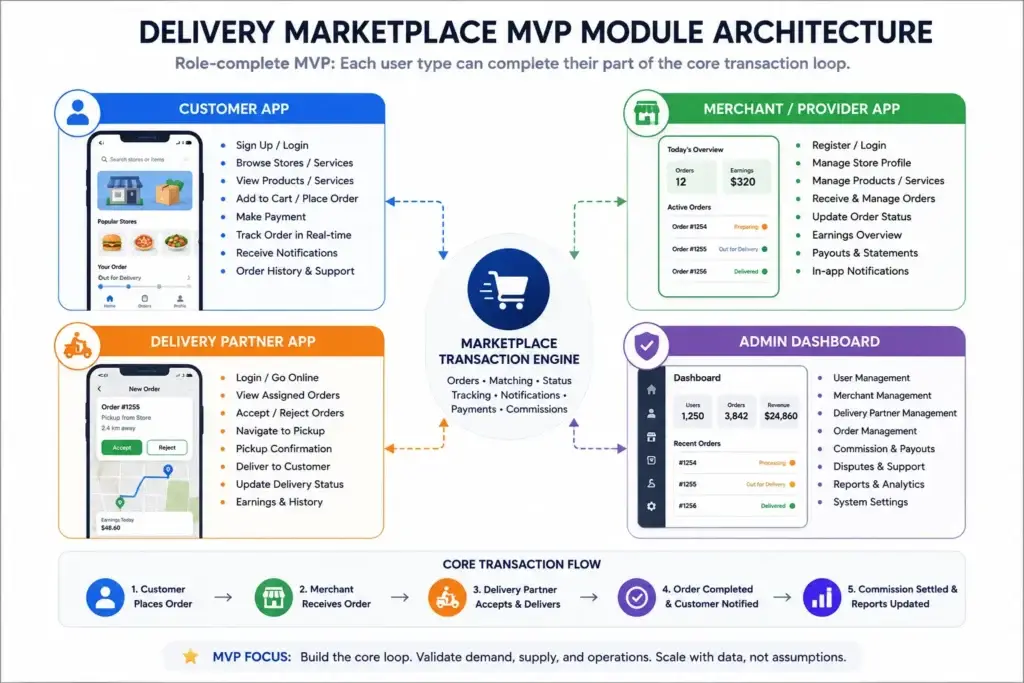
For a delivery marketplace ,that problem may be simple: can a customer place an order, can a delivery partner receive it, can the admin track what happened, and can the business manage basic payouts or commissions?
For a rental marketplace, the problem may be: can a host list an item, can a renter request availability, can payment or booking intent be captured, and can the operator manage disputes manually if needed?
For a services marketplace, the question becomes: can a customer find a provider, send a booking request, receive confirmation, and complete payment or inquiry flow?
Most failed MVP scopes break because founders confuse market validation with product maturity. They try to build everything a scaled marketplace will need before proving whether the core exchange works.
That creates three problems.
First, the team spends time on features that may never matter. Second, the product becomes harder to test because too many workflows are active at once. Third, the founder delays the most important learning cycle: real users interacting with the platform.
A marketplace MVP should be intentionally incomplete. It should include the minimum workflows required to test supply, demand, transaction confidence, admin control, and monetization logic.
The goal is not to impress every user. The goal is to learn from the right users.
The 144-Hour Marketplace MVP Rule: What Actually Fits Inside 6 Days
A 144-hour marketplace MVP does not mean rushing every possible feature into production. It means using time discipline to force better product decisions.
The scope must be built around one primary transaction. Everything else is either supporting infrastructure or post-launch backlog.
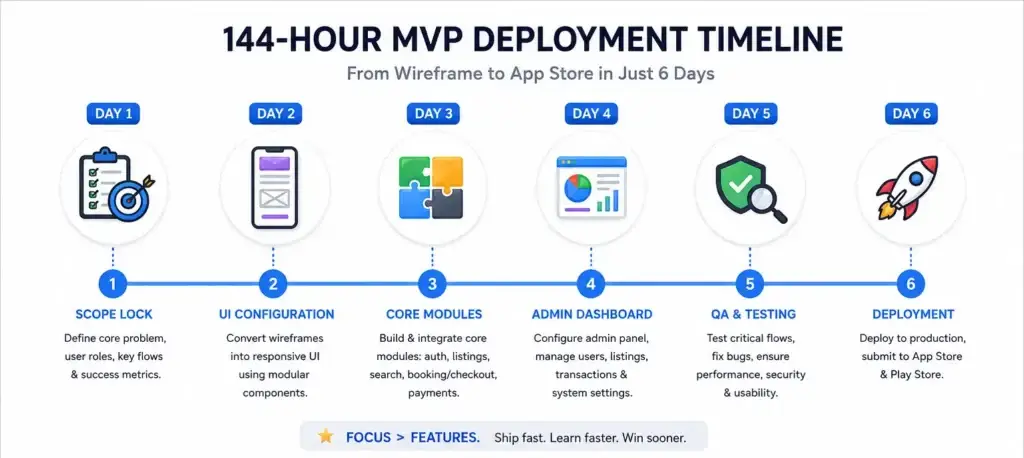
A practical 6-day breakdown looks like this:
Day 1: Scope lock, wireframe review, user roles, and transaction flow
The first day should not be spent adding ideas. It should be spent removing ambiguity.
The technical team defines user roles, screens, permissions, core flows, and admin requirements. For most marketplace MVPs, this means customer, provider or vendor, and admin modules.
The founder’s job is to answer business-critical questions quickly:
- What is the one transaction the marketplace must support?
- Who creates supply?
- Who creates demand?
- What does the admin need to approve, control, or monitor?
- What is manual for launch and automated later?
- What payment or inquiry flow is required for the first version?
By the end of Day 1, the team should have a locked scope. Without that, a 6-day launch becomes unrealistic.
Day 2: UI configuration and marketplace workflow setup
The second day focuses on turning wireframes into a working interface using reusable modules. This is where a modular foundation has a major advantage over a blank custom build.
Instead of designing every screen from zero, the team configures the core customer journey, provider flow, listing or order structure, and brand layer.
The aim is not pixel-perfect design. The aim is usability, clarity, and speed.
Day 3: Core module development and integration
The third day is where the transaction engine comes together.
Depending on the marketplace type, this may include listing creation, order placement, booking requests, service categories, provider availability, customer profiles, basic notifications, admin approvals, and commission logic.
This is where off-the-shelf scripts often look fast but become limiting. A script may already contain many features, but those features may not match the founder’s actual workflow. Modular custom IP allows the team to configure the business logic instead of forcing the business into a generic template.
Day 4: Admin dashboard, controls, and operational workflows
A marketplace without admin control is not ready for launch.
The admin dashboard must help the operator manage users, providers, listings, orders, payouts, disputes, categories, commissions, and platform activity. In a 6-day MVP, the admin system does not need advanced automation. It needs enough control to keep the marketplace operational.
This matters because early marketplaces are messy. Users ask questions. Providers make mistakes. Payments need review. Listings need moderation. Orders may fail. The admin layer is what allows the founder to manage that chaos without depending on developers for every small change.
Day 5: QA, deployment preparation, and edge-case testing
Fast deployment still needs disciplined testing.
The team should test the complete user journey across roles. Customer onboarding, provider onboarding, listing creation, order placement, booking request, admin review, notifications, and payment or inquiry flows should be checked against the locked scope.
The aim is not to eliminate every future bug. The aim is to avoid launch-blocking failures.
Day 6: Deployment, launch review, and handover
The final day focuses on deployment readiness, production configuration, app submission or distribution preparation, admin access, and founder handover.
A strong 6-day MVP handover should include:
- Access to the admin dashboard
- Role-based login credentials
- Source code handover where agreed
- Deployment notes
- Known limitations
- Post-launch backlog
- Recommended first 100 user testing plan
This is where speed becomes useful. The founder is not left with a demo. They get a working product foundation that can be tested in the market.
Read More:The True Cost of Waiting : Why Fast App Development Beats Long Timelines
Case Study-Style Breakdown: Building a Delivery Marketplace MVP in 6 Days
This is a representative project breakdown, not a fabricated client case study. It shows how a delivery marketplace MVP can be scoped when the objective is deployment speed and first-user validation.
The founder starts with a simple wireframe:
- Customer selects a store or service.
- Customer places an order.
- Delivery partner receives or accepts the task.
- Admin monitors order status.
- Business earns from commission, delivery fee, or service margin.
That is enough to validate the core business.
The 6-day delivery MVP does not need advanced route optimization, loyalty programs, AI demand prediction, multi-city franchise controls, warehouse automation, or deep analytics. Those features may matter later, but they are not required to test whether customers will place orders and whether delivery partners can fulfil them.
For the first version, the scope should be:
- Customer module
- Signup and login
- Location selection
- Store, category, or service browsing
- Product or service detail view
- Cart or order request
- Order placement
- Order status tracking
- Basic notifications
- Provider or merchant module
- Signup or admin-created access
- Profile management
- Catalogue or service listing
- Order acceptance or management
- Status update
- Basic earning visibility
- Delivery partner module
- Login
- Assigned delivery view
- Accept or reject task
- Pickup and delivery status
- Basic location update
- Delivery history
- Admin module
- User management
- Merchant or provider management
- Delivery partner management
- Order management
- Category management
- Commission settings
- Payment or payout records
- Support and dispute handling
- Basic reporting
This is enough for the founder to test the marketplace loop.
- Can demand be created?
- Can supply fulfil it?
- Can the admin control operations?
- Can revenue be captured?
- Can the founder identify what breaks first?
That is the real purpose of a delivery MVP.
Custom IP vs Off-the-Shelf Scripts: Why Modular Code Wins After Launch
Off-the-shelf scripts are attractive because they appear fast. You buy a prebuilt product, change the branding, configure a few settings, and launch.
That can work for very simple use cases. But for venture-backed founders, venture studios, and serious marketplace operators, scripts often fail at the exact point where the business starts learning.
The problem is not that scripts are always bad. The problem is that scripts are usually built around someone else’s assumptions.
A marketplace script may include many features, but the code structure may be rigid. The business logic may not match your operating model. Integrations may be harder to change. Scaling may expose hidden limitations. Custom workflows may require workarounds. Ownership terms may limit long-term flexibility.
Custom IP solves a different problem.
With source-code-owned modular development, the founder gets a launch-ready foundation that can be changed as the business evolves. The first version can still move fast, but the product does not have to remain trapped inside a generic script structure.
The difference becomes clear after launch.
A script asks: “Can your business fit inside this product?”
Custom IP asks: “How should this product evolve around your business?”
For marketplace founders, that distinction is critical. The first version teaches you what the business should become. If the codebase cannot adapt, your MVP becomes a ceiling instead of a foundation.
Read More:Why Time to Market Matters More Than Ever in App Development
Strategic Technical Debt: What to Build Now vs What to Build Later
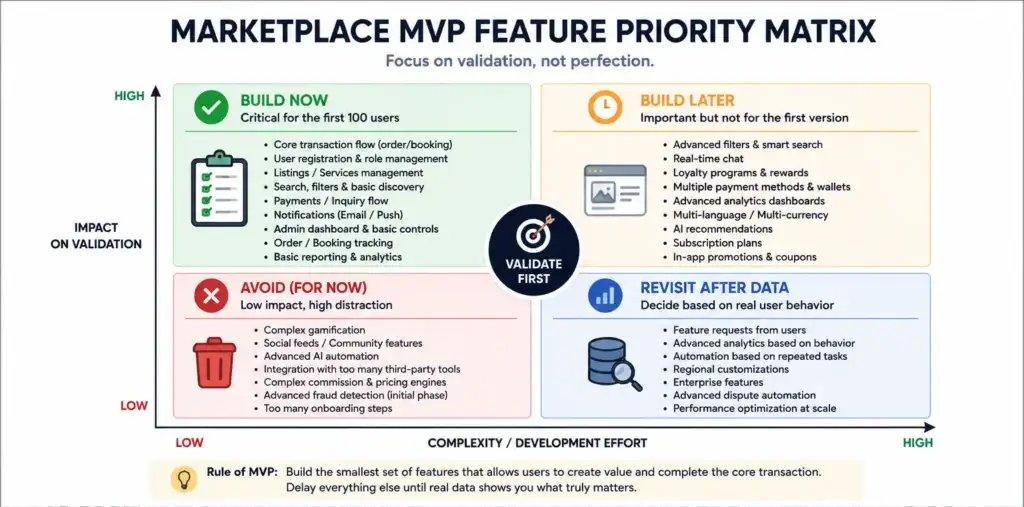
Technical debt is not always a mistake. In an MVP, some technical debt is strategic.
The mistake is not delaying complex features. The mistake is delaying the wrong features.
A 6 days marketplace MVP should build the foundation that supports learning. It should postpone features that require scale before they create value.
Build now:
- User registration and role management
- Core marketplace transaction flow
- Customer, provider, and admin workflows
- Listing, order, booking, or request management
- Basic payments or inquiry capture
- Admin controls
- Notifications
- Status tracking
- Basic reporting
- Essential security controls
Save for later:
- Advanced recommendation engines
- Deep analytics dashboards
- Complex loyalty programs
- Multi-language expansion
- AI-based automation
- Advanced route optimization
- Dynamic pricing engines
- Multi-country tax logic
- Enterprise-grade reporting
- Complex subscription tiers
- Fully automated dispute resolution
The principle is simple: build what helps users complete the first transaction. Delay what helps the business optimize thousands of transactions.
That is strategic technical debt.
The Marketplace MVP Feature Stack for First Deployment
A strong marketplace MVP is not feature-heavy. It is role-complete.
That means every major participant has enough functionality to complete their part of the marketplace loop.
Marketplace MVP Feature Stack
| Module | Build in First Version | Move to Post-Launch Backlog |
|---|---|---|
| Customer App | Signup, browsing, booking or ordering, status tracking, basic notifications | Loyalty points, advanced personalization, saved preferences, referral automation |
| Provider or Vendor App | Profile, listing management, order or request handling, status updates | Advanced analytics, promotional tools, subscription plans, bulk automation |
| Delivery or Service Partner App | Task view, accept or reject, pickup status, delivery status, history | Route optimization, heatmaps, incentives, advanced performance scoring |
| Admin Dashboard | User control, listing approval, order management, commissions, disputes, reports | Predictive analytics, automated fraud scoring, complex finance dashboards |
| Payments | Basic payment gateway or manual payment tracking based on launch scope | Wallets, split settlements, subscriptions, advanced payout automation |
| Security | Role-based access, secure login, encrypted transfer, admin permissions | Advanced risk scoring, enterprise compliance workflows, complex audit automation |
The mistake many founders make is prioritizing visible features over operational features.
A polished customer interface is useful, but if the admin cannot control users, providers, orders, commissions, and disputes, the business becomes difficult to run. A marketplace MVP needs enough backend control to support real activity, even if some processes remain manual during the first release.
Read More:Clone App Development: The Fastest Way to Validate a Market Without Starting From Zero
Founder Decision Signals for a 6 Day Marketplace MVP
Founder Decision Signals
Speed
If your market window is active now, a 6 day deployment helps you test demand before competitors or slower internal teams reach users.
Cost
A focused MVP prevents early budgets from being consumed by features that users have not validated yet.
Scalability
Modular custom IP gives the product a stronger foundation for future changes than rigid scripts that may restrict workflow evolution.
Market Fit
The first version should reveal whether buyers, providers, and operators can complete the marketplace loop with minimal friction.
Why 6 Day MVP Deployment Gives Founders a Competitive Advantage
Speed matters because early-stage markets reward learning velocity.
A founder who launches in 6 days can start testing onboarding, pricing, supply quality, provider responsiveness, customer trust, and operational friction while another team is still finalizing a feature list.
For venture studios, this is even more important. Studios often test multiple concepts, geographies, or verticals. A modular marketplace foundation allows the team to validate faster without treating every experiment as a full custom software project.
A fast MVP also improves investor conversations. Instead of presenting only wireframes, the founder can show a working product, admin dashboard, early user behavior, and a clear roadmap based on real feedback.
The first deployed version gives the founder evidence.
That evidence may show the concept is strong. It may show that the target customer is wrong. It may show that the provider side is harder than expected. It may show that manual operations are acceptable for the first phase. It may show that monetization needs to change.
All of those outcomes are useful.
The only bad outcome is spending months building a product that teaches you too late.
Mistakes Founders Should Avoid During Marketplace MVP Scoping
Mistakes Founders Should Avoid
Trying to Launch With Every Mature Marketplace Feature
Advanced features feel impressive, but they slow the first release and distract from the core question: will users complete the marketplace transaction?
Choosing a Script Without Understanding Code Flexibility
A script can look fast at the start but become restrictive when the founder needs custom workflows, integrations, or business-specific logic after launch.
Ignoring the Admin Dashboard
The admin dashboard is the control room of a marketplace. Without user, provider, order, commission, and dispute control, even a good front-end experience becomes hard to operate.
Automating Too Early
Manual operations are acceptable in the first version when they help the founder learn faster. Automation should follow repeated behavior, not assumptions.
Custom IP Marketplace MVP vs Off-the-Shelf Script
The strongest MVP path is not always a long custom build or a generic script. For many founders, the practical middle path is a modular, source-code-owned foundation.
That approach keeps speed high while protecting long-term flexibility.
Off-the-shelf scripts are usually built for broad use cases. They may help you launch a familiar marketplace pattern quickly, but they can become difficult when your business model changes.
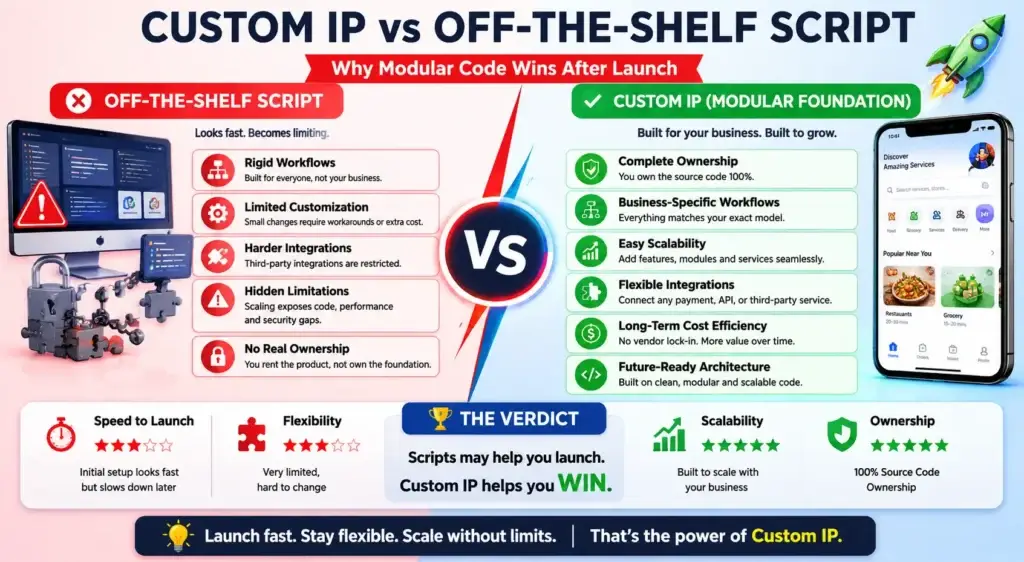
Custom IP gives you more control over the codebase, workflows, branding, integrations, and roadmap. That does not mean building everything from zero. It means starting with reusable modules while keeping ownership and adaptability.
For a founder, this changes the risk profile.
You are not buying a fixed template. You are building on a launch-ready foundation that can evolve.
This is where Miracuves’ white-label and source-code-owned app approach becomes useful for marketplace founders who need speed without giving up control.
What to Measure After the First 100 Users
The first 100 users should not be judged only by downloads or registrations.
Marketplace founders should watch the full transaction loop.
Track:
- How many users complete onboarding?
- How many providers create active supply?
- How many listings or services are approved?
- How many customers start an order or booking?
- Where do users abandon the flow?
- How many transactions require manual support?
- Which disputes or operational issues repeat?
- What feature requests come from real usage?
- Which monetization point feels natural?
These insights should decide the second release.
The second version should not be built from the founder’s original wish list. It should be built from user behavior, admin friction, provider feedback, and transaction data.
That is how a 6-day marketplace MVP becomes a scalable product roadmap.
How Miracuves Helps Founders Move From Wireframe to Launch Faster
Miracuves helps founders, startups, and venture studios launch marketplace products faster using ready-made, white-label, and source-code-owned app foundations.
For a marketplace MVP, this means founders can start with essential modules such as customer flows, provider or vendor workflows, admin dashboard, order or booking logic, payment integration, notifications, and operational controls.
The advantage is not only speed. It is the combination of speed, ownership, branding, and adaptability.
A founder can launch the first market version quickly, test real behavior, and then customize the product based on what users actually do.
Relevant Miracuves pages for this topic:
For marketplace categories such as delivery, rental, ecommerce, service marketplaces, travel, and on-demand platforms, a modular foundation gives founders a faster way to validate demand without starting every workflow from zero.
Final Thoughts: The First Version Should Teach You, Not Impress Everyone
A marketplace MVP should not be judged by the number of features it includes. It should be judged by how quickly it helps the founder understand what actually matters in the market.
The first version should answer clear business questions:
- Can users complete the core transaction?
- Can providers create enough supply?
- Can the admin control operations?
- Can the business model capture value?
- Can the product evolve without a rebuild?
These are the real questions a first version should answer.
That is the true purpose of moving from wireframe to deployment in 144 hours.
The goal is not to build the most complete product on day one. The goal is to launch a working product foundation that creates real evidence from real users.
The strongest first version is not the one that impresses everyone with features. It is the one that enters the market fast enough to reduce uncertainty, reveal user behavior, and guide the next product decision.
For early-stage founders and venture studios, speed is not about cutting corners. It is about cutting uncertainty.
FAQs
What is a marketplace MVP scope breakdown?
A marketplace MVP scope breakdown defines the exact features, user roles, workflows, admin controls, and integrations needed for the first deployable version of a marketplace app. It helps founders avoid feature bloat and focus on the core transaction between buyers and providers.
Can a marketplace MVP be deployed in 6 days?
Yes, a marketplace MVP can be deployed in 6 days when the scope is tightly controlled, the product uses a modular foundation, and the first version focuses only on essential workflows. A fully custom build from zero usually requires more time.
What features should a marketplace MVP include first?
The first version should include user registration, customer flow, provider or vendor flow, listing or order management, admin dashboard, basic payment or inquiry handling, notifications, and status tracking. Advanced analytics, loyalty programs, and automation can usually wait.
Why are complete features bad for the first 100 users?
Complete features can slow launch and distract from validation. The first 100 users are useful because they reveal whether the core marketplace exchange works. A focused MVP helps founders learn faster with fewer assumptions.
What is the difference between custom IP and an off-the-shelf script?
Custom IP gives the founder ownership and flexibility over the codebase, workflows, branding, and future roadmap. Off-the-shelf scripts can launch quickly but may limit customization and long-term product evolution.
What is strategic technical debt in marketplace MVP development?
Strategic technical debt means intentionally delaying non-critical features so the product can launch faster. It is useful when the postponed features do not block validation, user onboarding, admin control, or the core transaction.
Is a 6-day MVP suitable for venture studios?
Yes, a 6-day MVP can be useful for venture studios because it helps test multiple marketplace ideas faster. Studios can validate demand, user behavior, and operational friction before committing larger product budgets.
How does Miracuves help with marketplace MVP deployment?
Miracuves helps founders launch faster with ready-made, white-label, and source-code-owned app foundations. This gives founders a quicker path from wireframe to deployment while keeping room for customization after validation.
Miracuves is an independent software development company. We are not affiliated with, connected to, sponsored by, or endorsed by any company or product named in this article.
Terms such as “X Clone” are used descriptively. It is how the software industry refers to building a platform with functionality comparable to a known service, and how clients search for it.
The entire design and codebase of our products is built by our own team. Our products contain no code, design, graphics, or content originating from any third-party website or applications.
All third-party names and marks referenced in this article are the property of their respective owners, referenced solely to identify the services discussed.