


Key Takeaways
- A niche B2B network needs fast connection logic to support professional discovery and relationship mapping.
- Users, recruiters, founders, community members, and admins need connected workflows for networking.
- 1st, 2nd, and 3rd-degree connections, profile search, feeds, messaging, and recommendations are core features.
- Performance depends on database design, query optimization, indexing, caching, and backend architecture.
- A well-built connection tree can make a B2B network feel instant even as the user base grows.
Architecture Signals
- Users need profile discovery, connection requests, mutual contacts, messaging, and relevant feed updates.
- Admins need control over users, communities, reports, moderation, analytics, and platform visibility.
- Backend systems need optimized relationship tables, indexed queries, caching layers, and safe data retrieval.
- Connection depth logic must calculate relationships without slowing down feeds, search, or recommendations.
- Real-time notifications help users stay updated on connections, messages, profile views, and network activity.
Real Insights
- A professional network fails quickly if connection discovery becomes slow or inaccurate.
- Weak relational database design can make mutual connections, feeds, and recommendations expensive to compute.
- Clear indexing and query planning help calculate deep connection trees without overloading the backend.
- Fast connection mapping improves networking, recruiting, community engagement, and user retention.
- Miracuves builds B2B networking apps with connection trees, profile discovery, messaging, feeds, and admin workflows.
Most professional networking platforms look simple from the outside, but B2B network database architecture is what decides whether the platform can handle real professional relationships at speed.
A user creates a profile. They connect with another professional. They see posts, jobs, recommendations, mutual connections, and people they may know.
But behind that familiar experience sits one of the hardest backend problems in social product engineering: calculating relationships quickly enough that the platform still feels instant.
For a niche B2B network, the challenge becomes even sharper. These platforms are not built for casual scrolling alone. They are built for industry credibility, recruiter discovery, partnership mapping, expert access, warm introductions, and trusted professional context.
That means the database cannot simply store users. It must understand how users are connected.
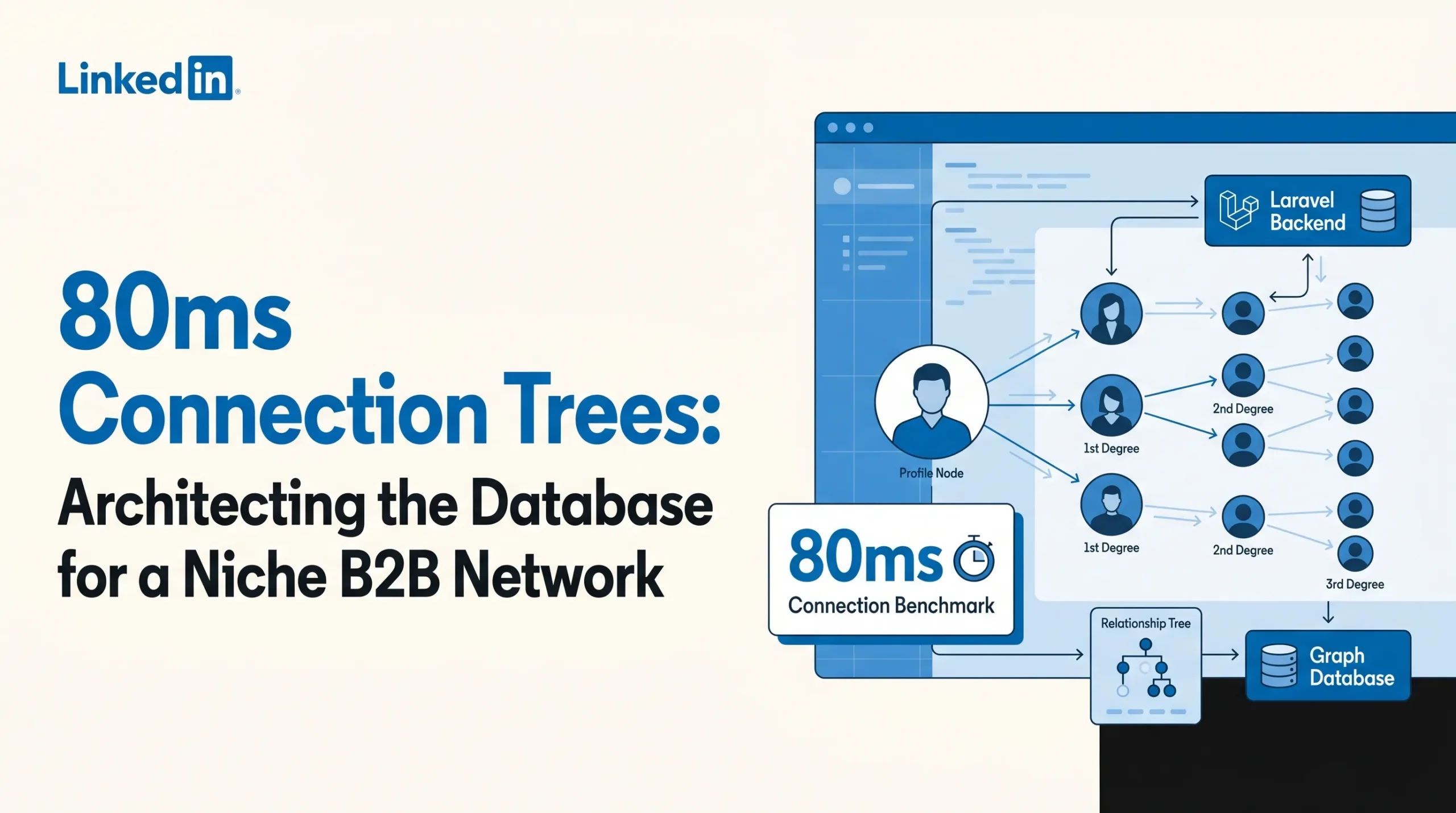
At Miracuves, we engineered a PHP/Laravel backend architecture capable of calculating 1st, 2nd, and 3rd-degree professional connections in under 80ms for a network of 50,000+ users. That benchmark matters because it proves something deeper than feature delivery. It proves that the platform can handle relational complexity without turning every feed load, profile view, or recommendation request into a database bottleneck.
This is where niche B2B network development becomes non-commodity.
You are not just building “a social network for professionals.” You are building a connection intelligence layer.
For founders planning a professional networking platform, Miracuves’ LinkedIn clone platform provides a stronger launch foundation than a generic script.
The Relational Nightmare: Why Standard Databases Choke on Connection Requests
A standard social app database usually starts with a familiar structure.
There is a users table. There may be a posts table, comments table, likes table, messages table, and a connections table. For a small user base, this structure works well enough.
The problem begins when the product asks a deceptively simple question:
“How is User A connected to User B?”
That one question can trigger multiple layers of relational lookup.
- A 1st-degree connection is direct. User A and User B are connected.
- A 2nd-degree connection means User A is connected to someone who is connected to User B.
- A 3rd-degree connection extends the graph again, looking through another layer of professional relationships.
On a small platform, the database can brute-force some of this logic. On a growing B2B network, brute force becomes dangerous.
The query is no longer asking for one row. It is asking the database to walk a relationship graph, remove duplicates, respect blocked users, filter inactive accounts, apply privacy rules, calculate mutual context, and return the result fast enough to support the interface.
That is where many generic professional network scripts fail.
They can store a connection. They cannot efficiently calculate a connection tree.
Read more: Beyond the Feed: Benchmarking Real-Time Messaging Latency in B2B Clone Apps
The Connection Tree Problem: 1st, 2nd, and 3rd-Degree Relationships
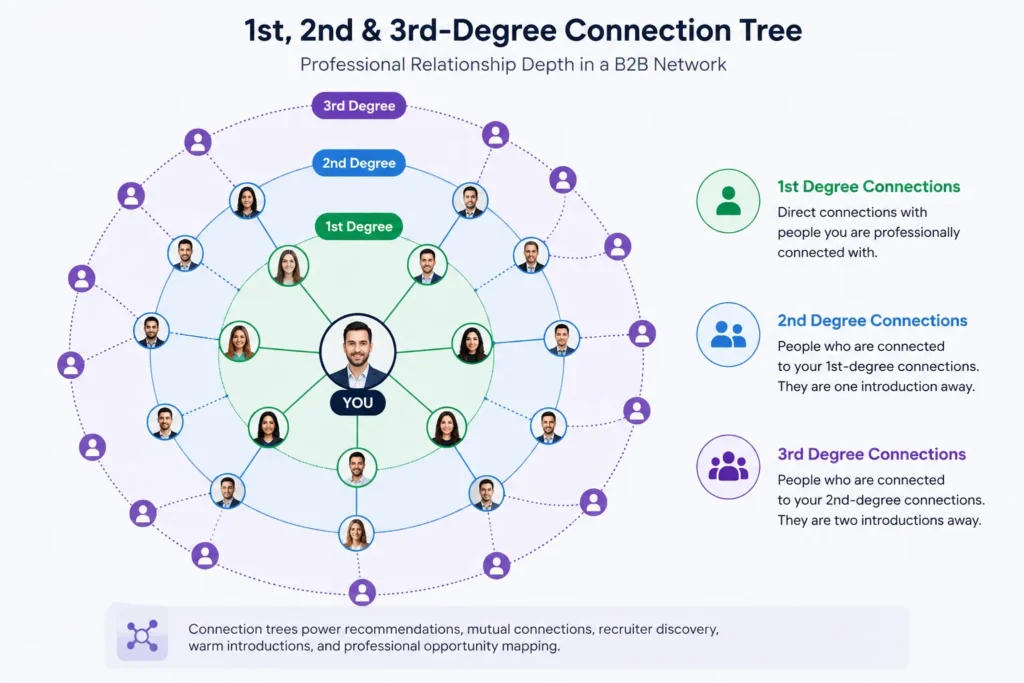
A connection tree is the structured relationship map around a user.
In a professional network, it typically answers questions like:
- Who is directly connected to this user?
- Who can this user reach through one trusted intermediary?
- Which professionals are relevant because they share mutual contacts, companies, skills, industries, or communities?
- Which recommendations should appear in the feed, search result, profile page, or “people you may know” module?
The mathematical challenge grows quickly because each connection multiplies the next lookup layer.
For example, imagine one professional has 400 direct connections. If each of those connections has 300 more connections, the second-degree layer can theoretically expose tens of thousands of relationship paths before filtering. Add a third-degree layer and the raw traversal size can become far larger than the number of users a founder expected the platform to handle in its early stage.
The architecture must control this expansion.
A professional networking app cannot afford to discover the connection graph from scratch every time someone opens the feed. It needs a deliberate strategy for storing, indexing, caching, limiting, and refreshing relationship data.
The goal is not to query everything.
The goal is to query the right relationship layer at the right time with the least possible database pressure.
Optimizing PHP/Laravel for Deep Query Graphs
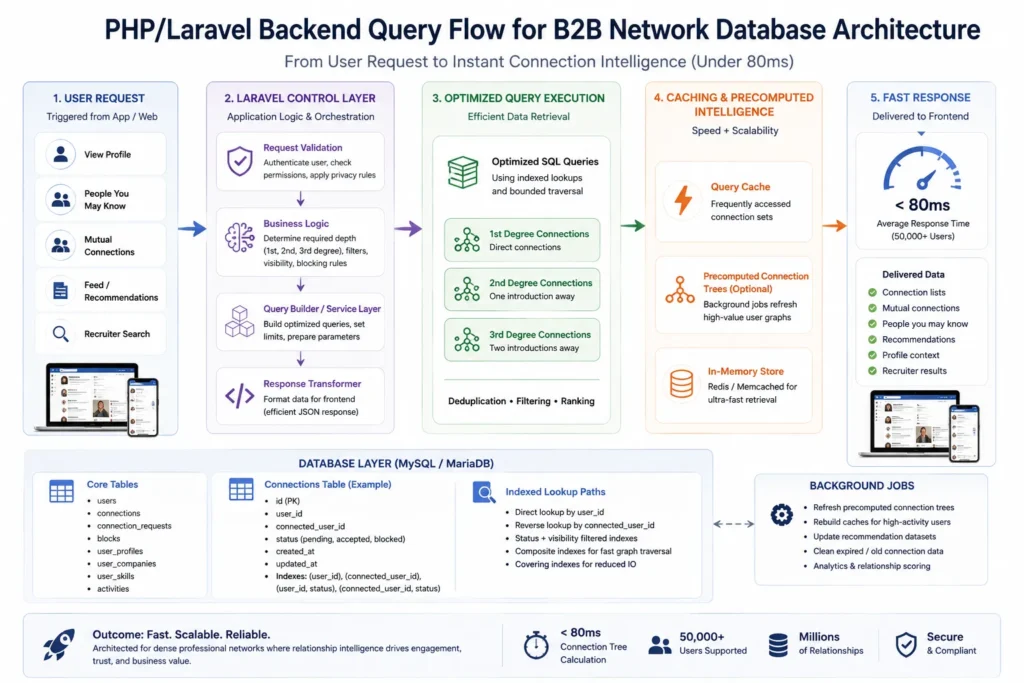
Laravel is often treated as an application framework, but for a data-heavy B2B network, it must be used as an architecture layer.
That distinction matters.
A generic script may rely too heavily on ORM relationships for every connection request. This is convenient during early development, but it becomes expensive when the platform needs to calculate 2nd- and 3rd-degree relationships repeatedly.
Miracuves approached the backend differently.
The connection system was modeled around controlled relational access, indexed lookup paths, and query flows designed specifically for professional graph traversal.
The architecture included four core principles.
1. Store Connections as Queryable Edges, Not Just User Actions
A connection request is an action. A confirmed connection is a relationship edge.
Those two concepts should not be treated the same way.
The backend needs to preserve request history, approval state, blocking rules, and audit context. But the live connection graph should be optimized for fast relationship lookup.
That means confirmed professional connections need to be stored in a way that supports directional and reverse lookup without forcing expensive scans.
For practical execution, this requires careful indexing around user identifiers, connected user identifiers, status, timestamps, and visibility rules.
The database should not have to wonder where the graph begins.
2. Separate Relationship Calculation From Feed Rendering
One of the biggest mistakes in professional network architecture is calculating too much during feed load.
Feed loading should be fast, predictable, and controlled.
If the application waits until a user opens the feed to discover every possible 2nd- and 3rd-degree connection, performance becomes inconsistent. Some users have small networks. Others have dense professional graphs. A single high-connectivity user can trigger a much heavier query path than expected.
Miracuves separated relationship calculation from feed rendering logic so the feed could rely on prepared or efficiently retrievable connection intelligence instead of raw graph exploration on every request.
That shift is important because user experience depends on the slowest common path, not the average path.
3. Use Laravel Where It Adds Control, Not Where It Adds Query Weight
Laravel can be extremely effective for professional network development when used with the right architectural discipline.
For simple profile, content, and admin workflows, Laravel keeps development clean and maintainable.
For deep connection-tree queries, a more deliberate approach is needed.
Miracuves used Laravel as the application control layer while keeping heavy relationship calculations closer to optimized database operations. This avoids the common trap of loading large relationship collections into application memory and then filtering them after the database has already done too much work.
The principle is simple:
Let Laravel orchestrate the workflow.
Let the database perform indexed retrieval.
Do not turn graph calculation into a PHP loop problem.
4. Build for Bounded Traversal, Not Endless Discovery
Professional networks do not need unlimited relationship traversal during every request.
Most business use cases are built around direct, second-degree, and third-degree relevance. Beyond that, the signal becomes weaker for most B2B workflows.
A bounded connection tree keeps performance predictable.
The backend can limit traversal depth, remove duplicate paths, exclude blocked or inactive accounts, and prioritize relationship paths with stronger business meaning.
For example, a 2nd-degree connection from the same industry may be more useful than a 3rd-degree connection with no shared context. A niche community founder does not need to show every possible connection. They need to show the most relevant connection paths.
This is where architecture and product strategy meet.
The 80ms Benchmark for Instant Feed Loading
The strongest test of professional network architecture is not whether the platform can display users.
It is whether the platform can display relationship-aware content quickly.
In Miracuves’ benchmark, the PHP/Laravel backend calculated 1st, 2nd, and 3rd-degree professional connections in under 80ms for a network of 50,000+ users.
That number matters because connection intelligence affects multiple high-frequency product surfaces:
- Feed ranking
- Profile context
- People recommendations
- Mutual connection labels
- Recruiter discovery
- Job and candidate matching
- Messaging permissions
- Community discovery
- Search relevance
- Admin analytics
If connection calculation is slow, the entire product feels slow.
A user may not know whether the delay came from the database, API, feed service, or frontend. They only know the platform feels heavy.
For enterprise architects, the 80ms benchmark is a signal that the backend is not relying on naive relationship lookup. It suggests that the data model, indexes, query paths, and application workflow were designed around the real bottleneck.
For niche community founders, it means the product can support deeper professional relevance without forcing a rebuild as the member base grows.
Why Generic Professional Network Scripts Collapse Under Relationship Load
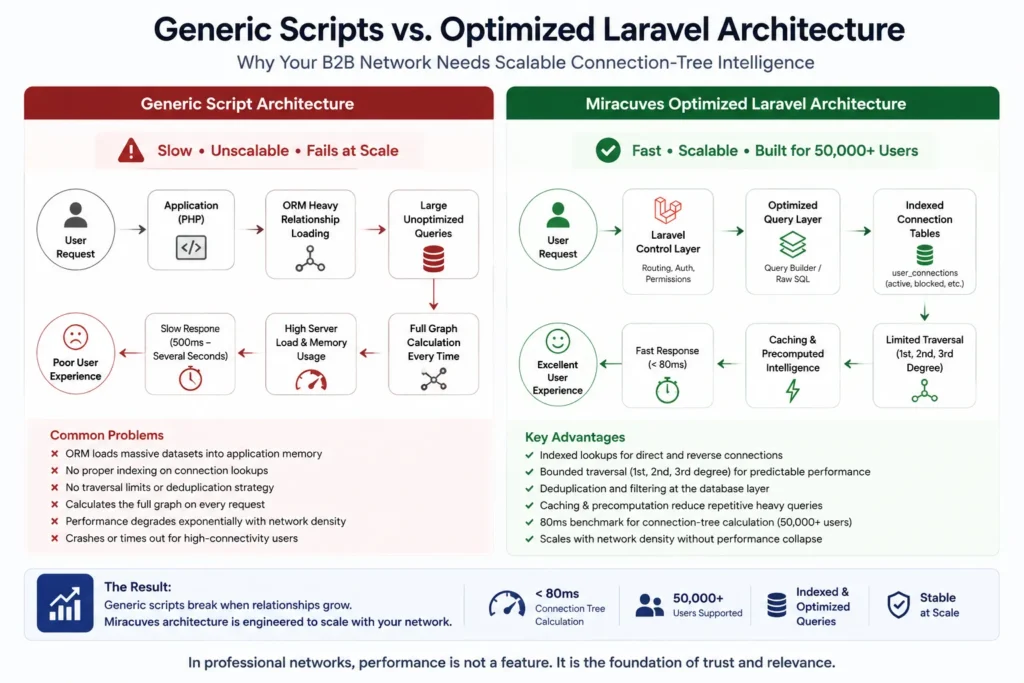
Many generic scripts can launch a professional network interface.
They can create profiles, follow users, send connection requests, publish posts, and add messaging.
That is not enough.
The real test begins when the network becomes dense.
A dense network has overlapping connections, repeated mutual contacts, active communities, recruiter searches, recommendation requests, and content feeds that depend on who knows whom.
Generic scripts often struggle because they are built around feature checklists instead of relationship architecture.
The common failure patterns include:
- Connection tables without the right compound indexes
- ORM-heavy relationship loading across large user sets
- No separation between connection calculation and feed rendering
- No strategy for deduplicating second- and third-degree paths
- No performance boundary for high-connectivity users
- No caching or refresh logic for repeated connection lookups
- No clean admin visibility into network behavior
- No scalable approach to mutual connections and recommendations
These problems may not appear during a basic product demo. They usually appear when real users start building real relationship graphs, creating mutual connections, joining communities, and triggering repeated recruiter or recommendation queries.
That is why a B2B professional network should not be evaluated only by screen count. It should be evaluated by how the backend behaves when the connection graph becomes large, dense, and commercially important.
Read More: Reasons Startups Choose Our LinkedIn Clone Over Custom Development
What This Means for Enterprise Architects and Niche Community Founders
Enterprise architects and niche community founders care about different outcomes, but they share one concern: platform durability.
An enterprise architect wants to know whether the system can support complex relational logic without becoming fragile.
A niche community founder wants to know whether the product can grow beyond early adopters without losing speed, relevance, or trust.
The connection-tree architecture supports both priorities.
For enterprise teams, it provides a cleaner foundation for performance tuning, query monitoring, data governance, and future feature expansion.
For founders, it supports more useful product experiences such as warm introductions, expert discovery, recruiter workflows, member recommendations, and industry-specific networking.
This is especially important for niche B2B communities.
A general social network can survive with broad engagement signals. A niche professional network must deliver relationship relevance.
Members return when the platform helps them find useful people faster.
That depends on database architecture as much as UI design.
Feature Layer vs Architecture Layer in a B2B Professional Network
A professional networking platform has visible features and invisible architecture.
Founders often compare vendors using visible features because they are easier to understand. But enterprise-grade performance usually depends on the invisible layer.
| Feature Layer | Architecture Layer | Why It Matters |
|---|---|---|
| User profiles | Indexed user identity and metadata structure | Helps search, filtering, and discovery stay fast |
| Connection requests | Relationship edge modeling | Supports direct, reverse, and mutual lookup |
| People recommendations | Connection-tree calculation | Powers relevant 2nd- and 3rd-degree discovery |
| Feed | Relationship-aware ranking logic | Makes content feel relevant instead of random |
| Messaging | Permission and relationship rules | Controls who can contact whom |
| Recruiter search | Filtered professional graph queries | Helps recruiters discover candidates faster |
| Admin dashboard | Network visibility and controls | Helps operators manage growth and abuse |
| Privacy settings | Conditional visibility rules | Protects user trust and platform credibility |
This is why “we build LinkedIn-like apps” is not a strong enough claim.
The better question is:
Can the platform calculate relationship context quickly when the network becomes active?
For a wider overview of professional networking platform planning, explore the process of building an app like LinkedIn.
Read More: How to Build an App Like LinkedIn – Full Stack Developers Guide
Where PHP/Laravel Still Makes Sense for Professional Network Architecture
Some enterprise teams assume that complex graph logic automatically requires a graph database from day one.
That is not always true.
A graph database can be useful for certain workloads, especially where graph traversal is the core product across many layers. But many niche B2B networks can perform extremely well with a carefully optimized relational model, strong indexing, controlled traversal depth, and Laravel-managed application logic.
The advantage of a PHP/Laravel backend is practical execution.
Laravel can support clean admin workflows, API development, authentication, permissions, dashboards, job queues, and integration logic while still allowing optimized query design for deeper relationship calculations.
The key is not the framework alone.
The key is how the framework is used.
A poorly designed Laravel backend can become slow. A well-designed Laravel backend can power complex professional network workflows with strong performance and maintainability.
Miracuves’ connection-tree benchmark demonstrates that a PHP/Laravel foundation can support serious relational complexity when the database architecture is engineered correctly.
Founder Decision Signals Before Building a Niche B2B Network
Founder Decision Signals
Relationship Depth
If your platform needs mutual connections, warm introductions, recruiter discovery, or expert recommendations, the backend must support 2nd and 3rd-degree connection logic.
Network Density
A niche B2B network may have fewer users than a consumer app, but dense professional relationships can create heavier query pressure.
Feed Speed
Connection intelligence must support fast feed loading, profile context, recommendations, and search without forcing the database to recalculate everything on every request.
Operational Control
Admins need visibility into users, connections, reports, blocked accounts, recruiter actions, and community activity as the network grows.
Before investing in a professional networking platform, founders should evaluate the product through technical decision signals, not only feature lists.
The first signal is relationship depth.
If the platform only needs followers and content, a simple social architecture may work. If it needs warm introductions, mutual contacts, recruiter discovery, expert recommendations, or deal-network mapping, the backend must support connection-tree logic.
The second signal is density.
A niche B2B network may have fewer users than a consumer social app, but its relationships can be more meaningful and more densely connected. A 50,000-user professional network can create a serious query challenge if members are active, connected, and segmented by industries, roles, companies, and communities.
The third signal is monetization.
Recruiter tools, premium discovery, sponsored visibility, job matching, expert access, and community subscriptions all depend on trust and relevance. Weak relationship architecture limits monetization because the platform cannot confidently surface the right people at the right moment.
The fourth signal is operational control.
Admins need visibility into users, connection patterns, reported accounts, blocked behavior, recruiter actions, community activity, and platform health. Without a strong backend control layer, founders depend on developers for every operational decision.
Miracuves Perspective: Build a Professional Network That Can Handle Real Relationships
A niche B2B network is not valuable because it looks like LinkedIn.
It is valuable because it understands relationships inside a specific market.
That market may be healthcare professionals, logistics operators, investors, founders, legal experts, real estate brokers, creators, recruiters, or enterprise partners.
The interface may look familiar, but the architecture should be designed around the community’s relationship logic.
Miracuves helps founders and businesses launch white-label, source-code-owned professional networking platforms with admin control, branded workflows, and scalable backend architecture. For teams planning a LinkedIn clone app or a niche B2B network, the stronger decision is not simply choosing the fastest interface build. It is choosing a product foundation that can support connection intelligence as the network grows.
Explore Miracuves’ LinkedIn clone platform here
For broader solution planning, you can also review Miracuves solutions hub
Mistakes Founders Should Avoid When Building Connection-Heavy Networks
Mistakes Founders Should Avoid
Treating Connections Like Simple Follows
Professional connections carry trust, permissions, visibility, and mutual context. A simple follower-style model can limit future recruiter, recommendation, and introduction workflows.
Calculating the Full Graph on Every Request
Repeated graph discovery during feed load creates unpredictable performance, especially when high-connectivity users join the platform.
Choosing Feature Count Over Backend Design
A professional network with many screens but weak relationship logic becomes a directory. The backend must power discovery, relevance, and trust.
Many generic scripts are useful for a quick demo, but niche B2B networks usually need custom workflows. Source-code ownership matters because the platform may need industry-specific connection rules, monetization logic, and enterprise integrations over time.
Read More: Top 5 Mistakes Startups Make When Building a LinkedIn Clone
Final Thoughts: In B2B Networks, the Database Is the Product
The real complexity in a professional networking platform is not the profile page.
It is the relationship layer behind the profile page.
A niche B2B network succeeds when users can discover the right people, understand how they are connected, and act on trusted professional context. That experience depends on fast, accurate, and scalable connection-tree architecture.
Miracuves’ 80ms benchmark for calculating 1st, 2nd, and 3rd-degree connections across 50,000+ users shows why this category should not be treated as a commodity app build.
For founders and enterprise architects, the takeaway is clear:
Do not only ask whether a vendor can build a professional network.
Ask whether their backend can calculate the relationships that make the network valuable.
To discuss your professional networking platform, contact Miracuves here
FAQs
What is a connection tree in a professional networking app?
A connection tree is the structured map of how one user is connected to others across direct and indirect relationship layers. In a B2B network, this usually includes 1st-degree direct connections, 2nd-degree mutual connections, and 3rd-degree extended professional relationships.
Why do 2nd and 3rd-degree connections slow down social network databases?
They slow down databases because each relationship layer multiplies the number of possible lookup paths. Without indexing, traversal limits, deduplication, and optimized query design, the database may scan too many connection records during feed, profile, or recommendation requests.
Can PHP/Laravel handle a professional networking platform?
Yes, PHP/Laravel can support professional networking platforms when the backend is architected correctly. The key is to avoid ORM-heavy graph traversal for deep relationship queries and use Laravel as the workflow layer around optimized database access.
Is a graph database required for a niche B2B network?
Not always. Some graph-heavy products may benefit from a graph database, but many niche B2B networks can perform well with a carefully optimized relational model, strong indexes, bounded traversal depth, and efficient caching or precomputation strategies.
What makes a B2B professional network different from a normal social app?
A normal social app may prioritize content and engagement. A B2B professional network must prioritize relationship trust, professional relevance, mutual context, recruiter discovery, warm introductions, and industry-specific member discovery.
Why do generic LinkedIn clone scripts fail at scale?
Generic scripts often focus on visible features such as profiles, feeds, jobs, and messaging. They may not be engineered for dense relationship graphs, 2nd- and 3rd-degree connection calculations, mutual connection logic, or high-speed recommendation queries.
What should enterprise architects check before choosing a professional network platform?
They should evaluate the data model, relationship indexing strategy, query depth limits, caching approach, admin controls, privacy rules, API structure, and how the platform calculates connection intelligence under load.
How does Miracuves support niche professional network development?
Miracuves helps founders and businesses build white-label, source-code-owned professional networking platforms with admin dashboards, branded workflows, and scalable backend architecture for relationship-heavy use cases.