


Building a professional networking platform is not only about creating profiles and letting users connect. The real product challenge is designing a system where identity, relationships, content, jobs, messaging, search, and governance work together without breaking the user experience.
A founder may start with a simple idea: professionals create profiles, connect with each other, post updates, apply for jobs, and message relevant people. But behind that simple experience sits a complex architecture. Profile data must remain structured. Connections need graph logic. Feeds need ranking rules. Job workflows need applicant tracking. Messaging must stay reliable. Search must be fast. Admin controls must protect the platform from spam, abuse, fake profiles, and low-quality activity.
This guide explains the architecture of a professional networking platform from a founder and product-planning perspective. It is designed for startups, agencies, communities, associations, recruiters, and business owners who want to understand what must be planned before launching a networking product.
Key Takeaways
- Professional networking platform architecture depends on six major systems: profiles, social graph, feeds, jobs, messaging, and search.
- The profile layer is the identity foundation. If profile data is weak, jobs, recommendations, search, and trust signals become weak too.
- The social graph should support connections, follows, invitations, blocked users, company relationships, and permission-based visibility.
- Feeds, jobs, and search must be designed around relevance, not just chronological activity.
- Admin controls, moderation, analytics, and monetization logic should be planned early because they decide whether the platform can scale as a business.
- Miracuves helps founders move faster with ready-made, white-label app foundations that can be customized for professional networking, hiring, and community-led business models.
Why Professional Networking Platforms Need Strong Architecture From Day One
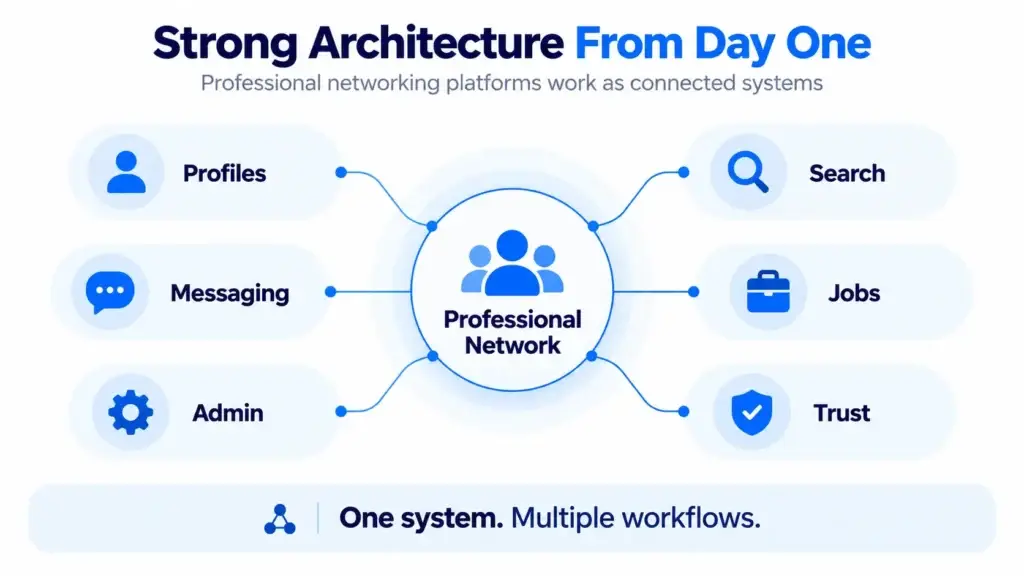
A professional networking platform is different from a casual social media app. Users are not only sharing content. They are building credibility, discovering opportunities, hiring talent, searching for experts, validating skills, and forming business relationships. That means every product layer must support trust.
For example, a weak profile system does not only affect user presentation. It affects search quality, recruiter filtering, recommendation accuracy, connection relevance, and job matching. A weak messaging system does not only create communication issues. It can damage lead generation, hiring conversations, and user retention. A weak admin panel does not only create operational inconvenience. It makes moderation, abuse handling, monetization, and reporting harder.
This is why founders should think in systems, not only features. The right question is not “Can users create profiles?” The better question is “Can profile data power search, jobs, feeds, messaging, permissions, analytics, and monetization?”
Core Architecture Layers of a Professional Networking Platform
A scalable networking platform usually needs these core layers:
Professional Networking Platform Architecture Layers
| Architecture Layer | What It Controls | Founder Impact |
|---|---|---|
| Profile Layer | User identity, work history, skills, education, credentials, privacy, verification | Creates trust and powers search, recommendations, and job matching |
| Social Graph | Connections, follows, invitations, blocks, company relationships, network distance | Controls how users discover people, content, jobs, and opportunities |
| Feed System | Posts, reactions, comments, shares, ranking, visibility, spam filtering | Drives engagement and repeat visits |
| Jobs and Hiring | Job posts, applications, recruiter workflows, candidate filters, saved jobs | Creates strong monetization potential for recruiters and companies |
| Messaging | Direct messages, permissions, notifications, message requests, abuse controls | Supports business conversations, recruiting, sales, and community interaction |
| Search and Discovery | People search, job search, company search, content search, filters, indexing | Helps users find value even before the network becomes very large |
| Admin and Governance | User control, content moderation, reports, analytics, roles, subscriptions | Gives the platform operator control over quality, revenue, and trust |
Profile Architecture: The Identity Foundation of the Platform
The profile system is the foundation of a professional networking platform. It should not be treated as a basic user bio page. It is a structured identity record that supports credibility, discovery, hiring, recommendations, and platform trust.
A strong profile architecture should include personal details, professional headline, work experience, education, skills, certifications, portfolio links, location, availability, preferred industries, company affiliations, endorsements, recommendations, and privacy controls. For some platforms, profile verification may also be important, especially for professional associations, alumni communities, industry networks, healthcare communities, legal networks, or expert marketplaces.
The profile database should separate structured fields from flexible fields. Structured data helps with search and filtering. Flexible sections allow users to express themselves. For example, “years of experience,” “location,” “skills,” and “job title” should be structured because they support search. A summary section can remain flexible because it supports personal branding.
Important Profile Architecture Questions
- Which profile fields are mandatory during onboarding?
- Which fields should be searchable?
- Which sections should support visibility settings?
- Should users be able to verify credentials?
- Should companies, recruiters, or admins approve certain profile claims?
- How will profile completeness influence ranking, recommendations, or trust?
Founders often underestimate profile architecture. But in a professional network, profile quality decides whether the platform feels credible. A thin profile system creates a thin network. A structured profile system creates better discovery, better hiring, better engagement, and stronger monetization potential.
Social Graph Architecture: Connections, Follows, and Network Distance
The social graph defines relationships between users. It decides who can connect, follow, message, view content, see jobs, receive recommendations, and appear in search results. This layer is one of the most important technical and strategic decisions in a professional networking platform.
A professional network may use multiple relationship types. A connection is usually mutual. A follow can be one-way. A company affiliation links a user to an organization. A recruiter relationship may give a company user access to applicant data. A blocked relationship prevents unwanted contact. A saved profile may help recruiters or sales users build lists. Each of these relationships requires different permission rules.
Connection Graph vs. Follow Graph
A connection graph is useful when trust and mutual relationships matter. A follow graph is useful when users want to consume content from experts, companies, or creators without requiring a mutual connection. Many professional platforms benefit from both.
The graph should also support network distance. First-degree connections are direct relationships. Second-degree connections are people connected through mutual contacts. This becomes useful for recommendations, search ranking, introductions, and trust signals.
For founders, the decision is strategic: should the platform feel like a closed professional community, an open expert network, an industry directory, a recruiter database, or a hybrid network? The answer affects onboarding, privacy, search, messaging, and monetization.
Feed Architecture: Turning Professional Activity Into Engagement
The feed is where users return to the platform. It helps them discover posts, industry updates, job changes, company announcements, expert opinions, events, and opportunities. But a professional feed should not work like a casual entertainment feed. Relevance, credibility, and context matter more than volume.
A professional feed system should support posts, images, documents, links, reactions, comments, reposts, mentions, hashtags, topic tags, company updates, and moderation signals. The feed ranking logic can consider connection strength, content freshness, profile relevance, industry match, engagement quality, and user interests.
Chronological Feed vs. Ranked Feed
A chronological feed is easier to build, but it can become noisy as the platform grows. A ranked feed can improve relevance, but it needs more thoughtful data modeling. Many early-stage platforms start with a simple feed and later introduce ranking based on engagement, user preferences, and network relationships.
Founders should avoid designing the feed only as a posting wall. The feed can become a business engine when it supports hiring updates, expert content, company visibility, paid promotions, premium posts, community announcements, and event discovery.
If your platform is also planned as a wider social product, Miracuves’ social networking app development category can help you understand how feeds, profiles, messaging, and moderation fit across different network models.
Jobs Architecture: Job Posts, Applications, Recruiter Workflows, and Matching
Jobs can turn a professional network from a passive community into a monetizable business platform. But a job module is more than a list of openings. It should support employers, recruiters, applicants, filters, saved jobs, application tracking, candidate shortlisting, and admin oversight.
A strong job architecture includes company profiles, job categories, location filters, experience levels, salary ranges, work type, application questions, resume uploads, saved candidates, status tracking, and notifications. Recruiters may need a dashboard to manage job posts, view applicants, shortlist candidates, reject applications, and communicate with potential hires.
Professional job search should also connect with the profile system. If a user’s profile already includes skills, experience, education, location, and availability, the job module can recommend relevant opportunities. This reduces friction because users do not have to re-enter the same information repeatedly.
For deeper job search planning, you can connect this article to Miracuves’ guide on advanced job search in professional networking platforms, especially when explaining skills, experience, location, and candidate-matching filters.
Messaging Architecture: Permissions, Conversations, Notifications, and Abuse Controls
Messaging is one of the most sensitive modules in a professional networking platform. It supports hiring, lead generation, mentoring, partnerships, sales conversations, and community engagement. But without permission rules, it can quickly become a spam channel.
The messaging architecture should define who can message whom. Can any user message another user? Can only connected users message each other? Can recruiters send message requests? Can premium users contact people outside their network? Can admins monitor abuse reports without violating user privacy expectations?
Messaging Features Founders Should Plan
- One-to-one conversations
- Message requests from non-connections
- Recruiter outreach limits
- Blocked user controls
- Unread message counts
- Email and push notifications
- Attachment support where relevant
- Spam detection and abuse reporting
- Admin review workflows for reported conversations
Messaging can also become part of the monetization model. For example, platforms can offer limited free outreach and paid recruiter or business messaging credits. However, this must be balanced carefully. Too many restrictions can reduce engagement, while unlimited messaging can create spam.
Search Architecture: People, Jobs, Companies, Content, and Filters
Search is one of the highest-value systems in a professional networking platform. It helps users find people, jobs, companies, posts, groups, events, and industry content. Search quality often decides whether users feel the platform is useful.
A professional search system should support keyword search, structured filters, sorting, saved searches, typeahead suggestions, location filters, industry filters, skills filters, experience filters, company filters, and role-based visibility. Recruiters may need candidate filters. Job seekers may need saved job alerts. Sales users may need company and lead discovery. Admins may need user and content search for governance.
Search should be planned around both database structure and indexing. Basic search may work for early-stage products, but larger platforms often need dedicated search indexing for faster filtering and better relevance. The platform should also decide which fields are public, private, searchable, or admin-only.
For a more technical database perspective, the supporting article on professional social graph database schema can help editors connect this architecture guide to deeper backend planning.
Company Page Architecture: Organizations, Recruiters, Employees, and Brand Presence
Company pages add another layer to a professional networking platform. They allow organizations to publish updates, list jobs, show employees, build credibility, and attract candidates or business leads. But company pages also introduce permission complexity.
The architecture should define who can create a company page, who can claim ownership, who can manage posts, who can publish jobs, who can view analytics, and how employee associations are verified. For professional communities, company pages can also support vendor listings, partner directories, industry groups, and sponsored visibility.
From a business perspective, company pages can support monetization through premium listings, recruiter plans, promoted posts, featured employer branding, analytics access, and job posting packages.
Admin Dashboard Architecture: The Control Layer Founders Should Not Ignore
The admin dashboard is where the platform operator manages the business. It should not be treated as an afterthought. For a professional networking platform, admin control affects user quality, moderation, subscriptions, job approvals, content governance, reporting, analytics, and support operations.
A useful admin dashboard should include user management, profile review, company approval, job post moderation, reported content, blocked accounts, role-based access, subscription control, revenue tracking, notifications, platform settings, and analytics. If the platform includes premium recruiter or business accounts, the admin panel should also manage plans, credits, invoices, and entitlements.
Admin architecture becomes even more important when a platform serves a niche community. For example, an alumni network may need batch user imports. A professional association may need credential verification. A recruiter-led network may need company approvals and applicant tracking. A private business community may need invite-only access and member review.
Security, Privacy, and Moderation Architecture
Professional networks carry sensitive user data: job history, contact information, resumes, messages, company relationships, and sometimes credentials. Security should be planned as part of the product foundation, not added later.
Important controls include encrypted data transfer, secure authentication, role-based access control, audit logs, admin permissions, privacy settings, abuse reporting, blocked users, content moderation, suspicious activity flags, and secure API integration. If the platform supports payments, subscriptions, or recruiter credits, secure payment gateway integration and payment event logs are also important.
Moderation architecture should cover fake profiles, spam posts, low-quality job listings, abusive messages, impersonation, and misleading professional claims. A practical moderation workflow separates user reports, admin review, action history, and appeal handling.
You can internally connect this section to Miracuves’ guide on professional networking app safety and trust where relevant, especially if the editorial goal is to strengthen the trust and governance cluster.
Monetization Architecture: Turning Platform Utility Into Revenue
A professional networking platform can monetize in several ways, but revenue should be connected to user value. The strongest monetization usually comes from recruiters, companies, sales users, premium professionals, and sponsored visibility rather than forcing every member to pay from day one.
Common Monetization Modules
- Recruiter subscriptions
- Paid job postings
- Featured employer listings
- Premium profile visibility
- Message credits or outreach limits
- Company page upgrades
- Sponsored posts or promoted content
- Candidate database access
- Industry directory subscriptions
- Learning or certification marketplace fees
The architecture should support plans, permissions, feature limits, invoices, usage tracking, and admin control. For example, a free user may access basic profiles and feeds. A recruiter may post jobs and contact candidates. A business account may access company analytics and promoted content. A premium professional may get profile boosts, advanced filters, or direct outreach options.
For editors building a monetization content cluster, the article on professional networking platform business models can be used as a natural next step from this section.
Build From Scratch vs. Ready-Made Platform Foundation
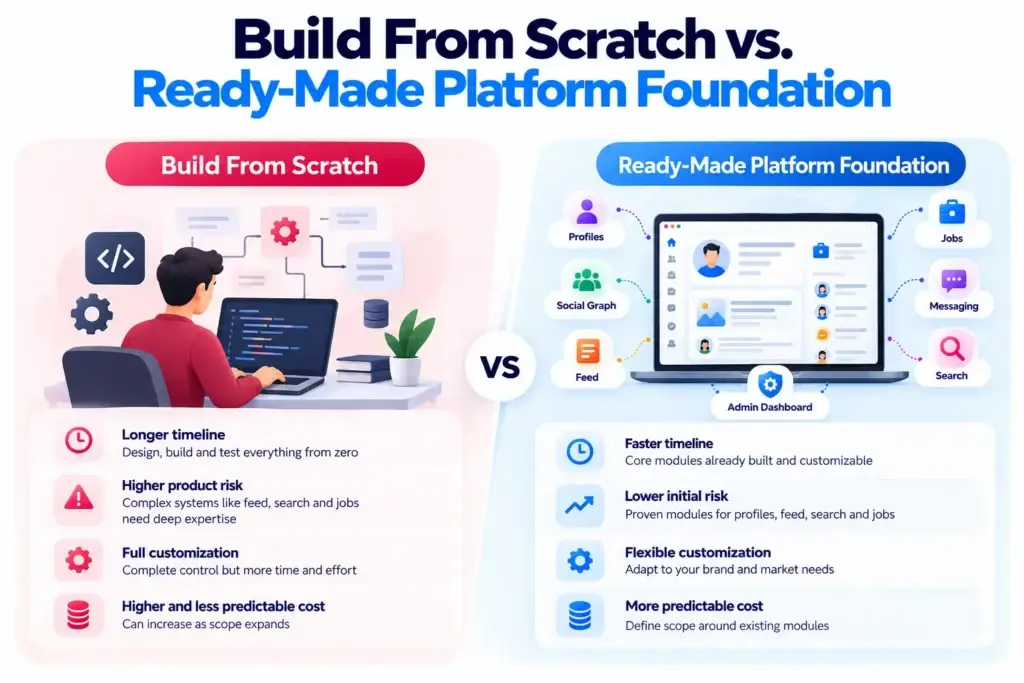
Founders usually face two practical paths. They can build every module from scratch, or they can start with a ready-made platform foundation and customize it around their market. The right choice depends on budget, timeline, internal technical capability, uniqueness of workflows, and go-to-market urgency.
Building from scratch gives full control, but it also increases planning time, development time, testing effort, and launch risk. A ready-made foundation can help founders move faster when the required modules are already known: profiles, social graph, feed, jobs, messaging, search, admin dashboard, subscriptions, and moderation.
Custom Build vs. Ready-Made Professional Network Foundation
| Decision Area | Custom Build From Scratch | Ready-Made Foundation |
|---|---|---|
| Timeline | Longer because every workflow is designed, built, tested, and refined from zero | Faster because core modules already exist and can be customized |
| Product Risk | Higher if the team has not built networking, feed, search, and job systems before | Lower initial risk when the foundation already includes proven platform modules |
| Customization | Highly flexible but time-intensive | Flexible when the source code and configuration layers are available |
| Cost Control | Harder to control if scope keeps expanding | More predictable when launch scope is defined around existing modules |
| Best For | Highly unique workflows with large budgets and longer timelines | Founders who want faster validation with profiles, jobs, feeds, messaging, and admin control |
If your goal is to launch faster without rebuilding every profile, feed, job, messaging, and search module from zero, Miracuves’ ready-made professional networking platform can be explored as a practical foundation. It is especially relevant for founders who want white-label branding, source-code ownership, admin control, and faster deployment.
Founder Decision Signals Before You Build
Speed
If your market opportunity is time-sensitive, starting with a launch-ready foundation can help you test demand faster instead of spending months building core modules from zero.
Cost
If your budget is limited, prioritize the systems that create value early: profiles, search, jobs, messaging, feed, and admin control. Avoid overbuilding low-use features before validation.
Scalability
If your platform will support recruiters, companies, creators, or premium users, plan roles, permissions, subscriptions, and data structure early. Retrofitting these later is harder.
Market Fit
If you are targeting a niche network, focus on the workflow that makes your community valuable: hiring, credentials, alumni relationships, expert discovery, partnerships, or industry visibility.
Mistakes Founders Should Avoid When Planning a Professional Network
Mistakes Founders Should Avoid
Building a feed before fixing profile quality
A professional feed depends on trusted profiles, relevant connections, and meaningful activity. If the profile layer is weak, feed relevance becomes weak too.
Treating search as a basic keyword box
Professional search needs filters, structured data, saved searches, and role-based visibility. A basic search bar may not support recruiters, companies, or serious users.
Ignoring messaging permissions
Open messaging can create spam. Over-restricted messaging can reduce networking value. The platform needs balanced permission rules, message requests, and abuse controls.
Adding monetization too late
Subscriptions, recruiter plans, job credits, and premium features require entitlement logic. If this is not planned early, revenue features may require expensive rework later.
Underestimating admin operations
Professional networks need moderation, approvals, analytics, reporting, role control, and dispute handling. Without admin control, platform quality becomes difficult to manage.
How Miracuves Helps Founders Launch Professional Networking Platforms Faster
Miracuves helps founders, startups, agencies, and businesses launch digital products faster using ready-made, white-label, source-code-owned app foundations. For professional networking products, this can include the core systems that usually take the longest to plan and build: user profiles, connection logic, feeds, jobs, messaging, search, admin control, monetization, and platform governance.
The advantage is not about copying another platform blindly. The advantage is starting with a proven product foundation and customizing it around a specific market: alumni networks, recruiter communities, professional associations, industry directories, private business communities, skill-based networks, or niche hiring platforms.
Where relevant, Miracuves can support a 6-day launch path for ready-made solutions, subject to final scope, branding, integrations, and customization requirements. This helps founders validate faster while still keeping room for long-term product customization.
Final Thoughts: Architecture Decides Whether the Network Can Scale
A professional networking platform succeeds when its systems work together. Profiles should support search. Search should support jobs. Jobs should connect with messaging. Messaging should respect permissions. Feeds should create useful engagement. Admin controls should protect quality. Monetization should match real user value.
Founders should avoid thinking of this product as a collection of isolated features. A professional network is an ecosystem. The stronger the architecture, the easier it becomes to create trust, improve discovery, support recruiters, grow communities, and build a revenue model around professional value.
If you are planning a niche professional network, the smartest starting point is clarity: know which users you serve, which workflows matter most, and which architecture layers must be ready from the beginning.
FAQs
What is professional networking platform architecture?
Professional networking platform architecture is the technical and product structure behind profiles, connections, feeds, jobs, messaging, search, admin controls, monetization, and moderation. It defines how users interact, how data is stored, how opportunities are discovered, and how the platform operator manages growth.
What are the most important modules in a professional networking platform?
The most important modules are user profiles, social graph, activity feed, job listings, recruiter workflows, messaging, notifications, search, company pages, admin dashboard, subscriptions, analytics, and moderation controls.
Why is the social graph important in a professional networking app?
The social graph controls relationships between users. It determines who can connect, follow, message, discover content, view profiles, and receive recommendations. A strong graph helps the platform create relevant networking and discovery experiences.
How should job search be designed in a professional networking platform?
Job search should support filters such as keyword, skill, location, experience, industry, work type, salary range, and company. It should connect with profile data so users can discover relevant jobs and recruiters can find suitable candidates.
Should a professional networking platform include messaging from day one?
Messaging is usually important, but it should include permission rules. Founders should decide whether users can message everyone, only connections, recruiters, premium users, or approved contacts. Message requests, blocking, reporting, and notifications should also be planned early.
How can a professional networking platform make money?
Common monetization models include recruiter subscriptions, paid job postings, premium profiles, sponsored posts, company page upgrades, message credits, candidate database access, featured listings, and professional community subscriptions.
Is it better to build a professional networking platform from scratch or use a ready-made foundation?
Building from scratch may suit highly unique workflows with larger budgets and longer timelines. A ready-made foundation can be better for founders who want to validate faster with core modules such as profiles, feeds, jobs, messaging, search, and admin control already available.
Miracuves is an independent software development company. We are not affiliated with, connected to, sponsored by, or endorsed by any company or product named in this article.
Terms such as “X Clone” are used descriptively. It is how the software industry refers to building a platform with functionality comparable to a known service, and how clients search for it.
The entire design and codebase of our products is built by our own team. Our products contain no code, design, graphics, or content originating from any third-party website or applications.
All third-party names and marks referenced in this article are the property of their respective owners, referenced solely to identify the services discussed.



