


Launching a professional networking platform sounds simple from the outside. You create profiles, add connections, enable posting, include messaging, and maybe add jobs. But professional networks do not grow because the screens look familiar. They grow when members see a clear reason to build identity, connect with the right people, trust the platform, and return for career, hiring, sales, or community value.
That is where many founders make expensive mistakes. They focus too early on surface-level features and too late on user behavior, trust, monetization, moderation, and long-term platform control. A professional networking product is not just a social media app with business profiles. It is an identity-driven ecosystem where every profile, connection, message, post, job, company page, and admin action affects credibility.
This guide explains the key mistakes founders should avoid before launching a professional networking platform. The goal is not to discourage you from building. The goal is to help you launch with better positioning, cleaner product logic, and fewer avoidable rebuilds.
Key Takeaways
- Professional networking platform mistakes usually happen when founders copy visible features without understanding member motivation, trust, and network behavior.
- A narrow niche often works better than a broad professional network because members need a strong reason to join and participate early.
- Feature overload can delay launch, increase cost, and make the first version harder for users to understand.
- Trust, moderation, profile quality, and admin control should be planned from the beginning, not added after problems appear.
- Miracuves helps founders move faster with ready-made and white-label professional networking app solutions designed for branding, control, and faster validation.
Why Professional Networking Platforms Fail When Founders Copy Instead of Position
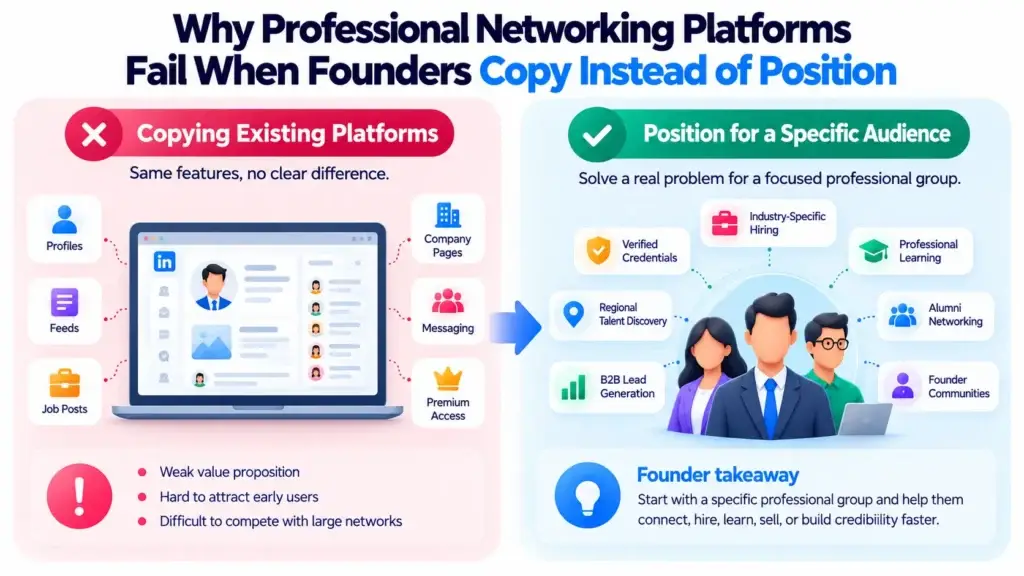
The biggest mistake is assuming that a professional networking platform succeeds because it has the same visible parts as a large professional network: profiles, feeds, job posts, company pages, recommendations, messaging, and premium access. Those features matter, but they are not the real strategy.
The real question is: why should a professional join your platform when general networks already exist?
A founder building for “all professionals” usually enters the market with a weak value proposition. Early users do not join empty platforms just because another professional network exists. They join when the platform solves a specific problem better than broad networks can.
That problem could be industry-specific hiring, verified credentials, alumni networking, regional talent discovery, B2B lead generation, professional learning, association management, founder networking, creator-led career communities, or niche job matching. The narrower the first audience, the easier it becomes to design relevant profiles, useful filters, targeted content, and monetization around a real need.
Founder takeaway
Do not begin with “we are building a professional network for everyone.” Begin with “we are helping this specific professional group connect, hire, learn, sell, or build credibility faster.” That positioning will shape your features, onboarding, monetization, and community growth strategy.
Mistake 1: Launching Without a Clear Professional Niche
A professional networking platform needs early density. If the first members do not find relevant people, useful posts, meaningful jobs, or credible profiles, they will not return. This is why niche clarity matters so much.
Many founders make the mistake of targeting a huge market from day one. They believe a larger audience means larger potential. In practice, a broad audience often weakens the first launch because the platform cannot serve every professional type deeply. A software developer, a healthcare recruiter, a legal consultant, a sales leader, and an architect do not all need the same profile fields, job filters, content categories, verification methods, or community workflows.
A strong niche gives your product a sharper reason to exist. For example, a professional network for healthcare workers may need licence verification, compliance-aware profiles, hospital hiring workflows, and shift-based opportunities. A platform for startup founders may need investor discovery, co-founder matching, mentor access, pitch visibility, and private founder groups. A professional network for skilled trades may need certifications, location-based discovery, project history, and employer requests.
When the niche is clear, your product roadmap becomes cleaner. You can decide which profile fields matter, which search filters are useful, what type of feed content should be promoted, and which monetization model makes sense.
Niche Clarity vs Broad Launch Risk
| Founder Decision | Weak Approach | Stronger Approach |
|---|---|---|
| Audience | Targeting all professionals at once | Starting with one industry, region, career segment, or professional community |
| Profile Design | Generic fields that do not prove expertise | Profile sections that reflect the niche’s real credentials, skills, and career signals |
| Job Discovery | Broad job board with low relevance | Role, skill, location, experience, and industry filters aligned with the target community |
| Community Growth | Trying to attract everyone through generic marketing | Building density inside one community before expanding outward |
Mistake 2: Treating the Profile Page as a Static Resume
In a professional networking platform, the profile is not just a personal page. It is the identity layer of the product. It affects search, recommendations, credibility, hiring, messaging, lead generation, content authority, and monetization.
A common mistake is launching with a basic profile that only includes name, title, company, experience, and education. That may be enough for a directory, but it is not enough for a professional network that needs meaningful discovery and trust.
A stronger profile system should help users prove who they are, what they know, what they have done, and why others should connect with them. Depending on the niche, this may include skills, certifications, projects, portfolio links, recommendations, profile completion prompts, badges, work history, publications, service offerings, endorsements, availability, or verified credentials.
The mistake is not launching with fewer profile fields. The mistake is launching with profile fields that do not support the user’s professional goal. A founder should ask: does this profile help a member get discovered, trusted, hired, contacted, referred, or followed?
What a useful professional profile should support
- Professional credibility through relevant experience and proof points
- Searchability through skills, roles, industries, location, and availability
- Trust through recommendations, verification, badges, or endorsements
- Conversion through contact options, portfolio links, job interest, or service pages
- Engagement through posts, comments, groups, events, or learning activity
If the platform’s profile system is too thin, every downstream module becomes weaker. Search becomes shallow. Recruiter discovery becomes limited. Content authority becomes unclear. Messaging becomes less trusted. Monetization becomes harder because users do not see enough value in upgrading.
Mistake 3: Adding Too Many Features Before Proving the Core Loop
Feature overload is one of the most expensive mistakes in professional networking app development. Founders often want profiles, feed, messaging, company pages, groups, events, learning, jobs, recruiter tools, sales tools, analytics, paid plans, ads, AI matching, video calls, newsletters, and creator tools from the beginning.
The issue is not that these features are bad. Many of them can become valuable later. The issue is that too many features before product clarity can create a confusing launch. Users may not understand what the platform is mainly for. Developers spend time building secondary modules before the core loop is proven. Admin teams may struggle to manage content, users, disputes, and monetization across too many surfaces.
A professional networking platform should begin with a strong core loop. For example:
- A member creates a credible profile.
- The platform recommends relevant people, jobs, posts, or opportunities.
- The member takes an action such as connecting, applying, posting, messaging, or saving.
- That action creates value for another member, recruiter, company, or community operator.
- The member receives enough feedback to return.
Once this core loop works, additional modules become easier to justify. Until then, every extra feature can become a distraction.
For founders comparing modules, Miracuves’ professional network features page can help identify which capabilities belong in the platform foundation and which ones should be configured based on audience, launch scope, and growth stage.
Mistake 4: Ignoring Trust, Moderation, and Professional Credibility
Trust is not optional in a professional networking platform. Users are sharing career history, business identity, company details, hiring information, professional opinions, messages, and sometimes sensitive career intentions. If users do not trust the platform, they will not build complete profiles, apply for jobs, engage with posts, or respond to messages.
Many founders think moderation can wait until the platform becomes larger. That is risky. Low-quality profiles, spam messages, fake recruiters, irrelevant posts, misleading job listings, harassment, impersonation, and poor reporting workflows can damage a professional network early. Once credibility drops, it becomes difficult to rebuild trust.
Professional platforms need governance from the beginning. This does not mean over-policing every action. It means giving the platform operator practical tools to manage quality and safety before problems scale.
Trust layers founders should plan early
- Profile verification or credential review where the niche requires it
- Report and abuse workflows for posts, comments, messages, profiles, and jobs
- Admin review queues for suspicious activity or flagged content
- Role-based access control for moderators, support teams, and billing operators
- Audit logs for important admin actions
- Company page claim and approval workflows
- Data privacy controls and account deletion request handling
For founder-led platforms, trust is a growth feature. It helps members feel safe enough to participate, helps recruiters trust candidate data, helps companies protect their brand presence, and helps operators maintain platform quality.
Mistake 5: Building the Feed Without a Content Strategy
A feed can make a professional networking platform feel alive, but it can also expose the platform’s weakness. If early posts are irrelevant, promotional, empty, or low quality, the feed becomes a reason not to return.
Founders often assume that once posting is available, users will create valuable content. In reality, professional content needs context. Users need a reason to post, a clear audience, useful categories, and feedback signals that make participation worthwhile.
A professional networking feed should not copy a consumer social feed blindly. It should support the platform’s business purpose. For a hiring-focused network, content might include role insights, hiring updates, skill trends, interview tips, and company posts. For an alumni network, it might include mentorship requests, career milestones, events, and peer introductions. For an industry association, it might include policy updates, certifications, professional discussions, and member spotlights.
What founders should define before launching a feed
- What topics should the platform encourage?
- Who is allowed to post in public, private, or group spaces?
- How will spam and low-quality content be reported?
- What content types will help members professionally?
- How will the platform surface relevant posts to the right members?
- What role will company pages, recruiters, experts, or community managers play?
A feed should create professional momentum. It should help members discover people, ideas, opportunities, jobs, services, or expertise. Without this strategy, the feed becomes another empty module.
Mistake 6: Monetizing Too Late or Choosing the Wrong Revenue Model
Some founders delay monetization planning because they want to “grow first.” Growth matters, but a professional networking platform should be designed with revenue logic from the beginning. This does not mean charging users immediately. It means understanding who will eventually pay, why they will pay, and what value boundary separates free access from paid access.
Professional networks can monetize in several ways: premium member plans, recruiter subscriptions, job postings, company pages, sponsored visibility, communication credits, learning programs, event access, lead-generation tools, and white-label community deployments. The right model depends on the audience and use case.
The mistake is choosing a revenue model because it sounds popular rather than because it matches user value. A recruiter will pay for candidate access only if the talent pool is relevant. A member will pay for premium visibility only if the platform has meaningful professional attention. A company will pay for branding only if the audience is valuable. A sales team will pay for prospecting tools only if data quality and search filters are strong.
Founders planning monetization can explore the professional networking platform business model guide to understand how member plans, recruiter access, company pages, and communication credits can fit different platform strategies.
Revenue Model Fit for Professional Networking Platforms
| Revenue Model | Works Best When | Founder Risk if Misused |
|---|---|---|
| Premium member plans | Members gain visibility, analytics, search access, or credibility benefits | Users may not upgrade if free access already gives enough value |
| Recruiter subscriptions | The platform has a focused, searchable, high-quality talent pool | Recruiters may churn if candidate relevance is weak |
| Job postings | The audience is specific enough to attract relevant employers | Generic job boards struggle to stand out |
| Company pages | Employers or brands want visibility inside a niche professional community | Company pages become inactive if there is no audience engagement |
| Communication credits | Outbound access has clear value, such as recruiting, sales, or expert outreach | Uncontrolled messaging can create spam and trust issues |
Mistake 7: Underestimating Admin Control and Operator Workflows
Founders often spend most of their attention on the user-facing app and too little on the admin side. That is a serious mistake. A professional networking platform becomes harder to operate as members, posts, jobs, messages, companies, reports, subscriptions, and permissions increase.
The admin dashboard is not just a backend panel. It is the control center for platform quality, trust, monetization, and operations. Without proper admin control, small problems become manual work. A support issue may require developer help. A fake profile may remain active too long. A payment issue may not update access correctly. A reported post may sit unresolved. A company page claim may create confusion.
Professional networks need operator workflows for member management, content review, job approval, company page oversight, subscription controls, analytics, reports, feature flags, and role-based permissions. These workflows help founders run the platform without depending on developers for every operational decision.
Founder Decision Signals
Speed
If your launch depends on building every module from zero, validation may take longer than the market opportunity allows. A ready-made foundation can help you move faster when the core model is clear.
Control
If admins cannot manage users, reports, tiers, jobs, content, and platform settings, the business becomes operationally fragile as activity grows.
Scalability
If the connection graph, feed, messaging, notifications, and search are not planned properly, growth can create performance and data-quality problems later.
Market Fit
If the platform does not serve a specific professional community better than broad networks, early users may not see a strong reason to return.
Mistake 8: Treating Scalability as a Future Problem
Scalability does not only mean handling millions of users. For a professional networking platform, scalability begins with how the system handles relationships and actions. Every profile connects to skills, companies, education, jobs, posts, messages, recommendations, saved items, notifications, applications, reports, and permissions.
If these data relationships are poorly designed, the platform may become difficult to improve later. Search may become inaccurate. Notifications may become unreliable. Job matching may require rebuilding. Messaging may become messy. Analytics may fail to show useful patterns. Admin controls may not reflect the real state of user activity.
Founders should think about scalability in practical terms. Can the platform support more members, more job posts, more company pages, more messages, more content, more admin roles, and more paid access rules without breaking the user experience?
A scalable foundation matters because professional networks depend on data quality. The better the underlying structure, the easier it becomes to add advanced search, candidate matching, recruiter workflows, premium access, analytics, and moderation later.
Mistake 9: Making Onboarding Too Long or Too Generic
Professional platforms need profile depth, but they also need fast activation. If onboarding asks too much too early, users may abandon the process. If onboarding asks too little, profiles remain incomplete and the platform loses value.
The solution is not simply shorter onboarding. The better approach is progressive onboarding. Ask for the minimum information needed to create a useful first experience, then encourage users to complete deeper sections as they discover value.
For example, a new member may first add name, role, industry, location, skills, and goals. Later, the platform can prompt them to add projects, certifications, recommendations, portfolio links, job preferences, or company details. This makes onboarding feel useful rather than exhausting.
Better onboarding questions for founders
- What information is needed to make the first recommendation useful?
- Which profile fields improve search and matching immediately?
- Which fields can be collected later through prompts?
- How will users understand the benefit of completing their profile?
- What action should a new user take within the first session?
Onboarding should create momentum. A user should leave the first session with a visible profile, relevant suggestions, and a clear next step.
Mistake 10: Building From Zero When Speed and Validation Matter
Custom development can make sense when the business model is highly unique, heavily regulated, or deeply integrated with existing enterprise systems. But many founders do not need to build every professional networking module from zero to test the market.
Starting from scratch can create long timelines, higher uncertainty, more technical decisions, and delayed market feedback. For founders who already know the audience and need to validate faster, a ready-made or white-label foundation can reduce avoidable effort while still allowing branding, configuration, and custom modules.
This is where Miracuves can help. Founders planning a professional networking product can explore a launch-ready professional networking platform that includes core app flows, admin control, source-code ownership, and deployment support. Instead of spending months recreating the basic platform layer, teams can focus on niche positioning, user acquisition, community quality, monetization, and product differentiation.
Miracuves’ ready-made approach is especially useful when the founder wants to launch quickly, test demand, and then customize based on real market response. The 6-day delivery model can support faster validation when the selected solution fits the launch scope.
Mistakes Founders Should Avoid
Copying visible features without defining the niche
A professional network needs a focused reason to exist. Without niche clarity, profiles, feeds, and jobs become too generic to attract repeat usage.
Building too many modules before proving the core loop
More features do not automatically create more value. The first version should prove that members can create identity, discover relevant people or opportunities, and return.
Ignoring trust and moderation until growth begins
Spam, fake profiles, weak job quality, and poor reporting workflows can damage credibility early. Governance should be part of the product foundation.
Leaving monetization as a later decision
Revenue logic affects feature boundaries, user roles, access control, recruiter value, company pages, and premium plans. It should be planned before launch.
How to Launch a Professional Networking Platform With Fewer Risks
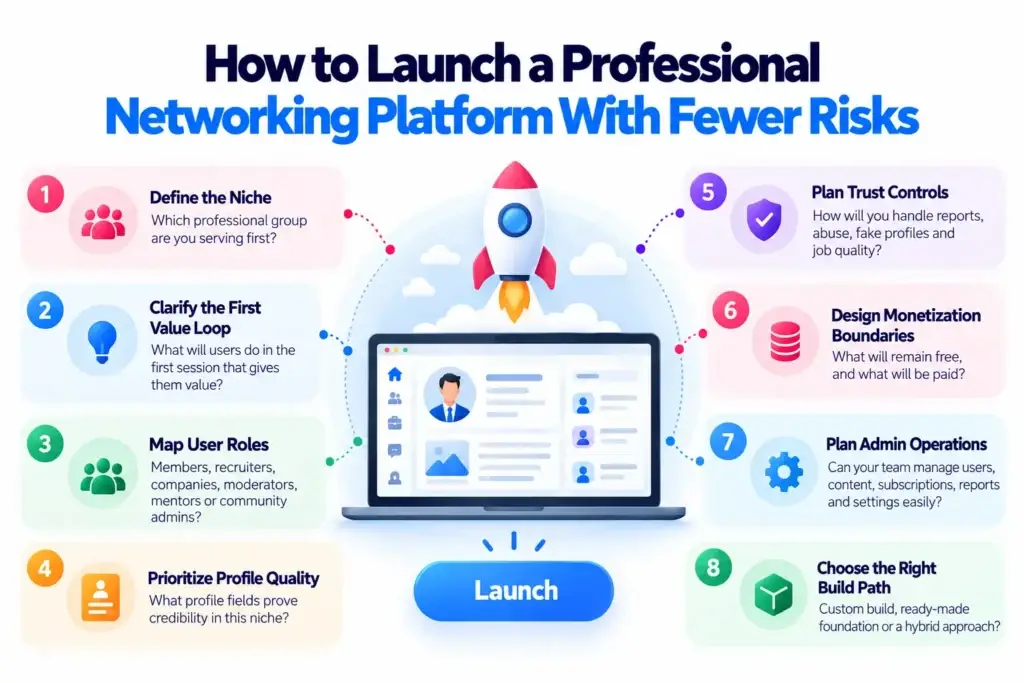
A stronger launch does not come from copying more features. It comes from making better product decisions before development becomes expensive. Founders should define the target community, core user roles, first value loop, trust rules, monetization model, admin workflows, and launch timeline before the build begins.
Here is a practical pre-launch checklist:
- Define the niche: Which professional group are you serving first?
- Clarify the first value loop: What will users do in the first session that gives them value?
- Map user roles: Do you need members, recruiters, companies, moderators, sales users, mentors, or community admins?
- Prioritize profile quality: What profile fields prove credibility in this niche?
- Plan trust controls: How will the platform handle reports, abuse, fake profiles, and job quality?
- Design monetization boundaries: What will remain free, and what will be paid?
- Think about admin operations: Can your team manage users, content, subscriptions, reports, and settings without constant developer help?
- Choose the right build path: Decide whether you need a custom build, a ready-made foundation, or a hybrid approach.
Founders exploring broader social and community products can also review Miracuves’ social networking app solutions to understand how different network models vary across use cases, audiences, and platform goals.
Final Thoughts: Build for Professional Value, Not Just Familiar Features
A professional networking platform succeeds when users believe their identity, attention, and interactions are worth investing in. That belief does not come from copying a familiar layout. It comes from relevance, trust, useful discovery, credible profiles, strong moderation, and a business model that aligns with real user value.
For founders, the smarter path is to avoid unnecessary complexity while still planning the foundation properly. Start with a clear niche. Build a strong identity layer. Keep the first value loop simple. Add trust controls early. Plan monetization before launch. Give your admin team the tools to operate the platform. Then expand features based on real user behavior.
Miracuves helps founders launch professional networking platforms with ready-made and white-label foundations that can be customized for brand, audience, monetization, and control. If your goal is faster validation without rebuilding every module from scratch, a launch-ready solution can help you move from idea to market with more clarity.
FAQs
What is the biggest mistake founders make when launching a professional networking platform?
The biggest mistake is copying visible features without defining a specific professional audience. A platform needs a clear niche, strong user reason, and useful professional value before features like feeds, jobs, messaging, and company pages can create traction.
Should a professional networking platform target everyone at launch?
No. A focused launch usually works better because early users need relevant people, jobs, posts, and opportunities. Starting with one industry, region, alumni group, professional category, or hiring niche can help the platform build density faster.
Which features matter most in the first version of a professional networking platform?
The first version should focus on credible profiles, relevant discovery, connection workflows, useful content or job activity, messaging where needed, and admin control. Advanced modules should be added when they support the core user loop.
Why is trust important in a professional networking app?
Trust affects whether users complete profiles, respond to messages, apply for jobs, share career updates, and engage with the community. Reporting tools, verification workflows, moderation queues, and admin access controls help protect platform credibility.
How should founders choose a monetization model for a professional networking platform?
Founders should choose monetization based on who receives the strongest value. Members may pay for visibility or analytics, recruiters may pay for candidate access, companies may pay for employer branding, and sales teams may pay for targeted outreach tools.
Is it better to build a professional networking platform from scratch or use a ready-made solution?
It depends on launch goals, timeline, budget, and customization needs. A custom build can fit highly unique requirements, while a ready-made white-label foundation can help founders launch faster, validate demand, and customize after real user feedback.
How can Miracuves help founders launch a professional networking platform?
Miracuves helps founders launch ready-made and white-label professional networking platforms with branding, source-code ownership, admin control, and faster deployment. The platform can be customized around audience, features, monetization, and launch scope.
Miracuves is an independent software development company. We are not affiliated with, connected to, sponsored by, or endorsed by any company or product named in this article.
Terms such as “X Clone” are used descriptively. It is how the software industry refers to building a platform with functionality comparable to a known service, and how clients search for it.
The entire design and codebase of our products is built by our own team. Our products contain no code, design, graphics, or content originating from any third-party website or applications.
All third-party names and marks referenced in this article are the property of their respective owners, referenced solely to identify the services discussed.



