


Key Takeaways
- Cheap OTT scripts often lack enterprise-grade DRM protection.
- Pirated copies can appear within hours of content release.
- Widevine and FairPlay help secure premium video content.
- Watermarking alone cannot stop content theft.
- Content security directly impacts platform revenue.
DRM Security Signals
- Use Widevine, FairPlay, and PlayReady DRM.
- Protect streams with encrypted video delivery.
- Use tokenized playback and signed URLs.
- Monitor suspicious viewing and sharing activity.
- Apply device and session access controls.
Real Insights
- Piracy can reduce subscription revenue significantly.
- Premium creators expect strong content protection.
- Security should be planned before platform launch.
- Low-cost scripts can create expensive long-term risks.
- Miracuves builds OTT platforms with enterprise-grade DRM security.
A cheap OTT script can look attractive when you are trying to launch your own streaming platform fast.
The demo works. The homepage looks familiar. Users can register. Videos can be uploaded. Subscriptions can be enabled. The vendor says it is a “Netflix clone,” and the price sounds low enough to make the decision feel safe.
But here is the uncomfortable truth for content creators and independent filmmakers: the most dangerous part of a streaming platform is not always the frontend. It is what happens after a paying user presses play.
If your app streams premium video without real DRM, secure playback rules, license-based access control, and device-aware protection, your paid content can be copied, screen-recorded, downloaded, repackaged, and redistributed almost immediately.
For a creator moving into SVOD, that is not a small technical bug. It is a business leak.
Google describes Widevine as its content protection system for premium media, used by major streaming and media platforms to protect digital distribution. Apple FairPlay Streaming is designed to secure media delivery over HLS on Apple platforms through encryption and protected key exchange.
Miracuves builds OTT and video content platforms with a founder-focused view of security: not as a checkbox, but as a product foundation for creators who need subscription revenue, content licensing trust, and long-term platform control.
The Screen-Record Vulnerability of Basic OTT Apps
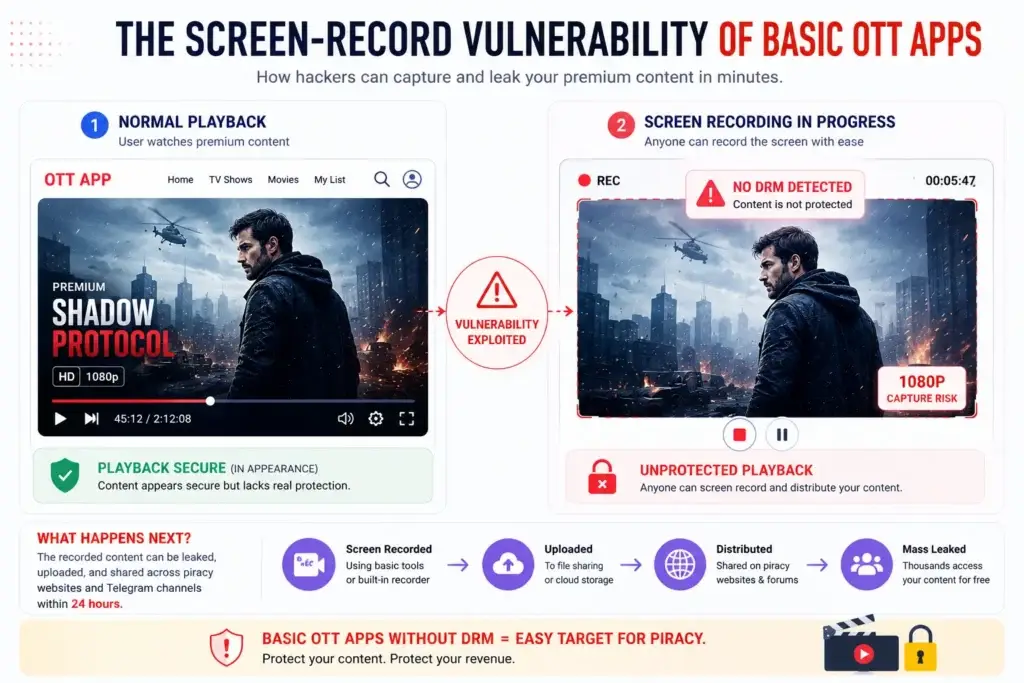
Most cheap OTT scripts are built around the visible parts of streaming: user login, video upload, categories, subscription plans, payment integration, watchlists, and a player page.
That may be enough for a demo. It is not enough for premium content security.
A basic script often protects the page, not the media. This means a user may need to log in to see the video player, but the underlying video file, stream URL, or playback session may still be weakly protected. In some cases, the platform relies on simple file hosting, public URLs, weak token expiry, or frontend-only restrictions.
That creates several piracy paths:
| Weak Layer | What Can Go Wrong | Business Impact |
|---|---|---|
| Public or poorly protected stream URLs | Users can inspect, copy, or reuse media links | Paid content circulates outside the platform |
| No proper DRM | Video may be easier to capture, download, or redistribute | Premium catalog loses exclusivity |
| Weak session control | Shared accounts can stream without meaningful limits | Subscription leakage increases |
| No device policy | Content plays on unsafe environments without restriction | Higher piracy risk for HD content |
| No watermarking or forensic traceability | Leaked files cannot be linked to user/session | Harder enforcement after piracy |
DRM does not make piracy impossible. No honest vendor should claim that. But it raises the protection standard by controlling license exchange, decryption, playback rules, and device capability. The W3C Encrypted Media Extensions specification describes how web applications can select content protection mechanisms and manage license/key exchange for encrypted media playback.
For a creator moving into SVOD, this distinction matters. A basic video player asks, “Can the user watch?” A secure OTT architecture asks, “Should this user, on this device, in this session, under this subscription right, be allowed to decrypt this content at this quality?”
That is the difference between a streaming app and a content business.
Read more : Subscription Models for Netflix Clone: Which One Will Maximize Your Profits?
Why Login, Watermarks, and Private URLs Are Not Enough
Many early-stage founders assume video security means three things: hide the video behind login, add a visible watermark, and make the video URL private.
Those steps help, but they are not a DRM strategy.
A login system protects access to the platform. It does not automatically protect the video once playback begins. A watermark may discourage casual sharing, but it does not prevent recording. A private URL may reduce basic copying, but if the URL is long-lived or the video is not encrypted properly, the content can still leak.
A stronger VOD security model needs layered control:
| Protection Layer | Role in OTT Security |
|---|---|
| Encrypted video packaging | Prevents raw video segments from being useful without keys |
| DRM license server | Controls whether playback keys are issued |
| Entitlement checks | Confirms subscription, rental, purchase, or geographic rights |
| Secure player integration | Handles license exchange and playback restrictions |
| Device security rules | Adjusts playback based on device/browser capability |
| HDCP and output protection | Helps reduce external display capture risk |
| Session control | Limits account sharing and suspicious playback behavior |
| Watermarking | Adds deterrence and traceability when leaks happen |
Mux explains that DRM-protected playback can include video encryption, screen capture protection, and HDCP to prevent recording through outputs such as HDMI.
For independent filmmakers, this is not overengineering. It is rights protection. If you plan to license films from producers, sell premium workshops, or onboard creators into a revenue-sharing SVOD marketplace, your platform must show that content security is part of the foundation.
Widevine, FairPlay, and True Enterprise DRM
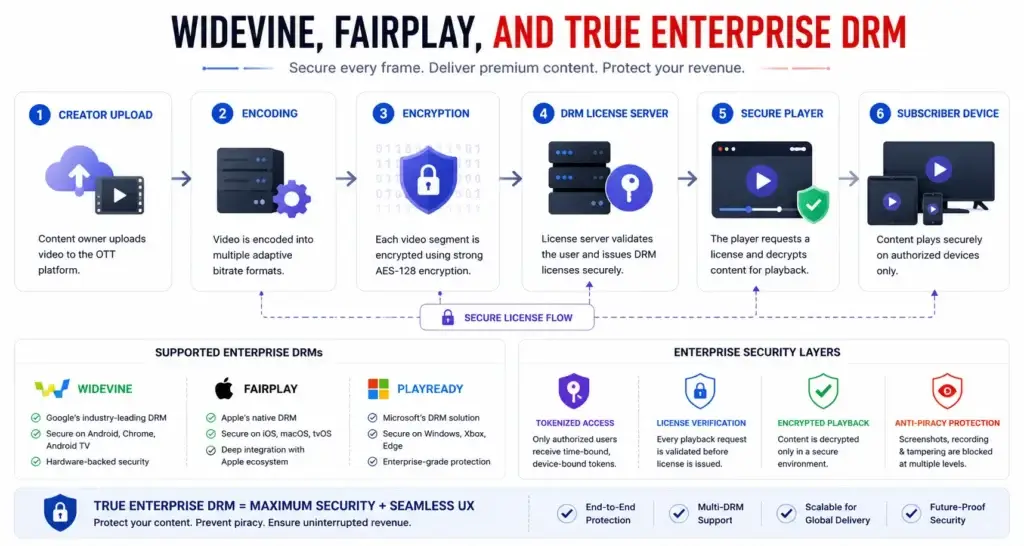
Enterprise DRM is not one plugin. It is a coordinated architecture across encoding, packaging, player integration, license management, and platform entitlements.
The three major DRM systems usually discussed for OTT are:
| DRM System | Common Device / Platform Coverage | Why It Matters |
|---|---|---|
| Google Widevine | Chrome, Android, many connected devices | Helps protect playback across a broad consumer device base |
| Apple FairPlay Streaming | Safari, iOS, iPadOS, tvOS, macOS via HLS | Required for protected playback inside Apple’s ecosystem |
| Microsoft PlayReady | Windows, Edge, Xbox, connected TV ecosystems | Common for Microsoft-based and TV-oriented playback environments |
FastPix notes that broad device coverage often requires Widevine for Chrome/Android, FairPlay for Safari/iOS, and PlayReady for Edge/Windows. Microsoft describes PlayReady as technology used to distribute audio and video content more securely over a network and help prevent unauthorized use.
This matters because your audience will not watch from one device. A filmmaker’s subscribers may watch on iPhone, Android, Safari, Chrome, web, tablet, smart TV, or casting environments. If your OTT platform only works securely on one surface and falls back to weak playback elsewhere, piracy risk moves to the weakest device path.
What a DRM-ready OTT architecture should include
A serious SVOD platform should be designed around secure playback from day one:
| Module | What It Should Do |
|---|---|
| Content ingestion | Upload and process original video securely |
| Encoding pipeline | Transcode into adaptive streaming formats |
| Encryption and packaging | Encrypt video segments for protected playback |
| Multi-DRM integration | Support Widevine, FairPlay, and PlayReady where relevant |
| License server flow | Issue keys only to authorized users and valid sessions |
| Entitlement engine | Validate subscription, rental, purchase, geography, and device rules |
| Secure player | Handle DRM playback, token checks, and quality restrictions |
| Admin dashboard | Manage content rights, access rules, pricing, subscriptions, and reports |
| Abuse monitoring | Detect account sharing, unusual playback, or suspicious access |
| Watermarking strategy | Add visible or forensic deterrents depending on content value |
Miracuves’ video content platform development services are aligned with founders who need a customizable, monetization-ready foundation for VOD, live streaming, subscriptions, and admin control. For creators planning a Netflix-style SVOD product, the platform decision should include DRM architecture, not just streaming UI.
Read more : Top 14 Features for a Competitive Netflix Clone in the Modern Market
The Real Cost of a Cheap OTT Script Is Not the Script Price
A $300 OTT script may look attractive because it reduces the visible entry cost. But the script price is not the business cost.
The real cost appears later:
| Hidden Risk | Why It Becomes Expensive |
|---|---|
| Rebuilding video infrastructure | Weak scripts may not support secure packaging, DRM, or scalable streaming |
| Losing creator trust | Premium creators may refuse to upload exclusive content |
| Failed licensing conversations | Distributors may ask how content is protected |
| Subscription leakage | Shared accounts and copied videos reduce paid viewing |
| Brand damage | A platform known for leaks struggles to attract serious partners |
| Emergency migration | Moving content and users after launch is harder than building correctly early |
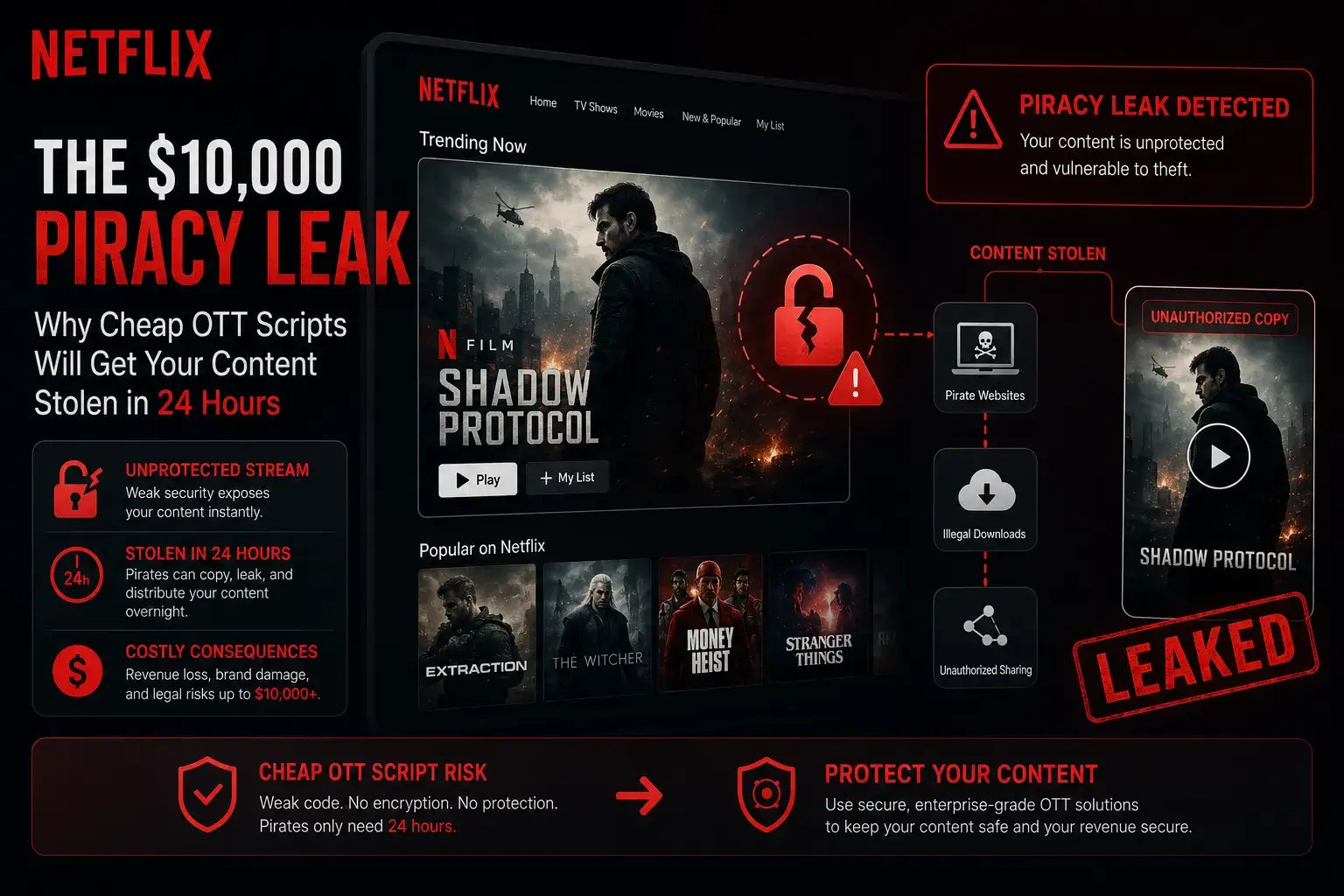
This is why the “$10,000 piracy leak” is not just about one stolen file. It represents legal review, takedown work, lost sales, support issues, angry creators, refund demands, and the cost of rebuilding architecture after the market has already seen the weakness.
A founder can recover from a delayed feature. Recovering from a leaked flagship film is harder.
Why Premium Creators Will Not License to Insecure Platforms
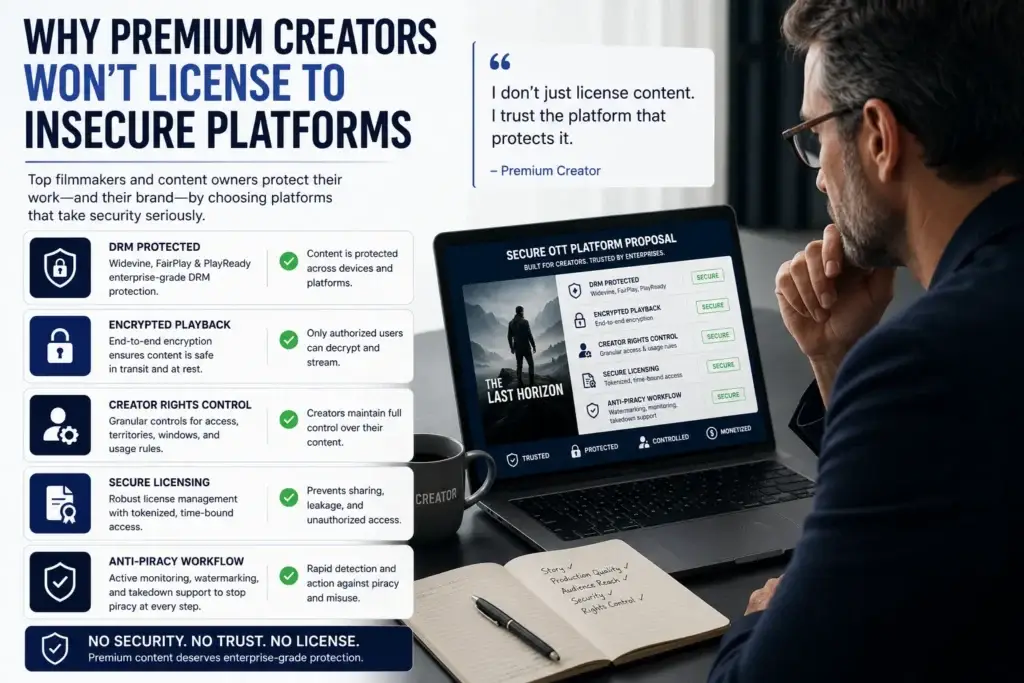
Premium creators ask sharper questions than casual uploaders.
They want to know:
- Who can access my video?
- Can viewers download it?
- Can someone screen-record it easily?
- Can the platform restrict playback by country or subscription plan?
- Can I remove content quickly?
- Can the admin identify suspicious activity?
- Can my content be streamed securely across devices?
- What happens if a user shares login access?
If your platform cannot answer these questions clearly, creators may not license their best content to you.
For a creator-led SVOD business, content supply is the moat. If you cannot convince filmmakers, educators, studios, trainers, or niche media producers that their assets are protected, the platform becomes a shell with weak content economics.
That is why DRM is not only a technical feature. It is a sales enablement layer.
A secure OTT architecture helps founders negotiate with:
| Partner Type | What They Care About |
|---|---|
| Independent filmmakers | Film protection, controlled access, anti-piracy workflows |
| Course creators | Paid lesson protection and subscription integrity |
| Documentary producers | Licensing safety and audience control |
| Fitness/media creators | Membership-only access and screen recording deterrence |
| Regional studios | Rights windows, geography, and distribution control |
| Creator networks | Revenue sharing, payout tracking, and content safety |
The stronger your security story, the easier it becomes to build a premium catalog.
Founder Decision Signals: When DRM Becomes Non-Negotiable
Founder Decision Signals
Premium Content
If your platform streams films, courses, documentaries, exclusive interviews, paid workshops, or licensed media, DRM should be considered part of the core product foundation.
Creator Licensing
If you need creators or producers to upload exclusive content, your platform must explain how playback, access, and redistribution risks are controlled.
SVOD Revenue
If subscriptions are the main revenue model, account sharing, downloads, and weak playback controls directly affect paid viewing and retention.
Multi-Device Reach
If users watch across Apple, Android, web, and connected devices, DRM planning must account for different playback ecosystems instead of relying on one generic player.
Cheap OTT Script vs DRM-Ready OTT Platform
| Decision Area | Cheap OTT Script | DRM-Ready OTT Platform |
|---|---|---|
| Video protection | Often depends on basic private URLs or simple player restrictions. | Uses encryption, DRM licensing, entitlement checks, and secure playback workflows. |
| Device coverage | May work visually across devices but lack proper DRM paths for each ecosystem. | Plans for Widevine, FairPlay, and PlayReady depending on target devices. |
| Creator trust | Difficult to convince premium creators or licensors. | Stronger foundation for licensing conversations and creator onboarding. |
| Admin control | May include basic content upload and user management. | Supports subscription rights, access rules, content status, reporting, and abuse monitoring. |
| Scalability | Built for demo-style launch, not necessarily secure growth. | Designed around streaming infrastructure, CDN, encoded assets, and rights-based access. |
| Long-term risk | Lower upfront cost but higher piracy, rebuild, and credibility risk. | Higher technical discipline upfront with stronger content-business protection. |
The Architecture Miracuves Recommends for Secure SVOD Platforms
For creators moving into SVOD, the platform should be designed as a secure content business, not only a streaming website.
A stronger architecture usually includes:
1. Secure Content Ingestion
The upload pipeline should protect original files, control who can upload, and separate raw assets from public playback environments. Creators should not upload premium files into a system where raw media paths are easily exposed.
2. Encoding and Adaptive Streaming
Premium platforms need adaptive playback so users can stream based on bandwidth and device capability. But encoded segments should be packaged securely, not simply stored as open files.
3. DRM and License Workflow
The platform should issue playback licenses only after checking user subscription, rental status, content rights, region rules, and session validity. This is where basic scripts usually fail because they focus on “video plays” rather than “video plays only under valid rights.”
4. Secure Player and Device Policy
The player must support DRM workflows, tokenized playback, and device-appropriate restrictions. A secure web player, iOS player, Android player, and TV player may require different implementation logic.
5. Admin Control for Rights and Abuse
The admin dashboard should help platform operators manage content approvals, plans, pricing, user accounts, creator uploads, suspicious activity, and content takedowns. For SVOD founders, backend control decides how quickly the business can respond to piracy signals.
6. Monetization-Ready Access Rules
SVOD platforms often combine monthly subscriptions, annual plans, pay-per-view, rentals, bundles, creator revenue sharing, and coupons. Security must align with monetization. A user who rented one film should not access the entire catalog.
Miracuves helps founders launch video content platforms with ready-made and customizable OTT foundations. For Netflix-style streaming businesses, explore the Miracuves Netflix Clone App and broader Entertainment Solutions.
Mistakes Founders Should Avoid
Mistakes Founders Should Avoid
Choosing a script based only on frontend demo quality
A polished homepage and smooth video player do not prove secure playback. Always evaluate DRM readiness, stream protection, admin controls, and entitlement logic before choosing an OTT foundation.
Adding DRM after piracy happens
Retrofitting DRM after launch can require changes to encoding, storage, player integration, license flows, and device policies. For premium content, security should be planned before the first title goes live.
Assuming all devices protect content equally
Different devices and browsers support different DRM systems and security capabilities. A serious SVOD platform should map its device strategy before scaling content acquisition.
Ignoring creator confidence
Premium creators care about how their content is protected. If your platform cannot explain its security model, creator onboarding becomes harder.
Where DRM Fits in the SVOD Business Model
SVOD revenue depends on one simple idea: users pay because the platform controls access to valuable content.
If the same content is easily copied and distributed elsewhere, the subscription promise weakens. This is especially important for:
- Independent film premieres
- Niche documentary libraries
- Paid education and masterclasses
- Fitness and wellness video memberships
- Regional entertainment catalogs
- Creator-led private communities
- Licensed content partnerships
DRM supports the business model by reinforcing scarcity, access control, and creator trust. It does not replace marketing, content quality, or pricing strategy. But without it, the platform’s revenue engine rests on weak technical ground.
For founders comparing OTT models, Miracuves’ Netflix Clone Business Model can support monetization planning alongside security architecture.
Final Thoughts: Do Not Build an SVOD Business on a Leaky Script
A cheap OTT script can help you visualize a streaming platform. It cannot automatically protect a premium content business.
For creators and independent filmmakers, the asset is not the app interface. The asset is the content. If that content leaks, the platform loses trust before it has a chance to build subscription momentum.
The smarter decision is not to buy the lowest-cost script and hope security can be added later. The smarter decision is to choose a platform foundation that treats DRM, encrypted playback, entitlement checks, admin control, and creator confidence as core business requirements.
Miracuves helps founders move faster with white-label, source-code-owned video platforms that can be aligned with their monetization model, content strategy, and security expectations. For serious SVOD businesses, speed matters. But secure speed matters more.
FAQs
What is OTT DRM?
OTT DRM, or Digital Rights Management, is a content protection system that controls how encrypted video is licensed, decrypted, and played on user devices. It helps reduce unauthorized downloads, screen recording, and content misuse by enforcing playback rules through DRM systems such as Widevine, FairPlay, and PlayReady.
Why do cheap OTT scripts create piracy risk?
Cheap OTT scripts often focus on visible features such as login, subscriptions, categories, and video playback. Many do not include strong DRM, encrypted packaging, license control, secure players, or device-level policies. This can expose premium video content to copying, screen recording, or unauthorized sharing.
Is DRM enough to stop all piracy?
No. DRM reduces piracy risk, but it does not make piracy impossible. A strong OTT security model should combine DRM, encrypted streaming, tokenized access, entitlement checks, HDCP where relevant, session monitoring, watermarking, and admin controls.
What is the difference between Widevine and FairPlay?
Widevine is commonly used for Android, Chrome, and many consumer devices, while FairPlay Streaming is Apple’s DRM technology for protected HLS playback across Apple platforms. Apple states that FairPlay Streaming helps encrypt content, securely exchange keys, and protect playback on Apple platforms.
Do independent filmmakers need DRM for SVOD?
Yes, if they are streaming premium films, documentaries, paid courses, exclusive content, or licensed media. DRM helps protect creator assets and also supports licensing conversations with content owners who expect secure playback controls.
Can DRM be added after launching an OTT app?
It can be added in some cases, but retrofitting DRM may require changes to encoding, packaging, storage, player integration, license management, and access rules. For premium content platforms, it is safer to plan DRM before launch.
What should founders ask before buying an OTT script?
Founders should ask whether the script supports Widevine, FairPlay, and PlayReady; whether videos are encrypted; how license keys are issued; whether content access is tied to subscription rights; whether screen recording is restricted where possible; and whether the admin can monitor abuse.
How does Miracuves help with secure OTT platform development?
Miracuves helps founders build ready-made and white-label OTT and video content platforms with source-code ownership, branded design, admin control, monetization workflows, and customizable architecture for serious video businesses.