
Key Takeaways
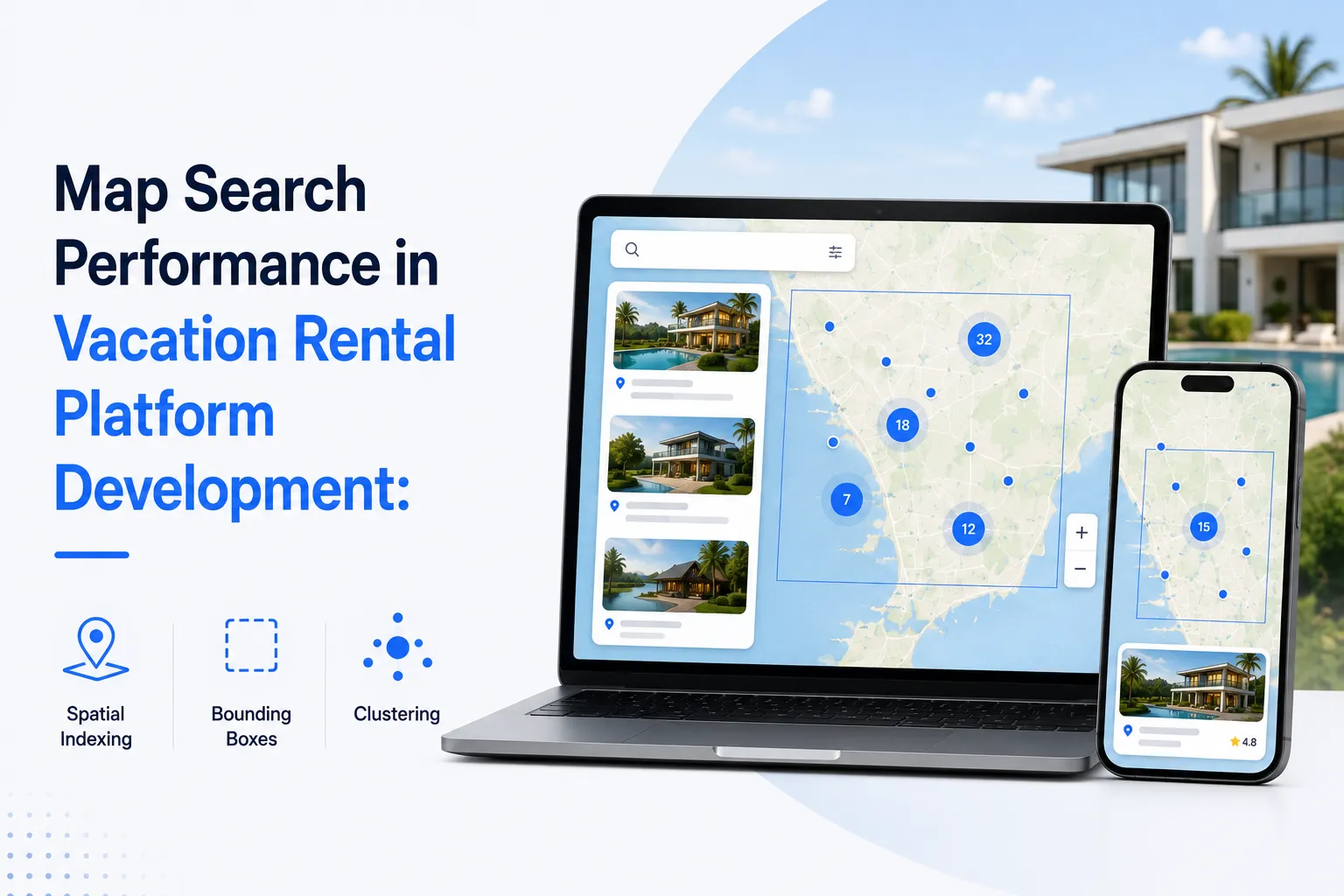
- rental marketplace map search needs fast map search because guests explore properties by location, neighborhood, price, distance, and availability.
- Spatial indexing helps the database find coordinate-based listings efficiently without repeatedly scanning the complete property database.
- Bounding-box queries return only properties inside the visible map area, reducing unnecessary data transfer and backend workload.
- Marker clustering groups nearby properties at lower zoom levels, keeping maps cleaner and reducing mobile rendering pressure.
- Map APIs should return lightweight preview data, while complete property information should load only when users open individual listings.
Performance Signals
- A scalable map backend should combine spatial indexes, coordinate filtering, query limits, filter sequencing, caching, and slow-query monitoring.
- Bounding-box search is well suited to interactive maps because every pan or zoom changes the exact geographic area the guest wants to explore.
- Map search should work together with availability, price, guest count, property type, amenities, ratings, and booking preferences.
- Debouncing reduces unnecessary API requests by waiting until the user finishes moving or adjusting the map before refreshing results.
- Caching should prioritize stable location and preview information while time-sensitive availability, prices, promotions, and blocked dates are carefully revalidated.
Real Insights
- A polished map interface cannot compensate for inefficient backend queries, making spatial indexing and query structure important from the beginning.
- Fetching every property in a city creates unnecessary payload and rendering pressure; map results should reflect only the current viewport.
- Clustering is not only a visual feature; it is a performance strategy that reduces the number of individual markers rendered at once.
- Search monitoring can reveal more than technical problems by identifying high-demand areas with weak inventory, incorrect listing coordinates, and poor-converting locations.
- The strongest map architecture combines spatial indexing → bounding-box filtering → lightweight APIs → clustering → controlled requests → monitoring.
Map search is one of the most important discovery layers in a rental marketplace.
Guests do not only search by city name. They explore neighborhoods, compare nearby prices, zoom into beach areas, drag across districts, check distance from landmarks, and look for properties around real-world locations. Every pan, zoom, and filter change can trigger a new search request.
That makes map performance a core part of vacation rental platform development.
A rental marketplace map search may have strong listings, attractive images, and a clear booking flow. But if the map freezes, loads too many pins, returns irrelevant properties, or takes too long to update, users lose confidence quickly. Slow map search directly affects discovery, comparison, and booking intent.
The solution is not just adding a map view. A scalable property discovery experience needs spatial indexing, bounding-box queries, lightweight API responses, marker clustering, caching discipline, and clear separation between map-preview data and full listing-detail data.
For founders still comparing different rental marketplace directions, Miracuves offers multiple rental and property platform options across short-stay booking, real estate listings, property management, car rentals, boat rentals, and related marketplace models.
This guide explains how founders and product teams should think about map search performance before launching a vacation rental marketplace, short-stay booking platform, villa rental app, apartment marketplace, or location-based property booking system.
Why Map Search Performance Matters in Rental Marketplaces
In a rental marketplace, the map is not just a visual feature. It is a decision interface.
A guest may care about being close to a beach, station, office district, university, airport, tourist zone, hiking trail, hospital, or event venue. A list view can show prices and images, but a map helps users understand location fit.
When the map experience is slow, the user has to work harder. They may drag the map and wait. They may zoom in and see pins load late. They may apply filters and receive outdated results. They may tap a marker and wait for a heavy listing payload to load.
These small delays create friction.
For founders, map performance affects:
- Property discovery
- Search engagement
- Listing comparison
- Mobile browsing quality
- Booking conversion
- User trust
- Infrastructure cost
- Platform scalability
A fast map helps users feel in control. A slow map makes the product feel unfinished, even if the underlying listings are strong.
The Common Mistake: Treating Map Search Like Normal Listing Search
A standard listing search page can load a paginated list of properties. A map cannot work the same way.
Map users behave differently. They drag, zoom, tap clusters, adjust filters, and explore visually. Each movement changes the visible region. If the backend returns all properties in a city every time the map moves, the system may over-fetch data, slow down rendering, and increase infrastructure pressure.
The map API should answer a focused question:
Which active properties are visible inside this map area, with the selected filters applied?
That is different from:
Give me every property that matches this city or category.
A high-performing rental marketplace should separate three types of data:
| Data Type | Purpose | Example Fields |
|---|---|---|
| Map preview data | Show lightweight pins and cards | ID, coordinates, price, thumbnail, rating, listing type |
| Search result data | Show sortable property cards | Title, price, location, images, rating, availability summary |
| Listing detail data | Show full property page | Amenities, house rules, host profile, reviews, cancellation policy, full gallery |
This separation matters because a map interaction should not load full property objects. Full descriptions, amenity arrays, review histories, host bios, and cancellation terms should load only when the user opens the listing detail page.
Spatial Indexing: The Backend Layer Behind Fast Property Discovery
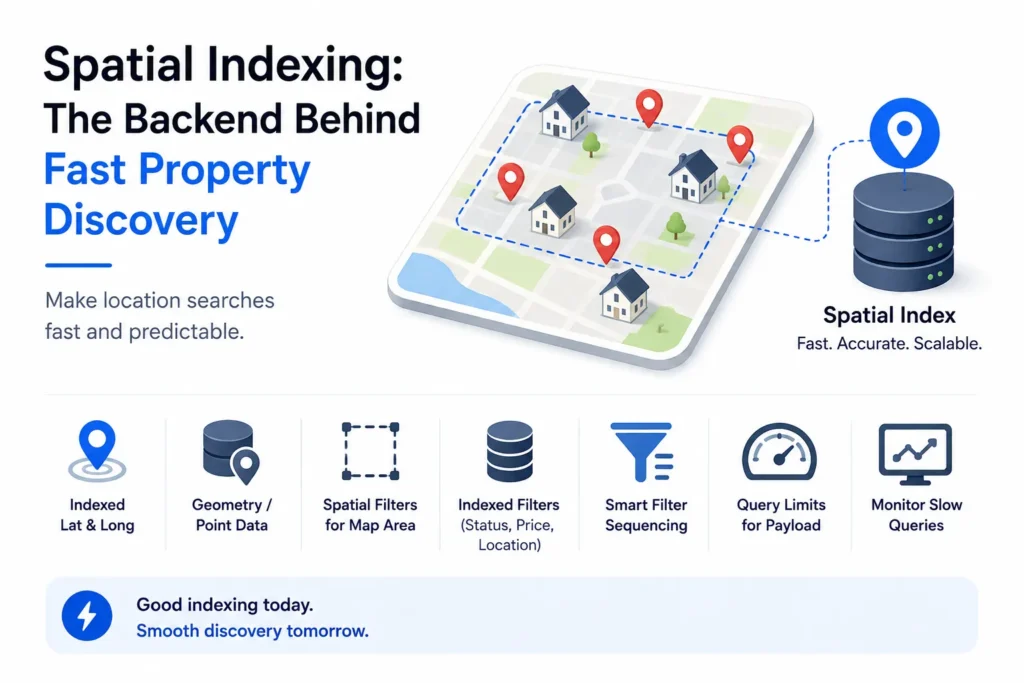
Spatial indexing helps the database search location-based records efficiently.
Without spatial indexing, the platform may need to scan too many property records whenever the user moves the map. That may work for a small demo, but it becomes unstable as listings grow across cities, neighborhoods, and service categories.
A rental marketplace usually stores property coordinates using latitude and longitude. For stronger geospatial search optimization, the backend may also use geometry or point-based columns where supported by the database.
The goal is simple: make coordinate-based lookups fast and predictable.
A strong map backend may include:
- Indexed latitude and longitude fields
- Geometry or point columns where supported
- Spatial predicates for map-area filtering
- Separate indexes for status, location, price, and category
- Filter sequencing so the database narrows results efficiently
- Query limits to avoid excessive map payloads
- Monitoring for slow geospatial queries
For founders, this matters because map performance is not only a frontend issue. A polished map design cannot fix a backend that searches location data inefficiently.
Map Performance Layers in Vacation Rental Platform Development
| Performance Layer | What It Does | Founder Impact |
|---|---|---|
| Spatial Indexing | Helps the database find properties by coordinates without scanning all listings. | Improves response speed as listing volume grows. |
| Bounding-Box Queries | Returns only properties inside the visible map area. | Reduces over-fetching and keeps map browsing relevant. |
| Lightweight Map APIs | Sends only the fields needed for pins and preview cards. | Lowers payload size and improves mobile responsiveness. |
| Marker Clustering | Groups nearby pins at lower zoom levels. | Prevents visual clutter and mobile rendering pressure. |
| Filter Sequencing | Applies location, status, price, category, and availability filters in a controlled query flow. | Improves search accuracy without unnecessary database load. |
| Caching Strategy | Stores repeatable map responses or location metadata where appropriate. | Helps reduce repeated work during high-traffic browsing. |
| Monitoring and Logs | Tracks slow queries, API response time, failed map requests, and filter behavior. | Gives the operator visibility before performance issues affect users. |
Founders who want to review the broader product layer can explore this rental marketplace features, including search, booking flows, host tools, payment handling, admin controls, availability logic, and marketplace modules.
Map performance is only one part of the full technical foundation. Founders who want to understand the larger platform structure can read this vacation rental platform architecture guide, which explains how booking workflows, host tools, guest journeys, payments, admin control, and backend planning connect inside a rental marketplace.
Bounding-Box Queries: Returning Only What the User Can See
A bounding box is the rectangular area currently visible on the user’s map.
When a guest pans or zooms, the frontend can send the visible map boundaries to the backend. The backend then returns only the properties within those coordinate limits.
A simplified bounding-box request may include:
northEastLat
northEastLng
southWestLat
southWestLng
minPrice
maxPrice
propertyType
guestCount
dateRange
The backend then checks which listings fall inside the visible map region.
A simplified SQL-style pattern may look like this:
SELECT
  id,
  latitude,
  longitude,
  nightly_price,
  property_type,
  rating_average,
  thumbnail_url
FROM properties
WHERE status = 'active'
  AND latitude BETWEEN :southWestLat AND :northEastLat
  AND longitude BETWEEN :southWestLng AND :northEastLng
  AND nightly_price BETWEEN :minPrice AND :maxPrice
ORDER BY updated_at DESC
LIMIT :limit;
For advanced spatial database setups, the logic can be improved with geometry columns and spatial predicates. But the business principle remains the same: the platform should return the right properties for the current map view, not overload the app with unnecessary inventory.
Bounding Box vs Radius Search vs Full City Fetch
Different location queries serve different purposes.
A radius query can work well for “near me” search. A full city fetch may work for a very small inventory. But interactive map browsing usually needs bounding-box logic because the user is exploring a visible region, not asking for everything around one point.
| Query Method | What It Does | Risk at Scale | Better Use Case |
| Full city fetch | Returns all listings in a city | Heavy payload, slow rendering, unnecessary data transfer | Small inventory demos only |
| Radius search | Returns listings around a center point | Can over-fetch listings outside the visible map frame | Nearby discovery or “around me” search |
| Bounding-box query | Returns listings inside the visible map area | Requires precise viewport handling | Interactive rental map browsing |
| Cluster-aware query | Returns grouped pins or limited visible pins | Requires frontend and backend coordination | High-density rental marketplace maps |
For vacation rental platform development, bounding-box and cluster-aware logic are usually stronger for map browsing because every zoom level changes what the user needs.
A guest viewing an entire city should not receive the same response as a guest zoomed into a two-street neighborhood.
Marker Clustering: Keeping Mobile Maps Smooth
When a rental platform has only a few listings, showing every property pin may work.
As inventory grows, this becomes a problem. A city-level map with hundreds or thousands of individual markers can become crowded, confusing, and slow. On mobile, rendering too many markers may lead to lag, memory pressure, slow taps, and poor gesture response.
Marker clustering solves this by grouping nearby listings at lower zoom levels.
Instead of displaying every property as a separate pin, the app shows a cluster marker such as:
27 staysWhen the user zooms in, the cluster expands into smaller clusters or individual listings.
This improves the user experience because:
- The map looks cleaner.
- The app renders fewer markers.
- Guests can understand density by area.
- The interface responds better to pan and zoom gestures.
- Users can explore from broad areas to specific neighborhoods naturally.
Clustering should not be treated as decoration. It is a performance strategy.
Lightweight Map Payloads: Do Not Send Full Listings to the Map
One of the most common map performance mistakes is sending too much data.
A map pin does not need the full property object. It usually needs only enough data to render a marker or preview card.
A lightweight map response may include:
{
  "id": 1842,
  "lat": 40.7128,
  "lng": -74.0060,
  "price": 160,
  "currency": "USD",
  "type": "Apartment",
  "rating": 4.7,
  "thumbnail": "listing-1842.webp"
}
A full listing response can be loaded later when the guest clicks into the property page.
This separation helps in three ways.
First, it reduces API payload size. Second, it helps mobile apps render faster. Third, it gives the backend more control over which endpoints need deeper caching, authentication, personalization, or availability validation.
For founders, this means the platform should not be judged only by how attractive the map looks in a demo. It should be reviewed by how efficiently the map handles real user behavior.
Filter Logic: Location Search Must Work With Price, Dates, Guests, and Availability
Map search is not only about coordinates.
A guest may search for a two-bedroom villa near the beach, available next weekend, under a specific price, with parking and strong ratings. The backend must combine geospatial filtering with business filters.
Common filter layers include:
- Location or visible map bounds
- Property status
- Date availability
- Guest capacity
- Price range
- Property type
- Amenities
- Ratings
- Instant booking or request-to-book
- Host verification
- Promotions or featured listings
The challenge is sequencing.
If the platform applies filters inefficiently, the database may do unnecessary work. If it applies filters incorrectly, the map may show listings that are unavailable, overpriced, or outside the guest’s actual search intent.
A scalable rental marketplace should narrow the result set logically, then return only the fields needed for the map state.
How Map Speed Affects Booking Conversion
Map speed affects more than technical performance. It affects buyer confidence.
When a guest browses a rental marketplace, each interaction is part of the decision journey. They compare neighborhoods, prices, reviews, amenities, and availability. If the map responds quickly, the user feels the platform is reliable. If the map delays or jumps, the user may assume the platform has weak inventory or poor engineering.
Fast map search supports conversion by helping guests:
- Discover relevant areas faster
- Compare prices visually
- Understand property density
- Shortlist listings by location
- Revisit areas without friction
- Move from exploration to booking with confidence
Once discovery performance improves, founders should also decide how the platform turns search activity into revenue. A clear rental marketplace revenue model can include booking commissions, host plans, guest service fees, featured placements, payout logic, and other monetization controls.
For founders, this is why map performance should be planned early. It is not only a technical optimization after launch. It is part of the product experience that influences whether users trust the marketplace enough to book.
What Founders Should Benchmark Before Launch
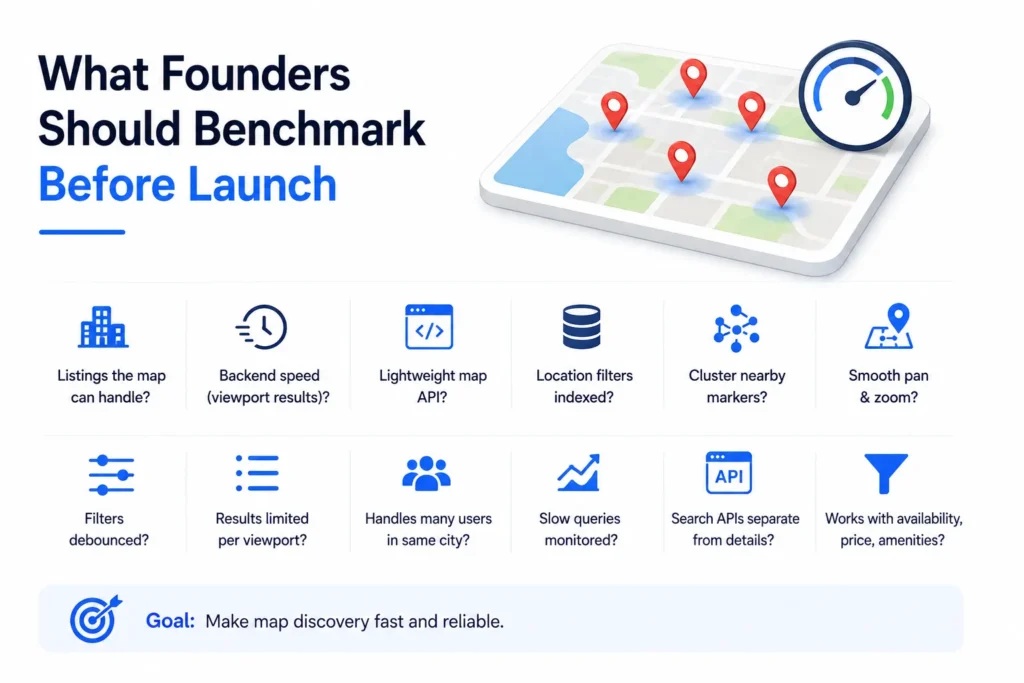
A rental marketplace does not need millions of users before performance matters. It only needs enough listings, filters, and mobile map usage to expose weak architecture.
Before launch, founders should review how the platform behaves under realistic browsing conditions.
Useful benchmark questions include:
- How many active listings can the map handle in one city?
- How fast does the backend return viewport-based results?
- Does the map API return lightweight preview data or full listing objects?
- Are location filters backed by indexes?
- Does the frontend cluster nearby markers?
- Does the map refresh smoothly when users pan or zoom?
- Are filter changes debounced so the app does not spam the backend?
- Does the platform limit results per viewport?
- Can the backend handle simultaneous users exploring the same city?
- Are slow map queries logged and monitored?
- Does the platform separate search APIs from listing-detail APIs?
- Does map search work with availability, price, amenities, and rating filters?
The goal is not to chase one universal response-time number. The goal is to make map discovery feel fast and reliable under the platform’s real expected inventory and traffic conditions.
Caching and Debouncing: Reducing Unnecessary Map Requests
Interactive maps can trigger many requests quickly. A user may drag the map slightly, zoom in, zoom out, and adjust filters within seconds.
Without request control, the frontend may send too many calls. The backend may process duplicate or unnecessary queries. The user may see flickering results or outdated markers.
Two techniques help reduce this pressure.
Debouncing
Debouncing waits briefly before sending a request after a user action. Instead of calling the API for every tiny map movement, the app waits until the user stops moving the map or reaches a stable state.
This helps reduce unnecessary requests while keeping the experience responsive.
Caching
Caching can help when users repeatedly explore the same area or when location metadata does not change frequently. But caching must be used carefully in rental marketplaces because availability, pricing, and booking status can change.
Static or semi-static data may be cache-friendly:
- Location names
- Neighborhood boundaries
- Popular search areas
- Map tile-related metadata
- Listing preview data with short expiry
Time-sensitive data needs caution:
- Availability
- Booking status
- Active promotions
- Price changes
- Host-blocked dates
The founder’s goal should be balanced performance. Cache what is safe, revalidate what affects booking accuracy.
Admin Visibility for Map and Search Performance
Map performance is not complete unless the operator can detect problems.
A strong admin or analytics layer should help the team monitor:
- Slow location queries
- High-error map API responses
- Search terms with zero results
- Overloaded city or region searches
- Filter combinations with poor results
- Listings missing coordinates
- Incorrect property locations
- Duplicate or outdated map markers
- Regions with high search activity but low booking conversion
- Mobile map abandonment patterns
This is useful because map performance is not only about speed. It also reveals marketplace health.
If many users search a region with no relevant inventory, the platform may need host acquisition there. If users frequently zoom into a neighborhood but do not book, the issue may be pricing, trust, photos, or availability. If listings appear in the wrong place, host onboarding or address validation may need improvement.
For vacation rental platform development, search analytics can guide both product and business decisions.
Mistakes Founders Should Avoid
Fetching Every Listing in a City
Returning all city listings may work in a small demo, but it becomes inefficient as inventory grows. Map browsing should return only relevant visible-area results.
Sending Full Property Objects to the Map
Full listing data should load on the detail page, not during every map movement. Keep map APIs lightweight to improve mobile responsiveness.
Ignoring Marker Clustering
Rendering too many individual pins can create clutter and lag. Clustering helps users understand density while reducing frontend rendering pressure.
Optimizing UI Before Query Logic
A beautiful map interface cannot compensate for slow backend location queries. Spatial indexing and query structure should be reviewed early.
Where Miracuves Fits Into Location-Ready Rental Marketplace Development
Miracuves helps founders launch rental marketplace platforms with ready-made, white-label solutions, source-code-owned foundations that can be customized for different booking and property discovery models.
For founders working on vacation rental platform development, map search performance should be part of the product conversation from the beginning. A rental marketplace needs more than listing pages and checkout. It needs location-based discovery, search filters, map views, availability handling, payment flows, host dashboards, guest experiences, and admin control working together.
A founder should evaluate whether the platform can support:
- Location-based property search
- Map view and listing discovery
- Search filters by price, guest count, dates, amenities, and rating
- Coordinate-based listings
- Lightweight APIs for browsing
- Mobile-friendly property exploration
- Admin controls for listings and locations
- Scalable backend logic for growing inventory
If you are ready to move from technical planning to solution evaluation, explore this aunch-ready rental marketplace platform as the next step. This blog should remain focused on map search performance, while the solution page handles direct product, demo, pricing, and purchase-intent details.
Final Thoughts: Fast Maps Create Better Property Discovery
Map search performance is not a technical luxury. It is part of the rental marketplace experience.
Guests use maps to understand where they are staying, compare nearby options, and decide whether a property fits the trip. If map search is slow, overloaded, or inaccurate, the platform loses trust before the booking flow even begins.
Strong vacation rental platform development should treat map search as a product foundation. Spatial indexing helps the backend handle location-based search. Bounding-box queries return only visible-area results. Marker clustering keeps mobile browsing clean and responsive. Lightweight APIs reduce unnecessary payload. Monitoring helps founders see where search performance and inventory quality need improvement.
Before choosing a build partner, founders should evaluate more than screen design. The right rental marketplace development partner should understand map search performance, spatial indexing, API payload design, booking workflows, source-code ownership, admin control, and post-launch support.
If the technical foundation is clear but the launch path is still undecided, this faster rental marketplace launch strategy explains why many founders compare ready-made booking foundations with full custom development before committing to a build path.
A fast rental marketplace map does not happen by accident. It comes from the right architecture, the right data model, and the right product decisions before launch.
FAQs
Why does map search performance matter in vacation rental platform development?
Map search performance matters because guests often explore properties by location, neighborhood, distance, and price. A slow or cluttered map can reduce discovery quality, comparison activity, and booking confidence.
What is spatial indexing in a rental marketplace?
Spatial indexing is a database strategy that helps the platform search coordinate-based listing data more efficiently. It allows the backend to find properties by location without scanning the entire listing database every time the map moves.
How do bounding-box queries improve map search?
Bounding-box queries return only the listings inside the visible map area. This reduces unnecessary data transfer, keeps results relevant to the user’s current view, and helps the backend respond faster during interactive map browsing.
Why is marker clustering important for rental marketplace maps?
Marker clustering groups nearby listings when the user is zoomed out. This reduces visual clutter, prevents the mobile app from rendering too many individual pins, and helps users understand property density by area.
Should a map API return full property details?
No. A map API should usually return lightweight preview data such as listing ID, coordinates, price, rating, property type, and thumbnail. Full property details should load only when the user opens a listing page.
What should founders benchmark before launching map search?
Founders should benchmark viewport-based query speed, payload size, marker rendering behavior, clustering, filter performance, mobile responsiveness, slow query logs, and how the map performs with realistic listing volume.
How does map search affect booking conversion?
Map search affects booking conversion by helping guests compare locations quickly and confidently. A responsive map can improve exploration, shortlisting, and trust, while a slow map can make the platform feel unreliable.
How can Miracuves help with rental marketplace development?
Miracuves helps founders launch ready-made, white-label rental marketplace platforms with source-code ownership, search workflows, booking modules, host and guest experiences, payment handling, admin control, and customization support for faster market entry.
Miracuves is an independent software development company. We are not affiliated with, connected to, sponsored by, or endorsed by any company or product named in this article.
Terms such as “X Clone” are used descriptively. It is how the software industry refers to building a platform with functionality comparable to a known service, and how clients search for it.
The entire design and codebase of our products is built by our own team. Our products contain no code, design, graphics, or content originating from any third-party website or applications.
All third-party names and marks referenced in this article are the property of their respective owners, referenced solely to identify the services discussed.