


Key Takeaways
- A competitive competitive OTT streaming platform should combine strong content discovery, smooth video playback, personalization, flexible monetization, and retention-focused features within one viewing experience.
- Core features include personalized recommendations, advanced search, watchlists, continue-watching, profiles, adaptive streaming, subtitles, notifications, subscriptions, and multi-device access.
- Platform competitiveness depends on helping viewers find relevant content quickly, watch without friction, return for new releases, and maintain long-term engagement with the service.
Discovery & Viewing Signals
- Personalized home feeds, genre filters, trending sections, smart search, recommendations, related titles, and curated collections help viewers discover content beyond the homepage.
- Adaptive bitrate streaming, CDN delivery, fast startup time, resume playback, subtitles, multiple audio tracks, playback controls, and device synchronization improve viewing quality.
- Profiles, watch history, favorites, parental controls, downloads, casting, smart-TV support, and cross-device continuity can make the OTT experience more convenient across different viewing situations.
Retention & Platform Insights
- Continue-watching, personalized recommendations, new-release alerts, watchlists, content drops, renewal reminders, and re-engagement campaigns can encourage viewers to return regularly.
- Operators should track watch time, completion rate, search success, recommendation clicks, return sessions, subscriber retention, churn, and content-level engagement to improve platform performance.
- Miracuves develops customizable OTT streaming platforms with content discovery, personalized recommendations, adaptive streaming, subscriptions, multi-device playback, analytics, retention tools, and admin controls.
An OTT streaming platform becomes competitive when it helps viewers find the right content quickly, watch without friction, return regularly, and feel that the subscription or rental experience is worth the price.
Many founders begin with a basic feature checklist: video player, login, subscription, search, admin panel, and payment gateway. Those are important, but they do not automatically make a streaming product competitive.
The real advantage comes from how features work together.
A strong OTT platform needs discovery systems, viewing experience quality, retention workflows, content management, monetization flexibility, analytics, and admin control. These layers help founders build a platform that is not only functional but also easier to market, manage, and grow.
Miracuves helps founders launch OTT and video streaming platforms faster with ready-made, white-label, source-code-owned foundations that can be customized around content strategy, subscriptions, rentals, producer workflows, and long-term audience growth.
Prefer to start from the platform itself? See our white label video streaming platform.
Why Competitive OTT Features Should Be Planned Around Viewer Behavior
OTT users do not judge a platform only by the number of features it has. They judge it by how easily they can discover something worth watching and how smooth the experience feels after they press play.
That means founders should plan features around real viewer behavior:
- How does a new visitor understand the platform’s content value?
- How does a viewer find the right title quickly?
- How does the platform bring users back after the first session?
- How does the app reduce buffering and playback frustration?
- How does the platform support subscriptions, rentals, or premium access?
- How does the admin team update content, offers, banners, and plans?
- How does the business measure what is working?
A competitive OTT platform is not only a content library. It is a complete viewing system.
Competitive OTT Feature Framework
| Feature Layer | What It Improves | Founder Impact |
|---|---|---|
| Content discovery | Search, categories, recommendations, filters, trending rows | Helps users find content faster |
| Viewing experience | Player quality, playback speed, subtitles, Continue Watching | Improves satisfaction and repeat usage |
| Retention | Watchlists, reminders, profiles, notifications, new releases | Encourages viewers to return |
| Monetization | Subscriptions, rentals, pay-per-view, coupons, producer revenue | Creates flexible revenue options |
| Content operations | Catalog, uploads, approvals, metadata, banners, scheduling | Helps teams manage content efficiently |
| Analytics | Watch time, completion, churn, revenue, content performance | Supports better business decisions |
| Admin control | Users, plans, payments, payouts, reports, roles, support | Gives operators control after launch |
This framework helps founders decide which features are essential for the first version and which can be added later.
1. Smart Content Discovery That Helps Viewers Find Titles Faster
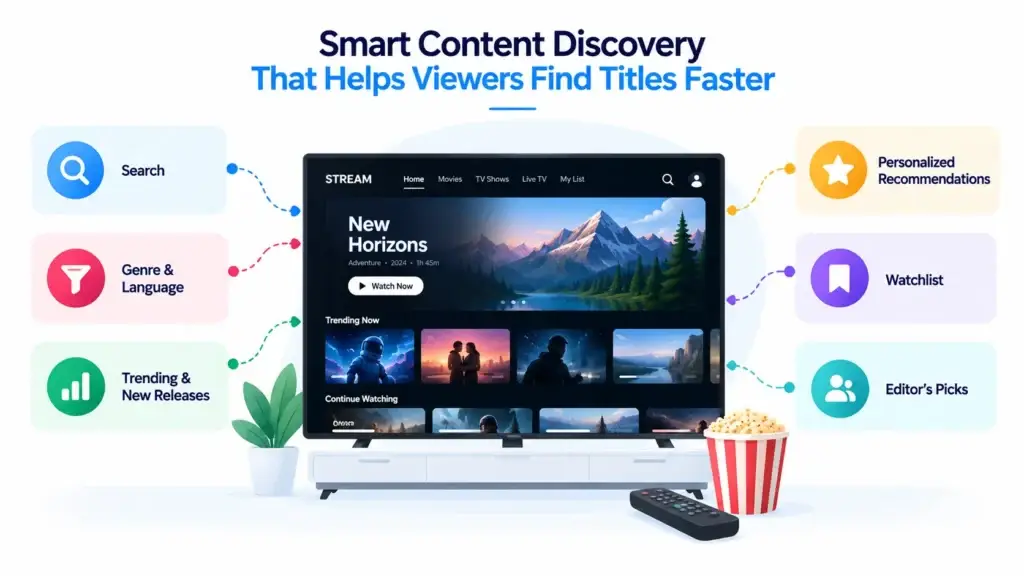
Content discovery is one of the biggest competitive factors in OTT products. If viewers cannot quickly find something relevant, they may leave even when the platform has good content.
Strong discovery features include:
- Search bar
- Genre filters
- Language filters
- Category pages
- Trending content rows
- New release sections
- Recently added rows
- Recommended content
- Popular in your region
- Editor’s picks
- Continue Watching
- Watchlist
- Actor, director, or creator pages where relevant
- Content tags and metadata
Search should not only match exact titles. It should also help users discover by genre, language, mood, topic, cast, content type, or release category.
For example, a regional entertainment platform may need language-first discovery. An education streaming platform may need topic and skill-based discovery. A sports or event-led platform may need date-based discovery and live-event reminders.
For readers who want a broader product checklist, this OTT platform feature list explains important user, admin, content, subscription, and streaming features that support a stronger content experience.
2. Personalized Recommendations That Improve Repeat Viewing
Personalization helps an OTT platform feel relevant to each viewer.
Instead of showing every user the same homepage, a competitive platform should gradually learn from user behavior.
Useful recommendation signals include:
- Watch history
- Search history
- Watchlist additions
- Completion rate
- Skipped content
- Favorite genres
- Preferred language
- Device usage
- Recently watched categories
- Rental or subscription behavior
- Family or profile-level preferences
Personalization does not need to be complex at launch. A first version can begin with category-based recommendations, popular titles, language filters, and manual editorial rows. As data grows, the platform can introduce more advanced recommendation logic.
For founders, the goal is not to copy every personalization system at once. The goal is to make the viewer feel that the platform understands what they want to watch next.
3. Smooth Video Playback and Adaptive Streaming
The video player is the heart of the OTT experience. A viewer may tolerate a simple interface, but they will not tolerate constant buffering, failed playback, poor audio, or broken subtitles.
Important playback features include:
- Fast video loading
- Adaptive bitrate streaming
- Pause, play, rewind, and forward controls
- Full-screen mode
- Resume playback
- Subtitle support
- Multiple audio tracks where relevant
- Quality selection
- Playback speed where useful
- Trailer playback
- Error handling
- Device compatibility
- Secure streaming workflows where required
Adaptive streaming is especially important because viewers use different devices and network conditions. The platform should adjust video quality based on connection strength instead of forcing one fixed quality.
A competitive OTT product should also plan for CDN delivery, video encoding, compression, storage, and playback monitoring. These technical layers directly affect the viewing experience.
4. Continue Watching and Watchlist Features for Retention
Retention improves when viewers can easily return to what they started.
Two simple but powerful features are Continue Watching and Watchlist.
Continue Watching helps users resume unfinished content without searching again. Watchlist helps users save content for later. Together, they reduce friction and increase return sessions.
These features are useful because not every viewer completes a title in one sitting. A user may start a film on mobile, continue on TV, and finish later on another device. The platform should remember progress and make the next step easy.
Useful retention features include:
- Continue Watching row
- Watchlist
- Viewing history
- Resume from last position
- New episode alerts
- Saved collections
- “Because you watched” rows
- Reminder notifications
- Recently viewed categories
For founders, retention features are not small UX details. They help protect subscription value after the first viewing session.
5. Multi-Profile and Household Viewing Support
OTT platforms often serve families, groups, teams, or shared households. Multi-profile support helps each viewer receive a more relevant experience.
A strong profile system may include:
- Separate viewing history
- Separate watchlists
- Age-based profiles
- Kids profile
- Parental controls
- Language preference per profile
- Personalized recommendations per profile
- Profile avatars
- Restricted content settings
This matters because one account may include multiple viewing preferences. Without profiles, recommendations can become messy. A parent’s watch history, a child’s cartoons, and a teenager’s interests may all affect the same homepage.
Multi-profile support improves both personalization and user satisfaction.
6. Subtitles, Audio Options, and Accessibility Features
A competitive OTT platform should not assume every viewer watches content in the same way.
Subtitles, captions, audio options, and accessibility features can expand reach and improve viewing comfort.
Important accessibility and language features include:
- Subtitles
- Closed captions
- Multiple audio tracks
- Language filters
- Audio description where relevant
- Clear player controls
- Readable typography
- Mobile-friendly UI
- Keyboard navigation for web where relevant
- Content rating labels
For regional or multilingual platforms, subtitles and language filters can be a major growth feature. They help users discover content outside their primary language and make the catalog more useful across markets.
7. Flexible Monetization Features That Match Content Value
OTT platforms can earn through different models. A competitive product should not lock founders into only one revenue path.
Common OTT monetization features include:
- Monthly subscriptions
- Annual subscriptions
- Free trials
- Freemium access
- One-time rentals
- Pay-per-view events
- Premium releases
- Coupons
- Promo codes
- Ads
- Sponsored placements
- Producer revenue sharing
- Corporate access
- Educational bundles
Each model needs different product workflows.
Subscriptions need recurring billing and plan control. Rentals need expiry logic. Pay-per-view needs event-level access. Producer revenue sharing needs reporting and payout workflows. Coupons need campaign management and expiry rules.
For a deeper revenue breakdown, review Miracuves’ OTT streaming platform business model guide, covering subscriptions, rentals, pay-per-view, producer revenue sharing, ads, and premium content models.
8. Content Management System for Catalog Control
A competitive OTT platform needs a strong content management layer.
The admin team should be able to upload, organize, edit, approve, schedule, and promote content without depending on developers for every update.
Important content management features include:
- Video upload
- Thumbnail upload
- Trailer upload
- Title and description fields
- Genre management
- Language management
- Cast or creator metadata
- Content rating
- Release date
- Featured banners
- Content scheduling
- Series and episode management
- Premium access settings
- Rental settings
- Approval workflow
- Content status control
- Bulk upload support where relevant
Content operations affect marketing. If the team cannot quickly feature a new release, create a seasonal collection, update banners, or promote a rental title, the platform loses campaign speed.
A good content management system makes the platform easier to operate after launch.
9. Subscriber Acquisition Features Built Into the Platform
Marketing does not happen only outside the product. The platform itself should support acquisition.
Useful acquisition-support features include:
- Public landing pages
- Shareable title pages
- Trailer previews
- App store-ready screenshots and descriptions
- Referral codes
- Promo codes
- Free preview access
- SEO-friendly content pages
- Social sharing buttons
- Email capture
- Campaign landing pages
- Deep links to content
- Trial signup flow
These features help turn visitors into viewers and viewers into subscribers.
For example, a trailer page can help users understand the value of a title before signing up. A referral code can encourage existing users to invite friends. A promo code can support launch campaigns. SEO-friendly title pages can help users discover specific content through search.
10. Notifications and Release Alerts That Bring Viewers Back
OTT retention depends on repeat viewing. Notifications can help, but only when they feel relevant.
Useful notification triggers include:
- New episode release
- New movie added
- Live event starting
- Rental expiring soon
- Watchlist title available
- Continue Watching reminder
- Subscription renewal reminder
- Personalized recommendation
- Seasonal collection launch
- Offer or coupon alert
Founders should avoid sending generic notifications too often. Notifications should be based on user interest, viewing history, subscription status, and content relevance.
A strong notification system helps users return without feeling interrupted.
11. Admin Dashboard for Platform Operations
The admin dashboard is the control room of the OTT business.
A competitive platform should give operators control over users, content, plans, payments, reports, campaigns, and support workflows.
The admin dashboard should help the team manage:
- Users
- Subscriptions
- Rentals
- Pay-per-view access
- Content catalog
- Producers
- Content approvals
- Coupons
- Banners
- Notifications
- Revenue reports
- Payouts
- Watch-minute data
- Support issues
- Refund workflows
- Analytics
- Roles and permissions
Without admin control, every campaign or content update becomes slow. That hurts execution because OTT teams need to react quickly to content performance, user feedback, subscription trends, and partner requests.
If your platform needs structured content, producer, and viewer-side modules, explore Miracuves’ complete OTT platform feature breakdown for a clearer view of catalog, streaming, subscription, and admin workflows.
12. Analytics That Help Improve Discovery, Viewing, and Retention
Analytics help founders understand what viewers actually do.
A competitive OTT platform should track product, content, revenue, and retention metrics.
Useful analytics include:
- New users
- Active users
- App installs
- Trial starts
- Subscription conversions
- Rental purchases
- Pay-per-view purchases
- Watch time
- Completion rate
- Drop-off points
- Search queries
- Most watched titles
- Least watched titles
- Continue Watching usage
- Watchlist usage
- Churn rate
- Renewal rate
- Revenue by plan
- Revenue by content type
- Campaign source
- Producer performance
Analytics should influence business decisions. If users search for content that is not available, it may reveal licensing demand. If viewers drop off early, content quality or playback may need review. If subscriptions spike after one campaign, that audience segment may deserve more focus.
13. Security, Access Control, and Trust Features
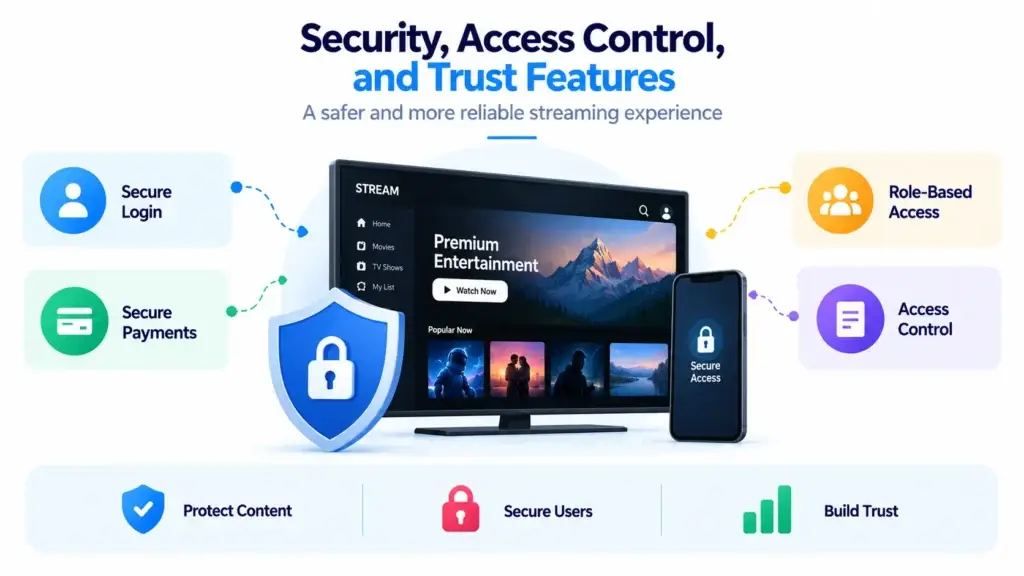
OTT platforms handle user accounts, payments, content access, subscription data, and sometimes producer payouts. Security should be treated as a foundation, not an add-on.
Important trust and security features include:
- Secure login
- Encrypted data transfer
- Secure payment gateway integration
- Role-based access control
- Admin activity logs
- Content access rules
- Subscription status checks
- Payment verification
- Refund and support workflows
- Account management
- Device/session management
- Abuse reporting where relevant
For premium content platforms, access control is especially important. The system should know who can watch which content, for how long, and under which plan or rental rule.
Founders should also plan clear privacy, payment, and content-access policies based on their operating market and legal review.
14. Multi-Device Experience for Modern Viewers
Viewers do not watch only on one device. A competitive OTT platform should consider mobile, web, tablet, and TV-style experiences depending on launch scope.
Useful multi-device features include:
- Mobile app support
- Web streaming
- Tablet-friendly design
- Smart TV roadmap where relevant
- Cross-device Continue Watching
- Account sync
- Responsive layouts
- Secure session handling
- Consistent watchlist across devices
- Push and email notifications
Not every startup needs every device at launch. Many founders begin with web and mobile, then expand based on user behavior and business demand.
The key is to avoid building a platform that cannot expand later.
15. Performance and Streaming Infrastructure
A competitive OTT platform needs reliable infrastructure behind the screen.
Important infrastructure layers include:
- Cloud hosting
- Video storage
- Encoding
- Compression
- CDN delivery
- Streaming protocol planning
- Database design
- API performance
- Payment gateway reliability
- Monitoring
- Backup workflows
- Error tracking
- Scalable admin operations
Performance affects acquisition and retention. If the platform loads slowly or videos fail during peak viewing hours, marketing spend can be wasted.
For a technical build perspective, read this OTT streaming app developer guide to understand platform setup, architecture, backend planning, and development workflow.
Feature Priority Table: What to Build First vs Later
OTT Feature Priority Matrix
| Feature Group | Launch Priority | Why It Matters |
|---|---|---|
| Video playback, login, content catalog, search | Must-have | Creates the basic viewing experience |
| Subscriptions, rentals, payments, access control | Must-have if monetized | Connects content access with revenue |
| Continue Watching, watchlist, history | High priority | Improves retention and repeat viewing |
| Recommendations and personalized rows | High priority | Improves discovery and engagement |
| Admin dashboard and analytics | Must-have | Helps operators manage content, users, revenue, and performance |
| Coupons, referrals, public title pages | Growth priority | Supports acquisition and campaign execution |
| Advanced personalization and multi-device expansion | Scale-stage priority | Useful once viewer data and platform demand increase |
Founder Decision Signals
Discovery
If users cannot find relevant content quickly, prioritize search, categories, metadata, recommendations, watchlists, and personalized rows.
Viewing Quality
If playback quality is weak, invest in adaptive streaming, CDN delivery, subtitles, resume playback, device support, and performance monitoring.
Retention
If users subscribe for one title and leave, strengthen Continue Watching, release alerts, watchlists, recommendations, new content scheduling, and win-back workflows.
Launch Speed
If the goal is faster market validation, begin with a launch-ready foundation and customize around your audience, catalog, monetization, and retention strategy.
Development Cost and Build Path Considerations
Competitive OTT features affect development cost because each feature adds product, backend, testing, infrastructure, and integration work.
Major cost drivers include:
- Mobile, web, and TV platform scope
- Video player complexity
- CDN and streaming infrastructure
- Subscription, rental, and payment workflows
- Content management requirements
- Recommendation depth
- Multi-profile support
- Producer workflows
- Analytics dashboard
- Admin dashboard complexity
- Security and access control
- Custom branding
- Third-party integrations
- Post-launch customization
If budget planning is part of your launch decision, this OTT platform development cost guide explains how features, integrations, streaming infrastructure, and customization affect the final investment.
A ready-made foundation can reduce setup time when the core modules already match the business model. A custom build may be better when the product needs unusual workflows, enterprise integrations, or a highly specialized architecture.
Common Feature Planning Mistakes OTT Founders Should Avoid
1. Building a catalog without discovery logic
A large content library does not help if users cannot find relevant titles. Search, filters, categories, metadata, and recommendations should be planned early.
2. Treating playback as a simple video player
OTT viewing depends on streaming infrastructure, adaptive playback, CDN delivery, subtitles, resume logic, and device compatibility. The player is only one part of the experience.
3. Ignoring retention features
Subscriptions weaken when users do not return. Watchlists, Continue Watching, reminders, personalized suggestions, and new release alerts help build repeat viewing habits.
4. Adding monetization without access rules
Subscriptions, rentals, premium access, and pay-per-view need clear content access rules, expiry logic, payment verification, and admin controls.
5. Underbuilding the admin dashboard
Founders need control over users, content, plans, payments, coupons, banners, analytics, approvals, refunds, and support workflows. Weak admin control slows growth operations.
How Miracuves Helps Founders Launch Competitive OTT Platforms Faster
Miracuves helps founders, media companies, agencies, and content-led startups launch OTT streaming platforms with ready-made, white-label, source-code-owned foundations.
Instead of building every module from zero, founders can start with core OTT workflows and customize the product around audience, content strategy, monetization, branding, admin control, and future growth.
A launch-ready OTT foundation can support:
- Viewer registration
- Content catalog
- Video streaming
- Subscriptions
- Rentals
- Pay-per-view access
- Watchlist
- Continue Watching
- Admin dashboard
- Content approvals
- Producer workflows
- Revenue reporting
- Coupons
- Banners
- Analytics
- Platform branding
Where the ready-made scope fits the business requirement, Miracuves can support 6-day solution delivery. Advanced customizations, integrations, Smart TV expansion, DRM, unique payment workflows, and scale-specific infrastructure can be planned based on the final roadmap.
Founders comparing build partners can read this OTT platform development company guide before choosing a team for launch, customization, source-code ownership, and support.
If you are evaluating a faster launch path, explore Miracuves’ ready-made OTT streaming platform foundation. You can also explore Miracuves’ broader video content platform solutions if you are planning an OTT, creator, or video-first entertainment product.
Related reading: Build vs Buy for an iOS OTT Streaming Platform.
Final Thoughts: Competitive OTT Platforms Are Built Around Discovery, Viewing, and Retention
A competitive OTT streaming platform is not defined by one feature. It is defined by how well the full product experience supports viewers, content teams, and business operations.
Viewers need fast discovery, smooth playback, personalization, watchlists, subtitles, and reminders. Founders need monetization flexibility, content management, analytics, admin control, and scalable infrastructure. Content teams need simple workflows for uploading, organizing, promoting, and measuring content.
The stronger approach is to build features around business outcomes: better discovery, better viewing, better retention, and better operational control.
Miracuves helps founders move faster with ready-made, white-label, source-code-owned OTT platform foundations built for customization, admin control, monetization, content workflows, and long-term growth.
FAQs
What makes an OTT streaming platform competitive?
An OTT platform becomes competitive when it offers strong content discovery, smooth playback, personalized recommendations, flexible monetization, retention features, analytics, and admin control.
Which OTT features improve content discovery?
Search, genre filters, language filters, categories, trending rows, recommendations, watchlists, Continue Watching, title pages, and metadata all help viewers discover content faster.
What viewing features matter most for OTT platforms?
Important viewing features include adaptive streaming, resume playback, subtitles, multiple audio options, quality selection, full-screen playback, multi-device support, and fast video loading.
How do OTT platforms improve viewer retention?
OTT platforms improve retention through Continue Watching, watchlists, personalized recommendations, new release alerts, viewing history, multi-profile support, notifications, and regular content updates.
What monetization features should an OTT platform include?
An OTT platform can include subscriptions, rentals, pay-per-view, premium content, coupons, ads, producer revenue sharing, corporate access, and sponsored placements depending on the business model.
Why is admin control important in an OTT platform?
Admin control helps platform operators manage users, content, subscriptions, rentals, payments, coupons, banners, producers, approvals, analytics, refunds, support issues, and roles.
Should founders build every OTT feature in the first version?
No. Founders should prioritize must-have features first: video playback, content catalog, login, search, payments, subscriptions or rentals, admin dashboard, analytics, watchlist, and Continue Watching. Advanced personalization and multi-device expansion can come later.
Can Miracuves help launch an OTT streaming platform quickly?
Yes. Miracuves helps founders launch ready-made and white-label OTT streaming platforms with source-code ownership, branded design, admin dashboards, content workflows, monetization modules, and faster deployment. Where the ready-made scope fits, 6-day solution delivery can support faster market entry.
Miracuves is an independent software development company. We are not affiliated with, connected to, sponsored by, or endorsed by any company or product named in this article.
Terms such as “X Clone” are used descriptively. It is how the software industry refers to building a platform with functionality comparable to a known service, and how clients search for it.
The entire design and codebase of our products is built by our own team. Our products contain no code, design, graphics, or content originating from any third-party website or applications.
All third-party names and marks referenced in this article are the property of their respective owners, referenced solely to identify the services discussed.



