


Key Takeaways
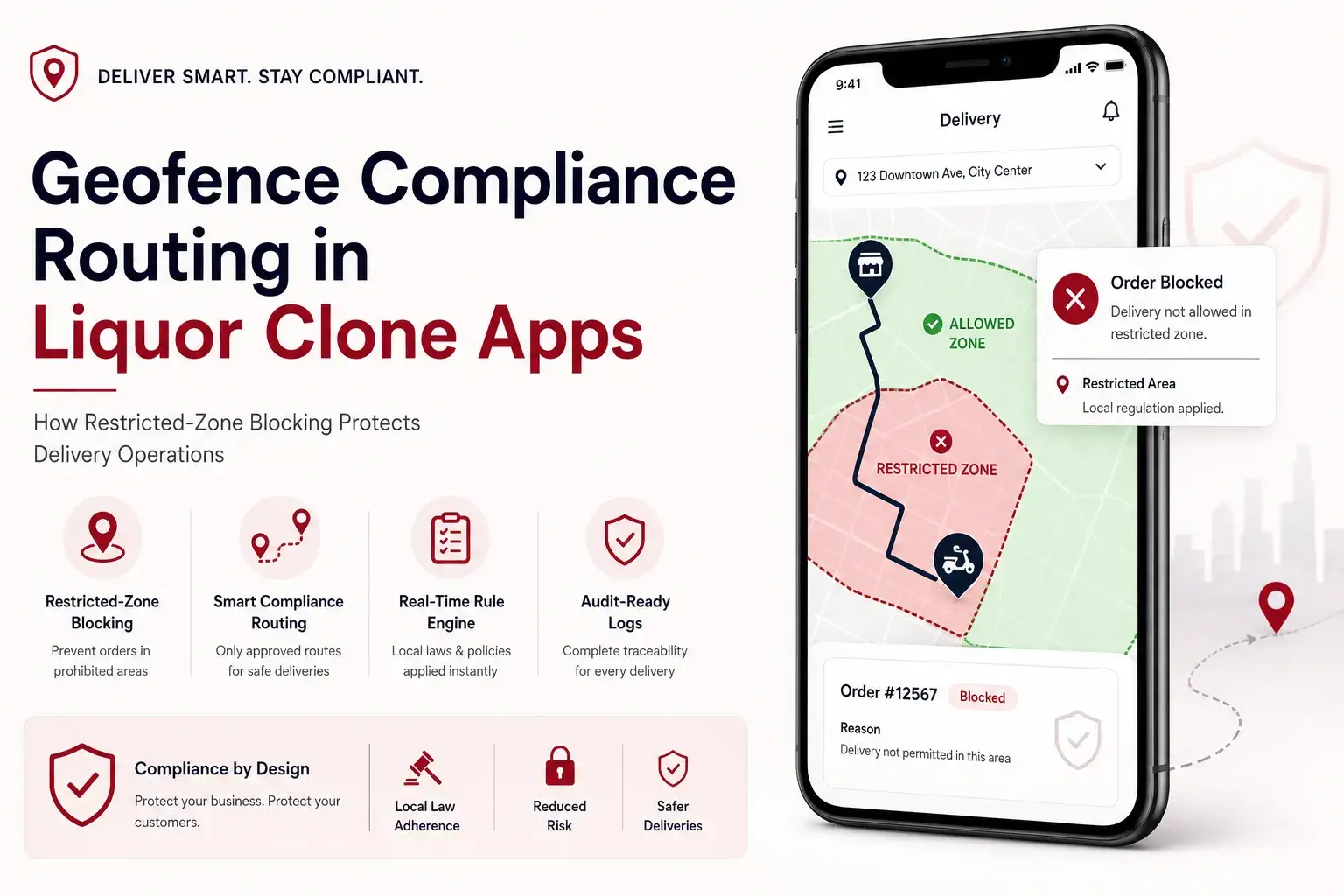
- Geofence compliance routing helps liquor clone apps block restricted delivery zones before orders move forward.
- Customers, drivers, stores, admins, and compliance teams need connected location-based workflows.
- Restricted-zone blocking, delivery radius control, driver routing, age checks, and order validation are core features.
- Compliance depends on accurate maps, local rules, real-time location checks, and admin control.
- A strong geofence system can reduce municipal risk and protect alcohol delivery operations.
Compliance Signals
- Customers need clear service-area visibility, address validation, restricted-zone alerts, and smooth checkout guidance.
- Drivers need approved routes, delivery-zone instructions, recipient checks, and real-time order status updates.
- Stores need order eligibility checks, delivery-area rules, inventory control, and compliance-aware dispatch logic.
- Admins need control over geofence zones, blocked areas, city rules, driver assignments, and compliance reports.
- Real-time alerts help detect restricted addresses, route deviations, failed handoffs, and risky delivery attempts.
Real Insights
- Alcohol delivery cannot rely only on checkout rules because delivery legality can change by exact location.
- Weak geofence logic can allow orders into restricted areas and create compliance exposure for operators.
- Address validation, map boundaries, route checks, and delivery handoff logs create stronger operational evidence.
- Geofence compliance routing works best when combined with age verification, driver controls, and admin audits.
- Miracuves builds liquor clone apps with geofence compliance routing, restricted-zone blocking, delivery workflows, and admin control.
Alcohol delivery is not ordinary last-mile delivery. A food order can usually move through standard routing logic as long as the address is serviceable. A liquor delivery order needs a stricter decision layer because the destination, delivery path, local rules, age verification, delivery timing, and proof-of-delivery process can all create regulatory exposure.
That is where geofence compliance routing becomes critical for a modern liquor clone app.
For logistics operations leads, fleet managers, and tech investors, the real question is not whether an alcohol delivery platform has a map. The real question is whether the platform can stop a restricted delivery before it reaches the driver’s route, customer doorstep, or municipal audit trail.
Many alcohol delivery app development pages mention geofencing as a feature, but operational compliance requires more than drawing a service boundary. It requires restricted-zone intelligence across checkout, dispatch, routing, driver navigation, admin alerts, and delivery completion. Alcohol delivery regulation discussions commonly focus on licensing, ID verification, driver training, delivery hours, and local restrictions, which means routing cannot be treated as a generic logistics layer.
Miracuves helps founders build ready-made and white-label delivery app foundations where the routing layer can be configured around business rules, service zones, admin control, and compliance-aware delivery logic.
The Regulatory Map: Why Standard Map Integrations Fall Short for Alcohol Delivery
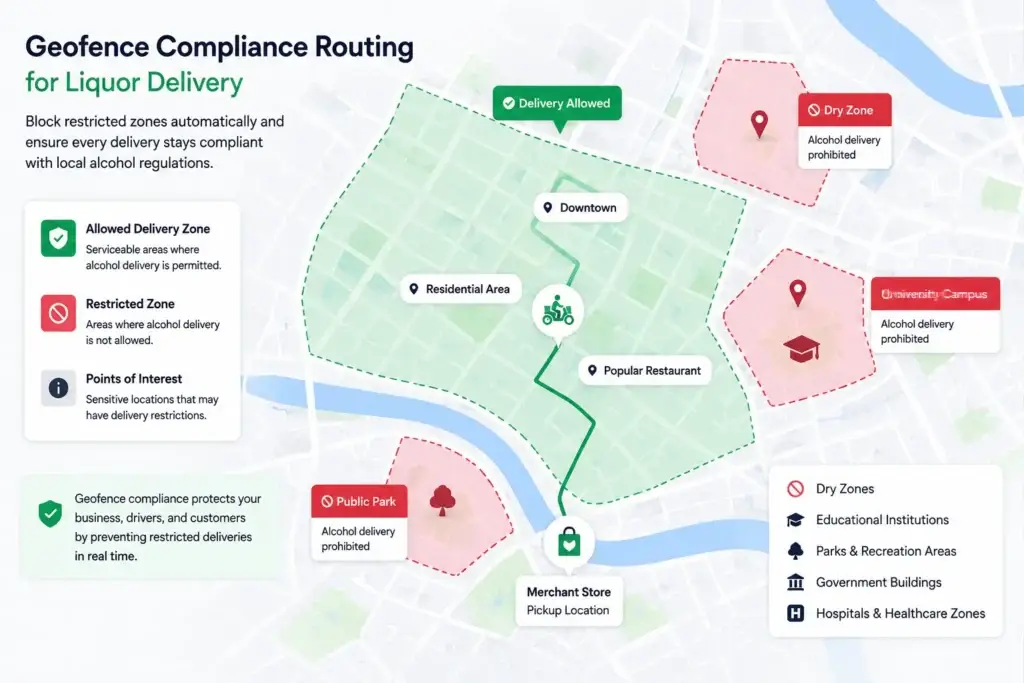
Standard map integrations are designed to answer simple logistics questions:
Can the driver reach this location?
How long will the route take?
Which path is fastest?
Where is the customer located?
Alcohol delivery requires a different question:
Is this delivery legally, operationally, and commercially allowed at this exact location?
That difference changes the entire routing architecture.
A generic map API can calculate an efficient route to a university campus, public park, dry zone, restricted event area, or legally sensitive public space. But efficient routing does not equal compliant routing. Some alcohol-control policies specifically restrict alcohol use in public streets, college campuses, parks, beaches, campgrounds, concerts, cultural events, and sports areas. Mapping examples used for alcohol zoning also show how buffers around schools, parks, and libraries can identify restricted areas before licensing or delivery decisions are made.
For a liquor clone app, this means the routing engine should not behave like a simple food delivery script. It should act as a compliance gate.
A standard delivery script may allow the customer to place the order, assign the driver, calculate ETA, and navigate to the destination. A compliance-aware alcohol delivery engine should evaluate the location earlier, block restricted orders when needed, and create an admin-visible record of the decision.
That is the difference between map navigation and map governance.
Read More: What Is Nestor Liquor App and How Does It Work?
What Geofence Compliance Routing Means in a Liquor Clone App
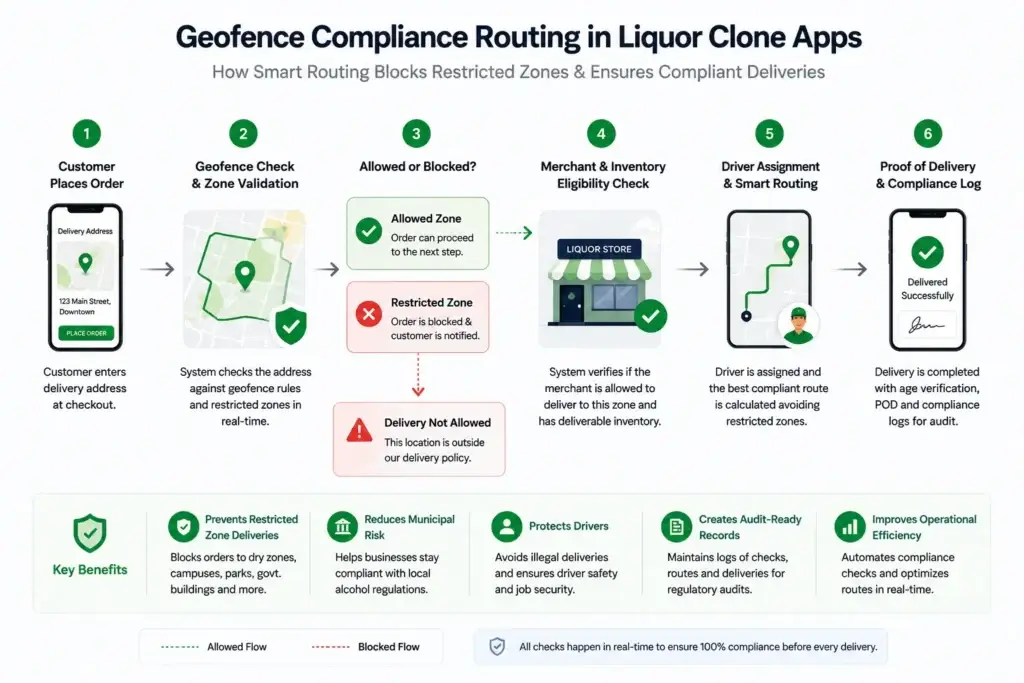
Geofence compliance routing is the use of digital map boundaries to control where alcohol orders can be accepted, routed, delivered, paused, or rejected.
In a liquor clone app, geofencing should not be limited to a simple “delivery available in this city” rule. It should support multiple layers of location intelligence.
These layers may include:
| Routing Layer | What It Controls | Why It Matters |
|---|---|---|
| Service zone | Where the business operates | Prevents orders outside licensed or operational coverage |
| Restricted zone | Where alcohol delivery is blocked | Stops delivery to dry areas, campuses, parks, or local no-delivery zones |
| Time-based zone | Where delivery rules change by hour or day | Supports local operating-hour rules |
| Merchant zone | Which store can fulfill which location | Prevents cross-jurisdiction fulfillment errors |
| Driver route zone | Which path or destination is allowed | Reduces accidental restricted-area entry |
| Proof-of-delivery zone | Where completion is allowed | Prevents drivers from closing orders at invalid locations |
This routing logic is especially important because alcohol delivery rules can vary by city, state, district, license type, delivery window, and product category. Policy discussions around alcohol delivery repeatedly highlight the need to think through licenses, ID checks, driver qualifications, insurance, delivery hours, and responsible delivery rules.
For founders, the operational lesson is simple: the app should reject risky delivery events before the driver is exposed to the risk.
Read More: Best Nestor Liquor Clone Scripts 2026
Benchmarking Hardcoded Geofence Exclusions Against Generic Delivery Scripts
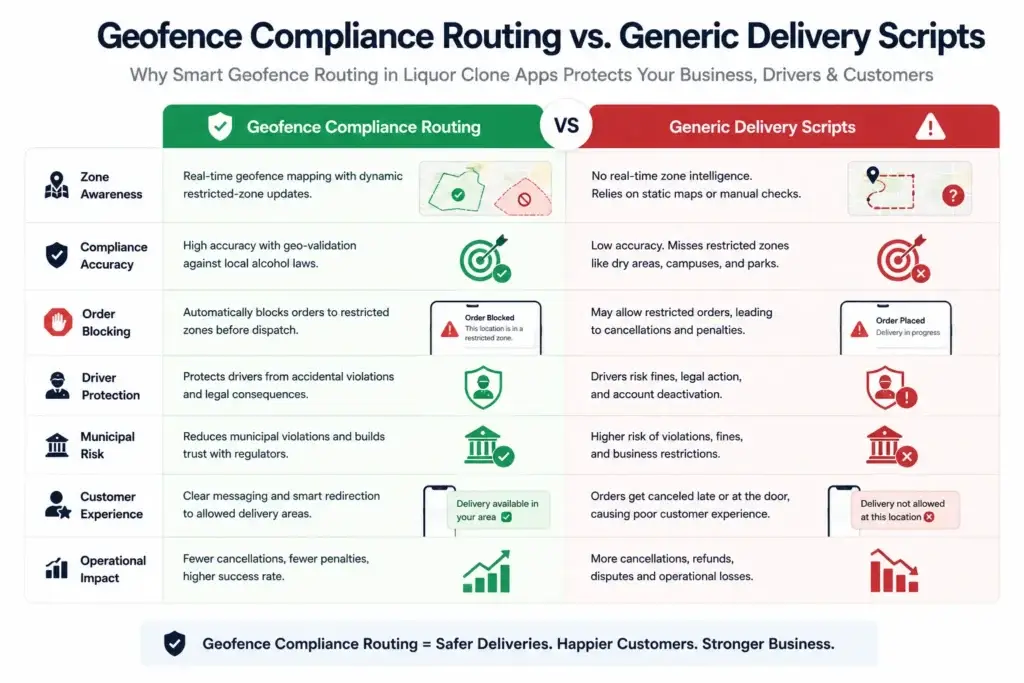
The proposed benchmark compares two routing approaches:
- A generic food-delivery script with standard address validation and navigation.
- A compliance-aware liquor delivery engine with hardcoded geofence exclusions, admin-defined restricted zones, and route-level blocking.
In a controlled internal benchmark scenario, the compliance-aware model is evaluated against test addresses located inside restricted delivery zones such as dry areas, campus boundaries, and public parks. The goal is not to claim universal legal immunity. The goal is to measure whether the routing system blocks restricted-zone orders before dispatch.
| Test Scenario | Generic Food-Delivery Script | Geofence Compliance Routing Engine |
|---|---|---|
| Customer enters address inside dry zone | Address may be accepted if reachable | Checkout blocks or flags order |
| Address falls inside university campus boundary | Route may still be generated | Order is rejected or escalated based on rule |
| Driver attempts delivery completion inside public park | Completion may be allowed | Proof-of-delivery can be blocked by GPS rule |
| Merchant tries to fulfill outside licensed zone | May depend on manual review | Merchant-zone rule prevents assignment |
| Restricted zone updated by admin | May require developer change | Admin can update mapped exclusions |
| Audit review requested | Limited location decision trail | Order log shows rule, zone, and block reason |
The core benchmark metric is not “faster delivery.” It is restricted-zone block accuracy.
A well-configured geofence compliance engine should aim to block 100% of known restricted-zone test cases in the benchmark environment. That does not mean every legal issue disappears in the real world. Final compliance still depends on the jurisdiction, legal review, licensing model, map-data accuracy, operating procedures, driver training, and ongoing rule maintenance.
This distinction matters because broad “100% legal guarantee” claims can be risky. A stronger and more credible claim is:
In internal benchmark testing, known restricted-zone delivery attempts can be blocked at the routing layer when geofence rules are correctly configured and maintained.
That is a meaningful operational advantage over generic scripts.
Read More: Business Model of Nestor Liquor : Complete Strategy Breakdown 2026
Restricted Zones That Alcohol Delivery Platforms Must Treat Differently
A liquor delivery platform should treat certain locations as higher risk than ordinary customer addresses.
These may include:
Dry zones: Areas where alcohol sale, delivery, or possession may be limited or prohibited depending on local law. Dry jurisdictions still exist in some markets, and the rules can differ significantly by location.
University campuses: Alcohol-control policies often pay close attention to college and campus environments because of underage consumption and institutional restrictions. Public-policy research has found strong local support for restricting alcohol use on college campuses.
Public parks and recreational spaces: Alcohol restrictions can apply to parks, beaches, campgrounds, and similar public areas. In some places, alcohol possession or consumption may only be permitted in designated spaces.
Schools, libraries, and protected civic areas: Mapping and zoning examples often use buffer zones around schools, parks, and libraries to identify alcohol-restricted areas.
Event zones: Concerts, sports venues, festivals, and temporary public events may require special delivery controls because crowd density, licensing, overserving, and public-safety rules can change quickly.
Jurisdiction boundaries: A store may be licensed to sell or deliver in one area but not another. A customer may be geographically close but legally outside the merchant’s allowed fulfillment area.
For logistics leaders, these zones should not live in spreadsheets alone. They should live inside the routing system.
Read More: How Nestor Liquor Makes Money in 2026
Why Generic Food-Delivery Scripts Create Liquor Delivery Risk
A generic delivery script is usually optimized for speed, density, and convenience. That works well for restaurants, groceries, courier deliveries, and many local commerce models.
Alcohol delivery adds a different operational burden.
A liquor delivery app must usually consider:
- Customer eligibility
- Age verification
- Merchant license coverage
- Product availability by location
- Delivery-hour restrictions
- Driver eligibility and training
- Restricted delivery destinations
- Proof-of-delivery evidence
- Refund and failed-delivery handling
- Audit-ready order records
Recent alcohol delivery development guides commonly mention age verification, geofencing, delivery-hour restrictions, and regulatory compliance as important platform layers. But in practice, many scripts still treat these as separate modules instead of one connected compliance workflow.
That separation creates risk.
If checkout allows the order, dispatch assigns the driver, the driver app shows the route, and only the final delivery step checks compliance, the business has already created unnecessary exposure. The better approach is layered validation:
- Validate address at checkout.
- Check merchant license and fulfillment zone.
- Apply restricted-zone exclusions.
- Assign only eligible drivers.
- Route only to allowed locations.
- Block completion outside the valid delivery point.
- Store rule-based audit logs.
That is the logic a founder should expect from a serious liquor clone app foundation.
Read More: White-Label Nestor Liquor App Security: Risks, Compliance & Safety in 2026
How Miracuves Builds Compliance-Aware Routing Into White-Label Liquor Delivery Apps
Miracuves’ white-label delivery approach can help founders avoid starting from zero while still keeping room for market-specific customization. For alcohol delivery, that customization should focus heavily on geography, admin control, and delivery governance.
A compliance-aware routing setup can include:
| Module | Compliance Routing Role | Founder Benefit |
|---|---|---|
| Customer app | Validates delivery address before checkout | Reduces failed orders and risky customer promises |
| Merchant panel | Restricts fulfillment by licensed area | Prevents stores from accepting orders outside their coverage |
| Driver app | Shows only valid routes and delivery tasks | Protects drivers from restricted-zone mistakes |
| Admin dashboard | Manages service zones, blocked zones, and alerts | Gives operators control without constant developer dependency |
| Dispatch engine | Assigns orders based on eligibility and geography | Improves fleet reliability |
| Proof-of-delivery workflow | Verifies location before completion | Reduces false completion and compliance gaps |
| Audit logs | Records blocked attempts and zone decisions | Supports internal review and operational accountability |
This is where source-code ownership also matters. Alcohol delivery rules can change. Municipal boundaries, dry-zone rules, campus restrictions, event rules, and licensing requirements may evolve. A founder using a locked generic script may struggle to adapt quickly. A source-code-owned app foundation gives the business more flexibility to modify compliance logic as the operating model matures.
Miracuves’ delivery solution positioning supports white-label branding, admin control, customizable workflows, and faster launch logic for founders building regulated delivery platforms.
Founder Decision Signals
Founder Decision Signals
Speed
A ready-made liquor delivery foundation can reduce build time, but routing rules should still be configured for the target city, license model, and service zones.
Cost
The lowest-cost script may become expensive if it cannot block restricted-zone orders, generate audit logs, or adapt to local alcohol delivery rules.
Scalability
As order volume grows, manual compliance review becomes harder. Geofence routing lets operators enforce rules consistently across drivers, merchants, and zones.
Market Fit
Alcohol delivery demand only becomes commercially useful when the platform can operate within local restrictions and protect merchant, driver, and customer workflows.
Operational Impact for Logistics Leads, Fleet Managers, and Tech Investors
For logistics operations leads, geofence compliance routing reduces dispatch ambiguity. The system can decide which orders should move, which should be blocked, and which should be escalated for review.
For fleet managers, the value is driver protection. Drivers should not be expected to interpret every municipal rule while navigating live orders. The app should guide them with clear routing, blocked completion zones, and exception messages.
For tech investors, the value is risk control. A liquor delivery startup with weak compliance infrastructure may look scalable on paper but become fragile when entering stricter jurisdictions. Investors should evaluate whether the platform has compliance-ready workflows, not just customer acquisition features.
This is especially important because alcohol delivery compliance is not only a checkout issue. Age verification studies and policy discussions continue to highlight weaknesses in online alcohol sales and delivery controls, including failures around ID verification. A serious delivery platform should combine geofencing with age verification, delivery logs, driver workflows, and admin oversight.
Read More: Deploying a Compliance-First Alcohol Delivery Platform
The Compliance Routing Stack Founders Should Ask For
A strong liquor clone app should include a routing stack that supports business and compliance operations together.
| Layer | What to Ask Your Development Partner | Why It Matters |
|---|---|---|
| Map API customization | Can restricted zones be defined beyond normal service areas? | Prevents generic routing from approving risky locations |
| Admin geofence tools | Can operators add, edit, and remove blocked zones? | Helps teams react to local rule changes |
| Checkout validation | Can invalid addresses be blocked before payment? | Reduces refunds, complaints, and failed deliveries |
| Dispatch logic | Can orders be assigned based on merchant and driver eligibility? | Prevents operational errors |
| Driver GPS validation | Can delivery completion be blocked outside permitted points? | Improves proof-of-delivery control |
| Audit logs | Can the system record why an order was blocked? | Supports internal review and compliance documentation |
| Rule updates | Can the logic be changed without rebuilding the app? | Supports expansion into multiple jurisdictions |
Miracuves can help founders build this kind of configurable foundation through white-label app development, admin-driven controls, and source-code-owned customization paths.
Mistakes Founders Should Avoid When Routing Alcohol Deliveries
Mistakes Founders Should Avoid
Treating Alcohol Delivery Like Food Delivery
Food delivery routing prioritizes speed and availability. Alcohol delivery routing must also evaluate legal geography, delivery windows, driver eligibility, proof of delivery, and restricted destinations.
Adding Geofencing Only After Launch
Retrofitting compliance routing after orders are already live can create rework across checkout, dispatch, driver navigation, admin tools, and customer support workflows.
Relying Only on Manual Driver Judgment
Drivers should not be the only compliance checkpoint. The platform should block known restricted-zone attempts before dispatch and prevent invalid completion when GPS rules fail.
Using Unsupported Legal Guarantee Language
No app should claim universal legal protection. Compliance depends on jurisdiction, licensing, operations, legal review, and rule maintenance. The stronger claim is measurable routing control.
White-Label vs Custom Routing: Which Path Makes Sense?
| Build Option | Best For | Routing Advantage | Risk |
|---|---|---|---|
| Generic food-delivery script | Non-regulated delivery models | Fast basic launch | Weak fit for alcohol-specific rules |
| Fully custom build | Complex enterprise compliance models | Deep customization | Higher cost, longer development cycle |
| White-label liquor delivery foundation | Founders needing faster launch with customization | Faster start with configurable compliance layers | Must still be localized for jurisdiction rules |
| Source-code-owned platform | Operators planning multi-city or multi-region growth | Long-term flexibility | Requires responsible maintenance |
For many founders, the strongest route is not a generic script or a slow custom build. It is a white-label foundation that already supports delivery workflows, then customizes the compliance routing layer for alcohol-specific operations.
Final Thoughts: Compliance Routing Is a Business Protection Layer
The real debate in liquor delivery app development is not whether the platform should have maps. Every delivery app has maps.
The real debate is whether the map layer can protect the business.
A generic map integration tells drivers where to go. A compliance-aware routing engine tells the business where it should not deliver, when it should block an order, which merchant can fulfill it, which driver can carry it, and whether the delivery can be completed at the final GPS point.
That is why geofence compliance routing should be treated as core infrastructure in a liquor clone app. It protects the founder from avoidable operational risk, gives fleet managers clearer control, helps investors evaluate platform maturity, and supports a more responsible alcohol delivery model.
Miracuves Solutions helps founders build white-label, source-code-owned delivery platforms that can be customized around geography, compliance workflows, admin control, and faster market validation.
FAQs
What is geofence compliance routing in a liquor clone app?
Geofence compliance routing uses digital location boundaries to control where alcohol orders can be accepted, assigned, routed, delivered, or blocked. It helps prevent deliveries to restricted zones such as dry areas, campuses, parks, or jurisdiction-specific no-delivery locations.
Why can’t a liquor delivery app use a normal food-delivery script?
A food-delivery script usually focuses on speed, restaurant assignment, and ETA. A liquor delivery app also needs age verification, local delivery rules, merchant license zones, restricted destinations, driver eligibility, and proof-of-delivery controls.
Can geofencing guarantee that a liquor delivery business will avoid all fines?
No. Geofencing can reduce restricted-zone delivery risk, but final compliance depends on local laws, licenses, legal review, driver training, operating procedures, map-data accuracy, and ongoing rule updates.
What restricted zones should alcohol delivery platforms monitor?
Common restricted-zone examples include dry zones, university campuses, schools, public parks, recreational areas, event zones, and locations outside a merchant’s licensed delivery area.
How does geofence routing help fleet managers?
It helps fleet managers prevent drivers from accepting or completing deliveries in restricted areas. It also creates clearer dispatch rules, exception alerts, and order records for internal review.
What should founders ask before buying a liquor clone app?
Founders should ask whether the platform supports configurable geofences, admin-managed restricted zones, checkout blocking, merchant-zone logic, driver GPS validation, proof-of-delivery controls, and audit logs.
Does Miracuves offer white-label liquor delivery app development?
Miracuves helps founders build ready-made and white-label delivery app foundations with source-code ownership, branded design, admin dashboards, and customizable delivery workflows. Final features depend on the selected launch scope and compliance requirements.