Key Takeaways
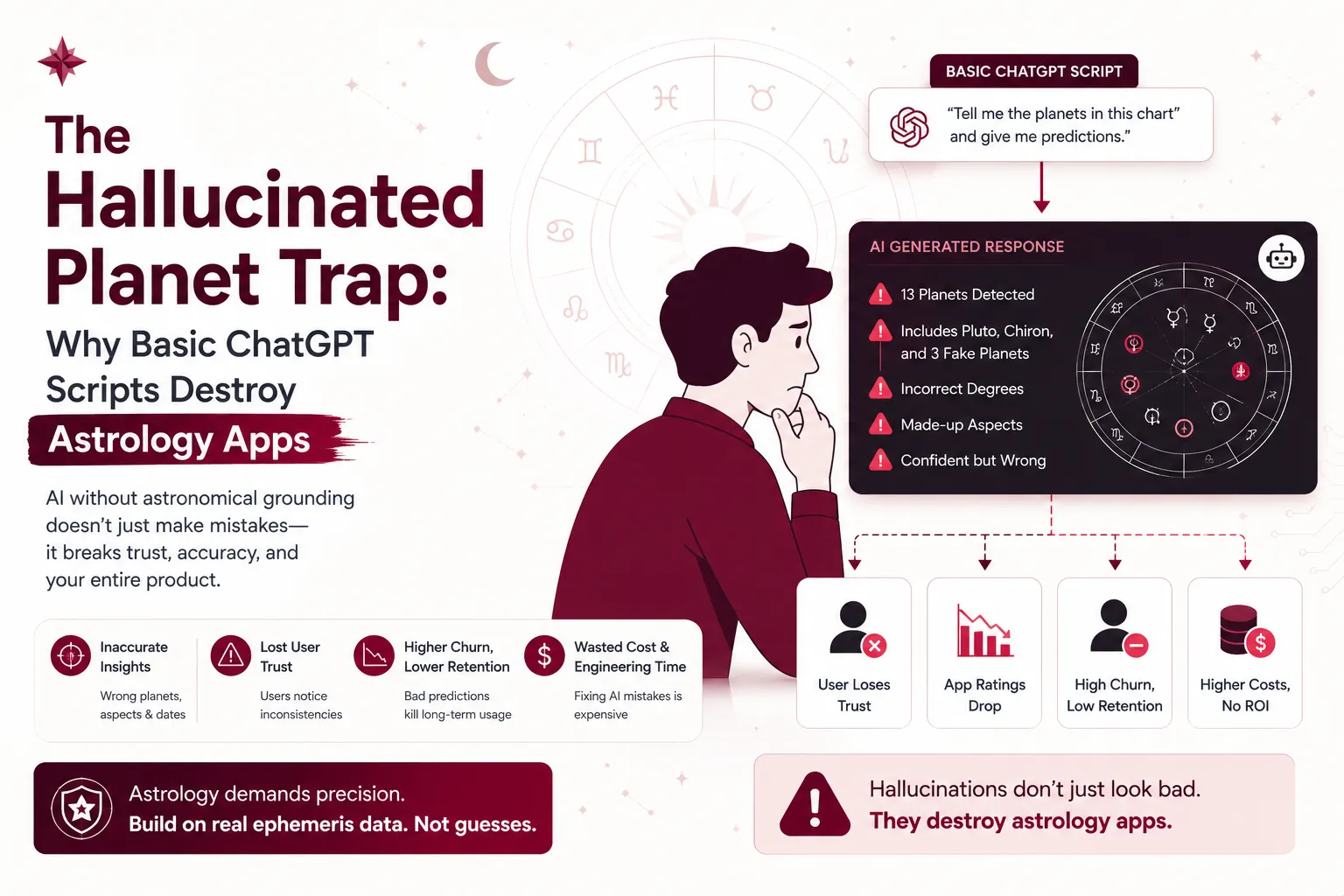
- LLMs should not calculate planetary positions independently.
- Verified ephemeris engines prevent hallucinated chart data.
- Separate astrology calculations from AI interpretation.
- Backend validation improves reading accuracy and trust.
- Reliable architecture reduces AI-generated errors.
Accuracy Signals
- Generate charts using trusted ephemeris libraries.
- Validate planetary positions before AI processing.
- Use structured astrology data instead of raw prompts.
- Log AI outputs for quality review and monitoring.
- Apply safety rules for every generated reading.
Real Insights
- Incorrect planetary data can damage user trust quickly.
- Deterministic calculations should stay outside the LLM.
- AI performs best when interpreting verified chart data.
- Quality controls improve long-term platform credibility.
- Miracuves builds AI astrology platforms with validated ephemeris-driven architecture.
AI astrology app looks simple from the outside. A user enters their birth date, time, and location. The app sends the details to a chatbot. A few seconds later, the user receives a personalized reading that sounds spiritual, emotional, and surprisingly confident.
That is the illusion. After 9 years of business engineering across SaaS, marketplace, consultation, and app ecosystems, one pattern keeps appearing in fast-moving AI products: the interface looks intelligent before the system is trustworthy. In astrology apps, this creates a dangerous technical flaw. Many cheap “AI astrology” scripts do not calculate the chart properly. They simply pass birth details into ChatGPT or another language model and ask it to generate a horoscope.
The problem is that a large language model is not an astronomical calculation engine. It can write. It can summarize. It can interpret structured inputs. But without verified planetary data, it may produce plausible-sounding chart information that is wrong. OpenAI describes hallucinations as plausible but false statements generated by language models, and that is exactly the risk founders face when they ask an LLM to invent birth chart logic from a prompt.
The Illusion of the AI Astrologer
Most users do not see the backend. They see a polished screen, a mystical design system, and a chatbot that speaks with confidence.
That confidence can trick founders too.
A basic AI astrology script may look functional during a demo because the AI response feels human. It may say things like “your Moon in Scorpio creates emotional intensity” or “your Venus placement affects your relationship style.” The writing sounds specific. The tone feels personal. The user experience feels premium.
But the core question is not whether the answer sounds good.
The real question is: where did the planetary positions come from?
If the app did not calculate the natal chart using reliable birth details, time zone handling, location data, house system logic, and ephemeris data, then the AI may be interpreting a chart that never existed. This is the “Hallucinated Planet” variable.
A language model can generate text that sounds astrologically fluent, but that does not mean it has calculated the sky at the user’s birth moment. Research and industry guidance around RAG show that LLMs need external grounding for factual tasks, and RAG helps reduce hallucination by retrieving relevant information before the model generates an answer.
For astrology founders, this means one thing: AI should not be the source of the chart. AI should be the interpreter of a verified chart.
Why Passing a Birthdate to ChatGPT Is Not an Astrology Engine
A birth chart is not a writing prompt. It is a structured astronomical calculation.
A serious astrology app needs to process:
| Input Layer | Why It Matters | What Can Go Wrong in Cheap AI Scripts |
|---|---|---|
| Birth date | Defines the date of planetary position lookup | AI may guess placements based on vague zodiac season logic |
| Birth time | Impacts Moon, Ascendant, houses, and chart angles | Generic prompts may ignore exact chart sensitivity |
| Birth location | Required for house calculation and local sky positioning | App may produce a chart without location-aware correction |
| Time zone | Converts local birth time into usable calculation context | Wrong time zone can shift placements and houses |
| Ephemeris data | Provides planetary positions for a specific date/time | LLM may invent placements if no external data is supplied |
| Interpretation rules | Converts chart structure into readable guidance | AI may mix traditions, overgeneralize, or contradict itself |
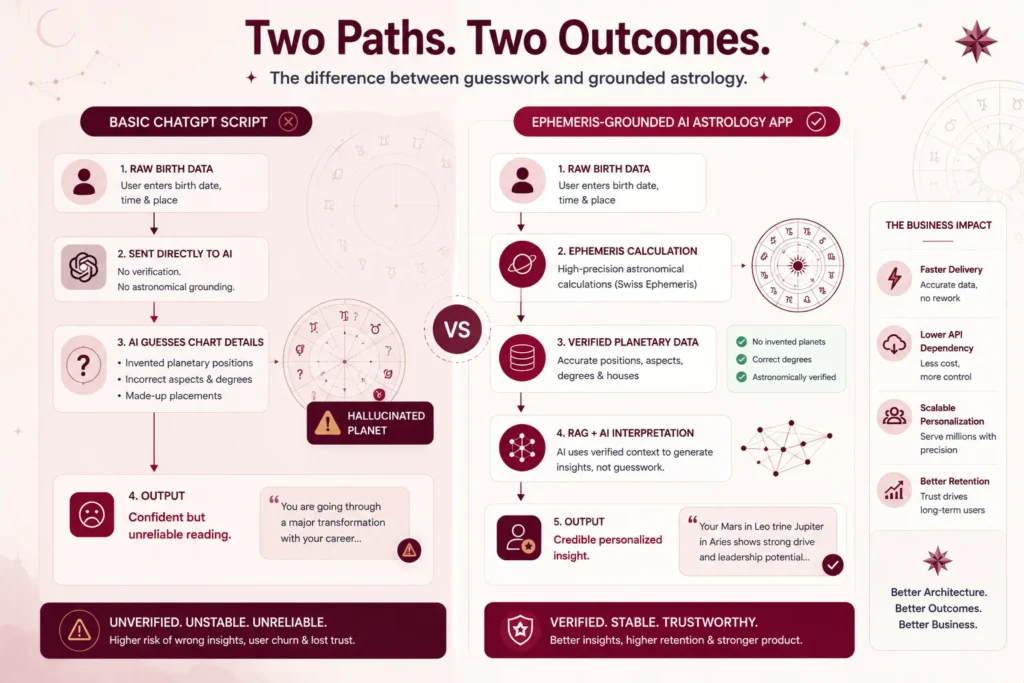
The dangerous shortcut is this:
“User enters birthdate → app sends it to ChatGPT → ChatGPT returns astrology reading.”
That is not AI astrology app development. That is prompt-based storytelling with a spiritual interface.
The better architecture is:
“User enters birth data → system calculates chart using ephemeris logic → structured chart is validated → RAG retrieves relevant interpretation context → LLM writes a human-friendly reading.”
A recent AI astrology technical paper describes an ephemeris computation engine using libraries such as AstroPy and Swiss Ephemeris to calculate planetary positions, house assignments, and aspect patterns before prediction workflows. That architecture reflects the right principle: calculation first, generation later.
Read more : How to Start an Astrology Consulting Business in UAE with a Secure App Platform
The Retention Killer of Wrong Natal Charts
Astrology users are not as passive as many app founders assume.
Many already know their Sun sign, Moon sign, rising sign, Venus placement, or at least one major chart detail from Co-Star, AstroSage, TimePassages, Astrotalk, or a personal astrologer. Influencer-led astrology audiences are often even sharper. They may follow chart breakdowns, compatibility posts, tarot readers, Vedic astrologers, or spiritual coaches daily.
So when your AI astrology app gives them a wrong placement, the trust break is immediate.
They do not think, “The model hallucinated because the backend lacked ephemeris grounding.”
They think:
- “This app is fake.”
- “This brand does not understand astrology.”
- “The reading is not for me.”
- “I cannot recommend this to my audience.”
- “I should cancel before paying.”
This is why inaccurate astrology data is not only a technical problem. It is a retention problem.
A wrong natal chart damages:
| Business Layer | Impact of Wrong Chart Data |
|---|---|
| User trust | Users doubt every future reading |
| Subscription conversion | Users hesitate to pay for premium reports |
| Influencer reputation | Tarot and astrology creators avoid promoting the app |
| Community growth | Users do not share readings they do not trust |
| Support workload | More refund requests and complaints |
| Brand positioning | The app becomes “another AI gimmick” instead of a serious spiritual product |
Teen Vogue’s reporting on AI astrology also highlights a broader market concern: astrologers and users often find AI-generated astrology too general, unreliable, or lacking ethical nuance when used without human judgment and accurate context.
For founders, the takeaway is simple. A beautiful astrology app can survive an imperfect color palette. It cannot survive a wrong birth chart.
The “Hallucinated Planet” Variable Founders Must Test Before Launch
Before launching an AI astrology app, every founder should run a brutal internal test.
Give the app birth details for users whose charts are already known. Then compare the output against a verified chart calculation.
Check whether the app correctly identifies:
- Sun sign
- Moon sign
- Ascendant
- Venus placement
- Mars placement
- Major aspects
- House placements
- Retrograde status where relevant
- Transit references if the app gives current predictions
If the app cannot consistently explain where the chart data came from, the AI layer should not be released.
This is especially important for non-technical founders and astrology influencers. You may not need to personally code the ephemeris engine, but you must know whether one exists. The vendor should be able to explain the data pipeline clearly.
A weak answer sounds like:
“We use ChatGPT to generate personalized horoscopes.”
A stronger answer sounds like:
“We calculate the chart using structured birth data and ephemeris logic, then pass verified placements into an AI interpretation layer.”
That difference decides whether your app is a credible astrology product or a chatbot with zodiac-themed packaging.
Grounding the AI with the Ephemeris-to-RAG Protocol
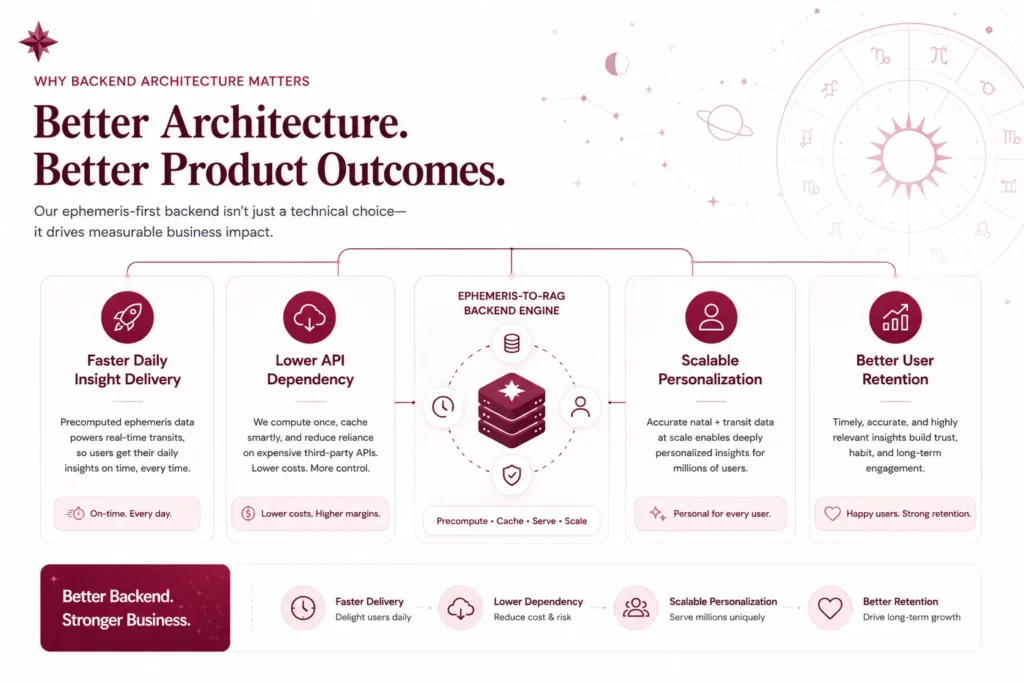
The safest architecture for AI astrology is not “ChatGPT-first.”
It is Ephemeris-to-RAG.
This protocol separates calculation, retrieval, and generation so the AI does not invent the foundation of the reading.
Step 1: Calculate the Chart Before the AI Writes Anything
The system should first process birth date, time, location, and time zone. Then it should calculate planetary positions, houses, aspects, and chart structure using an ephemeris-based calculation layer.
This gives the app verified structured data such as:
- Moon in Taurus
- Venus in Libra
- Mars in Capricorn
- Ascendant in Virgo
- Saturn retrograde in the 7th house
- Sun square Moon
- Jupiter transit over natal Venus
The AI should receive this as structured input. It should not be asked to guess it.
Step 2: Retrieve Interpretation Context from a Controlled Knowledge Base
Once the system has verified chart data, RAG retrieves relevant interpretation material from a controlled astrology knowledge base.
This can include:
- Vedic astrology rules
- Western astrology rules
- Tarot-style guidance frameworks
- Brand-specific tone guidelines
- Safety and ethics rules
- Relationship interpretation logic
- Career interpretation logic
- Transit interpretation rules
NVIDIA explains that RAG grounds LLM output in retrieved data, helping reduce hallucinations and improve factual accuracy. IBM also notes that RAG can reduce hallucination risk, though it cannot make a model completely error-proof.
That caveat matters. RAG is not magic. It is a control layer. It works best when the retrieved data is structured, relevant, and aligned with the product’s interpretation system.
Step 3: Generate the Reading Only After the Data Is Grounded
Only after the chart is calculated and interpretation context is retrieved should the AI generate the user-facing response.
At this point, the AI’s role becomes valuable:
- Translate complex chart data into simple language
- Personalize tone for beginners or advanced users
- Create daily, weekly, or monthly insights
- Explain relationships between placements
- Support multilingual guidance
- Produce summaries for reports, push notifications, or premium content
This is where AI belongs: not as the source of truth, but as the communication layer.
Founder Decision Signals
Founder Decision Signals
Speed
Fast launch matters, but not if the app ships with unverified chart logic. A ready-made astrology app foundation should still include structured calculation and validation workflows.
Cost
A cheap chatbot wrapper may reduce early development cost, but wrong chart data can increase churn, refund pressure, and brand damage after launch.
Scalability
Scaling AI responses is easy. Scaling trust is harder. The backend must separate calculation, retrieval, generation, moderation, and admin review.
Market Fit
Astrology audiences reward emotional resonance, but they also notice incorrect placements. Product-market fit depends on both spiritual tone and technical accuracy.
What an AI Astrology App Should Actually Include
Core AI Astrology App Features and Business Value
| Feature | Business Value | Founder Impact |
|---|---|---|
| Birth chart calculation | Creates accurate natal chart foundation | Protects credibility and reduces user distrust |
| Ephemeris-based planetary data | Grounds chart logic in astronomical position data | Prevents the AI from inventing placements |
| RAG interpretation layer | Retrieves approved astrology knowledge before generation | Keeps answers aligned with brand and astrology framework |
| AI reading generator | Turns structured chart data into readable guidance | Improves engagement without sacrificing data control |
| Astrologer consultation module | Supports paid chat, call, and video sessions | Creates human expert monetization beyond AI content |
| Wallet and payment system | Supports recharge, paid reports, and consultation fees | Enables monetization through multiple revenue streams |
| Admin dashboard | Controls users, astrologers, reports, payments, and content | Gives the platform operator operational control |
| Content safety workflows | Flags harmful, fatalistic, or sensitive AI outputs | Protects users and reduces brand risk |
Miracuves can help founders approach astrology app development as a full product system: user app, astrologer panel, admin dashboard, wallet flows, consultation features, and AI interpretation workflows. For founders exploring an Astrotalk-style model, Miracuves already has related astrology app resources such as its Astrotalk clone script guide and developer guide for building an app like Astrotalk
Read more : PCI-DSS Payments and Wallet Refills in Astrology Consultation Apps
Why Influencer-Led Astrology Apps Need Extra Data Discipline
Tarot readers, astrologers, manifestation coaches, and spiritual influencers face a different kind of risk.
A SaaS founder can sometimes recover from a bad feature. An influencer’s product is tied directly to personal trust. If the app gives wrong chart readings, users do not only blame the software. They blame the person who promoted it.
That is why influencer-led astrology apps should avoid generic AI wrappers.
A creator-branded astrology app should include:
- A verified chart calculation layer
- A defined interpretation style
- Human-reviewed premium content where needed
- Clear boundaries around sensitive topics
- A way to escalate users to human astrologers or advisors
- Admin control over prompts, outputs, and report categories
- A consistent brand voice across free and paid readings
The goal is not to remove AI. The goal is to stop AI from pretending to know what it has not been given.
Mistakes Founders Should Avoid
Building the app around a single ChatGPT prompt
A prompt can create a convincing reading, but it cannot replace chart calculation, ephemeris data, interpretation rules, user profiles, payments, consultation flows, and admin controls.
Assuming emotional language equals personalization
AI can sound intimate while still being wrong. Real personalization begins with accurate user data, verified chart structure, and controlled interpretation logic.
Ignoring astrology power users
Advanced users often know their placements. If your app gets basic chart details wrong, they will identify the issue quickly and may not return.
Launching without output safety rules
Astrology apps can touch emotional, relationship, health, career, and financial anxieties. AI outputs need careful boundaries, review logic, and escalation paths where needed.
Miracuves Perspective: Build the Astrology Engine Before the AI Personality
The next wave of astrology apps will not be won by the brands that add “AI” to every screen.
It will be won by brands that combine accurate calculation, meaningful interpretation, human consultation, monetization, and admin control into one trustable product foundation.
For founders, the practical decision is this:
- Use AI for explanation, personalization, summaries, and scalable engagement.
- Use ephemeris and structured astrology logic for chart truth.
- Use RAG to ground the AI in approved knowledge.
- Use human astrologers where emotional nuance, spiritual responsibility, or premium consultation matters.
- Use admin dashboards to manage content, users, experts, payments, and safety.
Miracuves helps founders build ready-made and white-label app solutions with source-code ownership, branded design, admin control, and faster deployment. For astrology founders, that means the product should not depend on a shallow chatbot wrapper. It should be built as a serious consultation and guidance platform.
Related reading: what makes AI astrology reliable.
Final Thoughts: Trust Is the Real Astrology App Feature
The biggest threat to AI astrology apps is not that users reject AI.
It is that users try the app, see a wrong chart, and never trust the brand again.
The “Hallucinated Planet” trap happens when founders mistake fluent writing for accurate astrology. A language model can make a reading sound beautiful. But if the Moon sign, Ascendant, houses, or aspects are wrong, the product has already failed the user.
The stronger path is not anti-AI. It is AI with discipline.
Calculate the chart. Ground the interpretation. Control the knowledge base. Add human consultation where needed. Then let AI make the experience faster, clearer, and more personal.
That is how founders build astrology apps that feel modern without sacrificing credibility.
FAQs
1. Can ChatGPT create an accurate astrology birth chart?
ChatGPT can explain astrology concepts and generate readable interpretations, but it should not be treated as the calculation engine for a birth chart. A serious astrology app should calculate planetary positions using birth date, time, location, time zone, and ephemeris data before the AI writes the interpretation.
2. Why do AI astrology apps hallucinate planetary positions?
AI astrology apps hallucinate planetary positions when the backend asks a language model to infer chart data instead of passing verified chart calculations. Since LLMs generate plausible text, they may produce confident but incorrect placements if they are not grounded in structured astronomical data.
3. What is the Ephemeris-to-RAG protocol?
The Ephemeris-to-RAG protocol means the app first calculates chart data using ephemeris logic, then retrieves relevant astrology interpretation context through RAG, and only then lets the AI generate the final reading. This reduces the risk of invented chart details.
4. Is RAG enough to make an AI astrology app accurate?
RAG helps ground AI responses in approved data and can reduce hallucination risk, but it does not make an AI system perfect. Accuracy also depends on chart calculation quality, structured prompts, source quality, validation rules, and output safety checks. IBM notes that RAG can reduce hallucinations but cannot make a model error-proof.
5. What features should an AI astrology app include?
A strong AI astrology app should include birth chart calculation, ephemeris data, AI interpretation, RAG knowledge grounding, user profiles, daily horoscopes, kundli or natal chart reports, astrologer consultations, wallet payments, admin dashboard, content moderation, and safety workflows.
6. Is a white-label astrology app better than building from scratch?
A white-label astrology app can help founders launch faster when the foundation already includes user flows, consultation modules, admin control, payments, and customization options. However, founders should verify that the AI astrology layer is properly grounded and not just a basic ChatGPT wrapper.
7. How can astrology influencers protect their brand when launching an AI app?
Astrology influencers should insist on verified chart logic, clear AI boundaries, human-reviewed content where needed, admin control, and a consistent interpretation style. Their audience trusts their personal credibility, so inaccurate AI outputs can damage both the app and the creator brand.
8. Can Miracuves help build an AI astrology app?
Yes. Miracuves helps founders and brand builders create ready-made and white-label app solutions with source code, branded design, admin dashboards, and faster deployment. For astrology apps, the stronger approach is to combine consultation workflows, chart logic, monetization, and AI-ready architecture instead of relying on a basic chatbot script.
Miracuves is an independent software development company. We are not affiliated with, connected to, sponsored by, or endorsed by any company or product named in this article.
Terms such as “X Clone” are used descriptively. It is how the software industry refers to building a platform with functionality comparable to a known service, and how clients search for it.
The entire design and codebase of our products is built by our own team. Our products contain no code, design, graphics, or content originating from any third-party website or applications.
All third-party names and marks referenced in this article are the property of their respective owners, referenced solely to identify the services discussed.