Key Takeaways
- Free sun-sign horoscopes have become a commodity.
- Timeline View creates a premium subscription experience.
- Personalized insights outperform generic daily horoscopes.
- Subscriptions generate stronger recurring revenue than ads.
- Premium personalization increases long-term user retention.
Subscription Signals
- Build Timeline View using birth-chart personalization.
- Offer premium reports and annual forecasts.
- Include paid chat, voice, and video consultations.
- Support wallets, subscriptions, and creator dashboards.
- Track revenue with a centralized admin panel.
Real Insights
- Ads alone rarely build sustainable astrology businesses.
- High-intent users pay for deeper personalized guidance.
- Premium dashboards improve subscription value.
- Brand differentiation matters more than generic content.
- Miracuves builds subscription-ready astrology platforms with Timeline View workflows.
The worst astrology app idea in 2026 is not a bad idea because astrology lacks demand. It is bad because the founder is aiming at the wrong layer of demand.
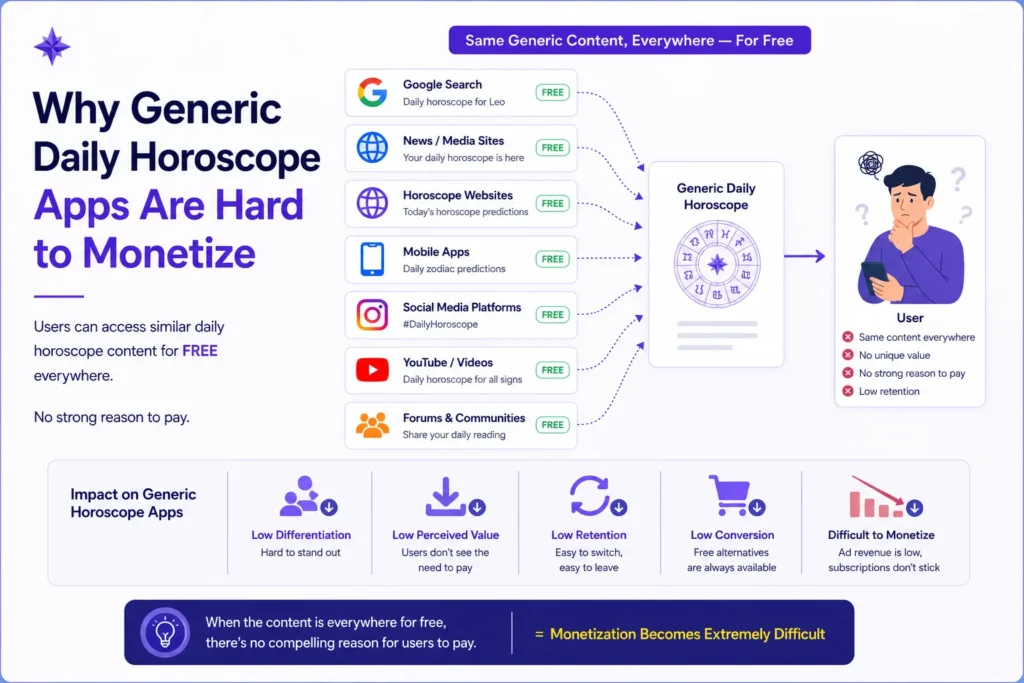
A generic daily sun-sign horoscope app is not a product strategy. It is a commodity content feed competing against free media sites, large horoscope portals, creator accounts, social posts, newsletters, and AI-generated spiritual content. When users can get a free Aries, Leo, Virgo, or Pisces horoscope from major publishers and astrology platforms every morning, charging for the same surface-level content becomes a weak business case. Large media and astrology platforms already provide free daily horoscope and premium report ecosystems at scale.
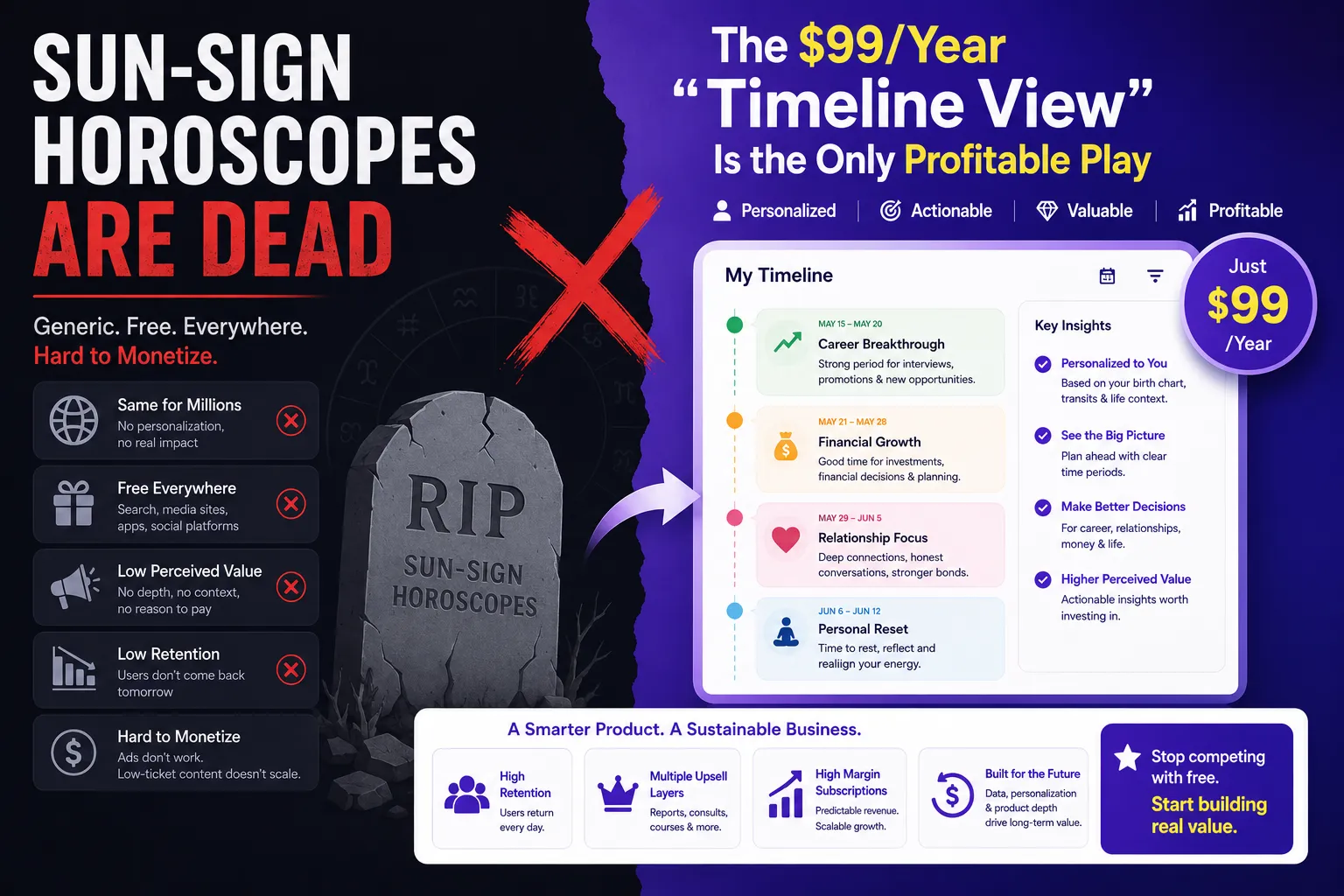
The better play is not “more horoscopes.” The better play is Timeline View.
A Timeline View astrology app turns the user’s birth chart, transits, lunar cycles, personal themes, relationship windows, career cycles, and spiritual milestones into a premium planning experience. It gives high-intent users a reason to subscribe because the product feels personal, layered, and useful beyond entertainment.
That is where a $99/year subscription can make sense.
For wellness tech investors, brand builders, and esoteric content creators, the question is no longer, “How do we monetize daily horoscopes with ads?” The better question is, “How do we build a premium astrology operating system that serious users return to every week?”
Miracuves helps founders and brands launch white-label astrology platforms with source-code ownership, admin control, consultation workflows, premium features, and faster deployment. For a market where speed and differentiation matter, the product architecture matters more than another generic content calendar.
The Commodity Trap of Free Sun-Sign Horoscopes
Sun-sign horoscopes are easy to produce, easy to distribute, and easy to replace.
That is exactly the problem.
The basic format is predictable: choose a zodiac sign, read a few lines about love, career, finance, or mood, and move on. It can drive casual traffic, but casual traffic rarely creates strong subscription intent. Most users do not need a dedicated paid app to read something they can already find through search, news portals, social feeds, or free astrology websites.
This creates a brutal founder reality.
You are not only competing with other astrology startups. You are competing with publishers that already have distribution, SEO authority, editorial teams, and daily content systems. You are also competing with AI astrology tools and free horoscope apps that make basic prediction content feel abundant. AstroSage, for example, positions AI-powered horoscope readings, Kundli generation, and AI astrologer interactions as part of its platform experience.
That means a founder launching a plain daily horoscope app has to fight on weak terms:
| Commodity Horoscope Model | Founder Problem |
|---|---|
| Free daily horoscope feed | Hard to charge for content users already expect free |
| Generic zodiac content | Weak personalization and low switching cost |
| Ad-based monetization | Requires large traffic before revenue becomes meaningful |
| Low-ticket in-app purchases | Small margins and constant conversion pressure |
| Basic push notifications | Easy to uninstall when novelty fades |
The uncomfortable truth is simple: a $0.99 daily horoscope app is not a premium wellness product. It is a disposable content wrapper.
Read more : Astrology App for Saudi Arabia: Features, Payment Gateways, Privacy, and Customization Guide
Why Ads Are the Weakest Monetization Model for Astrology Apps
Ads are the default answer when the product has no pricing power.
That is why “monetize your astrology app with ads” is often bad advice for serious founders. Ads may create supplemental revenue at scale, but they rarely create a defensible wellness technology business by themselves.
An ad-supported horoscope app needs large daily active usage, strong retention, constant content production, ad inventory, analytics, and high session frequency. Even then, the user experience often suffers because the app starts optimizing for impressions instead of transformation.
Astrology users are not all the same. There is a major difference between a casual user reading a free “today’s horoscope” and a high-intent user who wants to understand a Saturn transit, relationship timing, career transition, spiritual cycle, or lunar planning window.
The casual user tolerates ads.
The high-intent user pays to avoid noise.
That distinction should shape the business model.
A premium astrology app should not ask, “How many banner ads can we show?” It should ask:
- What personal insight does the user return for?
- What chart-based experience becomes more valuable over time?
- What premium view can the user not easily recreate on a free website?
- What content or consultation layer makes the subscription feel alive?
- What dashboard helps the user plan, reflect, and act?
This is where the Timeline View becomes powerful.
Read more : How to Start an Astrology Consulting Business in UAE with a Secure App Platform
The Timeline Premium: What High-Intent Esoteric Users Actually Pay For
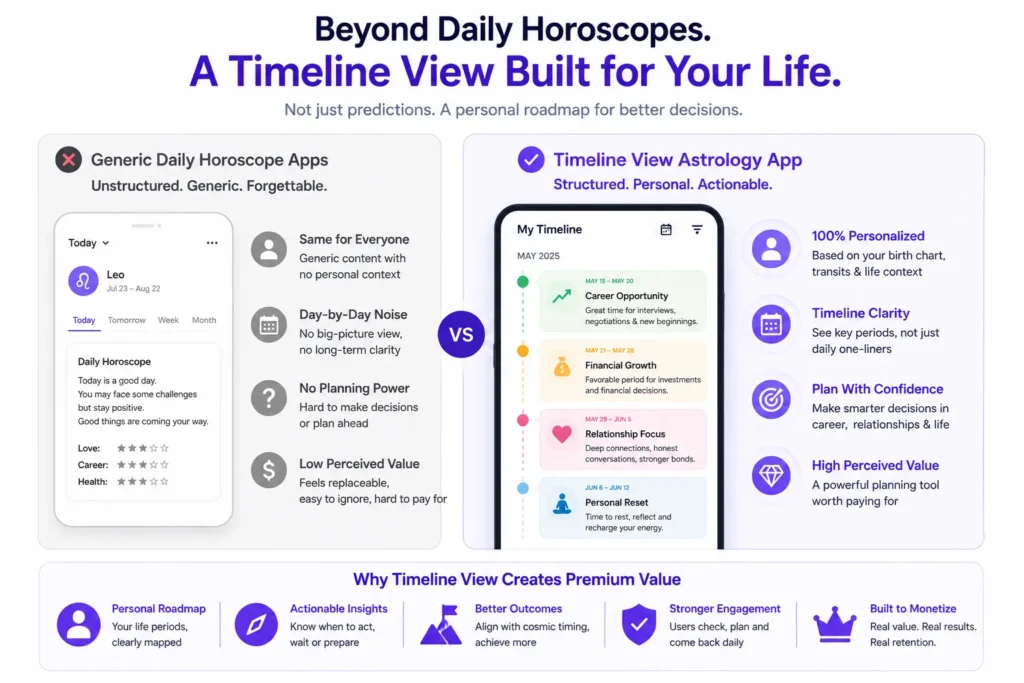
A Timeline View is not a longer horoscope.
It is a personal cosmic planning layer.
Instead of telling every Taurus the same generic message, it organizes the user’s astrological patterns into a structured timeline. The user can see what is happening this week, this month, this quarter, and this year based on their personal chart, preferences, and spiritual goals.
A strong Timeline View can include:
| Timeline Layer | User Value | Subscription Logic |
|---|---|---|
| Personal transits | Shows how current planetary movements interact with the user’s chart | Creates recurring weekly/monthly value |
| Lunar cycle planning | Helps users align rituals, journaling, launches, and reflection with moon phases | Supports habit formation |
| Relationship windows | Highlights compatibility themes, emotional cycles, and timing signals | Increases emotional relevance |
| Career and money periods | Gives users a planning lens for ambition, risk, patience, or visibility | Connects astrology to life decisions |
| Retrograde impact view | Explains what to review, delay, revisit, or clarify | Converts anxiety into guided action |
| Annual theme map | Gives a premium long-range view for the year | Justifies yearly subscription pricing |
| Creator commentary | Adds human interpretation from astrologers or spiritual creators | Builds brand trust and differentiation |
The value is not prediction alone. The value is orientation.
High-intent esoteric users do not just want to know what today means. They want to know what phase they are in, what pattern is repeating, what decision deserves attention, and how to move through the next cycle with clarity.
That is a much stronger product promise than “read your daily sign.”
Why $99/Year Works Better Than $0.99 Daily Horoscope Logic
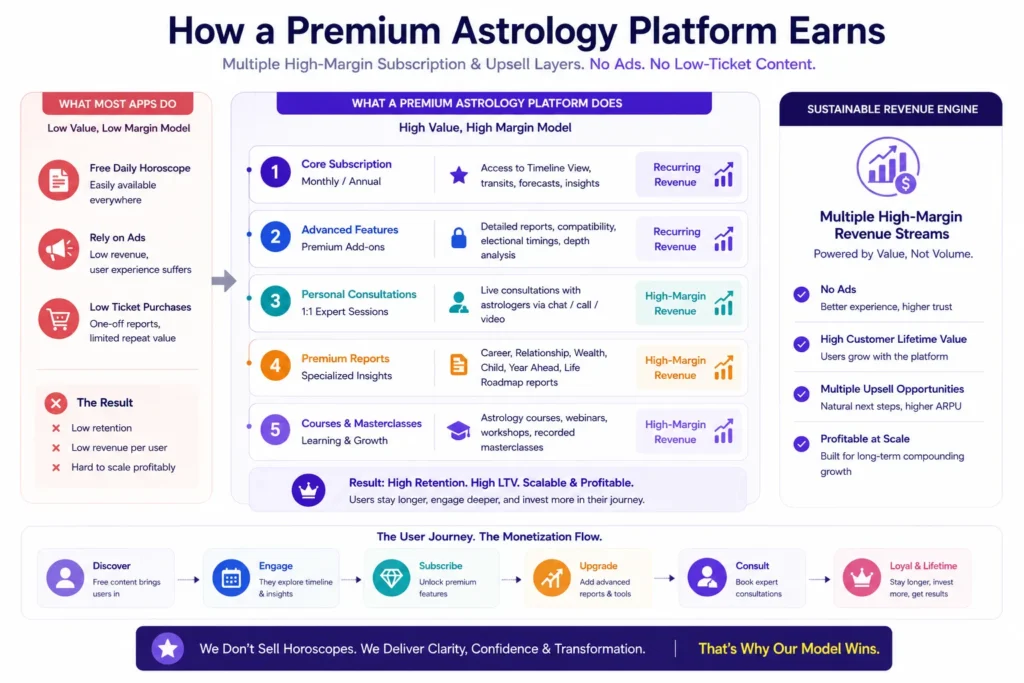
A $99/year astrology subscription is not about charging more for the same thing.
It is about changing the product category.
A $0.99 daily horoscope product trains users to see astrology as cheap content. A $99/year Timeline View trains users to see astrology as a personal planning system.
That difference changes everything.
| Low-Ticket Horoscope App | Premium Timeline View App |
|---|---|
| Sells daily content | Sells ongoing personal insight |
| Competes with free publishers | Competes on personalization and depth |
| Monetizes through ads or small upgrades | Monetizes through annual subscription |
| Needs massive volume | Needs high-intent retention |
| Feels replaceable | Becomes part of user routine |
| Weak brand moat | Stronger creator, wellness, and community moat |
The $99/year price point also changes founder economics. Instead of chasing huge traffic numbers from casual users, the brand can focus on a smaller audience with stronger willingness to pay.
For example, 5,000 users paying $99/year creates a very different business foundation from trying to extract pennies from ad impressions. The challenge is that the product must deserve the price. A generic horoscope feed will not. A layered Timeline View with chart-based interpretation, premium reports, reminders, rituals, creator guidance, and optional consultations has a stronger chance.
This is especially relevant for wellness creators, tarot brands, astrologers, numerologists, spiritual coaches, and esoteric media brands that already have trust but do not yet own their subscription technology.
What a Premium Timeline View Astrology App Should Include
A profitable astrology subscription app needs more than content. It needs a system.
The strongest version combines automation, personalization, creator insight, and monetization control.
1. Birth Chart and Personal Profile Foundation
The app should start with accurate onboarding. Users need to enter birth date, birth time, birth location, interests, relationship status, spiritual goals, and notification preferences.
This gives the platform a deeper personalization layer than sun-sign content alone.
2. Timeline Dashboard
The Timeline View should be the core premium screen.
It can show personal cycles in daily, weekly, monthly, quarterly, and yearly formats. Instead of random content cards, the user sees a structured path.
Example timeline sections:
- Today’s key influence
- This week’s emotional theme
- Current transit focus
- Relationship window
- Career/visibility signal
- Lunar ritual suggestion
- Reflection prompt
- Upcoming intensity dates
3. Premium Reports
Premium reports can help justify subscription pricing. These may include annual forecast reports, compatibility reports, career timing reports, love cycle reports, and spiritual growth reports.
Astrology.com already monetizes premium reports alongside free horoscope content, showing that users understand the difference between free daily content and deeper paid interpretation.
4. Creator or Astrologer Commentary
High-intent users often want interpretation, not just data.
A Timeline View becomes stronger when creators can add commentary, audio notes, rituals, journal prompts, or private content for subscribers. This gives brand builders and esoteric creators a reason to own their platform instead of relying only on social media.
5. Consultation Upgrade Layer
Not every subscriber needs a live reading, but many premium users eventually want one.
A strong app can connect Timeline View insights to paid chat, voice, or video consultation. Miracuves’ Astrotalk Clone page already positions chat, video, per-minute billing, premium subscriptions, source code, white-labeling, and 6-day deployment as core platform advantages.
6. Wallet, Subscription, and Admin Controls
The backend matters because astrology monetization can involve multiple revenue layers:
- Annual subscriptions
- Monthly plans
- Paid reports
- Wallet recharge
- Per-minute consultation
- Creator commissions
- Premium content access
- Referral credits
- Coupons and retention offers
Miracuves’ Astrotalk revenue model content highlights monetization modules such as paid chat consultation, voice/video consultation, wallet recharge, per-minute billing, admin revenue tracking, coupons, payouts, and paid reports.
Read more : Why the Middle East Demands a Different Kind of Astrology App — Private, Arabic, Locally Paid & Fully Custom
Deploying an Engine Built for Deep Astrological Subscriptions
A Timeline View subscription app should not be built like a blog reader with zodiac filters.
It needs an engine.
That engine must connect user profile data, chart logic, content rules, subscription permissions, creator content, consultation workflows, wallet activity, admin controls, and notifications.
For founders, the technical question is not, “Can we publish daily horoscope content?” The better technical question is, “Can our platform create a personalized, recurring, monetization-ready experience for each user?”
A launch-ready astrology platform should include:
| Platform Layer | Why It Matters |
|---|---|
| User onboarding | Captures birth details, goals, and preferences |
| Chart and timeline logic | Powers premium personalization |
| Subscription access control | Protects paid content and premium views |
| Creator/astrologer dashboard | Allows experts to manage content, availability, and earnings |
| Wallet and payments | Supports paid reports, consultations, and recharges |
| Admin dashboard | Tracks users, plans, revenue, disputes, content, and experts |
| Notification system | Brings users back around important personal cycles |
| Real-time consultation layer | Enables chat, voice, and video sessions |
| Security controls | Protects user data, payment flows, and role-based access |
This is where white-label development becomes strategically useful.
A founder does not need to spend months building every module from zero before testing the subscription thesis. A ready-made platform can provide the foundation, while the brand customizes the Timeline View, content system, creator experience, pricing, design, and market positioning.
Miracuves helps founders create astrology consultation and wellness platforms with white-label branding, source-code ownership, admin control, and ready-made launch foundations. The goal is not to copy another astrology app blindly. The goal is to build a monetization-ready product around a sharper business model.
Founder Decision Signals: When the Timeline View Model Makes Sense
The Timeline View strategy is not for every founder.
It makes sense when the brand has at least one of these advantages:
| Decision Signal | What It Means |
|---|---|
| Existing audience trust | You already have users, followers, readers, or customers who trust your spiritual or wellness perspective |
| Premium positioning | You want to sell depth, clarity, and personal insight instead of free entertainment |
| Creator ecosystem | You work with astrologers, tarot readers, coaches, or esoteric creators |
| Subscription ambition | You want recurring revenue instead of one-time reports only |
| Content differentiation | You can create unique interpretations, rituals, prompts, or frameworks |
| Consultation upsell | You want users to move from self-guided insights into paid expert sessions |
The strongest founder profile is not someone trying to launch “another horoscope app.”
It is a brand builder who sees astrology as part of a larger wellness, identity, relationship, or personal transformation ecosystem.
Mistakes Founders Should Avoid
Mistake 1: Building the App Around Daily Horoscopes Only
Daily horoscopes can support retention, but they should not be the entire product. If the app has no deeper chart logic, no premium timeline, no reports, no creator layer, and no consultation flow, it becomes too easy to replace.
Mistake 2: Treating Ads as the Main Revenue Strategy
Ads can be added later, but they should not be the foundation of a premium astrology product. The more serious opportunity is subscription revenue, premium reports, consultations, creator access, and recurring engagement.
Mistake 3: Selling a Subscription Without a Premium Interface
Users do not pay $99/year just because content is behind a paywall. They pay when the experience feels personal, organized, and valuable. The Timeline View should look and behave like a premium dashboard, not a locked blog category.
Mistake 4: Ignoring Admin Control
A subscription astrology business needs control over plans, users, content, astrologers, consultations, payouts, refunds, notifications, and analytics. Weak admin control creates operational friction as soon as the platform grows.
Mistake 5: Copying a Marketplace Without a Differentiated Brand Layer
An Astrotalk-style consultation marketplace can work, but brand builders need a unique angle. The Timeline View can become that angle because it turns the platform from a service directory into a personalized spiritual operating system.
How Miracuves Helps Brands Launch Subscription-Ready Astrology Platforms
Miracuves helps founders, wellness brands, and digital product teams launch astrology platforms faster using ready-made and white-label app foundations.
For this contrarian model, the strongest product route is not a basic horoscope feed. It is a subscription-ready astrology platform with:
- Timeline View experience
- Premium reports
- User profile and birth chart onboarding
- Astrologer or creator dashboard
- Paid chat, voice, and video consultation
- Wallet recharge and per-minute billing
- Subscription plan control
- Admin revenue tracking
- Content and notification management
- Source-code ownership
- White-label branding
- 6-day launch for ready-made solution scope where applicable
Miracuves’ internal solution positioning emphasizes ready-made clone app solutions, white-label branding, source-code ownership, admin dashboards, monetization-ready platforms, and 6-day launch for ready-made products where relevant.
The founder advantage is speed plus control. Instead of spending capital on a generic low-ticket app, founders can deploy a stronger platform foundation and focus their energy on brand, audience, content, astrologer quality, premium positioning, and retention.
Final Thoughts: The Future of Astrology Apps Is Not Free Content. It Is Premium Personal Context.
Sun-sign horoscopes are not dead because people stopped caring about astrology.
They are dead as a venture-backed product strategy because the format is too easy to copy, too easy to give away, and too weak to justify premium pricing.
The next profitable astrology app will not win by publishing another daily zodiac feed. It will win by helping users understand their personal timeline with depth, structure, and recurring value.
That is the real subscription opportunity.
A $99/year user does not want a longer horoscope. They want a personal map.
For founders, the smarter move is to stop competing in the commodity layer and build the premium layer instead. Miracuves can help launch that foundation with white-label astrology app development, source-code ownership, admin control, subscription workflows, and a faster route to market.
FAQs
1. Why are daily horoscope apps difficult to monetize in 2026?
Daily horoscope apps are difficult to monetize because basic sun-sign content is widely available for free through publishers, astrology portals, social media, and AI tools. A founder needs a stronger value layer, such as personalization, premium reports, consultations, or a Timeline View, to justify paid subscriptions.
2. What is a Timeline View astrology app?
A Timeline View astrology app organizes a user’s personal astrological cycles into a structured dashboard. It can show transits, lunar phases, relationship windows, career themes, emotional cycles, annual forecasts, and reflection prompts based on the user’s birth chart and preferences.
3. Can an astrology app charge $99/year?
Yes, but only when the product delivers enough premium value. A basic daily horoscope feed will struggle at that price. A $99/year subscription works better when the app includes personalized timelines, premium reports, creator guidance, rituals, consultation upgrades, and a polished subscription experience.
4. What features should a premium astrology subscription app include?
A premium astrology subscription app should include birth chart onboarding, Timeline View, personal transits, lunar planning, premium reports, creator commentary, paid consultations, wallet payments, subscription controls, notification workflows, and an admin dashboard.
5. Is a white-label astrology app better than custom development?
A white-label astrology app can be better for founders who want to launch faster and validate demand before investing in a long custom build. Custom development may be better when the product requires highly unique architecture from day one. For most founders, a ready-made foundation reduces time, cost, and execution risk.
6. How can wellness creators use a Timeline View app?
Wellness creators can use a Timeline View app to turn their content into a premium subscriber experience. Instead of posting general astrology updates on social media, they can offer personalized timelines, private content, paid readings, rituals, community access, and recurring subscription plans.
7. What monetization models work for astrology apps besides ads?
Strong astrology app monetization models include annual subscriptions, monthly memberships, paid reports, wallet recharge, per-minute chat consultations, voice/video readings, creator commissions, premium content, compatibility reports, referral credits, and event-based spiritual programs.
8. How does Miracuves help launch astrology apps?
Miracuves helps founders launch white-label astrology platforms with source code, branded design, admin control, user and astrologer workflows, subscription features, wallet payments, consultation modules, and faster deployment for ready-made solution scopes.
Miracuves is an independent software development company. We are not affiliated with, connected to, sponsored by, or endorsed by any company or product named in this article.
Terms such as “X Clone” are used descriptively. It is how the software industry refers to building a platform with functionality comparable to a known service, and how clients search for it.
The entire design and codebase of our products is built by our own team. Our products contain no code, design, graphics, or content originating from any third-party website or applications.
All third-party names and marks referenced in this article are the property of their respective owners, referenced solely to identify the services discussed.