Key Takeaways
- Hyper-niche SVOD platforms focus on specific audiences instead of competing with broad Netflix-style streaming apps.
- Niche viewers are more likely to pay when the content solves a clear interest, identity, or community need.
- Subscriptions, exclusive content, community access, creator control, and targeted recommendations are core features.
- Success depends on audience depth, content consistency, retention, pricing, and smooth streaming quality.
- A focused SVOD platform can create stronger recurring revenue than a generic entertainment marketplace.
Founder Signals
- Viewers need simple onboarding, clear subscription plans, fast playback, watchlists, and personalized content access.
- Creators and content owners need secure uploads, content libraries, pricing control, analytics, and payout visibility.
- Admins need control over users, subscriptions, content rights, payments, reports, and platform settings.
- Niche positioning helps reduce acquisition waste by targeting viewers with stronger content intent.
- Notifications keep subscribers updated on new releases, renewals, recommendations, and membership activity.
Real Insights
- Trying to build another broad streaming app can drain budget before a loyal subscriber base forms.
- Hyper-niche SVOD works because the audience already understands why the content matters.
- Clear content categories, predictable releases, and strong community identity improve retention.
- Focused platforms should validate willingness to pay before expanding into wider content categories.
- Miracuves builds hyper-niche SVOD platforms with subscriptions, secure streaming, content libraries, creator workflows, and admin control.
Most founders who say they want to build a streaming platform are already making the wrong strategic move.
They say, “We want to build something like Netflix.”
That sounds ambitious. It also sounds expensive, slow, and commercially dangerous.
Netflix, Hulu, Disney+, Prime Video, and other large streaming platforms are not just apps. They are content acquisition machines, licensing engines, recommendation systems, production studios, brand ecosystems, and retention operations running at massive scale. Trying to compete with them through a broad content library is not a startup strategy. It is a capital-burning exercise disguised as ambition.
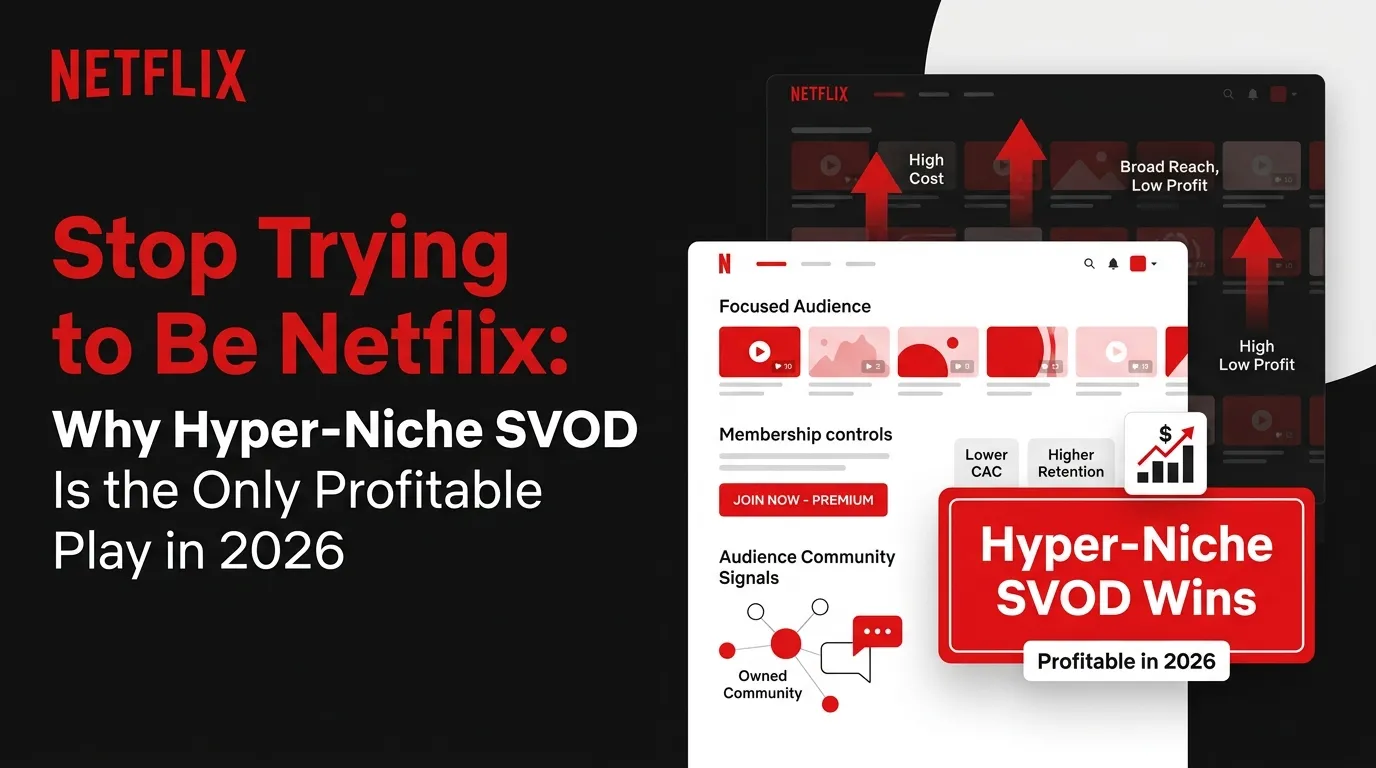
The smarter play in 2026 is not to become the next Netflix. It is to become the most valuable subscription platform for one specific audience that already cares deeply about one specific type of content.
That is where the hyper-niche SVOD platform wins.
A hyper-niche SVOD platform does not need every movie, every genre, and every casual viewer. It needs a sharp content promise, a loyal audience, a subscription-worthy library, and a stable video streaming platform foundation. With Miracuves, founders can use a white-label streaming engine to focus less on rebuilding core OTT infrastructure and more on licensing, creators, community, and retention.
The Broad Content Acquisition Trap
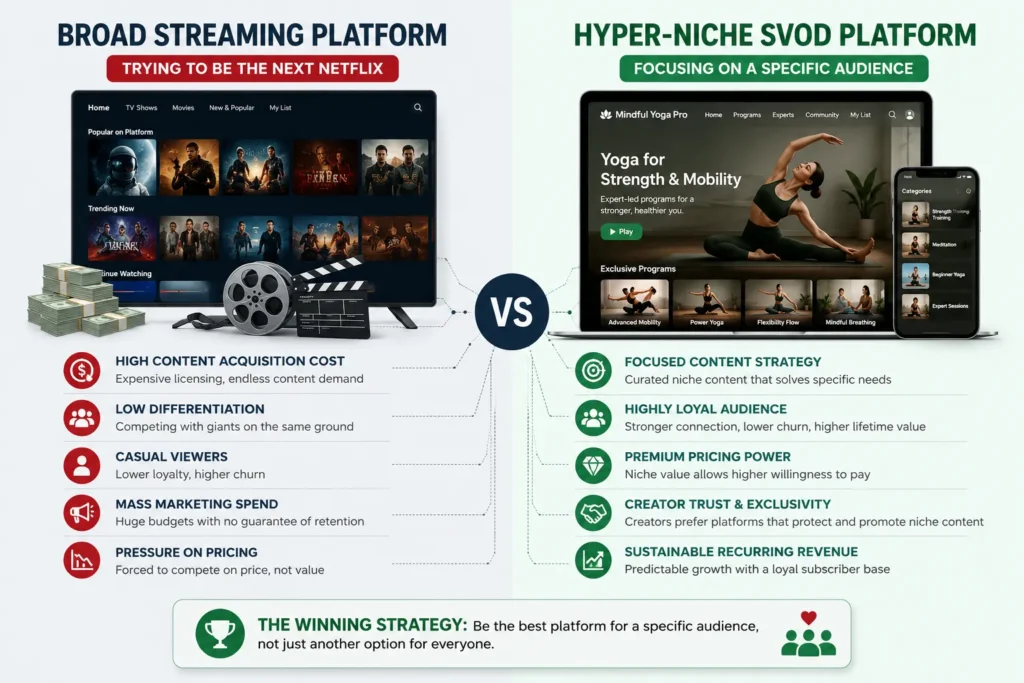
The fastest way to weaken a streaming startup is to build a platform for “everyone.”
Everyone is not a market. Everyone is not a positioning strategy. Everyone is not a retention plan.
A broad SVOD platform needs constant content volume. That means more licensing deals, more categories, more metadata, more recommendations, more moderation, more storage, more CDN planning, more support, and more marketing just to explain why users should choose your platform instead of the subscriptions they already have.
The real trap is not development. The real trap is content expectation.
When users open a broad streaming app, they compare it to Netflix, Hulu, Disney+, Prime Video, and YouTube. They expect polished originals, endless variety, multi-device access, strong recommendations, subtitles, downloads, profiles, watchlists, parental controls, and constant new releases.
That comparison is brutal for a startup.
A hyper-niche SVOD platform changes the comparison.
Instead of asking, “Is this better than Netflix?” the user asks, “Is this the best place for my specific interest?”
That is a much easier and more profitable battle.
A platform for indie horror collectors, advanced yoga instructors, regional theatre fans, combat sports analysts, creator-led business education, medical training, farming tutorials, faith-based learning, or local documentary lovers does not need to beat Netflix. It needs to be irreplaceable for its niche.
Read More: How to Build an App Like Netflix: A Developer’s Guide
1,000 True Fans vs. 1 Million Casual Viewers
A million casual viewers can look impressive in a pitch deck. They can also be expensive, disloyal, and hard to monetize.
A thousand serious subscribers are different.
They know what they want. They are more likely to pay for depth. They are more likely to join annual plans. They are more likely to recommend the platform inside niche communities. They are more likely to attend live sessions, buy premium courses, purchase merchandise, pay for exclusive drops, or follow creators across formats.
That is the power of a micro-niche subscription model.
The goal is not maximum awareness. The goal is maximum relevance.
For example, a general fitness streaming app competes with YouTube, Peloton, Apple Fitness+, Instagram creators, and thousands of free videos. A platform focused only on mobility training for runners over 40 has a sharper promise. The audience is clearer. The content roadmap is easier. The pricing can be premium. The retention logic is stronger because the platform solves a specific problem.
The same applies to media entrepreneurs.
A general movie streaming app is weak unless it has enormous capital. A subscription platform for restored regional cinema, underground horror, anime analysis, creator documentaries, niche sports breakdowns, or professional training content has a much clearer reason to exist.
The smaller the audience, the sharper the value must be. But when the value is sharp, pricing power improves.
Read More: Subscription Models for Netflix Clone: Which One Will Maximize Your Profits?
Reallocating Budget from Dev to Niche Creator Licensing
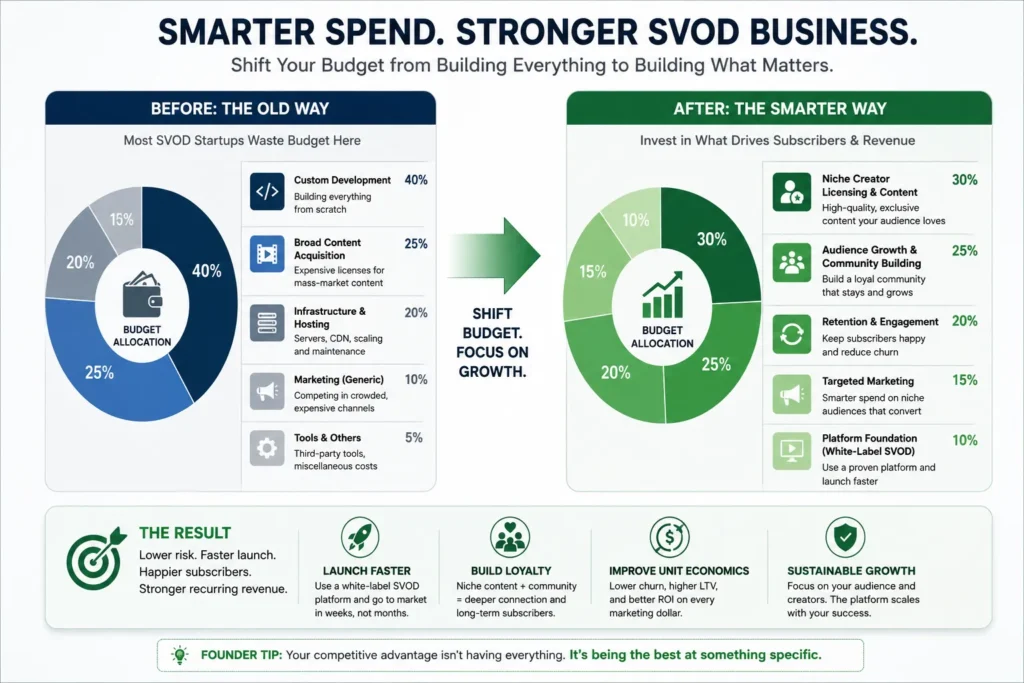
Many founders spend too much of their early budget trying to build streaming infrastructure from zero.
That is usually backward.
The viewer does not subscribe because you spent months building login, playback, subscription billing, CMS, watchlists, admin roles, and content upload workflows from scratch. The viewer subscribes because the content is valuable, the creator access is exclusive, and the platform feels built for their specific interest.
That is why the smarter budget allocation is simple:
Use a stable white-label SVOD engine for the platform foundation.
Spend the saved time and money on niche creator licensing, exclusive content, community building, partnerships, and retention campaigns.
This is where Miracuves fits the strategy. Miracuves offers OTT and video streaming app development solutions that support video-on-demand, live streaming, subscriptions, multi-device support, and secure content delivery. Its Netflix clone solution also supports subscriptions, rentals, profiles, playback, admin control, producer onboarding, revenue sharing, and source-code ownership.
That means a founder does not need to start with a blank technical canvas. They can start with the business question that actually matters:
What content is worth paying for every month?
Read More: How Netflix Makes Money in 2026
What a Hyper-Niche SVOD Platform Actually Looks Like
A profitable niche SVOD platform is not just a smaller Netflix. It is a focused subscription product built around audience identity.
Here are practical examples.
| Niche SVOD Idea | Audience | Premium Content Angle | Monetization Opportunity |
|---|---|---|---|
| Indie horror streaming platform | Horror fans and collectors | Curated indie films, director commentary, festival archives | Monthly SVOD, annual memberships, limited premieres |
| Niche sports analysis platform | Coaches, athletes, analysts | Tactical breakdowns, training film, expert sessions | Premium subscription, coaching bundles, PPV events |
| Specialized training platform | Professionals and learners | Certification-style courses, expert libraries, workshops | Tiered subscriptions, course bundles, corporate access |
| Regional cinema platform | Diaspora and local culture fans | Regional films, documentaries, interviews | Monthly plans, rentals, sponsorships |
| Creator-led business education platform | Founders and operators | Templates, deep-dive videos, private sessions | Subscription, paid cohorts, premium content drops |
The key difference is that every example has a clear audience and a clear willingness-to-pay trigger.
A founder should not ask, “How many videos can we upload?”
The better question is, “What content would this audience feel uncomfortable losing access to?”
That question leads to retention.
Read More: Reasons startup choose our netflix clone over custom development
The Monetization Model: Premium Depth Beats Mass-Market Volume
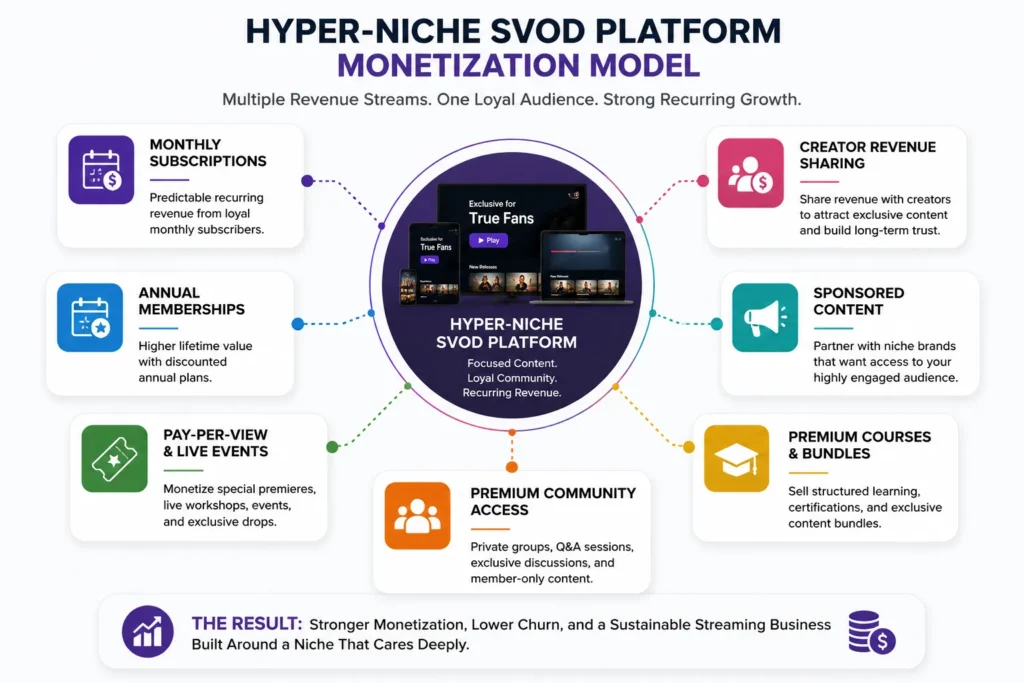
Hyper-niche SVOD works because it allows the founder to move away from low-price, high-volume thinking.
A broad streaming platform often feels pressured to price low because users compare it against bigger libraries. A niche platform can charge more when the content is rare, useful, exclusive, or professionally valuable.
The strongest monetization stack usually includes:
- Monthly subscriptions for casual committed users.
- Annual subscriptions for loyal niche members.
- Pay-per-view for special premieres, workshops, live events, or premium drops.
- Creator revenue sharing for exclusive contributors.
- Sponsored content from brands that want access to the niche audience.
- Community memberships for private groups, Q&A sessions, or expert access.
- Bundled learning paths for training-heavy niches.
The point is not to copy Netflix pricing. The point is to price based on niche value.
A platform for entertainment may need a different subscription model than a platform for professional education. A sports coaching library may support premium annual plans. A creator-led business platform may support paid cohorts. A horror streaming platform may monetize exclusive premieres and fan events.
Niche monetization gives founders more flexibility because the audience is not buying generic access. They are buying belonging, expertise, identity, and depth.
Founder Decision Signals
Founder Decision Signals
Speed
If your content partners and audience are already available, waiting months for custom development can delay revenue validation. A white-label SVOD foundation helps you launch faster and test the market earlier.
Cost
The biggest early expense should not be rebuilding standard OTT modules. Founders should protect budget for licensing, creator deals, content production, and subscriber acquisition.
Scalability
A niche platform still needs stable playback, subscription logic, admin controls, analytics, and content management. Weak backend control can damage retention even if the content is strong.
Market Fit
If users cannot describe the platform in one sentence, the niche is probably too broad. Strong SVOD positioning should make the audience feel, “This was built for people like me.”
Why the White-Label Engine Matters More Than Custom Ego
Some founders want custom development because it feels more serious.
That is not always a smart reason.
Custom development makes sense when the product needs unusual workflows, complex rights logic, advanced AI personalization, enterprise-grade integrations, or unique viewing experiences. But many early SVOD platforms do not fail because the app was not custom enough. They fail because the niche was vague, the content was not exclusive, the subscription value was weak, or the founder spent too much on development before proving demand.
A white-label engine helps founders avoid that mistake.
With a white-label SVOD platform, the core foundation can include user registration, subscriptions, content catalogues, video playback, admin dashboards, payment integration, search, watchlists, content upload workflows, and monetization controls. The founder can then customize branding, niche taxonomy, content rules, pricing, creator access, and community layers.
Miracuves’ white-label app approach is useful here because it supports faster launch, source-code ownership, admin control, and customization around the business model. For founders planning a niche streaming business, that means the product foundation can move quickly while the strategic budget goes where it matters most: content and audience.
Read More: Best Netflix Clone Script in 2026: Features & Pricing Compared
What Founders Should Build First
A hyper-niche SVOD platform does not need every advanced feature on day one.
It needs the features that protect subscription value.
Start with the core platform layer:
| Platform Layer | What It Should Include | Why It Matters |
| Content management | Uploads, categories, metadata, approval workflows | Helps the team manage niche libraries without developer dependency |
| Subscription control | Monthly, annual, trial, coupon, and access rules | Gives the founder pricing flexibility |
| Playback experience | Smooth video player, adaptive streaming, watch history | Reduces friction and supports repeat viewing |
| Admin dashboard | Users, content, payments, creators, reports | Gives the platform operator control over daily operations |
| Creator or producer panel | Uploads, content status, revenue share visibility | Supports creator-led or licensed content models |
| Analytics | Watch time, churn signals, top content, plan performance | Helps founders improve retention and content planning |
| Security and rights control | Access rules, secure delivery, admin permissions | Protects content value and platform trust |
The first launch should prove subscription demand. It should not attempt to become a giant media company overnight.
Once the platform has traction, the founder can add deeper personalization, community features, live events, smart recommendations, affiliate partnerships, and multi-language expansion.
Mistakes Founders Should Avoid
Mistakes Founders Should Avoid
Trying to license too many content categories
A broad library creates operational cost without creating a strong reason to subscribe. Start with the category your audience cares about most.
Building technology before validating content demand
If users will not pay for the content promise, custom development will not save the business. Validate the audience, creator partnerships, and subscription logic early.
Pricing like a mass-market platform
Niche platforms should not blindly copy Netflix-style pricing. Premium content, professional training, expert access, or rare libraries may justify higher pricing.
Ignoring admin control
Subscription platforms need control over users, payments, content approval, creator payouts, reports, refunds, and access rules. A weak backend slows the business down.
The Contrarian SVOD Rule for 2026
The streaming market is not dead. Generic streaming is tired.
The mistake is assuming that because big platforms dominate broad entertainment, there is no room for new subscription video businesses. There is room, but not for weak copies of Netflix.
The opportunity is in sharp, paid communities.
A hyper-niche SVOD platform can win when it has:
- A clearly defined audience.
- A painful or passionate content need.
- Exclusive or hard-to-find videos.
- Strong creator or expert relationships.
- Subscription pricing that reflects value.
- A stable OTT foundation.
- Admin control over content, users, payments, and growth.
- A retention strategy based on depth, not volume.
This is why the future is not “build a Netflix competitor.”
The future is “build the only platform your niche cannot replace.”
Read More: Business Model of Netflix in 2026
How Miracuves Helps Founders Launch Niche SVOD Platforms Faster
Miracuves helps founders build ready-made and white-label OTT platforms with branded design, source-code ownership, subscription workflows, admin dashboards, and monetization-ready modules.
For a niche SVOD founder, this matters because the platform does not need to be invented from zero. The business needs to be positioned correctly, launched quickly, and refined around subscriber behavior.
A Miracuves video streaming or Netflix clone foundation can support the core app layer while founders focus on niche creator licensing, content curation, pricing, partnerships, and community acquisition.
If your goal is to build a premium subscription video business, the stronger move is not to copy Netflix’s catalog strategy. It is to launch a focused platform with a specific audience, a clear subscription promise, and enough backend control to grow without rebuilding every module from scratch.
Final Thoughts: Stop Building for Everyone
The worst streaming startup strategy in 2026 is trying to impress everyone with a broad catalog.
Broad content is expensive. Broad positioning is weak. Broad audiences are difficult to retain.
Hyper-niche SVOD is different. It lets founders build around identity, passion, expertise, and recurring value. A smaller paying audience with stronger intent can create a healthier subscription business than a large audience that barely remembers why it signed up.
The real question is not, “Can we build the next Netflix-like platform?”
The real question is, “Can we build the subscription platform this niche has been waiting for?”
That is the profitable play.
FAQs
What is a hyper-niche SVOD platform?
A hyper-niche SVOD platform is a subscription video platform built for a very specific audience, content category, profession, fandom, or community. Instead of offering a broad entertainment catalog, it focuses on premium content that a smaller audience is willing to pay for regularly.
Why should startups avoid competing directly with Netflix?
Startups should avoid direct Netflix-style competition because broad streaming requires huge content libraries, licensing budgets, marketing spend, and retention infrastructure. A niche SVOD platform gives founders a sharper market, clearer positioning, and better pricing power.
Is niche SVOD profitable in 2026?
Niche SVOD can be profitable when the platform serves a specific audience with high-value content, strong creator partnerships, and recurring subscription demand. Profitability depends on content cost, pricing, churn, acquisition cost, and platform operations.
What are good examples of niche SVOD platforms?
Examples include indie horror streaming, specialized sports coaching, regional cinema libraries, professional training platforms, faith-based video libraries, creator-led education platforms, and premium documentary communities.
Should I build a custom SVOD platform or use a white-label solution?
A white-label SVOD solution is often better for founders who want to launch faster, validate demand, and avoid rebuilding standard OTT modules from zero. Custom development may be useful later if the business needs advanced workflows, unique personalization, or enterprise-grade integrations.
What features does a niche SVOD platform need first?
A niche SVOD platform should start with user accounts, subscription billing, content management, video playback, search, watchlists, payment integration, admin dashboards, analytics, and secure content access.
How can a niche SVOD platform monetize beyond subscriptions?
It can monetize through annual plans, pay-per-view events, creator revenue sharing, sponsorships, premium courses, merchandise, community memberships, and exclusive content drops.
How does Miracuves support niche SVOD platform development?
Miracuves supports niche SVOD founders with white-label OTT and video streaming app foundations, source-code ownership, branded design, admin dashboards, subscription workflows, and monetization-ready modules.