
Key Takeaways
- NFT marketplaces face legal and operational liability risks.
- Content moderation protects platforms from infringement claims.
- Creator verification reduces fraud and fake collections.
- Smart contract security protects marketplace transactions.
- Compliance is essential for long-term marketplace growth.
Risk Signals
- Verify creators before allowing NFT listings.
- Provide copyright reporting and takedown tools.
- Audit smart contracts before deployment.
- Track marketplace activity with detailed audit logs.
- Apply KYC and AML checks where regulations require.
Real Insights
- Weak moderation increases legal exposure for marketplaces.
- Security flaws can damage user trust and platform revenue.
- Governance is as important as blockchain technology.
- Compliance should be built into the platform from launch.
- Miracuves builds OpenSea Clone platforms with secure, compliant NFT marketplace architecture.
The fastest way to launch an NFT marketplace is also one of the easiest ways to create a legal problem: unrestricted open minting.
Many founders still evaluate an OpenSea clone by looking at surface features: wallet connection, NFT listing, auctions, collections, filters, royalty settings, and marketplace fees. Those features matter, but they are not the real risk layer. The real question is whether your NFT marketplace allows any anonymous user to mint anything without verification, review, ownership proof, or creator approval.
That is where open minting becomes dangerous. In 2022, OpenSea clone publicly acknowledged that over 80% of items created through one of its free minting tools were plagiarized works, fake collections, or spam. This was not a small UI issue. It exposed the operational reality of user-generated token platforms: when minting is too easy, fraud scales faster than trust.
For founders, legal teams, brand managers, and Web3 operators, this changes the buying decision. A low-cost OpenSea clone that gives everyone unrestricted minting access may look attractive at launch, but it can expose the platform owner to copyright complaints, brand takedowns, buyer disputes, regulator attention, and long-term reputation damage.
Miracuves approaches NFT marketplace development differently. Instead of treating KYC, creator whitelisting, admin review, audit logs, abuse reporting, and takedown workflows as optional add-ons, these controls should be part of the product foundation for any serious NFT marketplace.
The Copyright Nightmare of User-Generated Tokens
An NFT marketplace does not simply sell digital collectibles. It gives users the power to publish tokenized claims around images, videos, music, game assets, memberships, identity-linked items, and brand-linked digital goods.
That power creates risk.
When a platform allows open minting without creator verification, a bad actor can upload stolen art, copy a known collection, use a celebrity likeness, imitate a luxury brand, tokenize copyrighted media, or create misleading assets designed to defraud buyers. Once that token is minted, listed, sold, shared, indexed, and promoted, the damage is no longer limited to one user account.
It becomes a marketplace problem.
The copyright owner may not care that the platform calls itself decentralized. The buyer may not care that the smart contract was triggered by a user wallet. The regulator may not care that the operator did not personally upload the asset. The brand owner sees one thing clearly: the marketplace enabled distribution, monetization, and discovery.
That is why founders should stop treating copyright controls as a legal afterthought. In NFT marketplace development, copyright defense starts in the product architecture.
A serious platform should ask:
- Who is allowed to mint?
- What identity checks happen before minting?
- Can creators prove ownership or authorization?
- Can admins pause suspicious collections?
- Are takedown requests logged and traceable?
- Can repeated infringers be blocked?
- Can the platform show evidence of review, action, and escalation?
Without these controls, an OpenSea clone is not just a marketplace. It is a public publishing layer for unknown users, unknown rights, and unknown legal exposure.
Read more : Best OpenSea Clone Scripts in 2025: Features, Use Cases & Pricing Compared
Why “Decentralized” Does Not Remove Marketplace Responsibility
One of the most dangerous assumptions in Web3 is that decentralization removes operational responsibility.
It does not. A blockchain may record the token. A wallet may sign the transaction. A smart contract may execute the mint. But the marketplace still provides the interface, discovery system, search, categories, collection pages, transaction pathways, metadata display, moderation controls, fees, and user experience.
That means the platform operator is not invisible.
OpenSea’s own support documentation includes processes for reporting copyright, trademark, fraudulent, and disruptive content. Its prohibited-content policy also references infringing intellectual property and stolen items. The lesson for founders is simple: even major NFT marketplaces need governance layers.
Regulatory attention has also increased. In 2024, Reuters reported that the U.S. SEC issued OpenSea a Wells notice indicating potential enforcement action related to whether NFTs on the platform could be considered securities. Separately, the SEC has previously taken action involving NFT offerings, including Impact Theory and Stoner Cats, as referenced in SEC-related materials.
This does not mean every NFT is automatically a security. It means founders should avoid lazy assumptions. The regulatory treatment of NFTs depends on structure, marketing, utility, revenue promises, investment framing, jurisdiction, and operating model.
A compliance-ready foundation does not guarantee regulatory approval. Final compliance depends on jurisdiction, legal review, integrations, and how the marketplace operates. But building without KYC, creator controls, audit logs, and admin review makes it much harder for a founder to show responsible platform governance.
The Open-Minting Liability Variable Founders Ignore
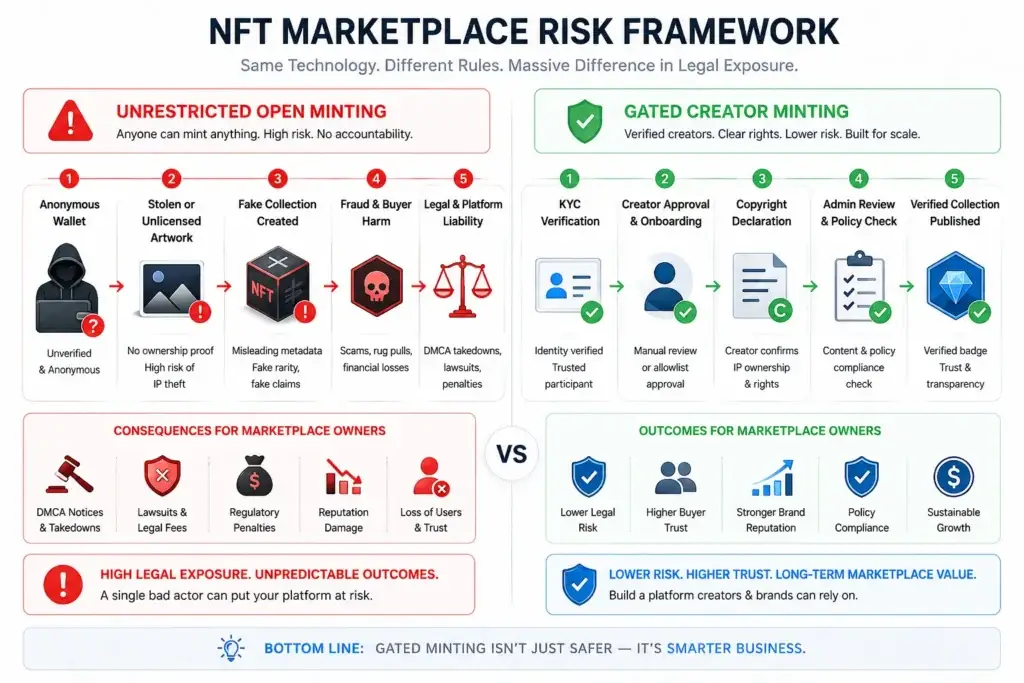
The open-minting liability variable is simple:
The easier it is for unknown users to mint NFTs, the faster the platform can grow — and the faster legal risk can scale.
Open minting is attractive because it reduces friction. Anyone can connect a wallet, upload media, create a token, and list it. For consumer hype, that feels powerful. For platform risk, it is dangerous.
The problem is not minting itself. The problem is unrestricted minting without identity, ownership review, category controls, fraud detection, or admin governance.
A platform operator must decide whether they are building:
- A public, open, high-risk NFT publishing layer
- A curated marketplace with verified creators
- A brand-safe NFT commerce platform
- A regulated or semi-regulated digital asset marketplace
- A private NFT ecosystem for approved artists, brands, agencies, or communities
Each model needs different controls. A gaming NFT marketplace needs asset provenance and publisher permissions. A music NFT marketplace needs rights documentation. A luxury brand NFT marketplace needs anti-counterfeit controls. A creator marketplace needs identity verification and abuse reporting. A financialized NFT marketplace may need stronger AML, transaction monitoring, and legal review.
The mistake is buying a generic OpenSea clone script and assuming the same minting flow works for every business model. It does not.
Read more : Top OpenSea Features Every NFT Builder Needs
Where Standard OpenSea Clone Scripts Create Legal Exposure
Many OpenSea clone scripts are sold around feature availability, not founder protection. They often highlight wallet login, NFT minting, bidding, collections, smart contracts, royalties, and multi-chain support. Those are useful platform modules, but they do not automatically solve liability.
The weak points usually appear in the control layer.
1. Anonymous Creator Onboarding
If anyone can connect a wallet and mint instantly, the platform has no meaningful way to know who created the asset, whether they own the rights, or whether they are using stolen material.
2. No Creator Whitelisting
Without creator approval workflows, the marketplace becomes reactive. The platform only acts after harm happens: after a stolen collection is listed, after a buyer complains, after a brand sends a notice, or after a creator discovers copied work.
3. Weak Takedown Infrastructure
A simple “report” button is not enough. A defensible platform needs case IDs, timestamps, claimant details, creator responses, admin decisions, evidence logs, and escalation status.
4. No Metadata Review
NFTs are not only images. Titles, descriptions, external links, collection names, unlockable content, and metadata can all create infringement or fraud risk.
5. No Transaction Monitoring
NFT marketplaces can be exposed to wash trading, suspicious pricing patterns, money laundering concerns, and fraud cycles. FATF has warned that weak virtual asset regulation creates loopholes criminals can exploit. Academic research has also highlighted fraud, wash trading, and abnormal trading concerns in NFT markets.
6. No Admin Freeze or Pause Controls
If a disputed asset is live, the admin needs the ability to pause listing, hide content, restrict trading, suspend creator privileges, and preserve logs for review. Without those tools, every dispute becomes a manual emergency.
Read more : Riding the NFT Wave: OpenSea App Marketing Strategy Breakdown
The Miracuves Standard: Hardcoding Creator Whitelists and KYC Gates
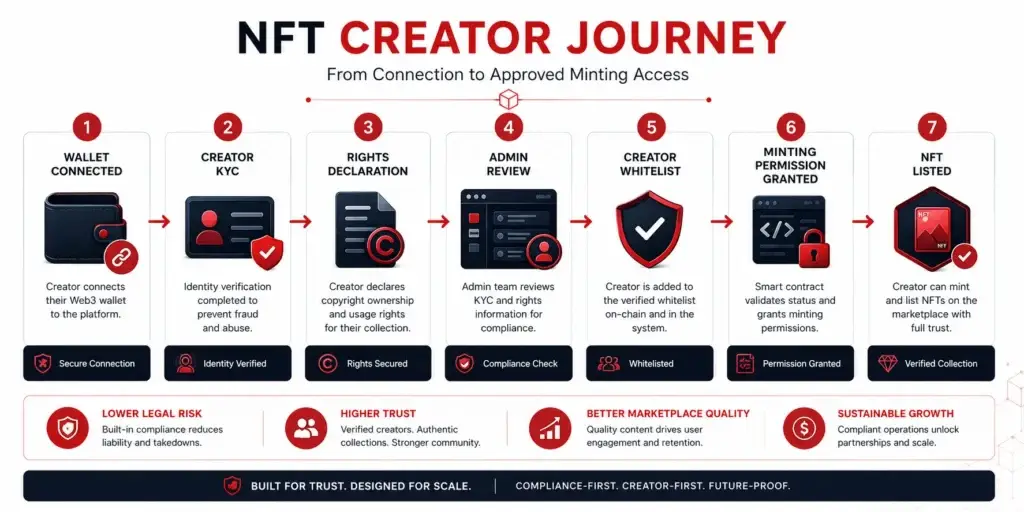
A serious NFT marketplace should not rely on a founder manually cleaning up abuse after launch. The software should reduce abuse before it becomes public.
That is why Miracuves treats KYC gates and creator whitelisting as core marketplace infrastructure for founder-risk-sensitive NFT platforms.
In practical terms, this means the minting flow can be designed so that a user does not receive full creator privileges immediately after wallet connection. Instead, the platform can require identity verification, profile approval, role-based permissioning, ownership confirmation, or admin review before minting access is enabled.
A defensible NFT marketplace can include:
- KYC workflows for creators, sellers, or high-risk users
- Creator whitelisting before minting privileges are activated
- Admin approval for first-time collections
- Document or rights-declaration uploads
- Category-level restrictions for sensitive assets
- Metadata review before public listing
- Abuse reporting and dispute workflows
- Activity logs and admin audit trails
- Suspicious activity flags
- Wallet and transaction monitoring integrations where relevant
- Role-based access control for internal teams
This does not mean every NFT marketplace needs the same level of friction. A closed brand marketplace may need strict creator approval but lighter buyer checks. A high-value trading marketplace may need stronger KYC and AML workflows. A creator-first marketplace may use tiered limits: browse, buy, sell, and mint permissions can each require different verification levels.
The key is to design risk controls around the business model instead of copying a generic OpenSea-style minting flow.
Open Minting vs Gated Minting: Founder Risk Comparison
| Decision Area | Unrestricted Open Minting | KYC-Gated Creator Whitelisting |
|---|---|---|
| Creator access | Anyone can mint after wallet connection. | Only approved creators can mint after verification or admin review. |
| Copyright risk | High risk because stolen or unauthorized assets can appear quickly. | Lower operational risk because creators are reviewed before publishing. |
| Brand safety | Weak, especially for luxury, entertainment, gaming, and IP-heavy marketplaces. | Stronger because admin teams can control who publishes and what categories are allowed. |
| Founder control | Reactive. Problems are handled after complaints arrive. | Preventive. Minting permissions, content review, and takedown workflows are built into operations. |
| Compliance readiness | Limited, especially if creators and sellers are anonymous. | Stronger foundation for KYC, AML support, audit logs, and suspicious activity monitoring. |
| Best fit | Experimental communities with high moderation tolerance. | Founder-led marketplaces, brand-safe NFT platforms, enterprise Web3 products, and regulated-risk environments. |
KYC, AML, Copyright, and Admin Controls: What a Defensible NFT Marketplace Needs
A founder should evaluate NFT marketplace development through four protection layers: identity, rights, transactions, and governance.
Identity Layer: Know Who Is Minting
Wallet connection is not identity. A wallet address tells you which wallet signed a transaction. It does not tell you whether the creator owns the artwork, whether the seller is a sanctioned actor, or whether the same person has created multiple abusive accounts.
KYC workflows can help verify creators, sellers, or users involved in high-value transactions. Depending on the marketplace model, KYC can be applied to all creators, only sellers, only high-volume accounts, or only users crossing specific risk thresholds.
The right model depends on legal advice, jurisdiction, transaction value, asset type, and business risk.
Rights Layer: Know What Is Being Tokenized
A defensible NFT marketplace should ask creators to declare that they own or are authorized to tokenize the asset. In higher-risk categories, the platform may require supporting documents, brand authorization, music rights, game publisher approval, or agency confirmation.
This is especially important for marketplaces focused on:
- Music NFTs
- Sports collectibles
- Gaming assets
- Film and entertainment IP
- Luxury goods
- Brand-backed collectibles
- Real-world asset tokenization
- Celebrity or influencer-linked assets
Transaction Layer: Watch for Suspicious Behavior
NFT fraud is not only about stolen images. It can include wash trading, fake volume, pump-and-dump activity, phishing-linked assets, suspicious wallets, coordinated purchases, and price manipulation.
A marketplace should include transaction monitoring support, suspicious activity flags, withdrawal controls where relevant, and admin review workflows. These controls do not replace legal compliance, but they help founders prepare stronger operational controls.
Governance Layer: Give Admins Real Control
The admin dashboard is where platform liability becomes manageable or chaotic.
A serious NFT marketplace admin panel should let operators:
- Approve or reject creators
- Review new collections
- Pause suspicious NFTs
- Hide disputed listings
- Manage takedown requests
- Track user reports
- Suspend abusive accounts
- Review transaction patterns
- Export audit logs
- Manage roles and permissions
- Control categories, fees, royalties, and marketplace rules
Miracuves’ white-label NFT marketplace approach is built around founder control, not just marketplace appearance. For founders planning an OpenSea-style platform, the goal should not be to copy the public interface. The goal should be to build a controlled marketplace system that can survive real users, real disputes, and real legal pressure.
Founder Decision Signals
Speed
A ready-made OpenSea clone can help founders launch faster, but speed should not remove creator verification, admin review, or takedown workflows.
Cost
The lowest upfront build cost can become expensive if the platform needs emergency legal fixes, content cleanup, fraud response, or compliance redesign after launch.
Scalability
Scalability is not only transaction volume. It includes the ability to scale moderation, creator approvals, dispute handling, and audit trails.
Market Fit
If your marketplace serves brands, artists, gaming publishers, or enterprise creators, gated minting may build more trust than fully open publishing.
Why Brand Managers Should Care About NFT Minting Architecture
Brand managers often enter NFT conversations after the product team has already chosen a script. That is a mistake.
NFT marketplaces can become brand-risk engines if they allow fake collections, unauthorized logos, copied character art, counterfeit digital collectibles, or misleading creator profiles. A copied brand asset can travel quickly across wallets, social feeds, community groups, marketplaces, and search results.
For brand-led NFT marketplaces, creator whitelisting is not friction. It is brand protection.
A brand-safe NFT marketplace should limit publishing permissions to approved artists, partners, internal teams, verified agencies, licensed collaborators, or authorized community creators. It should also give brand teams the ability to review collection names, asset previews, metadata, external links, and royalty structures before publication.
This is where product architecture supports legal and brand operations. The right software flow can prevent a brand manager from spending every week chasing fake assets after they go live.
Why Legal Compliance Officers Should Be Involved Before Launch
Legal review should not begin after the first takedown notice. It should begin before the minting workflow is finalized.
Compliance officers should review:
- Creator onboarding requirements
- KYC and AML workflow scope
- Terms of service acceptance points
- IP rights declarations
- Marketplace prohibited-content policy
- Takedown and counter-notice process
- Data retention and audit logs
- Jurisdiction-specific requirements
- Transaction monitoring expectations
- Admin authority to pause or remove listings
For some NFT models, especially those involving investment-style language, fractionalized ownership, revenue-sharing promises, or high-value trading, regulatory review becomes even more important. The EU’s MiCA framework introduced uniform rules for many crypto-assets, while NFT treatment can still depend on whether assets are genuinely unique or functionally resemble regulated crypto-assets.
The safest software posture is not to claim universal compliance. The safer posture is to build a compliance-ready foundation that can be configured with legal counsel based on the target market.
The Miracuves NFT Marketplace Architecture for Founder Protection
Miracuves helps founders build NFT marketplace platforms with a stronger control layer around identity, content, transactions, and admin governance.
For a founder comparing a generic OpenSea clone script against a more defensible product foundation, the difference is not only design. It is operational safety.
A Miracuves-style NFT marketplace build can support:
- White-label marketplace branding
- Source-code ownership
- Creator onboarding workflows
- KYC-gated creator permissions
- Admin-controlled creator whitelisting
- NFT minting and listing flows
- Smart contract integration
- Wallet integration
- Collection management
- Auction and fixed-price sale models
- Royalty logic
- Abuse reporting
- Takedown workflows
- Role-based admin access
- Activity logs and audit trails
- Suspicious activity monitoring support
- Scalable backend architecture
Mistakes Founders Should Avoid
Allowing instant minting for every wallet
Wallet connection is not identity verification. If every wallet can mint immediately, the platform may invite stolen art, fake collections, and repeated abuse from anonymous users.
Treating takedown requests as a manual inbox problem
A serious marketplace needs structured dispute tracking, evidence logs, claimant details, admin decisions, and escalation history.
Buying a script before defining creator policy
The marketplace rules should shape the software. Founders should decide who can mint, what assets are allowed, and what verification is required before launch.
Assuming decentralization removes liability
The marketplace still controls interface, listing visibility, discovery, categories, fees, moderation, and user workflows. Those are operational responsibilities.
What to Ask Before Buying an OpenSea Clone
Before selecting an NFT marketplace development partner, founders should ask practical questions that expose the risk layer.
Creator and Minting Controls
- Can minting be restricted to approved creators?
- Can the admin approve or reject creator applications?
- Can different creator tiers have different minting limits?
- Can minting access be suspended instantly?
KYC and Verification
- Can creators complete KYC before minting?
- Can KYC be required only for sellers or high-risk users?
- Can the platform integrate third-party KYC providers?
- Can identity status be connected to creator permissions?
Copyright and Content Safety
- Can admins review collections before publication?
- Can disputed NFTs be paused or hidden?
- Can users report infringement, fraud, or impersonation?
- Can the platform store takedown evidence and decision logs?
Admin and Audit Controls
- Does the admin panel include role-based access?
- Are all admin actions logged?
- Can support teams export dispute records?
- Can suspicious activity be flagged for review?
Smart Contract and Marketplace Logic
- Who owns the source code?
- Can smart contracts be reviewed before deployment?
- Can royalties, fees, and marketplace rules be customized?
- Can the marketplace support Ethereum, Polygon, Solana, or other chains based on business needs?
If a vendor only talks about UI, wallet login, and fast deployment, the founder should slow down. In NFT marketplace development, the hidden cost is often not building the marketplace. It is operating it safely after real users arrive.
Final Thoughts: In NFT Marketplaces, Freedom Without Controls Becomes Liability
The NFT marketplace opportunity is still real for brands, creators, gaming companies, collectors, communities, and Web3 founders. But the market has matured. A founder cannot responsibly launch a platform in 2026 with the same open-minting assumptions that fueled early NFT chaos.
The question is no longer, “Can users mint NFTs?”
The better question is, “Should every user be allowed to mint without verification, review, or accountability?”
For most serious marketplace operators, the answer is no.
A stronger OpenSea clone is not the one that copies every public feature. It is the one that gives founders the right control layer: KYC gates, creator whitelisting, copyright workflows, audit logs, admin permissions, transaction monitoring support, and a compliance-ready foundation.
Miracuves helps founders launch NFT marketplace platforms faster while keeping founder protection, source-code ownership, admin control, and marketplace governance at the center of the build.
FAQs
1. What is open-minting liability in an NFT marketplace?
Open-minting liability is the risk created when a marketplace allows users to mint NFTs without proper identity checks, creator approval, ownership confirmation, or content review. This can expose the platform to copyright complaints, fake collections, fraud, and takedown disputes.
2. Can an OpenSea clone get a founder sued?
An OpenSea clone can create legal exposure if it allows users to mint and sell unauthorized, copyrighted, fraudulent, or misleading assets. The risk depends on jurisdiction, marketplace rules, moderation process, creator verification, and how quickly the platform responds to disputes.
3. Why is unrestricted NFT minting risky?
Unrestricted minting allows anonymous users to publish digital assets with little friction. That can help growth, but it can also allow stolen art, copied collections, brand impersonation, and fake assets to spread quickly across the marketplace.
4. Does KYC make an NFT marketplace legally compliant?
KYC alone does not guarantee compliance. It helps create a stronger compliance-ready foundation, but final compliance depends on jurisdiction, legal review, marketplace model, integrations, transaction flows, and operating policies.
5. What is creator whitelisting in an NFT marketplace?
Creator whitelisting means only approved creators can mint or publish NFTs. The platform operator can review identity, profile details, rights declarations, documents, or business credentials before granting minting permissions.
6. What features should an NFT marketplace have to reduce copyright risk?
Important features include creator verification, rights declaration forms, admin approval workflows, content reporting, takedown management, metadata review, audit logs, account suspension, and collection-level controls.
7. Is a cheap OpenSea clone script enough for a serious NFT business?
A low-cost script may provide basic marketplace features, but serious NFT businesses need stronger controls around identity, copyright, fraud, transactions, admin permissions, and dispute handling. The lowest upfront cost can become expensive if the platform needs risk controls rebuilt after launch.
8. How does Miracuves help founders build safer NFT marketplaces?
Miracuves helps founders build white-label NFT marketplace platforms with source-code ownership, admin dashboards, creator verification workflows, gated minting, KYC support, smart contract integration, and compliance-ready controls.
Miracuves is an independent software development company. We are not affiliated with, connected to, sponsored by, or endorsed by any company or product named in this article.
Terms such as “X Clone” are used descriptively. It is how the software industry refers to building a platform with functionality comparable to a known service, and how clients search for it.
The entire design and codebase of our products is built by our own team. Our products contain no code, design, graphics, or content originating from any third-party website or applications.
All third-party names and marks referenced in this article are the property of their respective owners, referenced solely to identify the services discussed.