
Key Takeaways
- Insurance integration is essential for peer-to-peer car rental platforms.
- Coverage gaps can create major legal and financial risks.
- Booking protection should be automated from reservation to return.
- Claims workflows improve trust for hosts and renters.
- Risk management is critical for marketplace growth.
Insurance Signals
- Verify insurance before confirming every booking.
- Support claims, incidents, and damage reporting.
- Track vehicle inspections before and after trips.
- Maintain audit logs for every rental transaction.
- Provide admin controls for dispute and liability management.
Real Insights
- Weak insurance workflows expose marketplaces to costly disputes.
- Clear liability handling improves customer confidence.
- Integrated protection is more valuable than manual processes.
- Compliance should be built into the platform from launch.
- Miracuves builds Turo Clone platforms with integrated insurance and liability management workflows.
A Turo clone app does not fail only because of bad UI, slow search, or weak payments. In peer-to-peer car rental platform, the real failure can happen quietly in the gap between the scheduled trip end time and the actual vehicle return.
A renter is supposed to bring the car back at 5:00 PM. They arrive 45 minutes late. At 5:32 PM, they get into an accident. The platform shows the trip as ended. The static insurance record says coverage expired at 5:00 PM. The host’s asset is damaged. A third party may be involved. The renter says they still had the car because the platform allowed the booking. The host says the platform failed to protect the vehicle. The insurer asks one brutal question:
Was the vehicle covered at the exact time of loss?
This is the liability gap that many cheap Turo clone scripts never solve.
Most founders look at car rental marketplace software through the lens of booking, payments, listings, GPS tracking, and host dashboards. Risk managers and insurance underwriters look at something far more dangerous: whether the platform can dynamically bind protection, trip status, payment authorization, and underwriting logic to the exact hours of vehicle use.
Turo’s own help documentation shows why this matters. Guests are expected to return vehicles on time, and if they are running late, they must request an extension through the platform. A trip change is valid only when requested through Turo and accepted there. That operational rule is not just customer support language. It is a risk-control pattern.
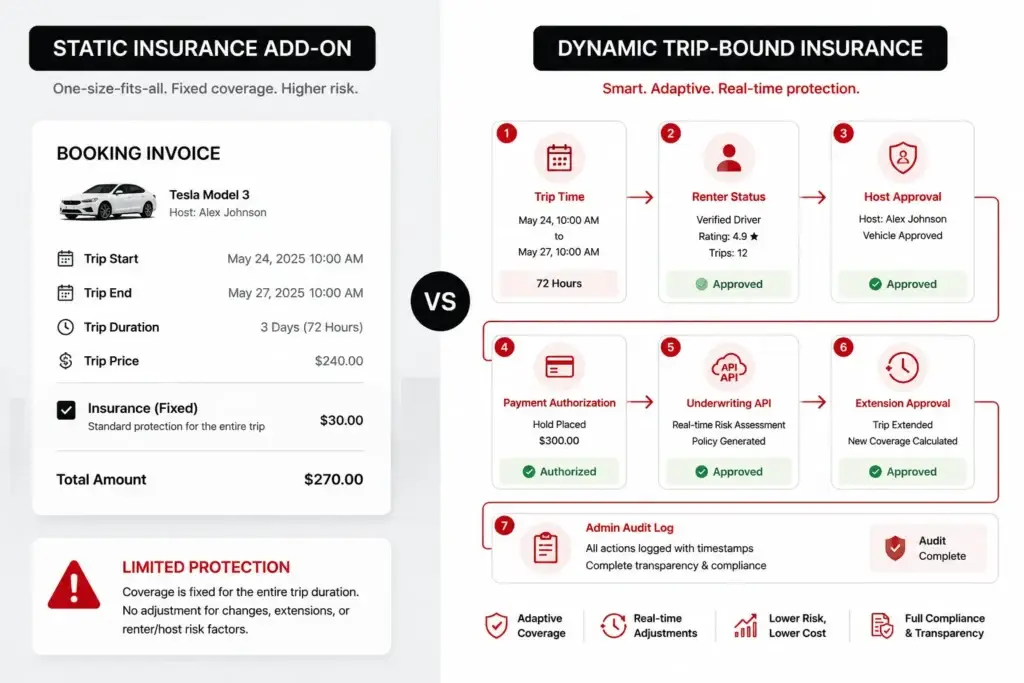
For founders building a Turo-style car rental platform, the lesson is clear: insurance cannot be treated as a static add-on. It must be a trip-bound, time-aware, API-connected system.
Miracuves helps founders build ready-made and white-label car rental marketplace solutions with booking, admin control, monetization logic, and risk-aware workflows. But in mobility platforms, speed alone is not enough. A fast launch without trip-bound insurance logic can create the kind of exposure that destroys the business before it gets traction.
The Static Policy Trap: What Happens When a Renter Is Late?
A basic Turo clone script usually creates a booking like this:
- Start time
- End time
- Vehicle ID
- Host ID
- Renter ID
- Payment status
- Booking status
- Optional insurance/protection fee
That looks acceptable during a product demo. It is not acceptable during a claim.
The weakness appears when the booking ends on paper but the vehicle is still physically in the renter’s control. A static system assumes the trip ended at the scheduled time. A real mobility platform must ask a different question:
Read more : Best Turo Clone Script in 2026: Features & Pricing Compared
Who had custody of the vehicle at the exact minute of the incident?
That is where cheap clone scripts become dangerous. Many scripts store insurance as a line item attached to the booking invoice. They do not continuously reconcile:
- Scheduled trip end time
- Actual check-in/check-out timestamp
- Host-approved extension status
- Renter location or vehicle telematics
- Payment capture for extra usage
- Insurance API policy window
- Underwriter approval or rejection
- Admin exception handling
- Late return dispute records
Turo’s additional usage policy shows that late returns are operationally structured by time bands. For hosts, Turo lists no charge for 0–29 minutes late, a partial daily charge for 30 minutes to 1 hour 59 minutes late, and a larger charge when the vehicle is 2 hours or more late. This matters because a real marketplace must not only calculate late fees. It must also decide what happens to risk coverage during that late-return window.
A script that only adds a late fee after the fact is not enough. Late fees recover revenue. They do not automatically prove that underwriting coverage was extended.
The Legal Nightmare of Uninsured Asset Damage
The most dangerous phrase in peer-to-peer car rental is not “payment failed.” It is:
Read more : Reasons startup choose our Turo clone over custom development
“The accident happened outside the insured trip window.”
When that happens, every party starts pushing responsibility away.
The host may argue that the platform accepted the rental and failed to enforce return. The renter may argue that the app allowed continued possession or did not block use. The insurer may say the policy or protection record ended at the scheduled trip time. The platform owner may discover that the software has no audit trail showing extension prompts, approval attempts, payment authorization, or underwriting updates.
Turo makes protection plans available for guests to purchase, but it also states that these plans are not insurance. For hosts, Turo’s earnings plans reference third-party liability insurance with limits and jurisdiction-specific differences. A founder building an independent Turo-style platform cannot casually copy the visible booking model and assume the legal risk layer will solve itself.
A car rental marketplace needs a clean chain of evidence:
| Risk Question | What the Platform Must Prove |
|---|---|
| Was the trip active? | Exact trip status at the time of incident |
| Was the renter authorized? | Valid renter identity, license, payment, and booking record |
| Was the host notified? | Extension request, approval, rejection, or escalation trail |
| Was coverage extended? | Underwriting API response or insurance provider confirmation |
| Was payment captured? | Late usage charge, authorization hold, or failed payment log |
| Was the admin alerted? | Risk dashboard event, escalation note, and support timeline |
| Was the vehicle still in renter custody? | Return confirmation, GPS/telematics, check-in record, or dispute log |
Without these records, the platform owner may be left with contradictory claims and no defensible system trail.
This is not just a technical bug. It is a risk architecture failure.
Why “Insurance Coverage” as a Feature Is Not Enough
Many car rental app pages mention “insurance coverage” as though it is a checkbox. That is the wrong way to think about mobility risk.
A serious Turo clone insurance integration needs to answer five product questions:
- When does coverage start?
At booking confirmation, scheduled pickup, actual vehicle unlock, manual check-in, or underwriter confirmation? - When does coverage end?
At scheduled drop-off, actual return, host confirmation, vehicle lock, or admin closure? - What happens when the renter is late?
Does the system trigger an extension workflow, block closure, update the underwriter, and capture payment? - What happens if the underwriter rejects the extension?
Does the renter get warned, the host get notified, the admin intervene, or the vehicle become marked as high-risk? - What evidence exists after a claim?
Can the platform produce timestamps, API logs, notifications, payment records, and admin actions?
A shallow Turo clone script may show an “insurance selected” field in the booking. A risk-ready car rental platform must maintain a live insurance state machine.
That state machine should know whether a trip is:
- Quoted
- Booked
- Payment-authorized
- Awaiting pickup
- Active
- Nearing expiration
- Extension requested
- Extension pending host approval
- Extension pending underwriting approval
- Extension approved
- Extension rejected
- Late without approval
- Returned
- Claim pending
- Closed
This is the difference between a booking app and a mobility risk platform.
The 45-Minute Liability Gap Explained
Let’s break down the late-return incident that exposes weak Turo clone architecture.
The renter books a car from 9:00 AM to 5:00 PM. The platform creates a static booking. The renter selects an insurance or protection option. The payment succeeds. The trip starts.
At 4:45 PM, the renter realizes they will be late. A cheap clone script may send a generic reminder. A better platform triggers a structured workflow:
- “Your trip ends in 15 minutes.”
- “Request an extension now.”
- “Additional usage fees may apply.”
- “Coverage extension requires approval.”
- “Host must approve the updated return time.”
- “Payment authorization will be updated.”
- “Insurance/underwriting status must be confirmed.”
At 5:00 PM, the original trip window ends.
At 5:10 PM, the renter is still driving.
At 5:32 PM, an accident occurs.
If the system did not extend the booking, payment, and insurance record before the incident, the platform may face a dispute over whether the vehicle was covered. Turo’s own extension workflow allows guests to request trip changes while a trip is in progress and, in some cases, up to 24 hours after the originally scheduled end time; if approved, an initially late guest may no longer be considered late.
For a founder building an independent car rental marketplace, this creates a critical product lesson: extension logic cannot be casual. It must be auditable, time-bound, and connected to the risk layer.
Hardcoding Dynamic Trip-Bound Underwriting: The Miracuves Protocol
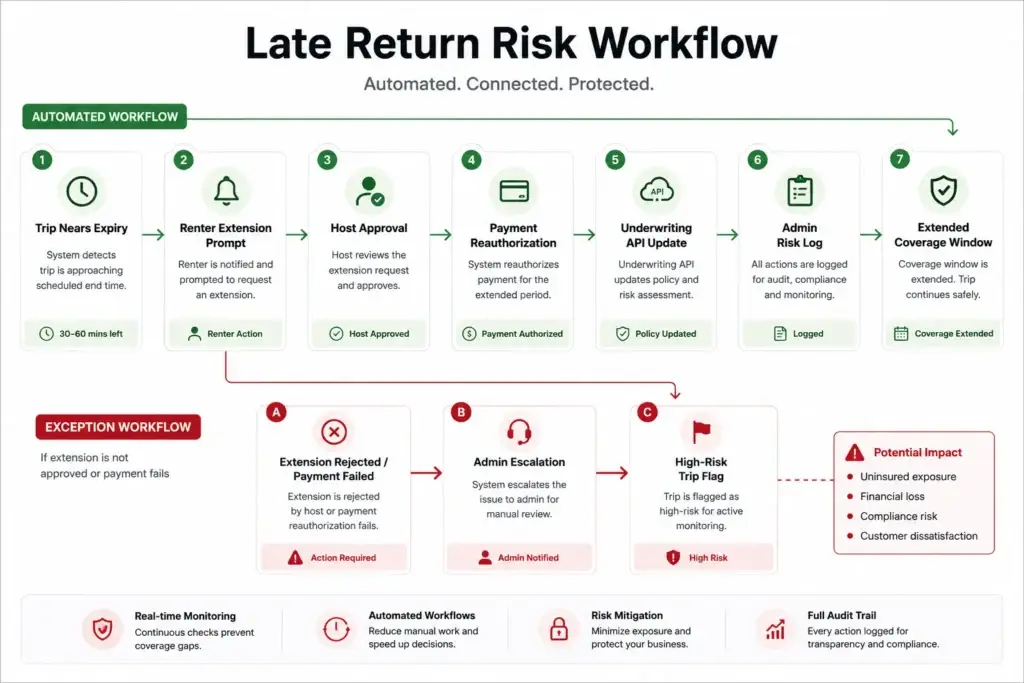
A risk-aware Turo clone app should not wait for a human support agent to discover late returns manually. The platform should treat late return as an automated underwriting event.
Miracuves approaches car rental marketplace architecture with a trip-bound control layer. The goal is not to claim universal legal protection or guaranteed insurance approval. Final compliance and coverage depend on jurisdiction, insurer rules, legal review, policy wording, integrations, and operating model. The product foundation, however, should be designed to support the right risk workflows from day one.
1. Trip Expiry Monitoring
The platform should continuously monitor every active trip against its scheduled return time.
At configurable thresholds, the system should trigger:
- Renter reminders
- Host alerts
- Admin risk flags
- Extension prompts
- Payment reauthorization
- Insurance API pre-checks
This converts late return from a customer-service surprise into a predictable workflow.
2. Extension Request Automation
The renter should not be able to casually “message the host” and continue driving outside the booked window. A structured extension flow should capture:
- Requested new return time
- Reason for delay
- Updated trip cost
- Additional usage fee
- Updated deposit or authorization
- Host approval
- Underwriting status
- Timestamped acceptance
If the extension is rejected, the platform should mark the trip as high-risk and escalate.
3. Insurance API Rebinding
This is the core difference between a commodity clone and a serious rental platform.
The system should send updated trip parameters to the insurer, broker, or underwriting API:
- Vehicle ID
- Driver/renter ID
- Host ID
- Original trip window
- New requested end time
- Location or jurisdiction
- Vehicle category
- Risk flags
- Payment authorization status
The platform should not simply assume coverage has extended. It should store the API response, approval status, error code, and timestamp.
4. Payment and Deposit Synchronization
A late return creates additional risk and additional cost. If the renter’s card cannot be reauthorized, the platform should not silently keep the trip in a normal state.
The system should connect:
- Late fee calculation
- Extra trip charge
- Deposit adjustment
- Failed payment alerts
- Admin escalation
- Host notification
- Extension approval lock
This prevents the platform from extending operational risk without commercial control.
5. Admin Risk Dashboard
The admin panel should not only show bookings and revenue. It should show risk states.
A serious car rental admin dashboard should include:
- Trips expiring soon
- Trips overdue
- Extension requested
- Extension rejected by host
- Extension rejected by insurer/API
- Payment reauthorization failed
- Vehicle not returned
- High-risk renter
- Claim initiated
- Damage report pending
- Dispute under review
Miracuves’ Turo-style car rental marketplace solution already includes core workflows such as listings, renter booking, host approval, availability calendars, pickup/drop-off scheduling, trip management, cancellation flow, customer notifications, insurance add-ons, late return penalties, damage reports, payment records, refund handling, dispute management, and rental analytics. The next founder-level decision is how deeply to customize those workflows for underwriting and regional legal requirements.
Founder Decision Signals
Speed
A ready-made Turo clone can help you launch faster, but speed becomes dangerous if late-return and insurance-extension workflows are missing.
Cost
A cheaper script may reduce upfront cost, but one uncovered claim can create legal, reputational, and operational damage far beyond development savings.
Scalability
As trips increase, manual monitoring fails. Automated trip expiry, extension, payment, and underwriting logic must scale with booking volume.
Market Fit
Hosts will not trust a platform that cannot protect vehicle custody, claims evidence, payment records, and late-return accountability.
Static Clone Script vs Risk-Ready Turo Clone Architecture
| Layer | Cheap Turo Clone Script | Risk-Ready Miracuves Approach |
|---|---|---|
| Insurance Logic | Insurance shown as a static booking add-on. | Insurance status linked to exact trip window, extension status, payment, and API response. |
| Late Return Handling | Late fee added manually or after trip closure. | Automated reminders, extension requests, host approval, payment update, and admin risk flags. |
| Underwriting API | No live connection or no timestamped response storage. | Trip extension sent to insurer/API with approval, rejection, and audit log stored. |
| Admin Control | Admin sees bookings, users, and payments. | Admin sees overdue trips, uninsured states, failed authorizations, claims, disputes, and escalation queues. |
| Claim Evidence | Limited timestamps and weak event history. | Full audit trail across renter actions, host approvals, API calls, payments, notifications, and admin decisions. |
The Underwriter’s View: Why Exact Trip Hours Matter
Underwriters do not evaluate your platform the same way founders do.
A founder asks:
“Can users book cars easily?”
An underwriter asks:
“Can the platform prove who was responsible for the vehicle at 5:32 PM?”
A founder asks:
“Can we charge a late return fee?”
An underwriter asks:
“Was the late return approved, paid for, and bound to the coverage record before the loss?”
A founder asks:
“Can hosts list vehicles?”
An underwriter asks:
“Can the platform prevent uninsured custody gaps across thousands of active assets?”
That is why trip-bound insurance integration belongs inside the product architecture, not inside a support manual.
The platform should create a clean event chain:
- Booking created
- Renter verified
- Payment authorized
- Protection option selected
- Insurance/API quote generated
- Trip started
- Return reminder triggered
- Extension requested
- Host approved
- Payment updated
- Underwriting extension confirmed
- New trip end time stored
- Vehicle returned
- Trip closed
- Claim window/audit trail retained
If any step fails, the platform should know what failed, when it failed, and who was notified.
What Risk Managers Should Demand Before Approving a Turo Clone Platform
Risk managers and insurance underwriters should not approve a Turo clone app based only on screens. They should ask for workflow evidence.
Before approving a car rental marketplace platform, demand proof of:
- Dynamic trip extension logic
- Insurance API integration capability
- Timestamped underwriting responses
- Late-return escalation rules
- Payment reauthorization workflow
- Host approval flow
- Renter warning notifications
- Admin risk dashboard
- Damage report workflow
- Claim documentation export
- Audit logs
- Role-based access control
- Dispute management records
- Jurisdiction-based policy configuration
Security should also be treated as a foundation. A rental marketplace should support encrypted data transfer, secure payment gateway integration, role-based access control, audit logs, user verification, provider verification, dispute workflows, and admin access controls.
This does not guarantee compliance in every market. Final compliance depends on jurisdiction, legal review, insurance contracts, integrations, and operating model. But a platform without these foundations starts from a weak position.
Mistakes Founders Should Avoid
Buying a Turo Clone Based Only on Demo Screens
A clean renter app does not prove the backend can handle late returns, coverage extensions, payment failures, damage claims, or underwriting audit trails.
Treating Insurance as a Static Add-On
Insurance or protection logic must follow the trip lifecycle. If it does not update when the trip changes, the platform can create dangerous coverage ambiguity.
Letting Late Returns Become Manual Support Tickets
Manual handling may work for five cars. It fails at scale. Overdue trips need automated alerts, escalation rules, and admin visibility.
Ignoring Failed Payment Reauthorization
If a renter cannot pay for extra usage, the system should not silently continue the trip as normal. Payment failure is a risk signal.
How Miracuves Helps Founders Build Safer Turo-Style Platforms
Miracuves helps founders launch car rental marketplace platforms faster using ready-made, white-label, source-code-owned app foundations. For a Turo-style business, that foundation can include renter workflows, host workflows, vehicle listings, booking calendars, pickup and drop-off scheduling, payments, admin controls, insurance add-ons, late return penalties, damage reports, dispute management, and analytics.
For founders who want to go beyond a commodity clone, the stronger move is to customize the platform around risk operations:
- Trip-bound insurance state management
- Insurance or underwriting API integration
- Automated trip extension workflow
- Late return risk flags
- Payment reauthorization rules
- Host approval workflow
- Claim evidence exports
- Admin escalation dashboard
- Jurisdiction-based configuration
- Source-code ownership for long-term control
Miracuves’ existing Turo-like app solution is positioned as a PHP/Laravel and Flutter-based package with a one-time price of $3,399 and a 6-day launch timeline, subject to final scope and customization requirements. Founders should confirm the latest quote, integration scope, insurance provider requirements, and regional legal obligations before launch.
Final Thoughts: A Cheap Clone Can Cost More Than a Custom Risk Layer
The cheapest Turo clone is not always the most affordable path. In car rental marketplaces, the expensive mistake is not paying for better architecture. The expensive mistake is launching a platform that cannot prove coverage, custody, payment status, and approval history when a real accident happens.
The 45-minute liability gap is not theoretical. Late returns happen. Extensions happen. Payment failures happen. Claims happen. The question is whether your software treats those moments as normal app events or as underwriting-critical risk events.
A serious Turo clone app should not only help renters book vehicles. It should help founders protect hosts, assets, platform reputation, insurance relationships, and long-term business survival.
That is the difference between launching a rental app and building a mobility platform founders can actually trust.
FAQs
What is Turo clone insurance integration?
Turo clone insurance integration is the process of connecting a car rental marketplace’s booking, trip, payment, and extension workflows with an insurance provider, broker, or underwriting API. The goal is to make sure coverage logic follows the exact trip window instead of remaining as a static invoice add-on.
Why are late returns risky for a Turo clone app?
Late returns create a gap between scheduled trip end time and actual vehicle return. If an accident happens during that gap and the platform has not extended the trip, payment, and insurance record, the founder may face serious coverage and liability disputes.
Can a Turo clone script include insurance as a simple feature?
It can, but that is usually not enough for a real mobility business. A serious platform should support trip-bound insurance logic, extension workflows, API responses, payment reauthorization, admin escalation, and audit logs.
What should happen when a renter requests a trip extension?
The platform should collect the new return time, calculate extra charges, request host approval, update payment authorization, send the updated trip window to the underwriting or insurance API, store the response, and notify all parties.
Does Miracuves guarantee insurance compliance for car rental apps?
No. Final compliance depends on jurisdiction, legal review, insurer requirements, policy wording, integrations, and operating model. Miracuves can help build a compliance-ready technical foundation and risk workflow support, but legal and insurance approval must be confirmed with qualified professionals and providers.
What features should risk managers check in a Turo clone platform?
Risk managers should check dynamic trip extension, insurance API integration, audit logs, late-return escalation, payment reauthorization, damage reports, claim evidence export, host approval workflows, and role-based admin controls.
Is a ready-made Turo clone safe for mobility startups?
A ready-made Turo clone can be a strong starting point if it supports customization, source-code ownership, admin control, and risk workflow configuration. Founders should avoid scripts that only provide booking screens without deeper trip, claim, and underwriting logic.
How does Miracuves support Turo-style car rental marketplace development?
Miracuves helps founders build white-label, source-code-owned car rental marketplace platforms with renter, host, and admin workflows. For risk-sensitive launches, the platform can be customized around trip extensions, insurance integration, late-return automation, damage reporting, and dispute workflows.
Miracuves is an independent software development company. We are not affiliated with, connected to, sponsored by, or endorsed by any company or product named in this article.
Terms such as “X Clone” are used descriptively. It is how the software industry refers to building a platform with functionality comparable to a known service, and how clients search for it.
The entire design and codebase of our products is built by our own team. Our products contain no code, design, graphics, or content originating from any third-party website or applications.
All third-party names and marks referenced in this article are the property of their respective owners, referenced solely to identify the services discussed.