


Launching a TikTok clone app is not only a product development decision. It is a creator economy decision.
A short-video platform can have a smooth feed, editing tools, effects, live streaming, and an admin dashboard, but growth does not happen automatically after launch. Before scaling acquisition, founders need clarity on the core TikTok clone features that shape creator publishing, viewer engagement, content discovery, and platform control.
The real challenge is building a platform where creators want to publish, viewers want to return, and every new piece of content improves discovery, engagement, and monetization. That is why TikTok marketing strategies need to go beyond app store ads or influencer shoutouts. A founder needs a complete growth system: creator acquisition, content seeding, viewer onboarding, retention loops, creator rewards, moderation, analytics, and monetization.
The monetization layer matters just as much as the engagement layer. A strong TikTok clone business model helps founders plan how the platform can generate revenue through ads, creator monetization, subscriptions, brand partnerships, in-app purchases, or other platform-specific revenue streams.
Miracuves helps founders launch white-label TikTok-style platforms with creator tools, admin control, monetization workflows, and source-code ownership. But once the product foundation is ready, the next business question becomes clear: how do you turn the platform into an active creator community?
This guide breaks down practical TikTok marketing strategies for creator acquisition, retention, and long-term growth.
Why Marketing a TikTok Is Different From Marketing a Normal App
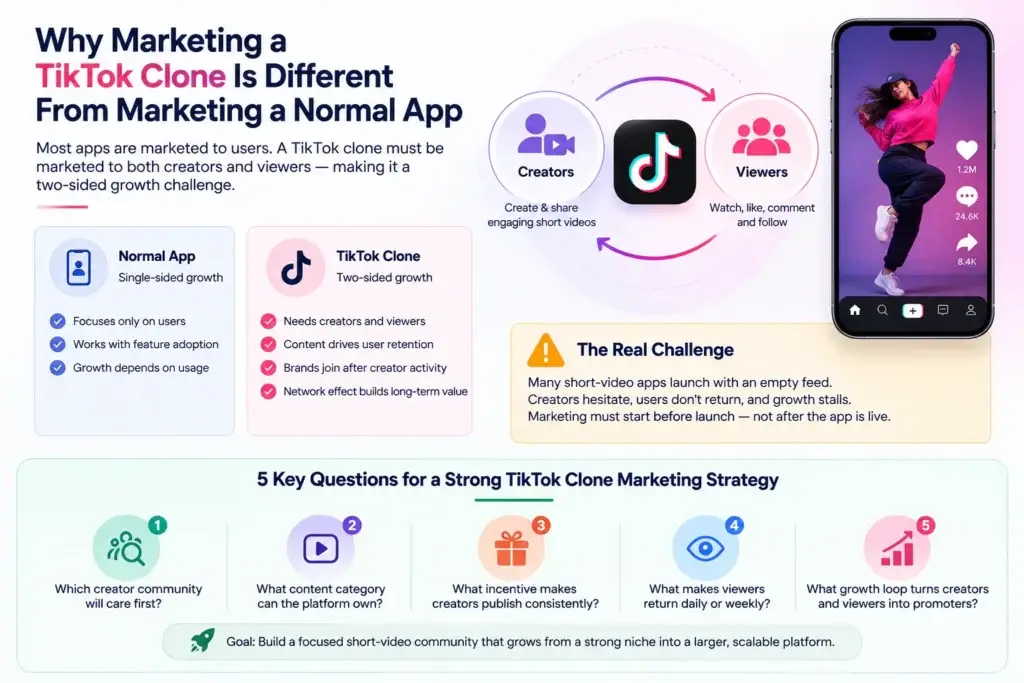
Most apps are marketed to users. A TikTok app must be marketed to both creators and viewers.
That makes it a two-sided growth challenge. Creators need a reason to publish before the audience is large. Viewers need enough relevant content before they form a habit. Brands need creator activity before they spend. The platform operator needs data before scaling paid acquisition.
This is why many short-video app launches struggle. The founder builds the app first and thinks about creator acquisition later. By the time the product is live, the feed feels empty, creators are unsure about the value, and early users do not return.
A stronger TikTok marketing strategy starts before launch. It answers five questions:
- Which creator community will care first?
- What content category can the platform own?
- What incentive makes creators publish consistently?
- What makes viewers return daily or weekly?
- What growth loop turns creators and viewers into promoters?
The goal is not to copy TikTok’s scale. The goal is to build a focused short-video community that can grow from a strong niche into a larger entertainment, learning, lifestyle, or commerce platform.
Read more: Build a Short Video App Like TikTok – Step-by-Step Guide
Start With a Niche Creator Market Before Spending on Ads
A TikTok-style platform that tries to serve everyone from day one usually becomes too generic. Large platforms already own broad entertainment discovery. A new short-video app needs a sharper reason to exist.
A strong niche gives your marketing a clear message, your creators a stronger identity, and your viewers a reason to choose your platform over larger apps.
Examples of strong niche positioning include:
- Regional short-video platform for local language creators and community influencers
- Fitness creator platform for trainers, coaches, nutrition creators, and transformation stories
- Education short-video app for tutors, exam mentors, language coaches, and micro-learning creators
- Creator commerce platform for product reviewers, affiliate creators, local sellers, and brand ambassadors
- Fan community platform for artists, performers, influencers, entertainers, and niche celebrities
The niche does not limit your future. It gives your first creator cohort a reason to join. Once the platform has active content, user behavior, and retention signals, expansion becomes easier.
Read more: Top 10+ Features to Make Your TikTok like App Go Viral
Build Creator Acquisition Like a Sales Pipeline
Creator acquisition should not be random outreach. It should work like a structured pipeline.
Founders should identify creator segments, create outreach scripts, define onboarding benefits, track creator activation, and measure repeat publishing. The best early creators are not always the largest influencers. Often, the strongest starting cohort includes rising creators who want visibility, direct fan access, monetization options, and a platform that listens.
A practical creator acquisition pipeline includes:
- Creator discovery: Find creators on TikTok, Instagram Reels, YouTube Shorts, niche communities, local events, and creator marketplaces.
- Creator segmentation: Separate seed creators, micro-creators, niche experts, regional creators, and brand-friendly creators.
- Outreach: Offer a clear reason to join, such as early visibility, featured placement, creator rewards, or niche ownership.
- Onboarding: Help creators set up profiles, upload first videos, understand the content calendar, and invite followers.
- Activation: Track whether creators publish within the first 48–72 hours after joining.
- Retention: Use analytics, payouts, campaigns, and community support to keep creators active.
The most important creator acquisition metric is not how many creators sign up. It is how many creators publish repeatedly.
Pre-Launch Marketing: Fill the Feed Before Public Launch
A TikTok app should not launch publicly with an empty or weak feed. The first user experience must feel alive.
Before launching publicly, founders should build a founding creator cohort and seed enough content for the first discovery experience. This helps users understand the platform’s identity within seconds.
A practical pre-launch plan includes:
- Create a waitlist landing page for creators and early viewers.
- Recruit 25–100 founding creators depending on niche size and launch region.
- Ask each creator to upload a minimum number of videos before launch.
- Prepare hashtag challenges before the app goes live.
- Create welcome campaigns for the first week of activity.
- Build teaser content for Instagram, YouTube Shorts, LinkedIn, X, Reddit, and niche communities.
- Prepare app store screenshots around creator value, not just app features.
A good launch feed should show variety, quality, and repeatable content formats. It should not look like a demo app. It should look like the beginning of a real community.
Creator Onboarding Should Feel Like a Growth Program
Creators do not join a new platform only because it exists. They join when the platform gives them a growth advantage.
Your creator onboarding should explain what creators can gain, how they should publish, how they can grow, and how they can earn. The first onboarding experience should reduce uncertainty.
Important creator onboarding elements include:
- Creator profile setup: Helps creators present their niche, bio, links, and content category clearly.
- First upload prompts: Guides creators to publish quickly instead of delaying activation.
- Hashtag challenge calendar: Gives creators repeatable content ideas and campaign direction.
- Creator analytics dashboard: Shows views, engagement, retention, earnings, and content performance.
- Monetization setup: Explains coins, gifts, subscriptions, sponsorships, or rewards.
- Community and safety rules: Clarifies acceptable content, reporting, moderation, and account protection.
Creator onboarding is not only a product flow. It is a marketing asset. The easier it is for creators to understand the platform’s value, the faster they move from signup to publishing.
Viewer Acquisition Starts With Creator-Led Distribution
A short-video platform grows faster when creators bring their own audience into the app.
Instead of relying only on paid ads, founders should help creators distribute their profiles, videos, live sessions, and challenges across existing social channels. Every creator becomes a distribution partner.
Useful viewer acquisition strategies include:
- Creator invite links: Give creators profile links they can share with followers.
- Launch challenges: Run niche-specific challenges that encourage user-generated videos.
- Cross-platform teasers: Let creators share short clips on Instagram Reels, YouTube Shorts, X, and community groups.
- Referral rewards: Reward creators or users for bringing high-quality active users, not just signups.
- SEO-friendly web profiles: Make creator pages, hashtag pages, and video pages discoverable on the web where relevant.
- App store optimization: Position the app around the niche, creator benefits, and community identity.
- Partnership campaigns: Work with niche brands, creator agencies, local communities, schools, gyms, media houses, or event organizers.
Paid ads can help, but they should usually come after you have retention signals. Otherwise, the founder pays to send users into an experience that may not yet be sticky.
Read more: Reasons startup choose our TikTok-like app over custom development
Retention Is the Real Growth Engine
Acquisition gets people into the platform. Retention decides whether the platform becomes valuable.
For a TikTok clone app, retention has two sides: creator retention and viewer retention.
Creator retention improves when creators see progress. This may include more views, better comments, featured placements, campaign invitations, revenue opportunities, audience growth, and useful analytics.
Viewer retention improves when the feed becomes more relevant, videos load quickly, creators post consistently, notifications feel useful, and the platform gives users a reason to return.
Important retention metrics include:
- Day 1, Day 7, and Day 30 user retention
- Creator first-post activation rate
- Creator repeat posting rate
- Average videos watched per session
- Watch completion rate
- Rewatch and save behavior
- Comment, share, follow, and live participation rates
- Creator earnings or reward participation
- Report volume and moderation response time
A founder should not scale acquisition before understanding retention. If users leave quickly, more marketing spend only exposes the weakness faster.
Founder Decision Signals
Speed
If creators can onboard, publish, and invite followers quickly, the platform has a stronger chance of early traction.
Cost
Retention quality should guide ad spend. Paying for installs before the feed is active can increase wasted acquisition cost.
Scalability
Growth requires more than downloads. Video delivery, moderation, notifications, analytics, and creator payouts must scale together.
Market Fit
Repeat creator publishing and returning viewers are stronger signals than one-time launch excitement.
Growth Loops That Help a TikTok Clone Scale
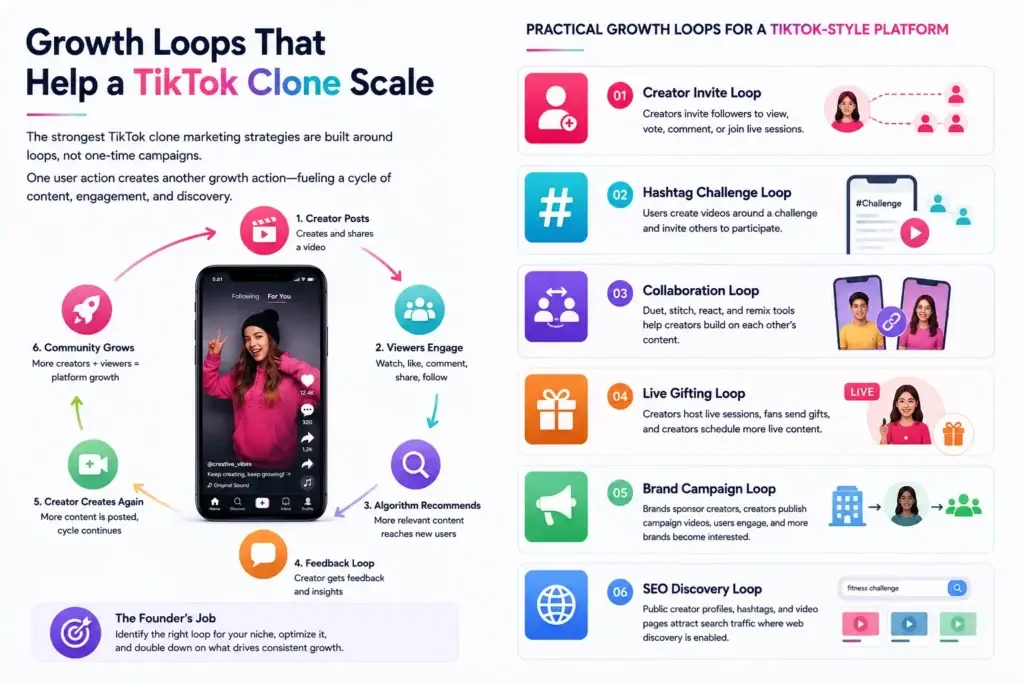
The strongest TikTok clone marketing strategies are built around loops, not one-time campaigns.
A growth loop means one user action creates another growth action. A creator posts a video, viewers engage, the algorithm recommends more content, the creator gets feedback, and the creator posts again. A user joins a challenge, invites friends, more videos appear, and the challenge becomes more visible.
Here are practical growth loops for a TikTok-style platform:
- Creator invite loop: Creators invite followers to view, vote, comment, or join live sessions.
- Hashtag challenge loop: Users create videos around a challenge and invite others to participate.
- Collaboration loop: Duet, stitch, react, and remix tools help creators build on each other’s content.
- Live gifting loop: Creators host live sessions, fans send gifts, and creators schedule more live content.
- Brand campaign loop: Brands sponsor creators, creators publish campaign videos, users engage, and more brands become interested.
- SEO discovery loop: Public creator profiles, hashtags, and video pages can attract search traffic where web discovery is enabled.
The founder’s job is to identify which loop fits the niche first. A regional entertainment app may grow through hashtag challenges. A fitness platform may grow through transformation series. A creator commerce app may grow through affiliate video campaigns.
Monetization Should Support Creator Retention
Monetization is not only a revenue decision. It is also a retention strategy.
Creators are more likely to stay active when they can see a path to value. This value can be financial, reputational, community-based, or commercial.
Common TikTok monetization models include:
- Virtual gifts and coins: Viewers support creators during videos or live sessions.
- Subscriptions and fan clubs: Creators offer premium access, exclusive content, or community benefits.
- Sponsored content: Brands collaborate with creators through managed campaigns.
- Affiliate and commerce revenue: Creators earn from product discovery, recommendations, or linked offers.
- In-app advertising: The platform monetizes attention through relevant ad placements.
- Premium creator tools: Advanced analytics, editing tools, promotion credits, or campaign access can become paid features.
However, founders should be careful with creator rewards. Paying creators without understanding retention quality can create short-term activity but weak long-term engagement. A better approach is to reward behavior that improves the platform: consistent posting, high-quality watch time, positive community engagement, live participation, and audience growth.
Admin Dashboard Strategy for Creator Growth
The admin dashboard is one of the most important growth tools in a TikTok clone app.
Founders often think of the admin panel as a backend management area. In reality, it should support marketing decisions. The operator needs visibility into creators, content, reports, campaigns, earnings, user behavior, and retention.
A growth-ready admin dashboard should help the platform operator:
- Track top creators by views, engagement, retention, and posting frequency.
- Identify creators who signed up but did not publish.
- Feature promising creators in the feed or challenge banners.
- Manage hashtag campaigns and sponsored content opportunities.
- Review content reports and protect community safety.
- Track coin purchases, gifts, payouts, subscriptions, and brand campaigns.
- Monitor retention cohorts and user engagement patterns.
- Adjust notifications, campaigns, and creator promotions based on real behavior.
This is where a ready-made platform foundation can reduce execution friction. A white-label app from Miracuves can help founders start with the core app, creator, monetization, and admin workflows already structured, then customize the growth strategy around their niche.
Community Safety Is a Marketing Advantage
Short-video platforms depend on user-generated content. That means growth and safety must work together.
If creators feel unsafe, they stop posting. If viewers see spam, abuse, low-quality content, or harmful behavior, they stop returning. If brands see weak moderation, they avoid partnerships.
A strong TikTok clone marketing strategy should include community rules from day one. This includes content reporting, comment moderation, account controls, verified creator workflows, abuse handling, role-based admin access, and clear escalation processes.
Safety should not be positioned as a boring backend function. For creator platforms, safety protects retention, brand trust, and monetization.
90-Day TikTok Clone Marketing Plan
A founder does not need to do everything at once. The first 90 days should build the foundation for repeatable growth.
Days 1–30: Creator Supply and Feed Readiness
Focus on niche clarity, creator recruitment, and content seeding.
- Finalize the target creator niche and audience promise.
- Recruit the founding creator cohort.
- Prepare creator onboarding materials.
- Seed the first content library.
- Launch a landing page and waitlist.
- Create the first hashtag challenge calendar.
- Prepare app store assets and social launch content.
Days 31–60: Launch, Activation, and Retention Signals
Focus on getting users into the product and measuring behavior.
- Launch with founding creators already active.
- Run the first major challenge or creator campaign.
- Track first-post activation and repeat publishing.
- Monitor user retention and feed engagement.
- Promote high-performing creators.
- Use push notifications carefully for live sessions, new challenges, and creator updates.
- Fix onboarding, upload, feed, and performance issues quickly.
Days 61–90: Growth Loops and Monetization Testing
Focus on repeatability and monetization experiments.
- Launch creator referral rewards.
- Test virtual gifting, subscriptions, or sponsored creator campaigns.
- Build partnerships with niche communities and brands.
- Identify top content formats and create repeatable campaign templates.
- Expand creator acquisition into adjacent niches.
- Use retention data to guide paid acquisition.
- Prepare a second growth cycle based on what worked.
Mistakes Founders Should Avoid
Mistakes Founders Should Avoid
Launching With an Empty Feed
A short-video app needs content density from the first session. Without enough videos, users cannot understand the platform’s value and are less likely to return.
Chasing Large Influencers Too Early
Large influencers can create awareness, but early-stage platforms often need committed niche creators who will publish repeatedly and help shape the community.
Scaling Paid Ads Before Retention
Paid acquisition should follow retention learning. If users do not stay, more installs will not solve the core product and community problem.
Ignoring Creator Analytics
Creators need feedback. Without performance insights, they may not understand what works, how to improve, or why they should keep publishing.
Treating Moderation as an Afterthought
Community safety affects creator trust, viewer comfort, and brand partnerships. Growth without safety can damage long-term platform value.
How Miracuves Helps Founders Launch Growth-Ready TikTok Clone Apps
A TikTok clone app should not be judged only by its screens. Founders should look at whether the platform can support creator acquisition, creator monetization, viewer retention, admin control, and future customization.
Miracuves’ TikTok clone app gives founders a white-label short-video platform foundation with creator tools, feed logic, live streaming, monetization workflows, admin dashboard controls, and source-code ownership. This helps founders move faster while keeping flexibility for niche positioning, custom campaigns, and growth experiments.
For supporting execution, founders can also explore Miracuves resources on short video platform user acquisition strategies, video streaming infrastructure for short video apps, background processing for creator platforms, and cloud infrastructure for short video platforms.
Final Thoughts: Grow the Creator System, Not Just the App
The real value of TikTok clone marketing strategies is not in copying viral tactics. It is in building a system where creators publish, viewers return, content improves, communities feel safe, and monetization becomes possible over time.
Founders should think beyond launch day. The stronger question is not “How do we get downloads?” It is “How do we make creators and viewers come back every week?”
A ready-made TikTok-style platform can reduce the time needed to launch, but growth still depends on strategy. Start with a focused niche, recruit the right creators, seed the feed before launch, measure retention carefully, reward meaningful creator activity, and use admin analytics to improve every growth cycle.
FAQs
What are the best TikTok clone marketing strategies for a new app?
The best TikTok clone marketing strategies include niche positioning, founding creator recruitment, content seeding, hashtag challenges, creator invite links, referral rewards, app store optimization, creator analytics, community partnerships, and retention-focused engagement campaigns.
How do you acquire creators for a TikTok clone app?
Start by targeting creators in a specific niche instead of chasing broad influencers. Recruit micro-creators, regional creators, educators, entertainers, coaches, or product reviewers who want visibility, monetization, and a focused community. Then support them with onboarding, featured placements, analytics, and campaign opportunities.
How many creators should a TikTok clone app have before launch?
There is no fixed number, but a founder should have enough creators to make the first feed feel active. For a niche launch, 25–100 founding creators can be a practical starting range, depending on market size, content category, and launch geography.
How can a TikTok clone retain creators?
Creator retention improves when creators get visibility, audience feedback, analytics, monetization options, campaign opportunities, and community protection. Features such as creator dashboards, virtual gifts, subscriptions, live sessions, and featured challenges can help creators stay active.
Should founders use paid ads for TikTok clone app growth?
Paid ads can help, but they should usually come after the platform has enough content and early retention signals. If the feed is empty or users are not returning, paid acquisition may increase cost without solving the core growth problem.
What growth loops work for a TikTok-style platform?
Useful growth loops include creator invite loops, hashtag challenge loops, duet and remix loops, live gifting loops, brand collaboration loops, referral loops, and SEO discovery loops through public creator profiles or hashtag pages.
Why is creator monetization important for TikTok clone growth?
Creator monetization gives creators a reason to keep publishing. Virtual gifts, coins, subscriptions, sponsored content, affiliate commerce, and premium creator tools can support long-term creator retention when aligned with content quality and audience engagement.
How can Miracuves help with TikTok clone app growth?
Miracuves helps founders launch white-label TikTok-style platforms with creator tools, feed logic, monetization workflows, admin control, content moderation, and source-code ownership. This gives founders a faster product foundation for testing creator acquisition, retention, and growth strategies.