


Key Takeaways
What You’ll Learn
- Many startups fail by building without a clear niche or target audience.
- Overloading features early increases cost, delays launch, and adds complexity.
- Ignoring user experience leads to low engagement and poor retention.
- Weak backend planning can create scalability issues as users grow.
- Missing a clear revenue model affects long-term sustainability.
Stats That Matter
- Networking platforms require multiple modules like profiles, messaging, feeds, and job systems.
- Scalability becomes critical as connections, posts, and interactions increase.
- Real-time features such as messaging and notifications add technical complexity.
- Security and data protection are essential for user trust and platform credibility.
- Early-stage mistakes can significantly increase long-term development costs.
Real Insights
- Startups often fail not because of the idea, but because of poor execution.
- Launching with a focused MVP helps reduce risk and validate demand faster.
- A clear niche positioning improves user acquisition and engagement.
- Planning architecture early prevents costly rebuilds later.
- Success comes from balancing usability, scalability, and business strategy.
Building a LinkedIn clone sounds like a brilliant idea. You imagine ambitious professionals signing up, recruiters posting jobs, thought leaders sharing advice, and your app becoming the next digital HQ for careers. But here’s what most founders miss: LinkedIn isn’t just a job board—it’s a complex ecosystem of status, strategy, and subtle networking rituals.
I’ve seen startups launch beautiful apps that look like LinkedIn but feel like… empty shells. No conversations. No connections. No conversions. That’s because LinkedIn didn’t win by features alone—it won by understanding professional behavior.
At Miracuves, we’ve helped launch purpose-driven networking platforms that actually serve their users. If you’re thinking of building a LinkedIn style clone, don’t just replicate what you see. Avoid these five common mistakes that keep startups stuck in the friend zone of the professional world.
Read More : Pre-launch vs Post-launch Marketing for LinkedIn Clone Startups
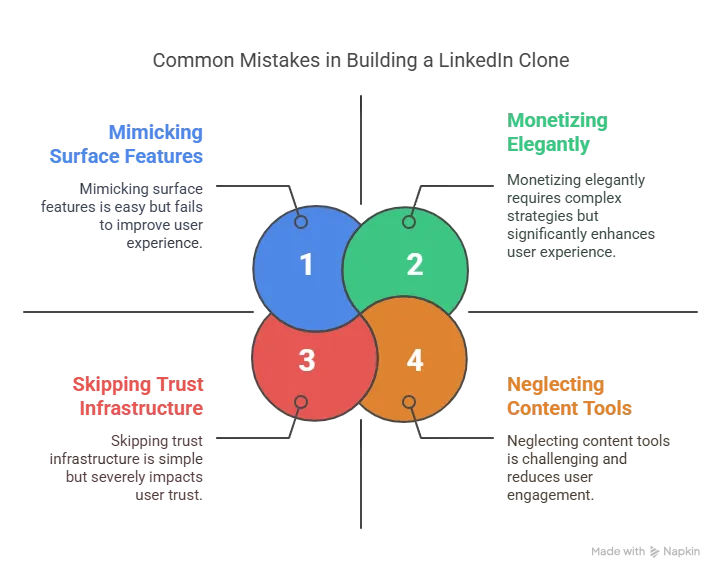
The 5 Most Common Mistakes When Building a LinkedIn Clone
1. Mimicking the Surface Instead of Serving the Purpose
So many startups obsess over LinkedIn’s interface—profile layouts, endorsements, job tabs—but miss the intent. People don’t log into LinkedIn just to look at profiles. They come to advance their careers.
Your platform must offer real, tangible value: connections that matter, job leads that pay off, visibility that feels earned.
Pro Tip:
Design around outcomes, not aesthetics. What do your users want to achieve in 3 months using your app? Build features that get them there.
2. Skipping the Trust Infrastructure
Trust is the currency of professional networking. LinkedIn thrives because it feels real—verified emails, work history, mutual connections, endorsements. Without these, your clone turns into a spam zone.
Too many apps skip verification, allow fake profiles, or ignore moderation. That’s an instant dealbreaker in a space where reputation is everything.
Pro Tip:
Verify user identity during onboarding. Encourage profile completeness. Add trust badges and highlight mutual affiliations.
3. Treating Jobs Like Classified Ads
A LinkedIn clone without an intelligent job system is just a digital Rolodex. Job boards aren’t enough. Users want discovery. Recruiters want filtering. Everyone wants relevance.
The difference? LinkedIn uses signals—job views, skill tags, activity—to recommend better jobs and better candidates.
Pro Tip:
Even basic smart filtering (by skills, location, activity) can dramatically improve job matching. Don’t just list jobs—help users find the right ones.
Related Internal Link:
Build a Professional Platform with a LinkedIn Clone
4. Neglecting Thought Leadership and Content Tools
People don’t just job hunt on LinkedIn—they post, comment, write, and share. Content fuels visibility, connection, and credibility.
Startups often skip content tools entirely. No post feed. No article sharing. No native content formats. That’s a huge miss in a world where personal branding is everything.
Pro Tip:
Enable status updates, long-form articles, polls, and post reactions. Your platform should help users grow their voice, not just their résumé.
5. Forgetting to Monetize Early (and Elegantly)
LinkedIn makes billions via premium memberships, recruiter tools, job ads, and lead generation. Your clone doesn’t need all that—but it does need a path to revenue.
Many founders wait too long, build a free platform, then panic when costs rise. Others slap on paywalls without adding any value.
Pro Tip:
Offer recruiter access, visibility boosts, premium analytics, or subscription tiers with real utility. Monetize through enhancement, not restriction.
Read More : How to Build an App Like LinkedIn – Full Stack Developers Guide
Conclusion
LinkedIn’s success is rooted in psychology, data, and community—not just code. Your clone needs to empower professionals, not just connect them. Focus on trust, value delivery, and creator tools, and you’ll build something that professionals actually return to.
You don’t need to be the next LinkedIn. You just need to be the platform your niche can’t live without.
At Miracuves, we help innovators launch high-performance app clones that are fast, scalable, and monetization-ready. Ready to turn your idea into reality? Let’s build together.
FAQs
Can I build a LinkedIn-style app for a specific industry?
Absolutely. Niche professional networks—like those for freelancers, doctors, or developers—are often more engaging than general ones.
How do I make users fill out their profiles?
Gamify it. Add profile completion bars, tooltips, and reward visibility for completeness.
What should I include in a job module?
Search, filters (role, experience, location), saved jobs, and one-click applications. Add recruiter dashboards for hiring.
Is content really necessary for a LinkedIn clone?
Yes. Posts, comments, and articles drive visibility, engagement, and user retention. Content is the new résumé.
Can I charge recruiters on day one?
Yes—if you offer value. Filters, saved pipelines, resume access, and direct messaging can all be monetized.
Should I offer messaging features at launch?
Only if your users need real-time collaboration. For job discovery, email-style communication works just fine early on.