


Key Takeaways
What You’ll Learn
- LinkedIn clone scripts provide a ready-made foundation to launch faster.
- Core features include profiles, connections, messaging, job boards, and content feeds.
- Choosing the right script depends on scalability, customization, and long-term goals.
- Pre-built solutions reduce development complexity compared to custom builds.
- Cost and feature balance plays a key role in startup decision-making.
Stats That Matter
- Basic LinkedIn-style platforms can cost around $70,000 globally for MVP builds.
- Full-feature networking platforms can reach $150,000 to $300,000+ depending on complexity.
- Ready-made solutions like Miracuves start from $2,899 for a complete platform.
- Development timelines can drop from months to just days with clone scripts.
- Pricing varies based on features like messaging, analytics, job systems, and scalability.
Real Insights
- Startups benefit from launching with proven feature sets instead of building from scratch.
- Cost savings allow founders to invest more in marketing and user acquisition.
- The right script should support future monetization and scaling.
- Feature-rich platforms improve engagement and retention from the start.
- Success depends on choosing a solution that balances speed, cost, and long-term flexibility.
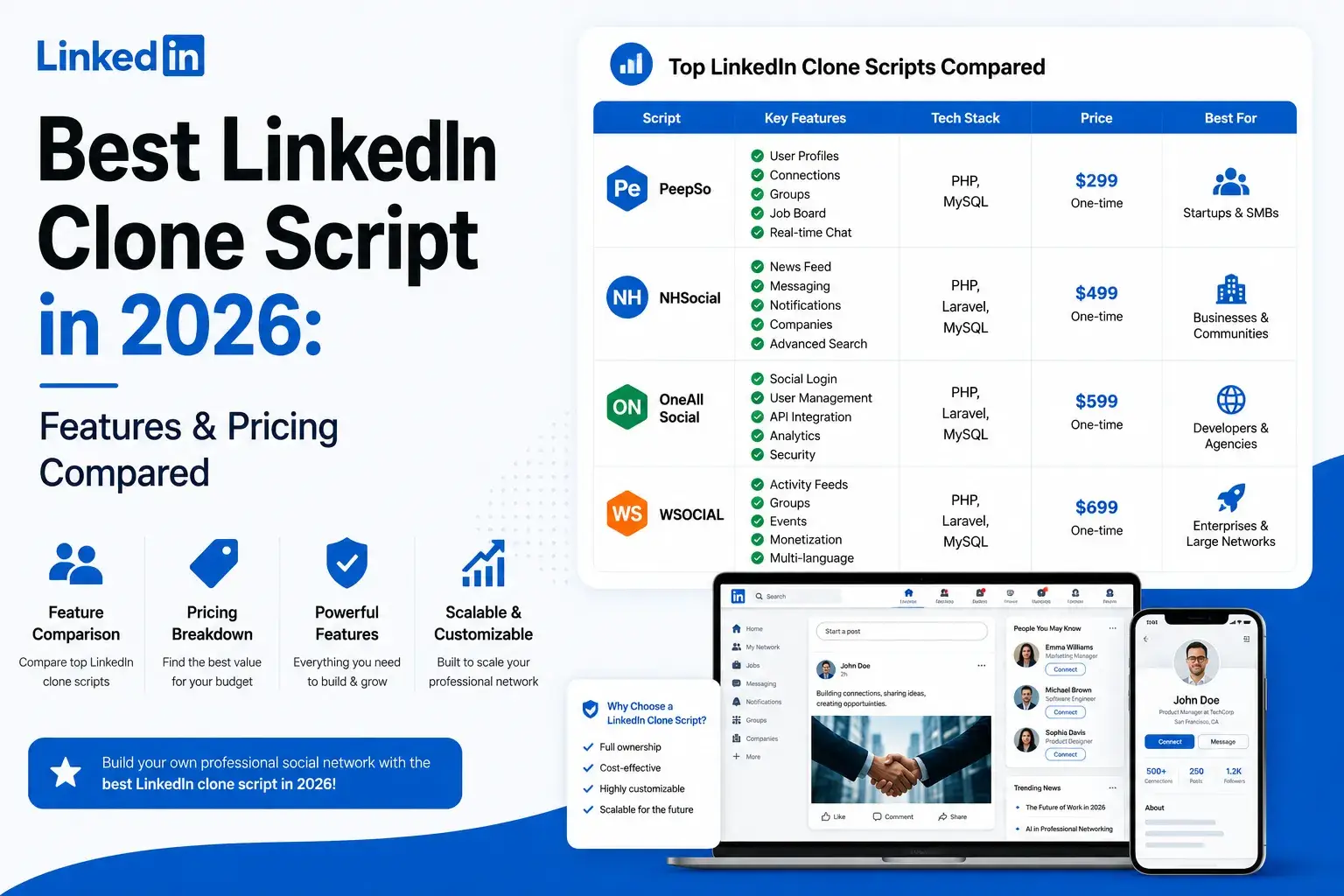
LChoosing the best LinkedIn clone script in 2026 is not just about finding software that looks similar to LinkedIn. For founders, the real decision is whether the script can support a serious professional networking business with profiles, connections, jobs, messaging, company pages, admin control, monetization, and long-term scalability.
Many scripts promise quick launch. Fewer are built to handle real platform operations.
That difference matters.
A LinkedIn-style platform is not a simple social app. It combines career identity, professional content, hiring workflows, recruiter access, business pages, private messaging, recommendations, groups, and trust signals. If the foundation is weak, the founder may save money upfront but lose time later rebuilding core modules.
This guide compares LinkedIn clone script features, pricing models, use cases, monetization options, and founder decision signals so you can choose a platform foundation with more clarity.
Miracuves helps founders launch ready-made and white-label app solutions with source-code ownership, branded design, admin control, and faster deployment. For professional networking platforms, that means starting with a proven structure while still customizing the experience for your niche audience.
Read More : Pre-launch vs Post-launch Marketing for LinkedIn Clone Startups
What Is a LinkedIn Clone Script?
A LinkedIn clone script is a ready-made software foundation that replicates the core functionality of LinkedIn-style professional networking platforms. It usually includes user profiles, professional feeds, connection requests, messaging, company pages, job postings, groups, notifications, and admin management.
The goal is not to copy LinkedIn blindly.
The smarter goal is to use LinkedIn’s proven product pattern as a base and then customize it for a focused market. That market could be healthcare professionals, alumni communities, freelancers, startup founders, recruiters, consultants, creative professionals, corporate teams, or industry-specific networks.
A strong LinkedIn clone script should help you launch faster, but it should also give you enough flexibility to create a differentiated platform. SocialEngine, for example, explains LinkedIn clone platforms around profiles, status updates, business pages, jobs, networking, content sharing, group discussions, and ads.
For founders, the important question is not “Can this script copy LinkedIn?” It is “Can this script support my business model after real users join?”
Why Founders Are Building LinkedIn-Style Platforms in 2026
LinkedIn is massive, but that is exactly why niche professional platforms still have room to grow.
Large platforms serve broad audiences. Niche platforms can serve specific communities with sharper identity, stronger moderation, better context, and more relevant opportunities.
A LinkedIn-style platform can work well for:
- Alumni networks that need verified members, career opportunities, mentorship, and private groups.
- Freelancer communities that combine profiles, portfolios, jobs, messaging, and paid access.
- Industry networks for doctors, engineers, legal professionals, consultants, creators, or finance experts.
- Recruitment marketplaces that connect employers with verified candidates.
- Corporate internal networks for employee discovery, knowledge sharing, and internal hiring.
- Startup ecosystems where founders, mentors, investors, and operators can connect.
The business advantage is focus. You do not need to compete with LinkedIn globally. You need to create a better professional experience for one clear audience.
That is where a LinkedIn clone script becomes useful. It gives founders a ready-made product structure while leaving room for niche branding, custom workflows, and monetization.
Best LinkedIn Clone Script Comparison: What Really Matters
Many search results compare LinkedIn clone scripts only by visible features. That is not enough.
A founder should compare scripts across six deeper layers:
| Comparison Factor | Why It Matters | Founder Decision Signal |
|---|---|---|
| Feature completeness | Profiles, feeds, jobs, chat, company pages, and groups must work together | Avoid scripts that only look like a resume directory |
| Customization | Your niche may need unique profile fields, verification flows, or recruiter tools | Choose flexible architecture over rigid templates |
| Source-code access | Ownership affects long-term control and scaling | Avoid being locked into a vendor with limited modification rights |
| Admin dashboard | Moderation, users, jobs, reports, payments, and analytics need backend control | Weak admin tools create operational bottlenecks |
| Mobile readiness | Professional users expect responsive web or mobile apps | Poor mobile UX reduces engagement |
| Monetization support | Subscriptions, job listings, ads, recruiter plans, and premium profiles need payment logic | Revenue model should be built into the platform foundation |
A cheap script may work for a small test. But if the goal is a monetization-ready professional network, the script needs stronger backend control.
Must-Have Features in a Scalable LinkedIn Clone Script
A LinkedIn clone script should not be judged only by its homepage design. The real value sits inside the platform workflows.
Core LinkedIn Clone Script Features and Business Value
| Feature | Business Value | Founder Impact |
|---|---|---|
| Professional Profiles | Allows users to show experience, skills, portfolio, education, and achievements. | Creates the identity layer required for networking, hiring, and discovery. |
| Connection System | Supports professional networking through requests, followers, and recommendations. | Builds repeat engagement and relationship depth. |
| Content Feed | Lets users publish posts, updates, articles, media, and industry insights. | Keeps the platform active beyond static profiles. |
| Job Board | Allows employers or recruiters to post jobs and receive applications. | Creates a strong monetization and retention layer. |
| Company Pages | Gives businesses a branded presence with hiring, updates, and follower engagement. | Expands the platform from users to organizations. |
| Messaging | Supports private professional communication between users, recruiters, and companies. | Turns discovery into real business conversations. |
| Groups and Communities | Enables niche discussions by industry, skill, university, location, or interest. | Improves engagement for focused communities. |
| Admin Dashboard | Controls users, content, jobs, payments, reports, roles, and moderation. | Reduces daily operating dependency on developers. |
| Payment and Subscription Tools | Supports premium memberships, paid jobs, recruiter plans, and featured listings. | Connects the product directly to revenue. |
| Moderation and Reporting | Helps manage spam, fake profiles, abusive content, and suspicious behavior. | Protects trust, safety, and platform quality. |
User Panel Features Every LinkedIn Clone Script Should Include
The user panel is where professionals build identity and engage with the network.
A strong user panel should include:
- Profile creation and editing
- Resume or experience section
- Skills and endorsements
- Portfolio or project showcase
- Education and certification fields
- Connection requests
- Follow/unfollow system
- News feed
- Post creation
- Likes, comments, and shares
- Saved posts
- Messaging
- Notifications
- Job search
- Job applications
- Privacy settings
The profile builder is especially important. A weak profile system turns your platform into a basic directory. A strong profile system turns it into a professional identity layer.
For niche platforms, profile fields should be customizable. A doctors’ network may need specialties and licenses. A creator network may need portfolios and audience links. An alumni network may need graduation year, department, and mentorship interest.
Company and Recruiter Features That Add Commercial Value
A professional networking platform becomes more monetizable when companies and recruiters can participate.
Useful company and recruiter features include:
- Company profile pages
- Company admin roles
- Job posting dashboard
- Candidate search
- Applicant tracking
- Featured job listings
- Recruiter subscriptions
- Sponsored company updates
- Resume access controls
- Candidate shortlisting
- Messaging with applicants
- Hiring analytics
This is where many basic scripts fall short. They include jobs, but not the recruiter workflows needed to monetize hiring activity properly.
For a founder, this matters because job boards and recruiter tools can become one of the strongest revenue streams in a LinkedIn-style platform.
Admin Dashboard Features That Decide Long-Term Control
The admin dashboard is not a secondary feature. It is the control room of the entire platform.
A founder should look for:
- User management
- Company management
- Job listing approval
- Content moderation
- Reported content review
- Role-based access control
- Payment and subscription management
- Featured listing control
- Category management
- Email and push notification control
- Analytics dashboard
- Dispute handling
- Verification approvals
- CMS pages
- Platform settings
If the admin panel is weak, every small change becomes a developer request. That slows operations and increases cost.
Miracuves’ white-label app approach focuses on admin control because founders need more than frontend screens. They need operational control over users, content, monetization, and growth workflows.
Global Cost Factors & Pricing Breakdown for a LinkedIn-Like App
The technology stack behind your platform plays a critical role in determining development cost, launch speed, and how efficiently your platform can scale as user activity grows. Some businesses aim for a lean MVP to validate their idea, while others require a more advanced setup to support professional networking, content feeds, messaging systems, job portals, and real-time engagement at scale.
Here is a simple comparison of common global development approaches for a LinkedIn-like professional networking platform:
PHP/Laravel is best for quick and budget-friendly launches, Node.js/Python supports dynamic interactions and scaling, while Go microservices are ideal for large-scale professional networking platforms.
Miracuves LinkedIn-Like App Solution Cost and Tech Stack
Miracuves Pricing for a LinkedIn-Like Professional Networking App developed in PHP/Laravel with Flutter Apps for $3,399 USD (One-Time Price) in just 6 days
Get a fully developed, deployment-ready platform modeled after LinkedIn. Built on a robust PHP/Laravel foundation, this complete package includes everything you need to launch and scale:
- Core Workflows: User profiles, professional networking, connections, posts, job listings, and activity feeds.
- Built-in Engagement: Messaging system, notifications, endorsements, and content sharing features.
- Management Hub: Advanced user management, recruiter tools, moderation controls, and a centralized admin dashboard.
- Launch-Ready: Fully prepared for your branding, customization, and immediate market launch.
What Makes It Affordable to Develop?
Professional networking platforms like LinkedIn require structured data handling, scalable user interactions, and reliable backend systems. However, compared to real-time-heavy platforms, they can be efficiently built using stable frameworks like PHP/Laravel, reducing overall development complexity and cost.
We took a smarter, more practical approach:
- You Aren’t Paying for Ground-Up Development: Our professional networking engine is already developed, tested on real-world use cases, and ready to deploy. You avoid high development costs and long timelines.
- The Power of PHP / Laravel: Built on a widely trusted and scalable framework, this solution reduces both initial and long-term costs. PHP has a massive global developer ecosystem, making it easier and more affordable to maintain, upgrade, and scale your platform over time. You get a powerful, scalable networking platform without unnecessary cost overhead.
Note: This cost is for the solution, re-branding, deployment, and source code only.
What Actually Drives LinkedIn Clone Script Cost?
The final cost depends on what the platform needs to do after launch.
Key cost drivers include:
1. Platform Scope
A simple web-based professional directory costs less than a full professional networking platform with mobile apps, jobs, messaging, subscriptions, and analytics.
2. Mobile App Requirements
Responsive web may be enough for early validation. Native or cross-platform Android and iOS apps increase scope but improve accessibility and engagement.
3. Custom Profile Logic
Niche networks often need custom profile fields, verification steps, badges, portfolios, or eligibility rules. More custom logic increases development effort.
4. Job and Recruiter Tools
A basic job board is simpler than a recruiter dashboard with candidate filtering, paid plans, applicant tracking, and messaging workflows.
5. Monetization Modules
Subscriptions, featured profiles, sponsored posts, paid job listings, recruiter plans, and payment gateway integration add product complexity.
6. Admin and Moderation Depth
Content moderation, profile approval, fraud reporting, user verification, and role-based admin controls increase operational maturity.
7. Source-Code Ownership
Source-code-owned solutions may cost more upfront than closed subscriptions, but they give founders stronger long-term flexibility.
8. Integrations
Payment gateways, email tools, analytics, video calls, AI recommendations, CRM tools, and cloud hosting can affect final scope.
Ready-Made Script vs White-Label Solution vs Custom Development
Founders often confuse these three options.
They are not the same.
| Option | Speed | Control | Customization | Cost Logic | Best Use Case |
|---|---|---|---|---|---|
| Ready-made script | Fast | Limited to moderate | Depends on vendor | Lower upfront in many cases | Testing a simple idea quickly |
| White-label solution | Fast to moderate | Higher | Stronger branding and workflow customization | Mid-range depending on scope | Launching a branded professional network faster |
| Custom development | Slower | Highest | Fully flexible | Higher investment | Building a highly unique platform from scratch |
A ready-made script is useful when speed matters. A white-label solution is stronger when you want speed plus brand control. Custom development makes sense when the product requires unusual workflows that no script can support.
For many founders, the better decision is not the cheapest option. It is the option that reduces launch risk while preserving enough control to grow.
Founder Decision Signals
Speed
Choose a ready-made or white-label foundation if your priority is getting a professional network into the market faster without building profiles, feeds, jobs, and messaging from zero.
Cost
Look beyond license price. Include customization, deployment, hosting, support, mobile apps, payment integration, and future rebuild costs in your decision.
Scalability
If your platform may grow into a recruiter marketplace, alumni network, or niche hiring ecosystem, choose architecture that can support users, content, search, and payments at scale.
Market Fit
The strongest LinkedIn-style platforms are built for a specific audience. Clear niche positioning usually matters more than copying every LinkedIn feature.
Revenue Models for a LinkedIn Clone Platform
A LinkedIn clone script should support monetization from the beginning, even if the founder activates revenue features later.
Common revenue models include:
| Revenue Model | How It Works | Best For |
|---|---|---|
| Premium Memberships | Users pay for advanced visibility, messaging, analytics, or profile boosts | Professional communities and freelancer networks |
| Paid Job Listings | Employers pay to post jobs or highlight openings | Recruitment and hiring platforms |
| Recruiter Plans | Recruiters pay for candidate search, filters, messaging, and resume access | Talent marketplaces |
| Featured Profiles | Users pay for better visibility in search or category pages | Freelancer and expert networks |
| Sponsored Posts | Companies pay to promote content in the feed | Industry communities |
| Company Page Upgrades | Businesses pay for enhanced branding, analytics, or hiring tools | B2B professional networks |
| Learning and Certification | Platform sells courses, certifications, or expert sessions | Edtech and career communities |
| Events and Webinars | Paid access to networking events, workshops, or virtual meetups | Alumni and expert networks |
The best model depends on the audience.
An alumni platform may monetize through institutional licensing or events. A freelancer network may monetize through featured profiles and project listings. A recruiter platform may monetize through employer subscriptions.
The script should allow the founder to test these models without rebuilding the platform.
Security, Moderation, and Trust Features Founders Should Not Ignore
Professional networking platforms handle personal identity, career history, private messages, company data, applications, and sometimes payment information. That makes trust a product requirement.
Important security and trust features include:
- Encrypted data transfer
- Secure password handling
- Role-based access control
- User verification
- Company verification
- Report abuse workflows
- Content moderation
- Spam detection
- Admin activity logs
- Secure payment gateway integration
- Permission-based dashboards
- Privacy-conscious data handling
- Dispute management for jobs, services, or paid listings
Founders should avoid claims such as “fully compliant everywhere” unless verified through legal and technical review. A safer and more accurate way to evaluate a script is to ask whether it provides a compliance-ready foundation and supports privacy, verification, access control, and audit workflows.
Mistakes to Avoid When Choosing a LinkedIn Clone Script
Mistakes Founders Should Avoid
Choosing Only by Lowest Price
A low-cost script may look attractive, but hidden costs can appear later through customization limits, missing mobile apps, poor support, weak admin tools, or lack of source-code access.
Treating the Platform Like a Resume Directory
A professional network needs engagement. Profiles alone are not enough. You need feeds, connections, messaging, jobs, groups, notifications, and discovery loops.
Ignoring Admin Control
If admins cannot manage users, jobs, reports, content, payments, and verification easily, operations become slow and expensive.
Skipping Monetization Planning
Founders should decide early whether revenue will come from subscriptions, job listings, recruiter access, ads, featured profiles, or institutional plans.
Not Checking Ownership Terms
Source-code ownership, licensing restrictions, update rights, and customization access should be clear before purchase.
How Miracuves Helps Founders Launch LinkedIn-Style Platforms Faster
Miracuves helps founders build ready-made, white-label, and source-code-owned app solutions for different business models, including social networking and communication platforms. A LinkedIn-style platform can be customized around professional profiles, connections, content feeds, messaging, job listings, company pages, monetization tools, and admin workflows.
For founders, the advantage is practical execution.
Instead of spending months building every module from scratch, you can start with a launch-ready product foundation and customize it for your niche. That could mean an alumni networking platform, a freelancer marketplace, a recruiter community, an industry-specific expert network, or an internal professional community.
Explore Miracuves’ broader clone app development solutions or talk to the team through the contact page to discuss the right feature scope, pricing, and launch path.
Final Thoughts: Choose a LinkedIn Clone Script Built for More Than Launch
The best LinkedIn clone script in 2026 is not simply the one with the longest feature list or the lowest price. It is the one that helps you launch faster, serve a focused professional audience, control your operations, test monetization, and scale without rebuilding too early.
For founders, the right decision starts with clarity.
Who is the platform for?
What professional problem does it solve?
How will users connect, engage, and return?
How will the platform make money?
How much control do you need over source code, branding, admin workflows, and future customization?
A ready-made or white-label LinkedIn clone script can be a smart foundation when speed, cost-efficiency, and market validation matter. The stronger move is not copying LinkedIn. It is building a focused professional network that gives your audience a reason to join, participate, and pay.
FAQs
What is a LinkedIn clone script?
A LinkedIn clone script is a ready-made software foundation used to build a professional networking platform with features such as profiles, connections, messaging, content feeds, company pages, job listings, notifications, and admin management.
How much does a LinkedIn clone script cost?
The cost depends on whether you choose a monthly script, one-time license, white-label solution, or custom development. Public examples show pricing can range from low monthly plans to one-time licenses and larger custom development budgets, but final pricing depends on features, source-code access, mobile apps, integrations, and customization.
What features should the best LinkedIn clone script include?
A strong LinkedIn clone script should include professional profiles, connection requests, content feeds, messaging, jobs, company pages, groups, notifications, subscriptions, payment integration, admin dashboard, moderation tools, analytics, and mobile-ready design.
Is a LinkedIn clone script better than custom development?
A LinkedIn clone script is better when speed and cost-efficient validation matter. Custom development is better when the platform needs highly unique workflows that cannot be supported by a ready-made or white-label foundation.
Can I monetize a LinkedIn clone app?
Yes. Common monetization models include premium memberships, paid job postings, recruiter subscriptions, featured profiles, sponsored posts, company page upgrades, learning products, and paid networking events.
Who should launch a LinkedIn-style professional networking platform?
LinkedIn-style platforms can work for alumni networks, freelancer communities, recruiter marketplaces, startup ecosystems, professional associations, industry communities, corporate networks, and expert-led learning communities.
Should I choose a white-label LinkedIn clone script?
A white-label LinkedIn clone script can be a strong choice when you want faster launch, branded design, admin control, and customization without building the entire platform from scratch.
Related Articles