



Key Takeaways
- Starting a freelance marketplace platform business requires more than launching a website; it depends on trust, payments, talent quality, and smooth client-freelancer interaction.
- A successful freelancer marketplace should solve a clear hiring problem for a specific niche, industry, region, or service category.
- Core platform features include freelancer profiles, job posting, bidding or fixed pricing, escrow payments, messaging, reviews, and admin management.
- The strongest monetization models include commissions, subscriptions, featured listings, premium memberships, ads, and service fees.
- Long-term success depends on marketplace liquidity, verified talent, dispute management, secure payments, and repeat client engagement.
Marketplace Growth Signals
- Niche-focused freelance marketplaces often grow faster because they attract more relevant clients and specialized professionals.
- Trust systems such as reviews, ratings, identity verification, milestones, and escrow payments are critical for reducing marketplace friction.
- Client retention improves when the platform simplifies hiring, communication, payments, contracts, and project tracking.
- Freelancer retention improves when payouts are reliable, platform fees are transparent, and quality leads are consistently available.
- Development complexity changes based on bidding logic, real-time messaging, payment gateways, escrow workflows, admin controls, and scalability requirements.
Real Insights
- A freelance marketplace platform works best when it solves a repeat hiring problem instead of trying to compete broadly with every global platform.
- Founders should focus on marketplace balance because attracting freelancers without clients, or clients without freelancers, creates growth challenges.
- Escrow systems, milestone payments, and dispute workflows are essential because marketplace trust directly impacts platform retention.
- Launching with a focused MVP is often smarter than building every advanced feature before validating demand and user behavior.
- The strongest freelance marketplace businesses combine niche positioning, secure payments, scalable infrastructure, verified talent systems, and long-term community trust.
Starting a freelance marketplace platform can be a strong business opportunity when it solves a clear hiring, service discovery, or talent access problem. Platforms like Upwork, Fiverr, Freelancer, and niche service marketplaces have shown that businesses are willing to hire independent professionals, remote experts, agencies, and project-based service providers online.
But building a freelance marketplace or Freelancer clone is not just about creating a website where freelancers can register and clients can post jobs. The real challenge is creating trust between both sides of the marketplace, managing payments safely, improving service discovery, handling disputes, and giving the platform operator enough admin control to grow the business sustainably.
For founders, the opportunity is not always to compete directly with large global platforms. A stronger path is often to build a focused freelance marketplace for a niche, region, industry, skill category, or underserved buyer segment. Miracuves helps founders create ready-made and white-label Freelancer clone and marketplace app foundations that can be customized for freelance, service, and on-demand business models.
What Is a Freelance Marketplace Platform?
A freelance marketplace platform is a digital platform where clients can find, hire, communicate with, and pay freelancers or service providers. The platform acts as the connection layer between demand and supply.
Clients use the platform to post jobs, browse freelancer profiles, compare skills, check reviews, send messages, and make payments. Freelancers use the platform to create profiles, list services, submit proposals, accept projects, deliver work, and receive payouts.
A freelance marketplace may work in different formats. Some platforms are project-based, where clients post jobs and freelancers submit proposals. Others are gig-based, where freelancers publish service packages and clients buy directly. Some platforms are highly curated, allowing only verified professionals to join.
The business value comes from reducing friction. Instead of clients searching across social media, referrals, job boards, and agencies, the marketplace gives them a structured place to discover and hire talent.
What Is a Freelance Marketplace Platform?
A freelance marketplace platform is a digital platform where clients can find, hire, communicate with, and pay freelancers or service providers. The platform acts as the connection layer between demand and supply.
Clients use the platform to post jobs, browse freelancer profiles, compare skills, check reviews, send messages, and make payments. Freelancers use the platform to create profiles, list services, submit proposals, accept projects, deliver work, and receive payouts.
A freelance marketplace may work in different formats. Some platforms are project-based, where clients post jobs and freelancers submit proposals. Others are gig-based, where freelancers publish service packages and clients buy directly. Some platforms are highly curated, allowing only verified professionals to join.
The business value comes from reducing friction. Instead of clients searching across social media, referrals, job boards, and agencies, the marketplace gives them a structured place to discover and hire talent.
Choose the Right Freelance Marketplace Business Model
Before development begins, founders need to decide how the platform will work. The business model affects features, pricing, user onboarding, payment flows, and marketing strategy.
| Business Model | How It Works | Best For | Main Challenge |
|---|---|---|---|
| Upwork-style marketplace | Clients post jobs and freelancers send proposals | Project-based services | Needs strong proposal, bidding, and project management flows |
| Fiverr-style marketplace | Freelancers list fixed-price service packages | Productized services | Needs strong search, category, and gig presentation |
| Curated talent marketplace | Platform approves freelancers before listing them | Premium or expert services | Requires verification and quality control |
| Niche freelance marketplace | Focuses on one industry, region, or skill category | Faster positioning and trust | Needs strong category understanding |
| Managed freelance marketplace | Platform helps match clients with freelancers manually or semi-automatically | High-value B2B services | Requires operations and support team |
| Subscription-based marketplace | Freelancers or clients pay monthly to access the platform | Communities and premium access models | Needs strong perceived value |
A founder should choose the model based on user behavior. If clients need custom work, an Upwork-style proposal system may work better. If services are repeatable and easy to package, a Fiverr-style gig model may be better.
Step-by-Step Guide to Starting a Freelance Marketplace Platform Business
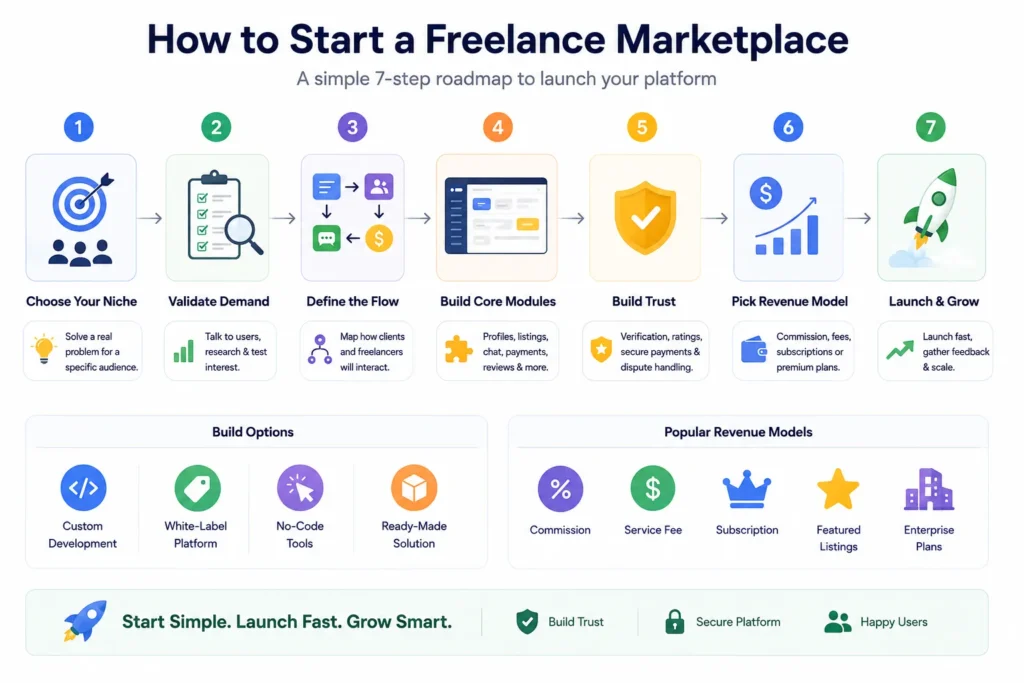
1. Identify the Niche and Target Audience
The first step is choosing the market. Many founders make the mistake of starting too broad. A platform for “all freelancers and all clients” sounds attractive, but it is hard to market and difficult to differentiate.
A sharper niche gives the platform a stronger reason to exist.
Ask:
- Who is the buyer?
- What service do they need repeatedly?
- Why are current hiring options not good enough?
- Are they already paying for this service elsewhere?
- Can freelancers in this niche earn enough to stay active?
- Is trust, speed, quality, cost, or convenience the main problem?
Examples of focused freelance marketplace ideas include:
- Freelance marketplace for AI automation experts
- Freelance marketplace for ecommerce developers
- Freelance marketplace for real estate marketing professionals
- Freelance marketplace for legal consultants
- Freelance marketplace for video editors
- Freelance marketplace for startup designers
- Freelance marketplace for local home service professionals
- Freelance marketplace for healthcare consultants
The more specific the audience, the easier it becomes to build relevant categories, onboarding questions, pricing logic, and marketing campaigns.
2. Validate Demand Before Heavy Development
A freelance marketplace needs both sides of the market. Clients must have enough demand, and freelancers must see enough earning opportunity.
Before building the full platform, validate the idea through:
- Interviews with potential clients
- Interviews with freelancers
- Competitor research
- Landing page waitlists
- Manual matching tests
- Paid ads to test interest
- Community surveys
- LinkedIn outreach
- WhatsApp, Slack, Discord, or Facebook groups
The goal is to confirm whether users actually want the platform.
A founder should avoid building a full product before answering three questions:
- Will clients pay for access to this talent?
- Will freelancers join without guaranteed projects at the beginning?
- Can the platform create better trust, speed, or quality than existing options?
If the answer is unclear, start smaller.
3. Define the Marketplace Flow
The platform flow decides how users interact.
For an Upwork-style model, the flow may look like this:
- Client posts a job.
- Freelancers submit proposals.
- Client reviews profiles and proposals.
- Client starts a chat.
- Client hires a freelancer.
- Payment is held or processed.
- Freelancer delivers work.
- Client approves the work.
- Freelancer receives payout.
- Both sides leave reviews.
For a Fiverr-style model, the flow may look like this:
- Freelancer creates a service listing.
- Client searches by category.
- Client compares packages and reviews.
- Client purchases a service.
- Freelancer delivers the work.
- Client approves or requests revision.
- Payment is released.
- Reviews are published.
The correct flow depends on whether your services are custom, fixed-scope, local, remote, high-value, or repeatable.
4. Build the Core Platform Modules
A freelance marketplace platform usually needs four main layers:
- Client panel
- Freelancer panel
- Admin dashboard
- Payment and communication layer
Each layer must work together. A visually attractive frontend is not enough if the backend cannot manage users, payments, disputes, reviews, service categories, commissions, and platform policies.
This is where many early-stage marketplace businesses fail. They launch with basic listings but lack the operational controls needed to run the business.
5. Set Up Trust and Verification Systems
Trust is one of the most important parts of a freelance marketplace.
Clients need confidence that freelancers can deliver quality work. Freelancers need confidence that clients will pay fairly and communicate clearly.
Trust-building features may include:
- Email and phone verification
- Freelancer profile approval
- Portfolio verification
- Skill tags and experience details
- Ratings and reviews
- Work history
- Identity checks where relevant
- Payment protection
- Milestone payments
- Dispute management
- Abuse reporting
- Admin moderation
Marketplace trust depends on identity, payment safety, dispute control, and transparent records. Security should be treated as a product foundation, not a marketing add-on. Miracuves content rules recommend careful wording around secure payments, verification, dispute workflows, admin controls, and role-based dashboards for marketplace platforms.
6. Decide the Revenue Model
A freelance marketplace can make money in several ways. The best platforms often combine multiple revenue streams instead of depending on one.
| Revenue Stream | How It Works | Founder Benefit |
|---|---|---|
| Commission | Platform takes a percentage from each transaction | Simple and performance-based |
| Client service fee | Client pays a fee on top of project value | Helps monetize demand side |
| Freelancer service fee | Freelancer pays a percentage after earning | Monetizes supply side |
| Subscription plans | Freelancers or clients pay monthly for premium access | Creates recurring revenue |
| Featured listings | Freelancers pay for better visibility | Useful once supply grows |
| Proposal credits | Freelancers buy credits to apply for more jobs | Works for proposal-based platforms |
| Verification fees | Freelancers pay for profile verification | Useful for premium or expert marketplaces |
| Enterprise hiring plans | Businesses pay for managed hiring or bulk access | Strong for B2B marketplaces |
| Ads and sponsorships | Relevant companies promote tools or services | Works after traffic grows |
Marketplace business model guides commonly highlight commissions, subscriptions, freemium plans, listing fees, and lead fees as common monetization models.
For a new platform, commissions are usually the easiest to understand. However, a commission-only model requires completed transactions. If transactions are slow at the beginning, subscriptions, listing upgrades, or managed services may help create earlier revenue.
7. Choose Between Custom Development and a White-Label Platform
Founders usually have two main development paths.
They can build the freelance marketplace from scratch, or they can start with a ready-made or white-label platform foundation.
Custom development gives maximum flexibility but usually requires more planning, more engineering time, and more budget. It may be suitable for founders with unique workflows, complex enterprise requirements, or deeply customized marketplace logic.
A white-label freelance marketplace platform gives founders a faster starting point. Core modules such as user profiles, service listings, chat, payments, reviews, admin control, and dashboards can already be available as a foundation. The founder can then focus on branding, niche customization, monetization, and market launch.
| Build Option | Best For | Advantages | Limitations |
|---|---|---|---|
| Custom development | Complex or highly unique platforms | Maximum flexibility and deep customization | Longer development cycle and higher planning effort |
| White-label platform | Faster market validation and standard marketplace flows | Faster launch, ready-made modules, lower initial complexity | May need customization for unique workflows |
| No-code marketplace tools | Early testing and simple marketplaces | Quick setup and lower technical barrier | Limited flexibility and ownership control |
| Ready-made source-code-owned solution | Founders who want faster launch with control | Faster deployment, branding, admin control, source-code ownership | Final scope depends on customization needs |
Miracuves focuses on ready-made, white-label, and source-code-owned app solutions that help founders launch faster while keeping room for branding and customization. For ready-made solutions, Miracuves can use a 6-day launch timeline where applicable, while final pricing depends on selected modules, integrations, branding, and customization scope.
Core Features Every Freelance Marketplace Platform Needs
A freelance marketplace platform must support both user experience and business operations. The frontend helps users discover, hire, and communicate. The backend helps the platform owner manage activity, revenue, quality, disputes, and growth.
Client Features
Clients need a simple way to find and hire the right talent.
Important client features include:
- Client registration and login
- Profile management
- Job posting
- Service search
- Freelancer filters
- Proposal review
- Direct messaging
- Saved freelancers
- Project tracking
- Milestone approval
- Payment history
- Ratings and reviews
- Dispute request option
Freelancer Features
Freelancers need tools to showcase skills, win work, communicate, and receive payments.
Important freelancer features include:
- Freelancer registration
- Profile creation
- Portfolio upload
- Skill and category selection
- Service listing or gig creation
- Proposal submission
- Chat with clients
- Order or project dashboard
- Earnings dashboard
- Withdrawal requests
- Reviews and ratings
- Availability status
- Verification badge
Admin Dashboard Features
The admin dashboard is where the platform operator controls the business.
Important admin features include:
- User management
- Freelancer approval
- Category management
- Job and service moderation
- Commission settings
- Payment tracking
- Withdrawal management
- Dispute management
- Review moderation
- Reported user management
- Analytics and reporting
- Featured listing control
- Subscription plan management
- Notification management
- Platform settings
Admin control matters because the founder needs to manage quality, pricing, abuse, disputes, commissions, and user trust without depending on developers for every operational change.
Payment and Transaction Features
Payments are central to marketplace trust.
Important payment features include:
- Secure payment gateway integration
- Commission deduction
- Milestone payments
- Wallet or balance system
- Freelancer payouts
- Refund handling
- Transaction history
- Invoice or receipt generation
- Payment status tracking
- Admin transaction reports
For high-trust freelance marketplaces, payment protection can become a major differentiator.
Communication Features
Freelance work requires clear communication.
Useful communication features include:
- Real-time chat
- File sharing
- Project notes
- Notifications
- Email alerts
- Order updates
- Revision requests
- Admin-monitored dispute communication where needed
Poor communication creates disputes. Strong communication flows reduce confusion and improve completion rates.
Founder Decision Signals
| Decision Area | What Founders Should Ask |
|---|---|
| Niche | Is the marketplace focused enough to attract a clear buyer segment? |
| Demand | Are clients already paying for these services elsewhere? |
| Supply | Can freelancers earn enough to stay active on the platform? |
| Trust | How will the platform verify quality and reduce risk? |
| Payments | Will the platform handle commissions, payouts, refunds, and disputes clearly? |
| Admin Control | Can the operator manage users, services, disputes, and revenue without constant developer support? |
| Launch Speed | Does the business need a custom build or a ready-made platform foundation? |
| Monetization | Will revenue come from commissions, subscriptions, featured listings, or managed services? |
How to Attract Clients and Freelancers to a New Freelance Marketplace
The hardest part of a freelance marketplace is not always development. It is liquidity.
Liquidity means having enough clients and enough freelancers so that both sides find value. If clients post jobs and receive no good proposals, they leave. If freelancers join and find no projects, they leave.
A new platform should not try to attract everyone. It should focus on one strong segment first.
Ways to Attract Freelancers
- Invite freelancers from LinkedIn, communities, and industry groups
- Offer early profile verification
- Give free featured visibility to early users
- Create niche-specific profile templates
- Help freelancers package their services
- Publish freelancer success resources
- Build community around the niche
Ways to Attract Clients
- Create landing pages for specific service categories
- Use content marketing around hiring pain points
- Run outbound campaigns to target buyers
- Offer curated freelancer recommendations
- Provide launch discounts or first-project support
- Build trust with reviews, portfolios, and verification
- Focus on one buyer segment before expanding
A freelance marketplace grows when both sides see value quickly. Early-stage founders may need to manually support matching before fully automating everything.
Custom vs White-Label Freelance Marketplace Platform
Choosing between custom development and a white-label platform depends on the founder’s goals.
A custom build may be better when the platform has unusual workflows, enterprise integrations, complex matching rules, or highly specific business logic.
A white-label freelance marketplace platform may be better when the founder wants to launch faster, validate the market, and customize an existing foundation instead of building every module from zero.
| Factor | Custom Development | White-Label Platform |
|---|---|---|
| Launch Speed | Slower because modules are built from scratch | Faster because core modules already exist |
| Cost Logic | Depends heavily on scope, team, and complexity | More cost-efficient for standard marketplace flows |
| Flexibility | Very high | High, depending on customization scope |
| Ownership | Depends on agreement | Source-code ownership may be available with the right provider |
| Best Use Case | Unique or complex platform idea | Faster validation and launch-ready marketplace model |
| Founder Risk | Higher if requirements are unclear | Lower if the base product fits the business model |
For many founders, the smarter move is to launch with a strong foundation, validate demand, and then customize deeper based on real user behavior.
Mistakes Founders Should Avoid When Launching a Freelance Marketplace
Mistake 1: Starting Too Broad
Trying to serve every industry, every freelancer, and every client makes marketing difficult. A focused niche helps the platform speak clearly to a specific audience.
Mistake 2: Ignoring Marketplace Liquidity
A marketplace needs active buyers and sellers. If one side is missing, the platform feels empty. Founders should plan supply and demand acquisition before launch.
Mistake 3: Treating Payments as an Afterthought
Payment flows affect trust. Clients want confidence before paying, and freelancers want confidence before working. Commission, refunds, payouts, and disputes should be planned early.
Mistake 4: Launching Without Admin Control
Without a strong admin dashboard, the founder may struggle to manage users, content, commissions, disputes, and platform quality.
Mistake 5: Copying Upwork or Fiverr Without Differentiation
Large platforms already have brand recognition and liquidity. A new marketplace needs a sharper reason to exist.
Mistake 6: Underestimating Trust and Verification
Freelance marketplaces depend on credibility. Reviews, profile verification, portfolio checks, reporting, and dispute systems help reduce risk.
Mistake 7: Choosing Technology Before Business Logic
The tech stack matters, but the business model comes first. Founders should define the platform flow, revenue model, and user journey before development.
How Miracuves Helps Founders Launch Freelance Marketplace Platforms Faster
Miracuves helps founders build ready-made and white-label app solutions with source code, custom branding, admin dashboards, and monetization-ready workflows.
For a freelance marketplace platform, Miracuves can help create a foundation that supports client profiles, freelancer profiles, service listings, job posting, proposals, payments, reviews, messaging, dispute handling, and admin control.
This is useful for founders who want to move faster without building every module from zero. Instead of spending the early stage only on development, founders can focus on niche positioning, supply acquisition, client onboarding, monetization, and market validation.
A ready-made solution is not about copying another platform blindly. It is about using a proven product pattern, customizing it for the target market, and launching with enough control to operate and improve the business.
Final Thoughts
Starting a freelance marketplace platform business is not just a technology decision. It is a marketplace strategy decision.
The strongest founders do not begin by asking, “How can I build another Upwork?” They ask, “Which hiring problem can I solve better for a specific audience?”
A successful freelance marketplace needs the right niche, strong trust systems, clear monetization, reliable payment workflows, useful freelancer and client tools, and an admin dashboard that gives the operator real control.
For founders planning to launch faster, Miracuves offers ready-made and white-label marketplace app foundations that can be customized around freelance, service, and on-demand business models. The goal is not only to launch quickly, but to launch with a product foundation that supports validation, monetization, and long-term growth.
FAQs
What is a freelance marketplace platform?
A freelance marketplace platform is a digital platform where clients can find, hire, communicate with, and pay freelancers or service providers. It usually includes profiles, job posting, service listings, proposals, payments, reviews, and admin controls.
How do freelance marketplace platforms make money?
Freelance marketplace platforms usually make money through commissions, client service fees, freelancer service fees, subscriptions, featured listings, proposal credits, verification fees, and enterprise hiring plans.
Is it better to build a niche freelance marketplace or a broad platform?
For most new founders, a niche freelance marketplace is easier to position and grow. Broad platforms require large supply and demand from the beginning, while niche platforms can focus on a specific audience, industry, or service category.
What features are needed in a freelance marketplace platform?
Important features include client profiles, freelancer profiles, job posting, service listings, proposals, messaging, secure payments, reviews, ratings, dispute management, notifications, admin dashboard, commission management, and reporting.
How can I build a freelance marketplace like Upwork?
To build a freelance marketplace like Upwork, you need job posting, freelancer profiles, proposal submission, client-freelancer chat, project tracking, milestone payments, reviews, dispute handling, and admin controls. You can build it from scratch or start with a ready-made marketplace platform foundation.
How can I build a Fiverr-style freelance marketplace?
A Fiverr-style freelance marketplace needs service listings, freelancer packages, category-based search, direct ordering, revisions, payments, reviews, freelancer dashboards, and admin controls. This model works well when services are repeatable and easy to package.