

Key Takeaways
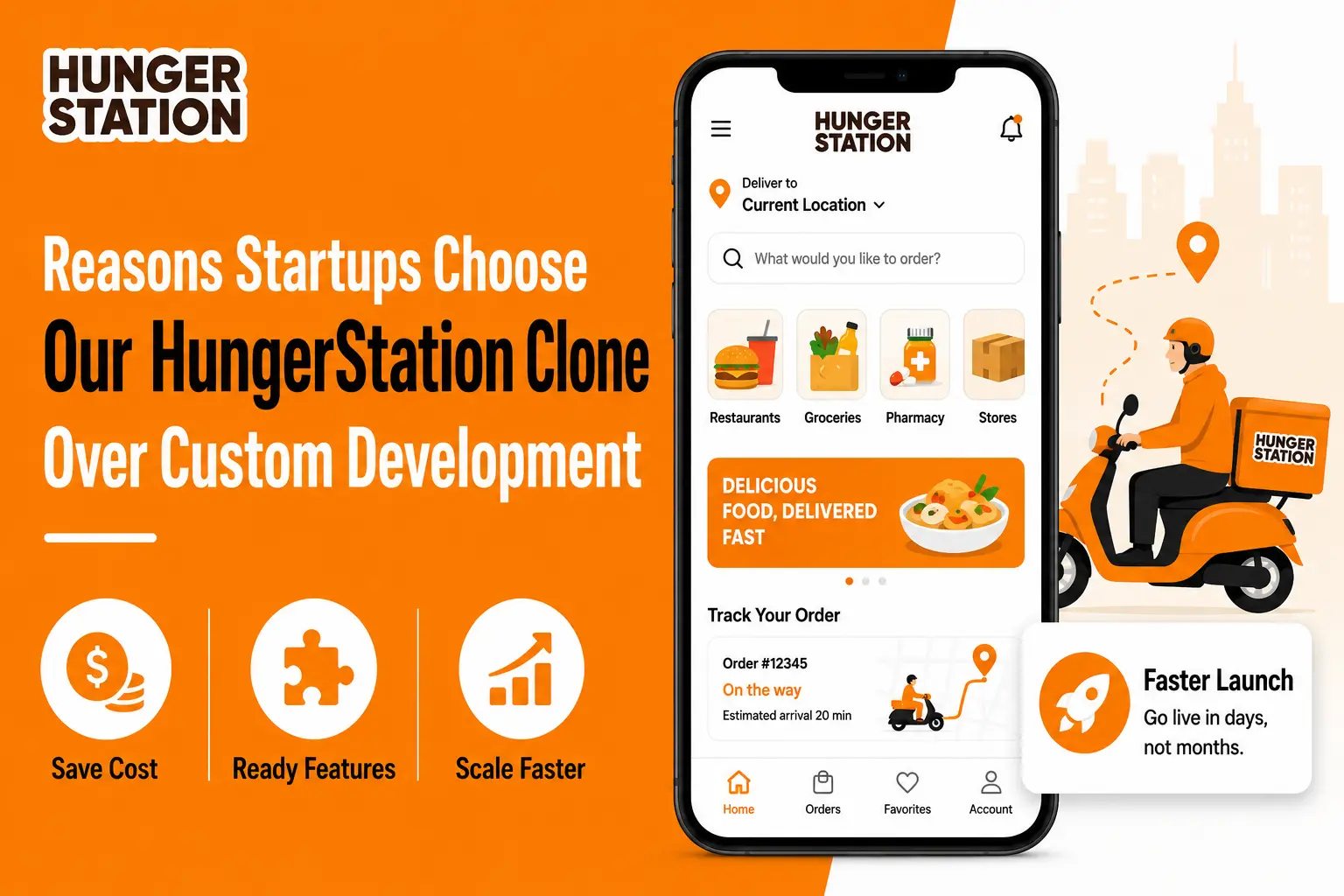
- White-label HungerStation clones launch much faster than custom builds.
- Ready-made platforms reduce development costs and risks.
- Core delivery features are available from day one.
- Customization helps businesses maintain unique branding.
- Faster launches create an earlier path to revenue.
Platform Signals
- Include customer, restaurant, driver, and admin apps.
- Support live order tracking and secure payments.
- Enable restaurant onboarding and commission management.
- Offer scalable APIs for future integrations.
- Provide full source code for long-term flexibility.
Real Insights
- Custom development often delays market entry.
- White-label platforms reduce technical complexity.
- Business growth depends more on execution than rebuilding common features.
- Scalable architecture supports future expansion.
- Miracuves builds HungerStation Clone platforms with customizable food delivery workflows.
Picture this: You’ve just convinced a group of hungry investors that your food-delivery idea will be the next HungerStation clone. Spirits are high, caffeine’s kicking, and visions of slick order-tracking screens dance in your head—until a senior developer whispers the dreaded phrase, “Eighteen-month custom build.”
Suddenly that runway looks shorter than a TikTok video. Sound familiar?
Founders tell us the same story on every discovery call: they want the blazing growth of a proven marketplace without the sticker shock, staffing marathon, or sleepless patch-Tuesday sprints that come with rolling a platform from scratch.
Between Saudi Arabia’s fast-growing delivery market and fierce new entrants like KeeTa, speed is not just nice; it is survival. That is why many startups now choose a HungerStation clone over custom development. It gives them a faster launch foundation with essential ordering, restaurant, delivery, payment, and admin workflows already in place, so they can focus on growth instead of rebuilding basics.
Enter the Hungerstation Clone—a battle-tested shortcut that lets startups skip the plumbing and focus on getting orders out the door (and riyals in the door). Today we’ll unpack why more founders pick a clone kit over custom code, sprinkle in fresh KSA data, and show you how Miracuves keeps the engine humming long after launch. Ready? Let’s feast.
Why Reinvent the Wheel When You Can Turbocharge It?
Speed to Market: Because Timing is Everything
In the fast-paced world of mobile apps, being late to the table can mean someone else gobbles up your market. Building a custom app from scratch often takes 8–12 months (or longer), while our HungerStation can have you up and running in weeks—not quarters.
Real-life scenario: Imagine a startup eyeing the Ramadan surge in food orders across Saudi Arabia. A custom app? Missed opportunity. Our clone? Deployed in time for suhoor orders.
Cost-Efficiency: Big Results Without Burning a Hole
Custom apps are like artisan bread — impressive, but resource-heavy. From UI/UX design to backend development, testing, integrations, and ongoing fixes, every stage adds more time and pressure.
A ready-made food delivery solution helps reduce that burden by giving startups a strong foundation from day one. Instead of spending months rebuilding basic ordering, tracking, payment, restaurant, and admin features, founders can focus on launch, user acquisition, restaurant partnerships, and market growth.
Tried, Tested & Tech-Stacked
Our HungerStation clone isn’t a flimsy template—it’s a fully-loaded product that’s been pressure-tested across different markets. From high-traffic Ramadan seasons in Riyadh to student-heavy cities in Turkey, it’s proven its mettle.
Features include:
- Real-time order tracking
- Seamless payment gateways
- Multi-language + multi-currency support
- Smart search & geolocation
- Admin, user & vendor dashboards
Laser-Focused Customization (Where It Matters)
“Wait, isn’t a clone restrictive?”
Nope. Our base app is like a pizza base—you get the essentials (dough, sauce), but we let you choose the toppings. Want to integrate crypto payments? Done. Need a loyalty points engine? Say no more. Whether you’re targeting iPhone-toting foodies or Android-heavy college campuses, we tailor accordingly.
And because the base is stable, your unique features don’t come at the cost of reliability.
Post-Launch Peace of Mind
Most custom app agencies disappear once the final invoice is paid. Not us. Miracuves provides:
- Ongoing support & maintenance
- Feature enhancements as you scale
- Security patches and performance tuning
- Upgrade paths for new OS versions
Think of us as your tech co-founder—minus the equity.
UX That Converts: Designed for Hungry Humans
Our HungerStation clone isn’t just functional—it’s addictive. The UI is crafted with conversion in mind, borrowing from proven UX patterns across apps like Swiggy, Talabat, and Uber Eats.
Micro-interactions, clean navigation, push notification logic, and gamified loyalty—all work together to drive repeat orders. Because let’s face it, hungry people don’t want to think. They want to tap, order, and munch.
Scalability from Day One
Going live in one city is great. Going national is better. Our tech stack is built on microservices, cloud-ready architecture, and database replication—so whether you’re onboarding 10 restaurants or 10,000, performance won’t flinch.
Bonus: We support integrations with POS systems, delivery APIs, CRMs, and even WhatsApp bots.
It’s Not Just the App—It’s the Ecosystem
Launching a food delivery business isn’t just about the app. You need onboarding tools, driver allocation systems, restaurant panels, and analytics dashboards. We bundle the full ecosystem—so you’re not stuck duct-taping multiple tools together.
Clone vs. Custom: The Fork in the Road
Building a delivery platform is like opening a restaurant chain. Custom development is the white-cloth bistro: stunning, unique—and eye-wateringly expensive. A clone is your dark-kitchen franchise model: proven menu, scalable recipe, room for your secret sauce.
Tech Stack Without the Stack Stress
Miracuves’ HungerStation clone ships with microservices, containerized deployments, and multi-tenant architecture baked in. Translation: upgrade modules like “contactless delivery” or “AI-powered ETA” without ripping out foundations.
Cost in Riyals, Not Riddles
A typical custom build in MENA starts near SAR 1.5 million for MVP; our clone trims that by 60-70%, keeping more runway for marketing blitzes and rider subsidies.
Read More : What is HungerStation App and How Does It Work?
Feature Parity + Freedom to Innovate
| Core Module | Out-of-the-Box | Customizable Hooks |
| Live order tracking | ✔ | Swap maps SDK, add AR courier pointer |
| Multi-vendor catalog | ✔ | Plug in grocery vertical |
| Wallet & vouchers | ✔ | Connect to BNPL API |
| Driver heat-map | ✔ | Train ML on your own telemetry |
No code is a prison. Miracuves exposes REST, GraphQL, and event streams so your devs can riff like jazz musicians—without rewriting the whole score.
Monetization Paths Already Baked In
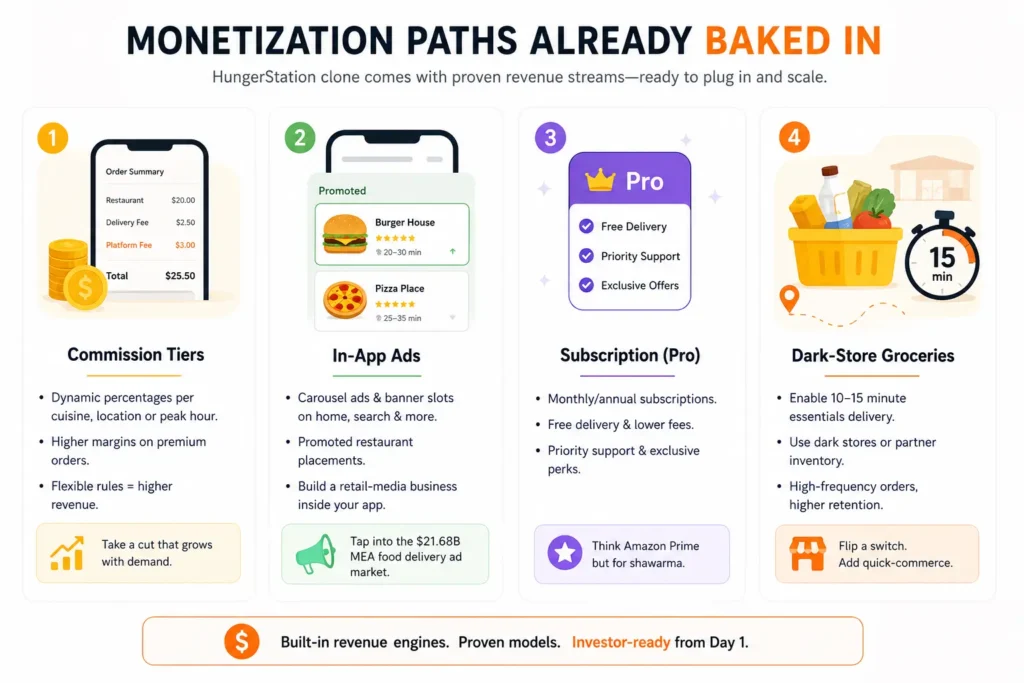
- Commission tiers—Dynamic percentages per cuisine or peak hour.
- In-app ads—Carousel slots and promoted restaurant placements are a growing retail-media revenue layer, backed by MEA’s online food delivery market reaching $21.68B.
- Subscription (Pro)—Free delivery, priority support; think Amazon Prime but for shawarma.
- Dark-store groceries—Flip a switch; add 15-minute essentials delivery.
Because the clone mirrors HungerStation’s monetization DNA, investor decks go from hypothetical to here’s-the-switchboard.
According to Statista, the global online food delivery market is expected to see significant revenue growth in the coming years, making it an attractive space for startups to enter with the right tech foundation.
Read More : How to Build an App Like HungerStation : A Full-Stack Developer’s Guide
Conclusion:
Custom code may woo your inner perfectionist, but a HungerStation clone hands you the keys to a vehicle already tuned for Saudi roads. Instead of spending months rebuilding core food delivery flows from zero, founders can move faster with ready ordering, restaurant management, delivery tracking, payment, and admin features.
The real advantage is not just speed. It is focus. When the foundation is already in place, your team can spend more time onboarding restaurants, improving customer experience, testing local offers, optimizing delivery operations, and building stronger brand loyalty.
In a competitive food delivery market, waiting too long can cost more than development itself. A well-built HungerStation-style platform helps you enter sooner, learn from real users faster, and invest savings in growth, not ground-up plumbing.
At Miracuves, we help innovators launch high-performance app clones that are fast, scalable, and monetization-ready. Ready to turn your idea into reality? Let’s build together.
FAQs:
1. Will investors frown on using a clone?
Not if the unit economics shine. Many VCs care more about traction and CAC/LTV than whether you reinvented the wheel.
2. Can I tweak the UI so it doesn’t look “copy-paste”?
Absolutely—our design system supports custom themes, layouts, and brand assets without touching underlying logic.
3. What about future features like drone delivery?
The microservice architecture means you can spin up new services (hello, drone dispatcher) and plug them into the existing event bus.
4. How do restaurant partners integrate?
We ship with POS connectors (Oracle, Foodics) and an open API for custom systems—so onboarding stays painless.
5. Is compliance for KSA taxes included?
Yes. Our clone supports ZATCA e-invoice and VAT reporting out of the box, with automatic updates as regulations shift.
Related Clone :
- Build a Food Delivery App Like ChowNow: Business Model, Features, and Costs
- How To Build a Food Delivery App Like Baemin: Features, Costs, and Development
- How to Make a Food Delivery App Like Deliveroo: Features, Costs, and Technology
- Create a Food Delivery App Like Swiggy: Key Features, Cost, and Development Process