


Key Takeaways
What You’ll Learn
- A Uniswap clone script helps launch a DEX faster with ready swap, wallet, and liquidity features.
- AMM powers the trading flow by letting users swap tokens through liquidity pools.
- Liquidity pools are the core engine because users deposit token pairs and earn trading fees.
- Wallet support improves usability with MetaMask, WalletConnect, Trust Wallet, and other integrations.
- The main lesson for founders is to build around swaps, liquidity, security, and governance.
Stats That Matter
- Core features include token swaps, AMM logic, liquidity pools, LP tokens, and slippage settings.
- Security features include smart contract audits, multi-sig control, time-locks, and upgrade protection.
- Revenue options include swap fees, token listing fees, farming incentives, and governance tokens.
- Admin tools help manage tokens, pools, fees, analytics, users, and platform settings.
- Pricing depends on blockchain support, wallet integrations, security depth, UI, and liquidity modules.
Real Insights
- DEX success depends on trust because users connect wallets and trade directly.
- Liquidity drives growth because deeper pools create better swaps and lower price impact.
- Simple UX matters in DeFi with clear swaps, fees, token warnings, and confirmations.
- Governance can improve retention by giving users voting power over protocol decisions.
- For founders, build a Uniswap clone script around AMM trading, liquidity pools, wallet support, analytics, governance, and secure smart contracts.
The wild west of crypto may have cooled down from its 2021 highs, but don’t be fooled—DeFi is far from over. If anything, it’s evolving. Today’s users aren’t just hunting memecoins—they’re farming yields, staking, swapping, and experimenting with community tokens. And one of the most powerful gateways to this ecosystem? Decentralized exchanges like Uniswap clone script .
Uniswap changed the game with its AMM (Automated Market Maker) model. No middlemen, no sign-ups, and no listing bureaucracy—just pure peer-to-peer token swapping. Now imagine owning that experience, rebranded, localized, and monetized. That’s where Uniswap clone script come in.
Whether you’re launching your own DeFi protocol, building a niche token exchange, or starting a DEX for a specific region or blockchain, a Uniswap clone can save you months of dev time. At Miracuves, we’ve helped DeFi innovators build safe, scalable, and feature-rich exchanges using best-in-class clone architecture.
What Is a Uniswap Clone Script?
A Uniswap clone script is a ready-made, customizable version of the Uniswap DEX. It enables you to deploy your own decentralized exchange on Ethereum, BNB Chain, Polygon, or any EVM-compatible network.
But don’t confuse “clone” with “copy-paste.” A modern Uniswap clone script doesn’t just replicate the swap interface—it provides core smart contracts, liquidity pool modules, admin tools, custom UI, and often even support for farming, staking, and analytics dashboards.
You’re not just launching a DEX—you’re building the infrastructure for community-driven finance.
Read More :Reasons startup choose our Uniswap clone over custom development
Must-Have Features in a Modern Uniswap Clone Script
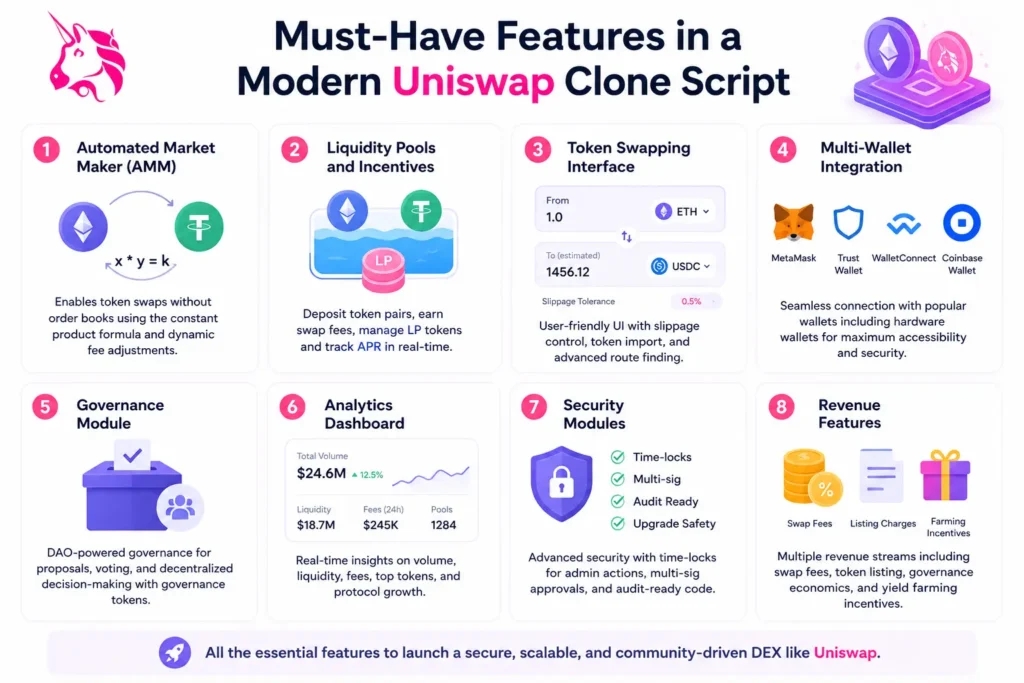
If you’re serious about launching a DEX that people will trust, here’s what your script needs to deliver:
1. Automated Market Maker (AMM)
The core engine that enables token swaps without order books. Should support constant product formula (x*y=k) and dynamic fee adjustments.
2. Liquidity Pools and Incentives
Enable users to deposit token pairs and earn swap fees. LP token management and APR tracking are essential.
3. Token Swapping Interface
Clean UI, slippage tolerance, token import, and custom route finding for complex swaps.
4. Multi-Wallet Integration
Users should be able to connect via MetaMask, Trust Wallet, WalletConnect, Coinbase Wallet, and hardware wallets.
5. Governance Module
For community votes, proposals, and decentralized decision-making via DAO tokens.
6. Analytics Dashboard
Real-time stats on pool volume, liquidity, fees, top tokens, and protocol growth.
7. Security Modules
Time-locks for admin functions, multi-sig for contract upgrades, and thorough audit support.
8. Revenue Features
Swap fees, listing charges, governance token economics, and farming incentives to boost retention.
Read More ;The Future of Decentralized Finance (DeFi) Apps: Trends to Watch in 2025 and Beyond
Top Uniswap Clone Scripts in 2026 (Compared)
Let’s break down the best options this year based on features, tech quality, and pricing.
1. Miracuves Uniswap Clone
- Blockchain Support: Ethereum, BNB Chain, Polygon, Arbitrum
- Smart Contract Quality: Audited, gas-optimized, upgrade-ready
- Liquidity Tools: Incentive pools, farming dashboards, auto-rebalancing
- Wallets: Supports 10+ wallets out of the box
- Extras: DAO builder, Launchpad module, multi-language UI
2. Hivelance DeFi DEX Script
- Blockchain Support: Ethereum and BNB Chain only
- Smart Contract Quality: Basic, manual audits needed
- Liquidity Tools: Included but lacks staking
- Wallets: MetaMask and WalletConnect only
- Extras: No DAO tools, basic charts
3. Antier Uniswap Clone
- Blockchain Support: Multi-chain
- Smart Contract Quality: Strong, but closed-source for clients
- Liquidity Tools: Included with farming
- Wallets: Multiple supported
- Extras: Comes with consulting package
4. Coinsclone DEX Script
- Blockchain Support: Ethereum-based only
- Smart Contract Quality: Needs external audit
- Liquidity Tools: Only swap and LPs
- Wallets: Basic integration
- Extras: Limited UI theming
Miracuves Uniswap Cost and Tech Stack
Miracuves pricing for a Uniswap clone script developed using a modern JavaScript / Web3 architecture is available on request. Contact Miracuves for custom pricing based on DEX features, blockchain network selection, smart contract requirements, wallet integrations, liquidity modules, token swap logic, and deployment scope. Estimated delivery timeline: 30 to 90 Days.
Build a scalable decentralized exchange platform designed for token swapping, liquidity pools, wallet connectivity, automated market making, and DeFi trading experiences.
Core Workflows: Token swap, wallet connection, liquidity pool creation, add/remove liquidity, token pair management, transaction history, and user trading flow.
Built-in DeFi Features: Smart contract integration, automated market maker logic, slippage control, swap fees, token listing support, multi-chain readiness, and liquidity provider rewards.
Management Hub: Admin dashboard, token pair control, liquidity monitoring, transaction analytics, fee management, user activity tracking, and platform configuration tools.
Enterprise-Ready: Fully customizable architecture prepared for DeFi startups, crypto exchanges, token launch platforms, Web3 ecosystems, multi-chain expansion, and long-term decentralized finance growth.
Why does a Uniswap-like platform require JavaScript / Web3 architecture?
A Uniswap-like platform is more than a normal trading website. It needs blockchain connectivity, smart contract execution, liquidity pool logic, token swap routing, wallet authentication, and real-time transaction visibility.
We recommend a modern JavaScript and Web3-based architecture because:
Built for Decentralized Trading Operations: JavaScript-based backend and frontend systems can support token swaps, liquidity pool interactions, transaction updates, and Web3 event handling.
Advanced Web3 User Experience: React.js or similar frontend frameworks help create smooth wallet connection flows, swap interfaces, liquidity dashboards, token search, and real-time transaction feedback.
Smart Contract Ready: This architecture supports automated market maker contracts, liquidity pool contracts, token standards, fee logic, and blockchain transaction validation.
Flexible Blockchain Integration Layer: Easily integrates with crypto wallets, blockchain networks, token contracts, analytics tools, liquidity APIs, and DeFi ecosystem services.
You get a scalable, Web3-ready DEX foundation designed for modern DeFi platform growth.
Note: Final pricing depends on blockchain network, smart contract complexity, token swap features, liquidity modules, wallet integrations, security review requirements, admin features, and custom development scope.
Launch Your Uniswap-Style Decentralized Exchange — Contact Us Today
Real-World Use Cases for a Uniswap Clone
- Token communities launching their own DEXes to support micro-economies
- NFT marketplaces with ERC-20 support offering integrated swaps
- Regional DeFi hubs providing localized trading experiences
- Launchpads that offer immediate token liquidity post-IDO
- Crypto influencers creating branded, whitelisted token swaps
If you’ve got an engaged community, launching your own DEX isn’t just smart—it’s strategic.
Common Mistakes to Avoid
Some DeFi founders rush into launch without checking critical issues. Don’t be one of them. Watch out for:
- Unverified contracts: Trust dies when users see “Unverified” on Etherscan
- No audit history: Vulnerabilities can wipe liquidity overnight
- Gas-guzzling code: Poor optimization means costly swaps and lost users
- Centralized admin control: If users sense foul play, they’ll flee
- Missing DAO support: Decentralization without governance is just branding
DeFi users are savvy. Earn their trust with transparency and rock-solid code.
Read More : How to Start a Decentralized Finance (DeFi) Platform Business
Final Thoughts
Decentralized exchanges aren’t just trading platforms—they’re programmable finance protocols. Launching your own Uniswap-like DEX isn’t a “nice to have” for modern crypto communities—it’s a moat.
Whether you’re building the future of DAOs, launching a community token, or enabling safe token swaps, a Uniswap clone script can fast-track your vision. But you need real tech, not just flashy UI.
At Miracuves, we help innovators launch high-performance app clones that are fast, scalable, and monetization-ready. Ready to turn your idea into reality? Let’s build together.
FAQs
Is a Uniswap clone script legal?
Yes—as long as your contracts are original and your operations comply with your local regulations, it’s completely legal to deploy.
Can I add my own token to the DEX?
Definitely. You can deploy custom tokens, liquidity pairs, and even incentivize trading for them.
How do liquidity providers earn money?
They earn a percentage of trading fees based on the liquidity they provide to each pool.
Does a Uniswap clone require KYC?
No. Most decentralized platforms are KYC-free, but you can add optional modules for compliance if needed.
Is it possible to launch on chains like Polygon or Arbitrum?
Yes. Modern clone scripts are built to support multiple EVM-compatible chains.
What’s the difference between Uniswap v2 and v3 functionality?
v2 uses a constant product AMM; v3 introduces concentrated liquidity and better capital efficiency. Your script should support at least v2, if not both.
Related Articles
- Best SushiSwap Clone Scripts in 2025: Features & Pricing Compared
- Best MakerDAO Clone Scripts in 2025: Features & Pricing Compared
- Best Pinksale Clone Scripts in 2025: Features & Pricing Compared
- Best Metamask Wallet Clone Scripts in 2025: Features & Pricing Compared
- Best PancakeSwap Clone Scripts in 2025: Features & Pricing Compared