


Key Takeaways
What You’ll Learn
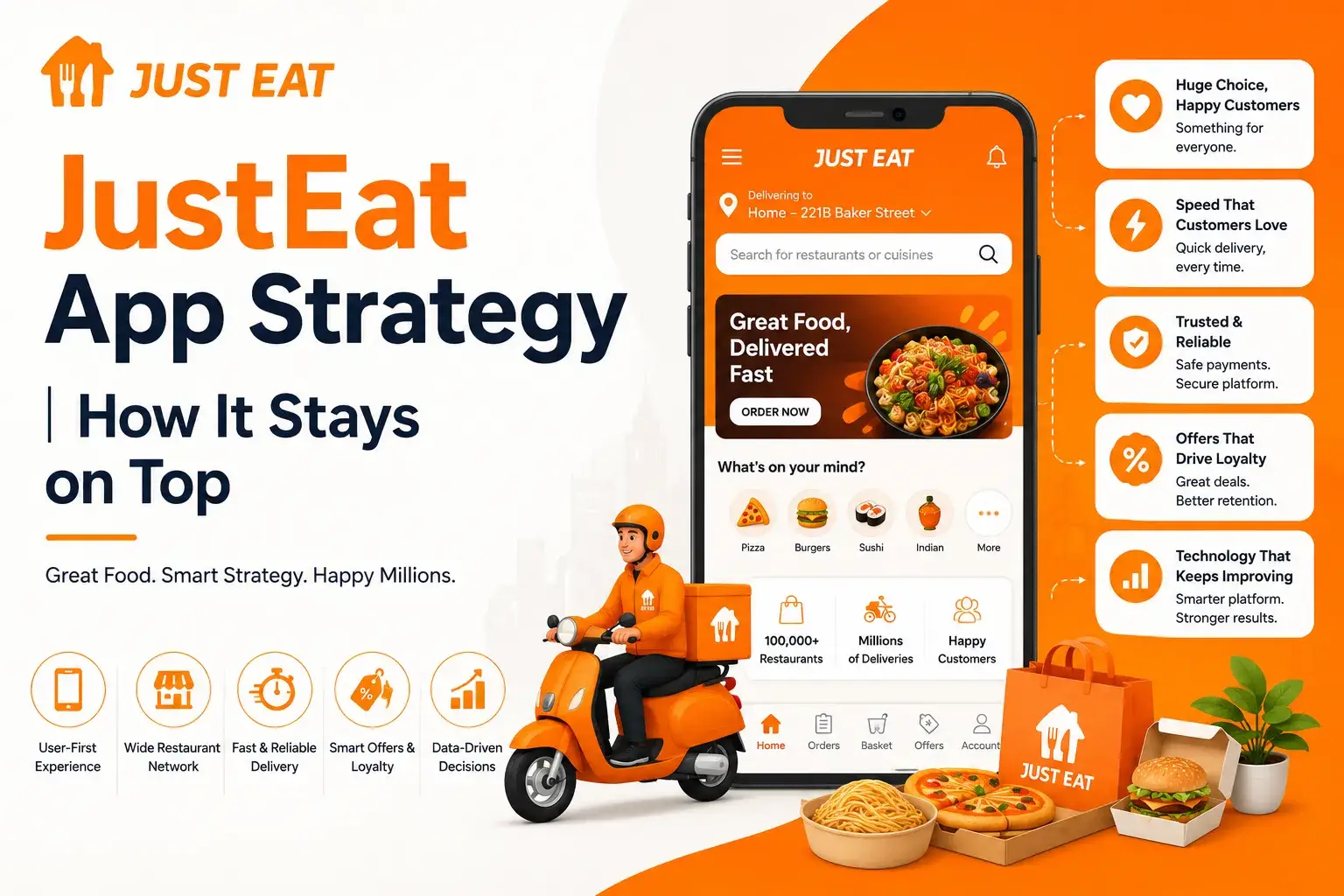
- Just Eat’s strategy is built around marketplace convenience, helping customers discover restaurants, place orders easily, and receive a reliable food ordering experience.
- The platform grows by balancing customer demand, restaurant supply, and delivery efficiency across local markets.
- Its strategic strength comes from layered monetization, combining restaurant partnerships, order volume, delivery operations, and repeat customer behavior.
- Restaurant onboarding, user retention, and operational consistency are key to making the model scalable and defensible.
- A strong Just Eat-style strategy depends on execution, not just app features, because food delivery growth is shaped by logistics, trust, and local market performance.
Stats That Matter
- Food ordering platforms perform best when local restaurant coverage is strong, because customer choice directly affects repeat ordering behavior.
- Customer retention is one of the biggest strategy drivers, since repeat users improve profitability more than one-time promotions alone.
- Operational efficiency affects both growth and margins, especially in areas like order routing, restaurant coordination, and delivery reliability.
- Marketplace trust matters at every stage, because users expect accurate menus, secure payments, timely delivery, and dependable support.
- A scalable delivery platform becomes stronger when restaurant partnerships, logistics systems, and customer experience work together as one coordinated ecosystem.
Real Insights
- Just Eat’s strategy works because it focuses on market coordination, not just digital ordering, by connecting demand, restaurant availability, and operational flow.
- Growth becomes more sustainable when the platform strengthens restaurant value, because merchant success directly affects menu quality, order volume, and retention.
- Discounts can drive short-term demand, but long-term strategy depends more on convenience, reliability, and repeat customer habits.
- Expansion only works when local execution is strong, because food delivery platforms often fail when they scale faster than their operational capacity.
- For most entrepreneurs, the biggest lesson from a Just Eat-style strategy is that strong marketplace execution, restaurant relationships, and repeat customer behavior matter more than feature overload.
Let’s be real—no one wants to cook after a 10-hour hustle. You’re neck-deep in Slack pings, your keyboard’s full of crumbs, and all you crave is hot food, fast. That’s where JustEat swoops in like a hero on a scooter. It’s not just a food delivery app—it’s a craving-satisfying, hunger-zapping lifesaver.
But here’s the kicker: JustEat clone didn’t become a household name by luck or logo alone. According to Statista It climbed the food chain with a spicy blend of smart marketing, delicious user experience, and laser-focused growth hacks. From push notifications that make your stomach growl to mouthwatering visuals that guilt you into ordering—JustEat knows how to play the game.
If you’re building your own on-demand food delivery app or looking to launch a JustEat clone, buckle up. We’re about to dissect JustEat’s app marketing strategy and serve up insights that you can actually use. And yes, Miracuves is your behind-the-scenes tech chef when you’re ready to cook up something amazing.
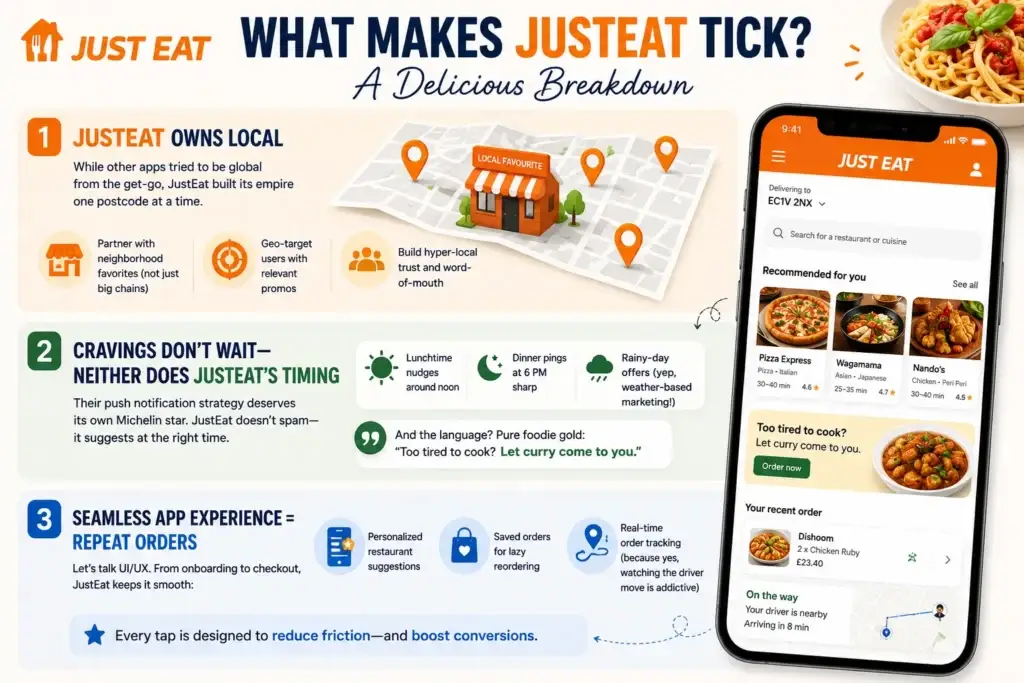
What Makes JustEat Tick? A Delicious Breakdown
1. JustEat Owns Local
While other apps tried to be global from the get-go, JustEat built its empire one postcode at a time. That local-first strategy allowed it to:
- Partner with neighborhood favorites (not just big chains)
- Geo-target users with relevant promos
- Build hyper-local trust and word-of-mouth
2. Cravings Don’t Wait—Neither Does JustEat’s Timing
Their push notification strategy deserves its own Michelin star. JustEat doesn’t spam—it suggests at the right time.
- Lunchtime nudges around noon
- Dinner pings at 6 PM sharp
- Rainy-day offers (yep, weather-based marketing!)
And the language? Pure foodie gold:
“Too tired to cook? Let curry come to you.”
3. Seamless App Experience = Repeat Orders
Let’s talk UI/UX. From onboarding to checkout, JustEat keeps it smooth:
- Personalized restaurant suggestions
- Saved orders for lazy reordering
- Real-time order tracking (because yes, watching the driver move is addictive)
Every tap is designed to reduce friction—and boost conversions.
Learn More: Build an App Like JustEat – Developer Guide for Node.js & PHP
Influencer Collabs, TV Spots & Guerrilla Marketing
JustEat isn’t afraid to go old school and ultra-digital. They’ve dropped millions on:
- Celebrity partnerships (remember Snoop Dogg’s “Did Somebody Say… JustEat?” ad? Iconic.)
- Event-based promotions during football matches or holidays
- Influencer shoutouts on TikTok and Instagram Reels
It’s not about being everywhere—it’s about showing up where your audience eats, scrolls, and chills.
Loyalty + Convenience = App Retention Goals
JustEat Pay + Discounts = Stickier Than Cheddar
Retention is where most apps flop. Not JustEat. Their combo of:
- Promo codes
- Discounted delivery passes
- In-app loyalty schemes
…keeps users coming back like clockwork. Plus, JustEat Pay lets users order using pre-tax benefits in some markets. That’s next-level convenience.
How JustEat Uses Tech to Scale Marketing Features
JustEat isn’t just about pizza and puns—it’s got serious data chops. Behind the scenes, they leverage:
- Machine learning for recommendation engines
- Heatmaps for UX optimization
- AI-powered copy testing to improve CTAs and headlines
They even A/B test emoji usage in notifications.
Learn More: Key JustEat Features for Food Delivery Apps
Real Lessons for Founders & Food Delivery Startups
If you’re building a food delivery app or want to launch a JustEat clone, here’s what you can take away:
| Tactic | Why It Works | How to Use It |
|---|---|---|
| Geo-targeted promos | Feels personal, boosts engagement | Use location data to trigger local offers |
| Predictive ordering | Convenience at its best | Suggest based on time, history, and weather |
| Loyalty rewards | Encourages habit-forming behavior | Free deliveries, cashback, or surprise perks |
| Sassy copywriting | Adds character to your brand | Speak like a human, not a bot |
Conclusion
JustEat’s strategy is proof that when tech meets taste, magic happens. They’re not slowing down either—with drone delivery pilots, voice-based ordering, and AI-driven meal planning on the horizon.
At Miracuves, we help innovators launch high-performance app clones that are fast, scalable, and monetization-ready. Ready to turn your idea into reality? Let’s build together.
FAQs
How does JustEat attract new users?
Through local ads, influencer partnerships, geo-targeted push notifications, and app store optimization strategies.
What makes JustEat different from UberEats or Deliveroo?
JustEat focuses more on local eateries and loyalty incentives. It also heavily customizes marketing per region.
How does JustEat retain users?
By offering discounts, personalized reordering, saved favorites, and easy payment options like JustEat Pay.
Can I build an app like JustEat for my city?
Absolutely! With the right development partner (cough Miracuves), you can localize and scale fast.
What role does UI/UX play in JustEat’s success?
It’s central. Clean design, smart reordering, and real-time tracking all contribute to a smooth user experience.
How can Miracuves help with a JustEat clone?
We offer end-to-end app clone development—design, features, integrations, scalability, and post-launch support.