


Key Takeaways
What You’ll Learn
- AmazonFresh is an online grocery delivery platform offering fresh produce, daily essentials, and household items.
- Users order groceries through a seamless app experience with scheduled or same-day delivery options.
- Supply chain and logistics are tightly integrated to ensure freshness and fast delivery.
- Amazon ecosystem integration enhances convenience through Prime, payments, and subscriptions.
- Operational efficiency is key to scaling grocery delivery profitably.
Stats That Matter
- The global online grocery market is projected to exceed $800 billion by 2026.
- Same-day and scheduled delivery are becoming standard expectations in urban markets.
- Amazon leverages its massive logistics network to optimize delivery efficiency.
- Subscription-based users (like Prime members) drive higher repeat purchases.
- Digital grocery platforms are becoming a core part of everyday shopping behavior.
Real Insights
- Convenience and speed are the biggest drivers of online grocery adoption.
- Strong platforms rely on efficient logistics and inventory management.
- Customer retention depends on reliability, freshness, and delivery accuracy.
- Bundled ecosystems (like Prime) increase lifetime customer value.
- Growth comes from operational excellence, not just app features.
In an era where convenience is king and grocery aisles are going digital, AmazonFresh stands as a pioneer reshaping how consumers shop for daily essentials. Launched by Amazon to bring fresh produce, pantry staples, and household goods directly to doorsteps, AmazonFresh is not just a delivery service—it’s a full-fledged e-grocery powerhouse.
As a startup founder, SaaS builder, or digital agency, understanding the revenue model of AmazonFresh reveals more than just how a tech titan earns money. It showcases a blueprint for tapping into one of the fastest-growing verticals in e-commerce: online grocery delivery. With global e-grocery sales projected to hit $1.2 trillion by 2026. AmazonFresh’s monetization strategies offer valuable lessons for any digital business aiming to blend logistics, technology, and consumer behavior into a profitable operation.
In this blog, we’ll explore how AmazonFresh earns money, break down each of its revenue streams, and show you how you can replicate this proven model with a ready-made AmazonFresh clone solution by Miracuves—customized for your startup’s success.
Want to launch your own grocery delivery business like AmazonFresh? Partner with a trusted grocery delivery app development company and bring your idea to life.
How AmazonFresh Makes Money
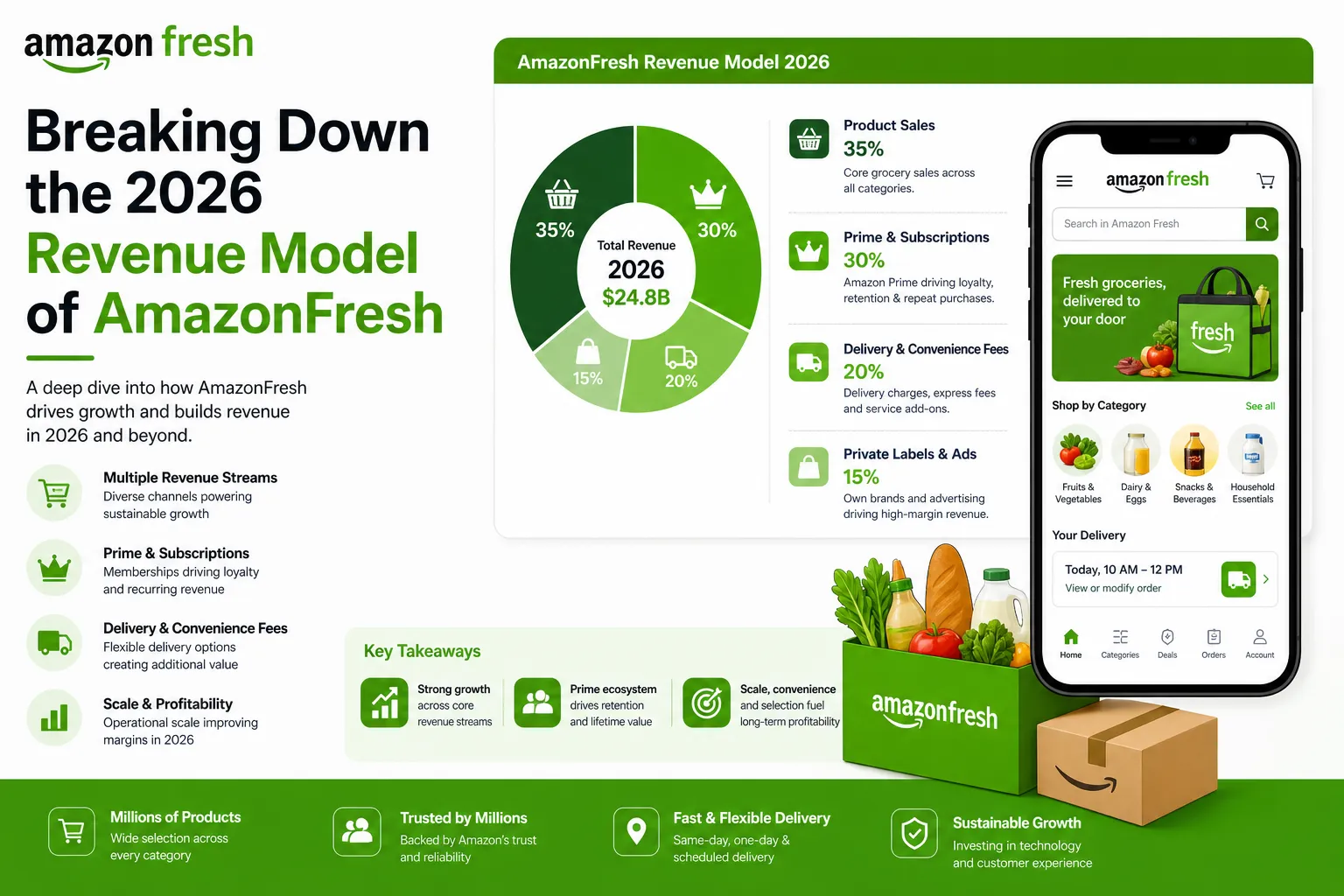
AmazonFresh generates revenue through a diverse mix of income streams, combining e-commerce fundamentals with Amazon’s ecosystem of subscriptions, partnerships, and technology. Here are the major ways AmazonFresh earns money:
- Monthly Membership Fees – Standalone or bundled with Amazon Prime.
- Product Markups – Marginal price increases on groceries compared to in-store pricing.
- Delivery Fees – For non-Prime members or small basket sizes.
- Private Label Sales – Selling Amazon’s own grocery brands like Amazon Fresh and Happy Belly.
- Third-Party Vendor Commissions – Revenue from external brands listing products on the platform.
- Advertising Fees – Sponsored product placements within the app.
- Cross-Selling with Amazon Services – Boosting Prime subscriptions and Alexa ecosystem usage.
- Data Monetization & AI Optimization – Leveraging purchase data for predictive logistics and inventory efficiency.
These revenue streams not only keep the platform profitable but also tightly integrate it into the larger Amazon ecosystem—making it harder for customers to switch to other grocery apps.
Detailed Breakdown of Revenue Channels
1. Membership Fees (Amazon Prime + Fresh Add-on)
AmazonFresh is often bundled with Amazon Prime, which costs around $14.99/month or $139/year. While Prime includes free delivery from AmazonFresh in select areas, some regions charge an additional Fresh subscription fee, typically around $9.99/month.
Who pays? Customers
Why it scales: Millions of Prime members already exist—converting them into Fresh users is frictionless.
2. Product Markups
While most prices match local grocery stores, AmazonFresh subtly applies markup margins on select goods, especially private-label and imported items.
Who pays? Customers
Why it scales: Consumers are willing to pay a premium for convenience and time saved.
3. Delivery Fees
Although many orders qualify for free delivery, AmazonFresh often charges delivery fees for orders below a minimum threshold (e.g., under $50). Fees range from $5.95 to $9.95 depending on location and delivery window.
Who pays? Non-Prime members or small basket customers
Why it scales: Predictable, incremental revenue with minimal operational cost increases.
4. Private Label Products
AmazonFresh offers in-house brands like Amazon Fresh, 365 by Whole Foods, and Happy Belly. These generate higher profit margins due to the lack of middlemen.
Who pays? Customers
Why it scales: Brand control, margin optimization, and loyalty-building.
5. Commissions from Third-Party Sellers
Similar to Amazon Marketplace, AmazonFresh allows select vendors and local grocers to list their products. Amazon takes a commission cut, typically between 8–15%.
Who pays? Sellers
Why it scales: No inventory risk, scalable catalog expansion, and diverse product selection.
6. In-App Sponsored Ads
Brands can promote their products via sponsored listings within AmazonFresh search results or suggestion carousels. This advertising revenue mirrors Amazon’s broader ad model, which generated over $47 billion in 2023.
Who pays? Brands and manufacturers
Why it scales: High-intent audience, data-driven ad targeting, and excellent ROI for advertisers.
7. Cross-Selling of Amazon Ecosystem Services
AmazonFresh serves as a gateway into the Amazon ecosystem, encouraging customers to try Alexa voice ordering, Dash Smart Carts, and Whole Foods perks.
Who pays? Indirect monetization (subscription upgrades, device purchases)
Why it scales: Ecosystem lock-in increases lifetime value per customer.
8. AI-Driven Inventory & Logistics Optimization
While not a direct revenue stream, AmazonFresh uses AI-powered demand prediction and last-mile logistics to reduce costs, minimize spoilage, and improve delivery efficiency—thus increasing profit margins.
Who pays? Nobody directly; it boosts profitability.
Why it scales: Automation and machine learning reduce operational overhead at scale.
AmazonFresh thrives on a smart blend of subscriptions, logistics, and customer trust. Learn from the AmazonFresh business model and apply its strategies to your venture.
Why This Revenue Model Works in 2026
The revenue model of AmazonFresh is more powerful than ever in 2026, thanks to a perfect blend of market dynamics, consumer expectations, and technological innovation. Let’s explore why it remains a winning strategy:
1. Surge in Online Grocery Shopping
The global online grocery market is expected to exceed $1.2 trillion by 2026. Urbanization, busy lifestyles, and the desire for contactless shopping have made grocery delivery a standard expectation—not a luxury.
AmazonFresh leverages this momentum with:
- Hyper-local fulfillment centers
- AI-driven inventory to reduce waste
- Faster delivery windows using micro-warehousing
2. Subscription Economy Dominance
Customers now prefer bundled value. AmazonFresh’s integration with Prime taps into this behavior. A single subscription delivers:
- Groceries
- Entertainment (Prime Video)
- Exclusive deals (Prime Day, Fresh discounts)
This drives retention and recurring revenue, the holy grail for startups and SaaS models alike.
3. AI & Predictive Logistics
Amazon’s AI forecasts demand down to SKU-level in specific neighborhoods. This minimizes:
- Overstock and understock
- Delivery times
- Perishable waste
These efficiencies increase margins, allowing AmazonFresh to scale rapidly without compromising unit economics.
4. Dynamic Pricing & Personalization
The use of AI also enables dynamic pricing and personalized promotions, nudging users toward higher-margin items or larger basket sizes—boosting average order value (AOV).
5. Advertising-as-a-Service
With product searches starting on Amazon, brands willingly pay top dollar for ad placement. In 2026, Amazon’s ad revenue is projected to surpass $60 billion, with AmazonFresh playing a crucial role for CPG (Consumer Packaged Goods) brands targeting high-intent shoppers.
6. Ecosystem Lock-In
Once a customer is in the Amazon loop—Prime, Alexa, Whole Foods, Fresh—they’re unlikely to leave. This increases Customer Lifetime Value (CLV) and reduces churn.
In short, AmazonFresh’s revenue model thrives in 2026 because it adapts to changing consumer behaviors, automates operational complexity, and monetizes every customer interaction across multiple layers.
Miracuves AmazonFresh-Like App Solution Cost and Tech Stack
Miracuves Pricing for a AmazonFresh-Like Grocery Delivery App developed in PHP/Laravel with Flutter Apps for $2,199 USD (One-Time Price) in just 6 days
Get a fully developed, deployment-ready platform modeled after AmazonFresh. Built on a rock-solid PHP/Laravel foundation, this complete package includes everything you need to launch and scale:
Core Workflows: Grocery ordering, real-time inventory handling, scheduled deliveries, and multi-category product management.
Built-in Commerce: In-app cart logic, dynamic pricing operations, discount handling, and secure checkout systems.
Management Hub: Comprehensive vendor/store management, order tracking, and a centralized admin backend.
Launch-Ready: Fully prepped for your custom branding, configuration, and immediate market entry.
Why is it so affordable?
Most advanced grocery delivery platforms rely on expensive architectures like Node.js or Go to manage real-time orders, logistics coordination, and high user traffic. Building from scratch with these frameworks requires highly specialized, expensive engineering teams, which significantly increases overall development cost.
We took a smarter, more practical approach:
You Aren’t Paying for Ground-Up Development: Our grocery delivery engine is already developed, battle-tested, and ready to deploy. You skip the inflated costs and long timelines associated with building everything from scratch.
The Power of PHP / Laravel: We built this on one of the most reliable, globally adopted frameworks in the world. Not only does this reduce upfront investment, but it also ensures long-term scalability. PHP has a massive global talent pool, making it easier and more cost-effective for you to hire developers for future upgrades or customizations. You get a scalable, enterprise-ready system without the high development overhead.
Note: This cost is for the solution, re-branding, deployment and source code only.
Conclusion
AmazonFresh has mastered the art of monetizing online grocery delivery—through a balanced mix of subscriptions, commissions, delivery fees, ad revenue, and ecosystem synergies. Its success isn’t just about fresh produce—it’s about fresh thinking in how to generate consistent, scalable revenue.
For startups, the revenue model of AmazonFresh is not only replicable, but also adaptable. With the right tools, infrastructure, and tech partner, you can launch a grocery delivery platform that earns from multiple streams—just like Amazon does.
FAQs
How does AmazonFresh generate revenue?
AmazonFresh makes money through subscription fees (Prime and Fresh add-ons), delivery charges, product markups, private label sales, advertising, and commissions from third-party grocery sellers.
Is AmazonFresh profitable in 2026?
While Amazon doesn’t break out AmazonFresh profits separately, its integration into Prime and rising grocery demand suggest it’s contributing positively to Amazon’s overall retail and logistics margin in 2026
What are the main income sources for AmazonFresh?
Key income streams include memberships, delivery fees, private label sales, third-party seller commissions, and ad revenue from sponsored grocery listings.
Can startups use the same revenue model as AmazonFresh?
Yes, with the right tech stack and features, startups can replicate this model—combining subscription, delivery, commission, and ad-based monetization to maximize revenue.
Does Miracuves offer an AmazonFresh clone with monetization features?
Absolutely. Miracuves provides a ready-made, fully customizable AmazonFresh clone that includes all major monetization features—subscriptions, commissions, ad integration, and more.