


Key Takeaways
- A Swiggy-like delivery app needs smooth ordering, fast delivery, and reliable restaurant management.
- Customers, restaurants, delivery partners, and admins need connected workflows.
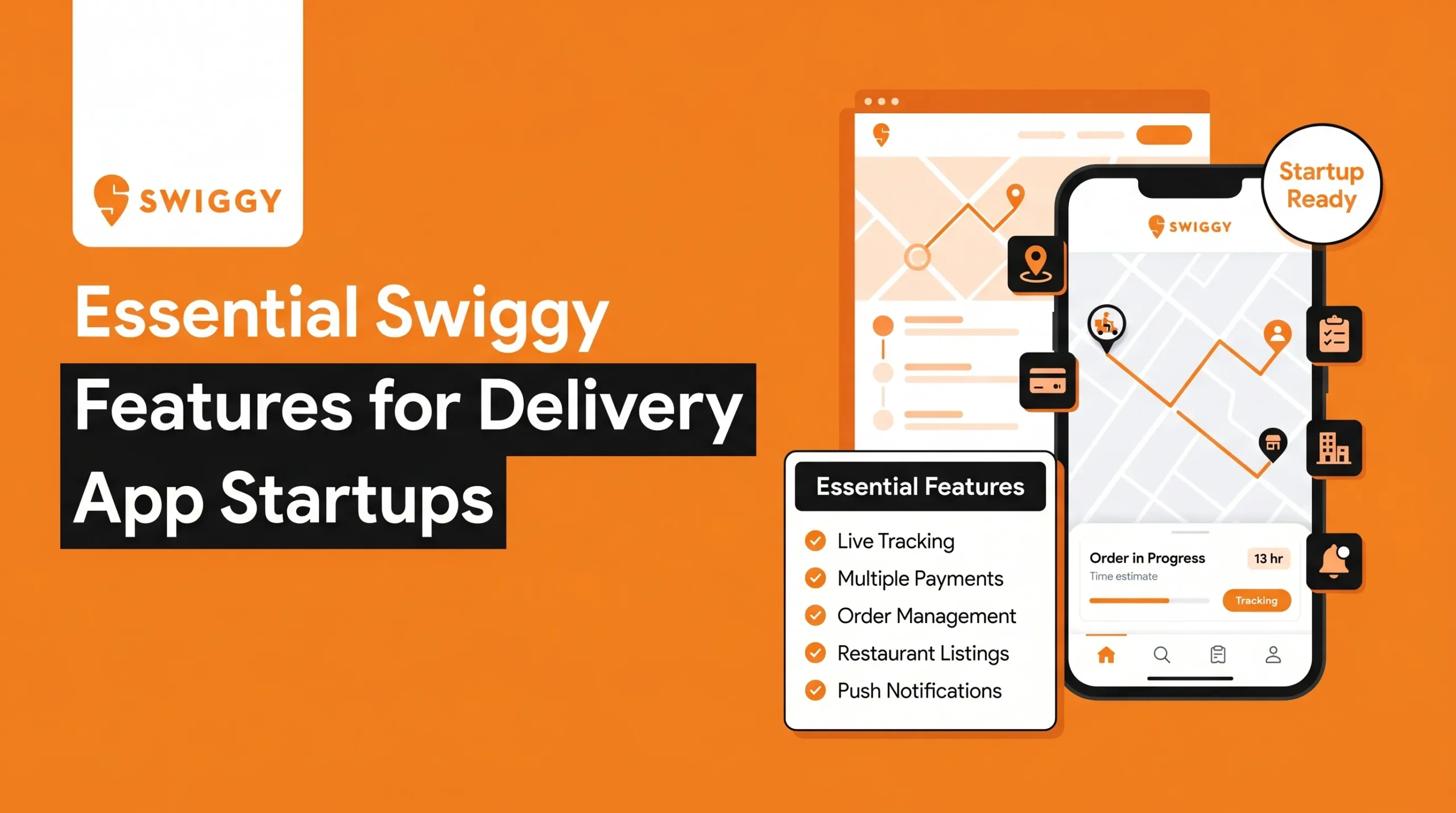
- Menu browsing, cart, payments, live tracking, delivery assignment, and reviews are core features.
- Startup success depends on strong logistics, clear pricing, and real-time order visibility.
- A feature-rich Swiggy clone can help delivery startups launch faster and scale smarter.
Feature Signals
- Customers need restaurant search, smart filters, menu details, coupons, checkout, and live order tracking.
- Restaurants need menu control, order alerts, preparation status, pricing, offers, and payout tracking.
- Delivery partners need order requests, route navigation, delivery status updates, and earnings visibility.
- Admins need control over users, restaurants, delivery zones, commissions, refunds, and reports.
- Push notifications keep customers, restaurants, and riders updated throughout the delivery journey.
Real Insights
- A food delivery startup needs strong delivery logic before scaling to multiple locations.
- Weak restaurant onboarding can reduce menu quality, order accuracy, and customer trust.
- Transparent delivery fees, taxes, discounts, and ETA details help users complete orders faster.
- Refunds, cancellations, and dispute handling protect both customers and restaurant partners.
- Miracuves builds Swiggy Clone apps with food ordering, restaurant management, delivery tracking, and admin workflows.
A couple of years ago, I was just another startup founder with big dreams and a half-baked food delivery idea scribbled on the back of a napkin. I remember ordering a biryani on Swiggy and thinking—“How do they make this look so effortless?” Ten minutes later, the piping hot order was at my doorstep, and I realized: this app isn’t just about delivery; it’s about experience. That’s what sets a successful Swiggy Clone apart.
In a world where attention spans are shorter than a TikTok video, users want now, not later. Food delivery apps need to be fast, frictionless, and flavor-packed (pun intended). Swiggy nailed that sweet spot by weaving technology with user behavior—no fluff, just smart design and powerful backend logistics.
If you’re a creator, entrepreneur, or digital business maverick dreaming of launching your own food delivery app—or building a Swiggy Clone that works—this one’s for you. At Miracuves, we’ve reverse-engineered Swiggy’s magic and helped visionaries launch scalable food delivery platforms that don’t just compete but thrive.
Read more: Swiggy Clone App Cost: Full Breakdown & Budget Tips
Top Swiggy Features That Drive Growth
Let’s break down what makes Swiggy so damn addictive (and successful). These are not just features—they’re smart product decisions that delight users and drive growth.
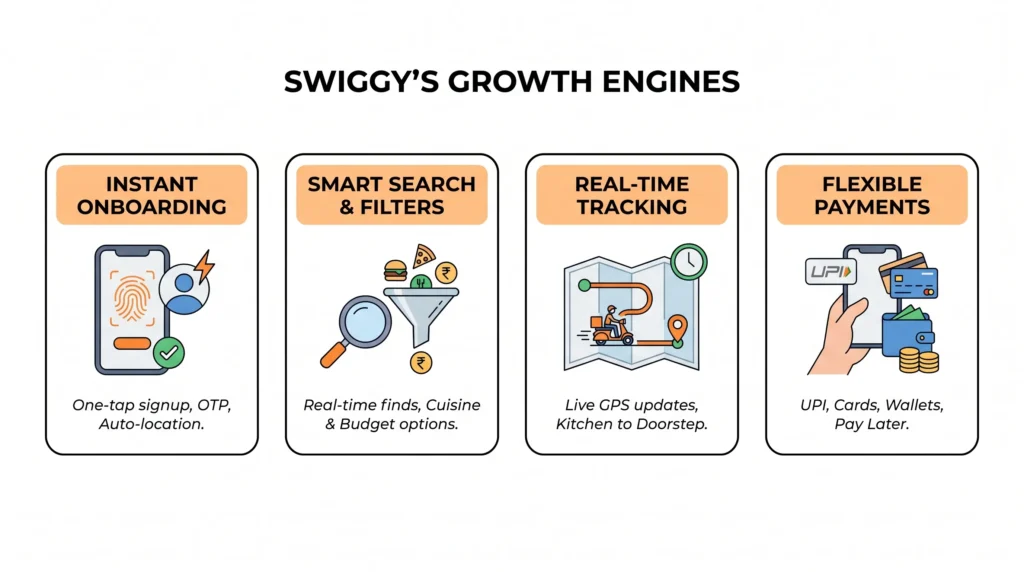
1. Seamless User Onboarding
Nobody wants to feel like they’re filling out tax forms just to get dinner. Swiggy keeps onboarding light, fun, and blazing fast. One-tap signups, OTP logins, and location auto-detection? Chef’s kiss.
2. Intelligent Search and Smart Filters
What’s worse than being hungry? Being hangry while scrolling through a never-ending food menu. Swiggy’s real-time search bar, cuisine filters, and budget-friendly toggles help users find what they crave—fast.
3. Hyperlocal Real-Time Tracking
Swiggy delivers live updates like your nosy neighbor—but in a good way. Users can track their meal from kitchen to doorstep with turn-by-turn GPS updates. This builds trust and reduces “Where’s my food?” anxiety.
4. Multiple Payment Gateways + Wallet Integration
From UPI and credit cards to lazy pay and loyalty points—Swiggy gets the millennial money game. This frictionless payment system increases conversions and reduces cart abandonment.
For the Hungry and the Hangry: User-Facing Features
Let’s face it, the user’s got one thing on their mind—food. So the app better make that journey fun, fast, and tasty.
1. Curated Collections and Recommendations
Swiggy doesn’t just dump options on you. It smartly serves up “Top Rated”, “Under 30 Minutes”, or “Healthy Picks”. It’s like Netflix suggestions, but for your stomach.
2. Scheduled Deliveries and Dineout Integration
Want biryani at 8 PM sharp? No problem. Users can schedule orders and even book tables via Dineout (now part of Swiggy). This dual-mode UX is a game-changer for hybrid dining behavior.
3. Offers, Loyalty Programs, and Swiggy One
Swiggy’s “Swiggy One” subscription gives free delivery and priority service—kind of like Amazon Prime for foodies. Regular promos, wallet cashback, and coupon gamification? All part of the retention playbook.
Behind the Scenes: Admin + Delivery Partner Features
Now here’s the spicy backend sauce that most clone builders miss out on. Let’s peek behind the kitchen counter.
1. Admin Dashboard for Business Analytics
Real-time dashboards help restaurant partners monitor orders, cancellations, ratings, and delivery times. This is where data meets decisions.
2. Delivery Partner App with Route Optimization
Delivery heroes get a dedicated app with optimized routes, order stacking, heatmaps, and earnings insights. It’s gamified, motivating, and efficient.
3. Heat Maps and Zone Management
Admins can identify demand-heavy zones, tweak delivery fees, and even reassign drivers. Dynamic pricing? Totally doable.
Emerging Add-Ons: Going Beyond Just Food
Swiggy isn’t just about food anymore, and neither should your clone be.
1. Swiggy Genie and Instamart
Groceries, courier services, pet supplies—Swiggy’s add-ons like Genie and Instamart tap into adjacent markets without new users. Same app, broader use case.
2. Dark Kitchens and Cloud Kitchens
Swiggy’s partnership with cloud kitchens allows more listings without actual dine-in spaces. For startups, this means lower capex and a faster go-to-market.
Read more: Create a Food Delivery App Like Swiggy: Key Features, Cost, and Development Process
Looking to revolutionize the way meals reach doorsteps? Explore our end-to-end food delivery app development services to build a user-friendly, scalable delivery platform tailored to today’s digital economy.
Global Cost of Development for a Swiggy-Like Delivery App
Swiggy-Like Food Delivery App Development — Market Price by Tech Stack
The tech stack affects order speed, restaurant management, live tracking, delivery assignment, and customer experience in a Swiggy-like delivery app. PHP/Laravel works well for cost-effective food delivery launches, Node.js/React.js supports real-time orders, GPS tracking, and notifications, while Go microservices suit large delivery platforms with high traffic, multi-city operations, and faster dispatch handling.
PHP/Laravel is often the most practical choice for launching a Swiggy clone quickly and affordably. Node.js/Python fits better when real-time order flows and heavier platform activity become more important, while Go microservices are better suited for enterprise-scale food delivery platforms with higher concurrency and more complex infrastructure needs.
These values reflect global development cost estimates. Final pricing varies based on customer, restaurant, delivery partner, and admin apps, menu management, live tracking, offers, payments, refunds, delivery fees, commission setup, and platform complexity.
Miracuves Swiggy-Like App Solution Cost and Tech Stack
Miracuves Pricing for a Swiggy-Like Food Delivery App developed in PHP/Laravel with Flutter Apps for $2,499 USD (One-Time Price) in just 6 days
Get a fully developed, deployment-ready food delivery platform modeled after Swiggy. Built on a stable PHP foundation, this complete package includes everything you need to launch and scale a restaurant delivery marketplace:
- Core Workflows: Customer registration, restaurant listing, menu browsing, cart checkout, order placement, restaurant order acceptance, delivery partner assignment, live order tracking, and customer notifications.
- Built-in Revenue Logic: Restaurant commissions, delivery fees, service charges, small order fees, surge pricing, promoted restaurant listings, subscription plans, promo codes, and delivery partner payout setup.
- Management Hub: Centralized admin dashboard, restaurant management, customer management, delivery partner management, order monitoring, payment records, refund handling, coupon management, support handling, and delivery analytics.
- Launch-Ready: Fully prepared for your custom branding, configuration, payment gateway setup, map integration, restaurant onboarding, delivery partner onboarding, and immediate market entry.
Why Is Swiggy-Like App Development More Affordable?
Most food delivery apps become expensive when businesses choose fully custom development from scratch. A Swiggy-style platform usually needs customer apps, restaurant panels, delivery partner workflows, admin controls, real-time tracking, order dispatch, payment systems, refunds, promo logic, and notifications. Building all of this separately can increase both development cost and launch time.
We took a smarter, more practical approach:
You Aren’t Paying for Ground-Up Development: Our food delivery marketplace engine is already developed, tested, and ready to deploy. You skip the inflated cost and long waiting period usually required for building a Swiggy-style platform from scratch.
The Power of PHP: We built this solution on a reliable and cost-effective PHP architecture. This keeps the upfront price affordable while supporting essential food ordering, restaurant management, delivery assignment, payment workflows, live tracking, promo codes, and admin operations.
You get a launch-ready Swiggy-like food delivery platform with practical marketplace features, source code access, and faster deployment without the high custom development price tag.
Note: This cost is for the solution, re-branding, deployment, and source code only.
Conclusion
Building a Swiggy-like platform isn’t about copying buttons—it’s about recreating that fluid user journey with business smarts and tech power. The market for hyperlocal delivery and on-demand convenience is only heating up. Whether you want to cater to midnight snackers or 10-minute grocery runs, it all starts with building on a solid feature foundation.
At Miracuves, we help innovators launch high-performance app clones that are fast, scalable, and monetization-ready. Ready to turn your idea into reality? Let’s build together.
FAQs
Q:1 What makes Swiggy different from other food delivery apps?
Swiggy focuses on hyperlocal logistics, real-time tracking, and a broad use case beyond food—like Instamart and Genie. It’s an all-in-one lifestyle convenience app.
Q:2 Can I build a Swiggy clone for a smaller city or niche market?
Absolutely. With the right tech stack and local marketing, even tier-2 and tier-3 cities are ripe for food delivery platforms.
Q:3 What tech stack does a Swiggy-like app require?
You’ll need GPS tracking, real-time databases, a robust backend (like Node.js or Django), cloud infra (AWS or Firebase), and separate apps for users, restaurants, and delivery.
Q:4 How do Swiggy’s loyalty programs work?
Swiggy One offers subscription perks like free delivery and exclusive deals. This helps retain high-frequency users and increase lifetime value.
Q:5 Is Swiggy profitable?
Swiggy is aggressively expanding and burning capital for growth, but it’s building a sticky user base. Its diversification into grocery and courier services is also helping boost margins.
Q:6 Can Miracuves help me build a Swiggy-like app?
Yes! We specialize in food delivery app clone development with customized features, modern UI/UX, and scalable architecture to suit your business goals.
Related Articles: