


Key Takeaways
What You’ll Learn
- Banking solution clone scripts help you launch a digital banking platform without building from scratch.
- Core features include user onboarding, KYC, wallets, transfers, and admin control systems.
- Modern platforms support multi-currency, payments, and secure transaction workflows.
- Compliance and security are essential for building trust in fintech applications.
- Choosing the right tech stack directly impacts cost, scalability, and launch speed.
Stats That Matter
- Basic digital banking platforms can cost around $70,000 globally to build from scratch.
- Full-feature fintech systems can go up to $140,000 depending on complexity.
- Enterprise-grade banking ecosystems can exceed $250,000+ with compliance and integrations.
- Development timelines typically range from several months to over a year.
- Ready-made solutions can reduce both cost and time significantly.
Real Insights
- Launching faster is a competitive advantage in fintech markets.
- Start with core banking features instead of building everything at once.
- Security, KYC, and compliance should be prioritized from day one.
- Scalable architecture helps you expand into lending, cards, and investments later.
- Successful platforms focus on user experience as much as financial functionality.
Banking isn’t what it used to be. Brick-and-mortar branches are becoming relics, while mobile-first neobanks, digital wallets, and fintech apps are redefining how people handle money. From bill splitting to crypto savings to instant loans, consumers now expect banking to be fast, personalized, and app-driven. And if you’re an entrepreneur looking to launch your own digital banking platform, there’s no need to start from zero. Banking Solution Clone Script are making it easier than ever to step into the fintech arena.
These clone Script take inspiration from platforms like Revolut, N26, Chime, and Monzo, offering a full stack of digital finance tools—ready to customize, rebrand, and deploy. This blog explores the best banking solution clones in 2026, their must-have features, pricing tiers, and how to choose the one that fits your vision.
Why Build a Banking Solution Clone?
Building a banking app from scratch is expensive, time-consuming, and regulation-heavy. Clone Script help founders skip months of development and launch a robust MVP or even a full-fledged product faster. Whether you’re targeting underbanked regions, launching a niche financial tool, or building a digital wallet for a specific sector, banking clones let you focus on market fit—not foundational code.
Key Reasons Founders Choose Banking Clone Script
- Faster Time to Market: Prebuilt modules for KYC, wallets, transfers, and cards reduce development time by 70–80%
- Custom Business Models: Adapt for personal banking, small business banking, freelancer accounts, or community credit
- Full Source Code Ownership: Many clones allow full customization with admin rights to modify every function
- Built-In Compliance Tools: KYC, AML, and transaction logging are often baked into the script architecture
- Modern UX/UI Standards: These apps are designed to match the sleek, minimalist style users expect from fintech tools
Read More : How to Start a Digital Banking App Business in 2025
Core Features Every Banking Solution Clone Script Must Include
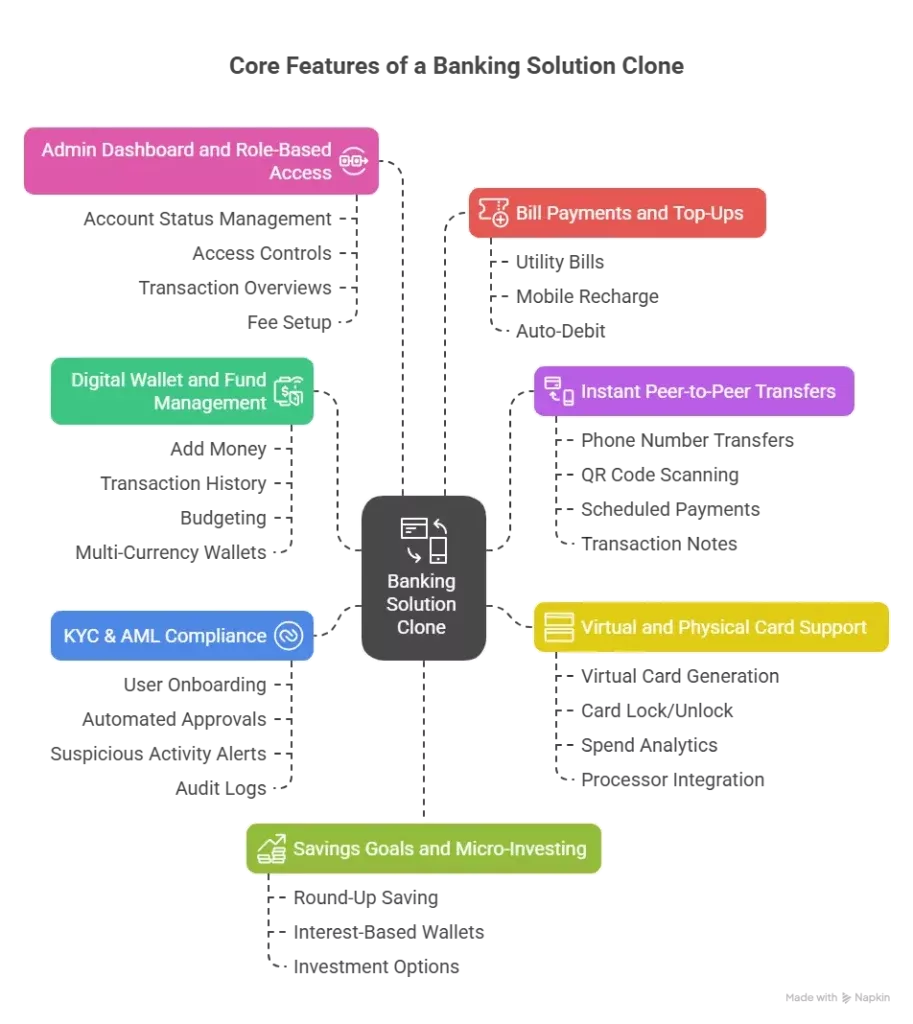
In 2026, a successful banking app isn’t just about holding funds—it’s about how users interact with money. If your clone script is missing any of these, you’ll struggle to gain traction.
1. Digital Wallet and Fund Management
Every user should be able to:
- Add money via bank, card, or UPI
- View transaction history
- Set monthly budgets or limits
- Manage multi-currency wallets
2. Instant Peer-to-Peer Transfers
Transfers should be seamless, with no hidden fees. Your clone must support:
- Phone number-based transfers
- QR code scanning
- Scheduled recurring payments
- Internal notes or tags per transaction
3. Virtual and Physical Card Support
Offer:
- Instant virtual card generation for online purchases
- Card lock/unlock features
- Spend analytics per card
- Integration with card processors like Stripe, Marqeta, or Mastercard
4. KYC & AML Compliance
Your clone should support:
- User onboarding with ID upload and live selfie checks
- Automated KYC approvals via third-party APIs
- Suspicious activity alerts and transaction caps
- Admin audit logs and reporting tools
5. Bill Payments and Top-Ups
Integrate APIs that let users:
- Pay utility bills (water, gas, electricity)
- Recharge mobile phones and internet plans
- Schedule auto-debit instructions
6. Savings Goals and Micro-Investing
Help users grow their money with:
- Round-up saving (e.g., round $1.75 to $2.00 and save the difference)
- Interest-based savings wallets
- Investment options in ETFs, mutual funds, or crypto
7. Admin Dashboard and Role-Based Access
Backend features should include:
- Account status management (active, suspended, flagged)
- Access controls for finance team, support agents, auditors
- Transaction overviews and trend reports
- Fee and commission setup per transaction type
Technology Stack That Powers Banking Clone Script
Financial apps must be secure, scalable, and fast. Look for clone Script built with these technologies:
- Frontend: Flutter, Swift, or React Native for smooth cross-platform mobile experiences
- Backend: Node.js or Django for real-time processing and robust API connections
- Database: PostgreSQL or Oracle for secure, scalable transaction storage
- Security: SSL encryption, 2FA, biometric login, tokenized payments
- Compliance Tools: Integrations with KYC/AML platforms like Sumsub, Onfido, or Trulioo
- Payment APIs: Stripe, Razorpay, Plaid, or PayPal for handling deposits and withdrawals
Read More : How to Market a Digital Banking App Successfully After Launch
Key Metrics for Script Comparison
Before purchasing a clone, use these benchmarks to guide your decision:
- Security Standards: Does it meet PCI DSS, GDPR, and regional finance regulations?
- Transaction Speed: How fast can users deposit, withdraw, and transfer funds?
- Customization Flexibility: Can you create savings plans, card types, or niche workflows?
- User Load Capacity: Can the platform handle 100,000+ users without downtime?
- Open APIs: Is the script future-proof with RESTful APIs for third-party services?
Global Cost Factors & Pricing Breakdown for a Banking Solution
The technology stack behind your banking platform plays a critical role in determining development cost, launch speed, and how securely and efficiently your platform can scale. Some businesses aim for a fast and budget-friendly launch, while others require a more advanced setup to handle transactions, regulatory compliance, multi-currency operations, and high-level financial security at scale.
Here is a simple comparison of common global development approaches for a banking solution:
PHP/Laravel is best for fast, affordable launches. Node.js/Python suits real-time systems, while Go is ideal for large-scale banking platforms.
Banking Solution Development Cost & Miracuves Pricing Breakdown
Miracuves Pricing for a Banking Solution developed in PHP/Laravel with Flutter Apps for $2,499 USD (One-Time Price) in just 6 days
Get a fully developed, deployment-ready platform designed for modern digital banking and fintech operations. Built on a stable PHP/MySQL backend with Flutter mobile apps, this complete package gives you everything needed to launch and scale a secure, compliance-ready banking platform with efficient financial workflows and real-time transaction control.
- Core Banking Flow: User onboarding, account management, fund transfers, transaction history, and multi-service financial workflows.
- Built-in Operations: Payment processing, wallet systems, transaction logic, settlement workflows, and financial reporting tools.
- Management Hub: Centralized admin backend for users, transactions, KYC handling, and complete financial platform control.
- Launch-Ready Setup: Fully prepared for branding, deployment, API setup, and app store publishing support.
Why is it so affordable?
Most digital banking platforms require advanced infrastructure for transactions, security layers, compliance handling, and financial integrations. Building this from scratch involves complex architecture, regulatory considerations, and high engineering costs. Miracuves simplifies this by offering a ready-made banking platform that already includes these essential fintech workflows.
We took a smarter, more practical approach:
- You Aren’t Paying for Ground-Up Development: Our banking engine is already developed and tested, helping you skip months of backend development and financial system setup.
- The Strength of PHP / MySQL with Flutter Apps: This stack is reliable, scalable, and cost-effective, making it easier to manage fintech operations and future upgrades.
- Fast Launch Advantage: Instead of spending months building a banking platform, you can launch a fully branded fintech app in just 6 days with all core workflows ready.
You get a complete, business-ready digital banking platform without the inflated cost of custom development.
Note: This cost includes the solution, re-branding, deployment support, source code, backend/API setup, admin panel configuration, and publishing support for Google Play Store and Apple App Store.
Real-World Applications and Use Cases
A well-built banking solution clone can adapt to dozens of fintech niches. Here’s how some founders are positioning theirs:
- Neobank for Freelancers: Custom tools for tracking income, issuing invoices, and saving tax
- Youth Savings App: Gamified savings plans with parental oversight and learning modules
- Crypto-Friendly Bank: Multi-wallets for stablecoins, cross-border remittances, and swap features
- Banking for Migrant Workers: Zero-fee transfers, low-KYC accounts, and local language interfaces
Mistakes to Avoid When Launching a Banking Clone
- Skipping Legal Review: Even clone Script need legal compliance before going live
- Ignoring Mobile UX: Banking apps must load fast, reduce taps, and use simple flows
- Overcomplicating Launch Features: Start with the core. Don’t launch with savings, crypto, loans, and trading all at once
- Neglecting Data Encryption: If user data isn’t secure, nothing else matters
- Choosing Closed Systems: Look for clone Script with API access so you can evolve and expand
Read More : Top UI/UX Mistakes in Digital Banking & Fintech Apps
Conclusion
Banking is now as much about user experience as it is about money. The winners in 2026 will be those who simplify finance, offer trust through transparency, and move fast with secure, scalable tech. Whether you’re creating a wallet for a small niche or building a global challenger bank, a banking solution clone script helps you get started without getting stuck in code or compliance chaos. At Miracuves, we help innovators launch high-performance app clones that are fast, scalable, and monetization-ready. Ready to turn your idea into reality? Let’s build together.
FAQs
Is it legal to launch a banking clone?
Yes, but you must comply with regional banking laws and obtain the appropriate licenses or partner with a licensed financial institution.
Can I launch without a banking license?
Yes, many startups partner with Banking-as-a-Service (BaaS) providers or operate under the license of a regulated institution.
What monetization options are available?
You can earn through transaction fees, card fees, currency exchange, lending, paid features, and affiliate products.
How long does it take to launch?
Basic apps can launch in 6 Days with minor customization. Full-featured platforms can take 8–12 weeks, especially if legal approvals are needed.
Can I add crypto features later?
Yes, if your script supports modular updates and open APIs, you can add crypto wallets, trading, or staking at any time.
Will I need a developer after launch?
Yes, ongoing maintenance, performance tuning, and feature releases require a technical partner or in-house team.
Related Articles