


Key Takeaways
What You’ll Learn
- OneCart’s revenue model works through multiple monetization streams, not grocery delivery fees alone.
- Core earnings come from delivery charges, retailer commissions, service fees, and partner-led income streams.
- Operational convenience helps the platform create repeat customer behavior and stronger order frequency.
- Retail and logistics coordination add more depth to long-term platform growth.
- Founder lessons come from execution, monetization depth, and customer convenience.
Stats That Matter
- The model is built around 4 core revenue layers: delivery fees, retailer commissions, service fees, and partner-led income.
- It is positioned in the grocery delivery space, where repeat orders and basket value both matter for growth.
Real Insights
- Grocery delivery platforms grow better when revenue comes from more than one monetization layer.
- Strong businesses combine customer convenience, retailer value, and recurring order behavior.
- The best models make delivery fees, commissions, and service flow support each other naturally.
- Operational clarity matters as much as the app experience itself.
- Growth comes from smart monetization, not only more orders.
OneCart has emerged as one of South Africa’s most efficient multi-retailer delivery platforms, allowing customers to shop from multiple stores — like Woolworths, Pick n Pay, Clicks, and Dis-Chem — and get everything delivered in a single order. Whether it’s groceries, pharmacy items, electronics, or pet food, OneCart simplifies the online shopping experience by consolidating multiple orders into one seamless checkout and delivery process.
As the demand for ultra-convenient, multi-retailer shopping grows across Africa and beyond, OneCart’s business model has positioned it as a key player in the on-demand delivery economy. Its acquisition by Massmart (a Walmart subsidiary) further reinforces its market potential and strategic significance.
But how does OneCart turn convenience into cash? Let’s unpack how this logistics-lite marketplace makes money — and how you can replicate the model using a white-label OneCart clone from Miracuves.
How OneCart Makes Money
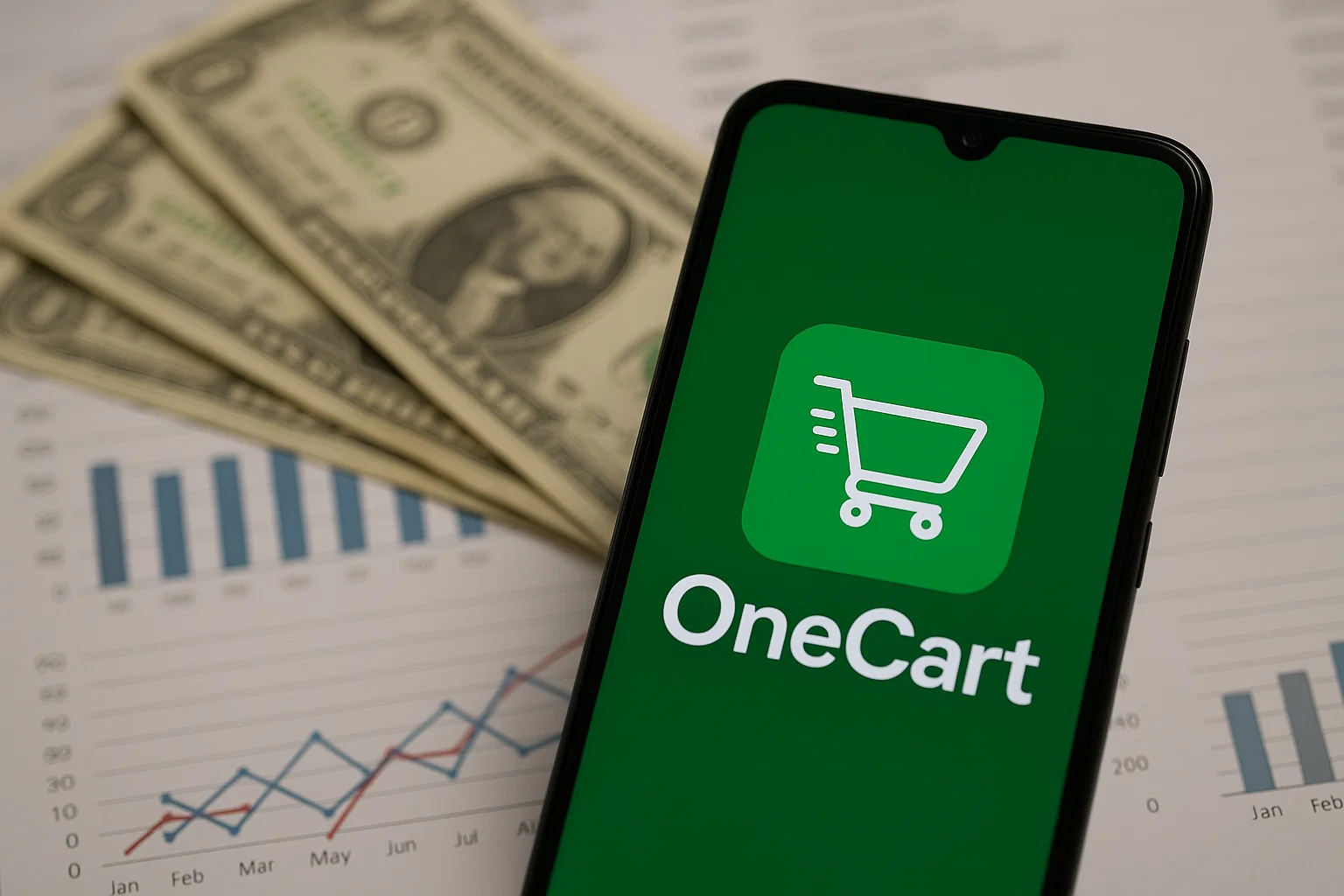
OneCart operates on a hybrid marketplace and logistics model that generates revenue from multiple sources — all optimized for scalability and partner collaboration. Here’s how the platform earns:
- Retailer Commissions – OneCart earns a commission on each order placed with partnered stores.
- Delivery Fees – Customers pay a delivery charge that goes either partially or fully to OneCart.
- Service Fees – An additional platform or convenience fee is often applied at checkout.
- In-App Advertising & Sponsored Listings – Retailers can promote their products or stores within the app.
- Partnership Revenue – Strategic integrations with loyalty programs or retail chains bring in B2B revenue.
- Bulk or Business Orders – OneCart serves corporate clients with dedicated account management and volume discounts.
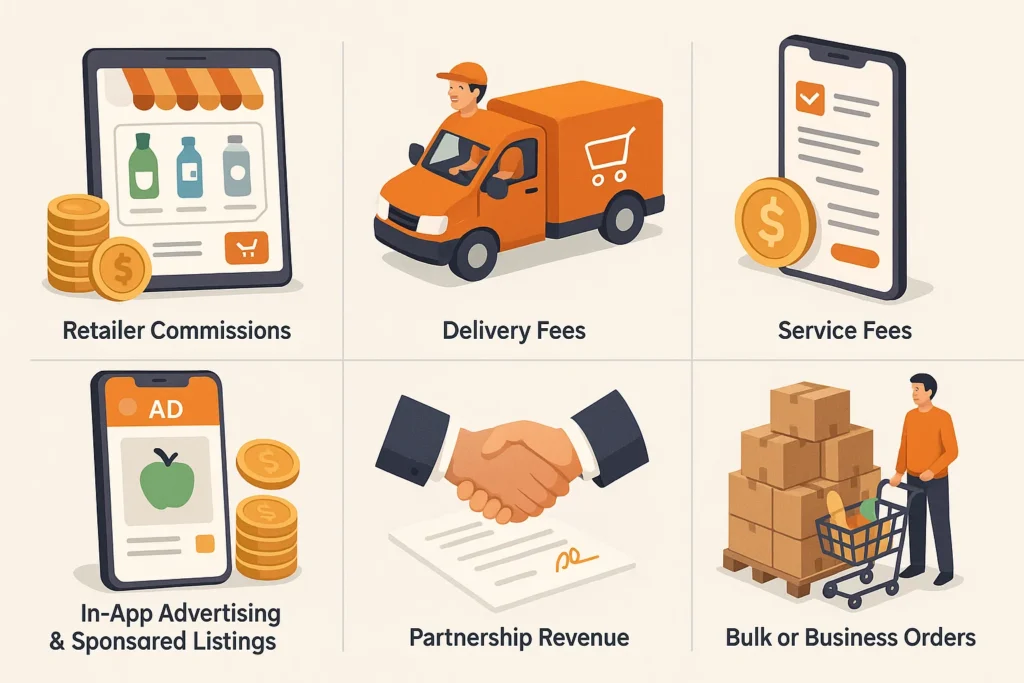
This blend of B2C and B2B monetization streams makes OneCart a flexible and powerful revenue-generating machine — without needing to own inventory or operate large fleets.
From multi-vendor support to real-time tracking, OneCart simplifies digital shopping—explore the OneCart features every founder should know.
Detailed Breakdown of Revenue Channels
Retailer Commissions
OneCart’s core revenue comes from commissions charged to partner retailers for every order placed through the platform. These commissions typically range from 8% to 20% depending on the category, location, and order volume.
- Who Pays? Partnered retail stores like Checkers, Woolworths, and Dis-Chem.
- Why It Scales? More orders = more volume = more revenue, without OneCart needing to handle inventory.
Delivery Fees
Customers are charged a delivery fee per order, which varies by distance, store count, and location. Some of this fee goes toward the fulfillment network (drivers or couriers), while the rest is retained by OneCart as operational margin.
- Who Pays? End customers.
- Why It Scales? Every order includes this charge — even during peak demand or promotional periods.
Service Fees
Apart from delivery, users may also see a “platform” or “convenience” fee during checkout. This fee is usually fixed (or tiered) and adds pure margin for OneCart.
- Who Pays? Customers placing orders.
- Why It Scales? Transparent and accepted as a standard fee for fast service and convenience.
In-App Advertising & Sponsored Listings
Retailers can pay for premium placements, banners, or category highlights within the OneCart app and website. This helps them boost visibility, especially during promotions or product launches.
- Who Pays? Retail partners and FMCG brands.
- Why It Scales? Ad space is scalable and repeatable with no extra fulfillment cost.
Partnership Revenue
OneCart has entered into deeper partnerships with large retail chains and loyalty programs (like Massmart or Makro). These deals may include tech licensing, data sharing, or co-branded campaigns.
- Who Pays? Corporate partners and retail groups.
- Why It Scales? Long-term deals and B2B revenue streams boost financial sustainability.
Bulk and Business Orders
OneCart also caters to offices, schools, and co-living spaces by facilitating bulk purchases through a dedicated team. These orders come with higher average cart value and more predictable volumes.
- Who Pays? Institutional buyers and bulk consumers.
- Why It Scales? Larger order size means higher commissions and upsell opportunities.
OneCart turned simple checkout into a growth engine—explore the OneCart marketing strategy that keeps customers coming back.
Why This Revenue Model Works in 2026
OneCart’s revenue model continues to thrive in 2026 due to a perfect alignment of technology, consumer behavior, and retail industry trends.
Multi-Retailer Convenience is the New Norm
Consumers increasingly prefer platforms where they can shop across multiple stores in a single checkout. OneCart’s multi-retailer cart model taps into this trend and justifies service and delivery fees for the added convenience.
On-Demand Delivery is Now Infrastructure
Thanks to improved last-mile logistics and gig workforce availability, cities are better equipped to support real-time delivery — making per-order monetization via fees and commissions highly scalable.
Retail Chains Want Digital Shelf Space
Retailers and FMCG brands are investing more in online visibility. OneCart’s in-app advertising and sponsored listings turn its app into a profitable marketing channel — similar to how Amazon monetizes search results.
Rising Acceptance of Micro-Fees
Customers now expect and accept convenience and service charges for time-saving platforms. This enables OneCart to monetize every transaction without resistance or churn.
B2B Fulfillment Opportunities
With remote work, corporate wellness, and community living models growing, bulk delivery solutions are gaining traction. OneCart’s ability to serve both individual and institutional buyers gives it added resilience.
From quick orders to doorstep delivery, OneCart makes e-commerce simple—see how OneCart works to streamline online shopping.
Can Startups Replicate OneCart’s Revenue Model?
Yes — and faster than ever before.
While building a platform like OneCart from scratch requires extensive logistics know-how, complex integrations with multiple retailers, and scalable technology, startups don’t have to start at zero. The real challenge lies in developing:
- A unified multi-store checkout experience
- Dynamic fee and commission structures
- Real-time inventory sync with partner stores
- Location-based delivery allocation
- Monetization features like ads and service charges
These components can take years to perfect. But with Miracuves’ OneCart Clone, startups can skip the heavy lifting.
Our clone solution offers:
- Pre-integrated multi-retailer cart system
- Built-in modules for delivery fees, commissions, and service charges
- Vendor dashboards for order management and promotions
- Ad modules for sponsored listings and retail visibility
- Scalable admin panel for managing pricing, delivery zones, and user rewards
- Native Android & iOS apps with white-label options
Time-to-market, scalability, and monetization flexibility are all baked in — so you can focus on operations, partnerships, and growth, while we power the tech.
The OneCart Clone by Miracuves is priced at $2,199, built for multi-store grocery and household delivery businesses.
Provide customers with a unified platform for food, essentials, and daily needs.
Miracuves development timeline including setup, configuration, admin deployments, API integrations, and platform handover in 6 Days, depending on customization and additional functional layers requested. This ensures a stable, market-ready system with predictable delivery and no hidden engineering delays.
This solution is built with robust frameworks — Web using PHP, MySQL & Apps using Flutter, optimized for performance, stability, and easy maintenance. Other tech stacks can be discussed upon request — Contact us
Startups can launch faster with the best OneCart clone scripts in 2025, scale smarter by following our developer guide for building a OneCart-like app, and save big by choosing our OneCart clone over expensive custom development.
Global Cost Factors & Pricing Breakdown
Onecart-Like App Development — Market Price
These values reflect global development cost estimates. Final pricing varies based on feature scope, team location, and platform complexity.
These amounts reflect the broader market cost of building a OneCart-style grocery delivery platform based on the selected backend architecture, order and inventory workflow complexity, real-time operational needs, monetization logic, and long-term scalability goals.
Miracuves Onecart-Like App Solution Cost and Tech Stack
Miracuves Pricing for a OneCart-Like App developed in PHP/Laravel with Flutter Apps for $2,199 USD (One-Time Price) in just 6 days
Get a fully developed, deployment-ready platform modeled after OneCart. Built on a rock-solid PHP/Laravel foundation, this complete package includes everything you need to launch and scale:
- Core Workflows: Grocery discovery, product browsing, cart management, order scheduling, and end-to-end grocery delivery management.
- Built-in Finance: In-app wallet logic, order pricing operations, and payout setups.
- Management Hub: Comprehensive store and delivery partner management and a centralized admin backend.
- Launch-Ready: Fully prepped for your custom branding, configuration, and immediate market entry.
Why Miracuves’s OneCart Like App is so affordable?
Most complex grocery delivery platforms force you into expensive architectures like Node.js or Go. Building from scratch with those frameworks requires highly specialized, expensive engineering teams, which drives the cost into the tens or hundreds of thousands of dollars.
We took a smarter, more practical approach:
- You Aren’t Paying for Ground-Up Development: Our grocery delivery platform engine is already developed, battle-tested, and ready to deploy. You skip the inflated costs and months of waiting associated with building from scratch.
- The Power of PHP / Laravel: We built this on one of the most reliable, globally adopted frameworks in the world. Not only does this keep our upfront costs down, but it also protects your future budget. PHP has a massive global talent pool, making it incredibly easy and cost-effective for you to find developers for future scaling or customizations.
You get an enterprise-capable, heavy-duty foundation without the inflated Silicon Valley price tag.
Note: This cost is for the solution, re-branding, deployment and source code only.
Conclusion
OneCart has successfully built a hyperlocal delivery engine that monetizes every step of the user journey — from order placement to delivery and even product discovery. Its revenue model is both agile and diversified, combining commissions, service fees, advertising, and B2B channels to drive profitability.
For entrepreneurs looking to launch their own OneCart-style marketplace, the path is now much shorter and smarter.
With Miracuves’ OneCart Clone, you get a fully customizable, revenue-ready platform — designed to help you earn from day one through proven monetization strategies.
FAQs
How does OneCart generate revenue?
OneCart earns revenue through a mix of retailer commissions, delivery charges, service fees, in-app advertising, and B2B partnerships. Each order placed through the app creates multiple monetization opportunities.
Is OneCart profitable in 2026?
While profitability specifics aren’t publicly disclosed, OneCart’s acquisition by Massmart and increasing order volumes point to strong unit economics, especially with growing advertising and B2B revenue streams in 2026.
What are the main income sources for OneCart?
Key revenue streams include commissions from partnered stores, customer-paid delivery and service fees, sponsored placements in the app, and revenue from bulk/corporate orders.
Can startups use the same revenue model as OneCart?
Yes, startups can replicate OneCart’s revenue model using white-label platforms like the OneCart Clone by Miracuves. It includes built-in monetization features like multi-retailer checkout, delivery fee logic, and ad modules.
Does Miracuves offer a OneCart clone with monetization features?
Absolutely. The OneCart clone by Miracuves includes customizable revenue streams such as commissions, service charges, in-app advertising, vendor dashboards, and subscription options for long-term monetization.