



Uber Eats alone brought in $13.7 billion in revenue in 2026, contributing a major share to Uber’s overall earnings. For entrepreneurs exploring delivery startups, this model is a goldmine of monetization insights. Understanding how Uber Eats structures commissions, fees, and dynamic pricing can help you design a scalable, profitable delivery app.
Let’s break down how Uber’s delivery model works — and how Miracuves helps entrepreneurs replicate and improve it for instant revenue growth.
Uber Delivery Revenue Overview – The Big Picture
Current Valuation & Revenue
Uber Delivery reported $12.7 billion in revenue in Q2 2025, up 18% year-on-year. In 2024, total company revenue was $43.9 billion, with Uber Eats contributing $13.7 billion, roughly 30% of total earnings.
Year-over-Year Growth
Uber Eats recorded 13% YoY growth in 2024, driven by new delivery markets, grocery expansion, and higher order frequency. Gross bookings reached $74.6 billion, showing strong user activity.
Revenue Breakdown by Region
- North America: ~54% of revenue
- EMEA: ~28%
- APAC: ~12%
- LATAM: ~6%
The U.S. remains Uber Eats’ largest contributor, but Asia-Pacific is the fastest-growing segment.
Profit Margins & Unit Economics
Uber’s average take rate in delivery is around 18–19%. While margins remain tight, Uber Eats is approaching profitability in mature markets thanks to scale and optimized logistics.
Market Position vs Competitors
Globally, Uber Eats is a top-two player in most regions. Its advantage lies in integrating ride and delivery data, dynamic pricing, and subscription bundling.
Read More: Build an App Like Uber Delivery – Developer’s Guide

Primary Revenue Streams Deep Dive
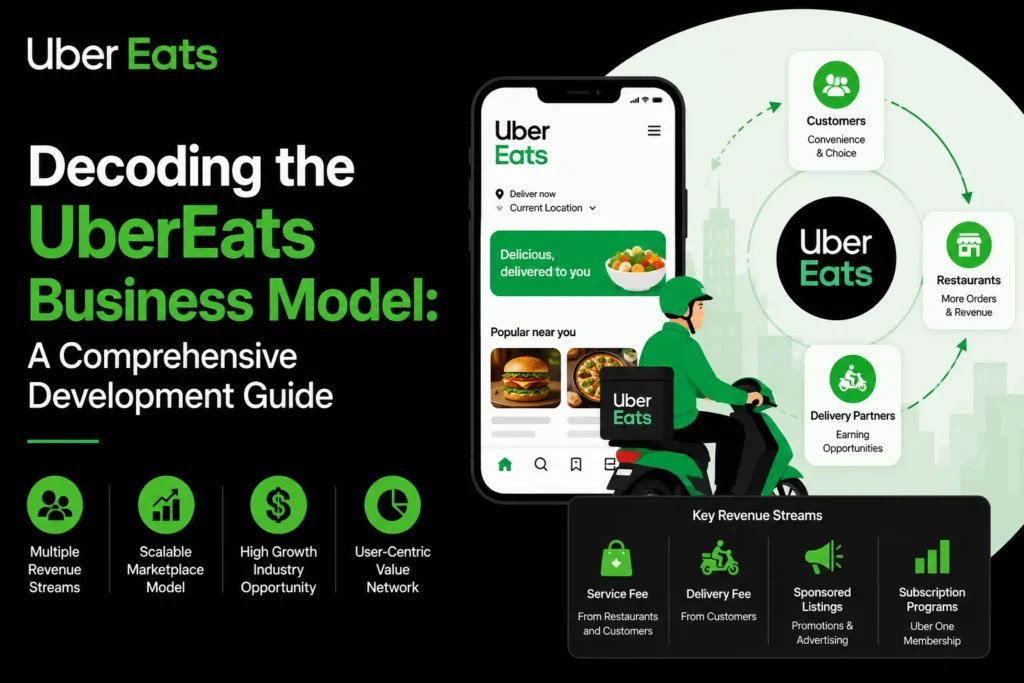
1. Restaurant Commissions
Restaurants pay Uber a 15–30% commission per order for marketplace access, delivery support, and customer acquisition. This is Uber’s largest revenue source, contributing 40–60% of delivery earnings.
Example: On a $100 order, Uber may earn $25 from commissions.
2. Delivery & Service Fees
Customers pay delivery fees (based on distance and demand) plus service fees up to 15%. These dynamic charges make up 20–30% of Uber’s delivery revenue.
Example: A $30 order might include a $5 delivery fee and $2 service charge.
3. Subscriptions (Uber One)
Uber One members pay $9.99/month for free delivery and exclusive discounts. This growing subscription segment provides predictable, high-margin revenue while increasing order frequency.
4. Advertising & Promotions
Restaurants pay Uber for sponsored placements and featured listings to boost visibility. Advertising contributes around 5–10% of delivery revenue and is rapidly growing.
5. Grocery, Retail, and Partner Deliveries
Uber now handles deliveries for grocery and retail partners, earning a share from logistics fees. This diversification adds another 5–10% of revenue and strengthens order density.
Estimated Revenue Stream Breakdown
| Revenue Stream | Estimated Share |
|---|---|
| Restaurant Commissions | 40–60% |
| Delivery & Service Fees (Customer) | 20–30% |
| Subscription / Membership | 5–10% |
| Advertising / Promotional Fees | 5–10% |
| Grocery & Partner Logistics | 5–10% |
The Fee Structure Explained
Uber’s dual-sided marketplace charges both customers and merchants — maximizing monetization from each transaction.
User-Side Fees
- Delivery Fee: Varies by distance and demand
- Service Fee: Percentage of order value
- Surge Fee: Added during peak times
- Subscription Discount: Uber One waives delivery charges
Provider-Side Fees
- Commission: 15–30% per order
- Onboarding or Listing Fee: In some markets
- Ad Fees: For promotional visibility
- Payment Processing Fee: For digital transactions
Hidden Revenue Levers
- Menu price markups
- Sponsored listings
- Data insights to merchants
- Bundled offers and dynamic pricing
Regional Pricing Variations
Developed markets favor higher commissions; price-sensitive markets rely more on delivery fees.
Detailed Fee Structure Breakdown by User Type
| Fee Type | Customer | Merchant | Notes |
|---|---|---|---|
| Delivery Fee | Yes | No | Dynamic by distance |
| Service Fee | Yes | No | Up to 15% of order |
| Commission | No | Yes | 15–30% standard |
| Listing / Onboarding | No | Yes | Optional setup fee |
| Advertising / Promo | Rare | Yes | Sponsored visibility |
| Subscription / Member | Yes | No | Monthly plan |
How Uber Maximizes Revenue Per User (RPU)
User Segmentation
Uber categorizes customers by frequency and order size, tailoring offers and discounts accordingly.
Upselling
Encourages add-ons, premium options, and bundled deals to lift average order value.
Cross-Selling
Integrates rides, grocery, and food within one ecosystem — increasing lifetime value.
Dynamic Pricing
Machine learning adjusts delivery fees based on supply-demand balance and location.
Retention Monetization
Rewards programs, targeted discounts, and Uber One memberships boost loyalty.
Lifetime Value Optimization
Frequent users generate multiple streams: commissions, service fees, and subscriptions.
Example
If a user orders 10 times a month, Uber can earn $15–$20 monthly from that user — a recurring revenue base scaled across millions.
Cost Structure & Profit Margins
Major Cost Categories
- Technology & Infrastructure
- Delivery Operations (courier payouts)
- Marketing & CAC
- Customer Support
- R&D for AI and logistics
Unit Economics (Example)
On a $100 order:
- Uber revenue: $18.8
- Delivery cost: $8
- Support & tech: $2
- Gross margin: ~$9 (before overhead)
Path to Profitability
Uber Eats reached breakeven in mature markets by optimizing delivery density, reducing incentives, and pushing subscriptions.
Margin Improvement Levers
- Subscription growth
- Better route algorithms
- Reduced incentives
- Ad monetization
- AI-driven logistics

Future Revenue Opportunities & Innovations
New Revenue Streams
- White-label delivery for other brands
- Premium delivery tiers
- AI-based predictive promotions
- B2B logistics partnerships
AI & Machine Learning
AI optimizes demand forecasting, route planning, and personalized pricing, directly improving profit margins.
Market Expansion
Emerging markets and Tier-2 cities offer untapped potential with localized pricing strategies.
Future Monetization Features
- Express delivery options
- Group orders and corporate plans
- Ad-supported discount models
2025–2027 Predictions
- Margins may rise to 6–8%
- Subscription share will double
- Grocery delivery to surpass restaurants in select regions
Threats
- Commission caps
- Labor laws and compliance costs
- Intense competition driving down fees
Entrepreneurial Opportunities
Startups can target niche categories — like organic groceries or cloud kitchens — using lower commissions and regional focus.
Lessons for Entrepreneurs & Your Opportunity
Key Takeaways
- Dual monetization (users + providers) is powerful
- Subscriptions increase retention and predictability
- Dynamic pricing boosts revenue intelligently
- Data-driven decisions enhance profitability
Gaps to Exploit
- Localized delivery platforms
- Specialized categories (e.g., vegan, grocery)
- Transparent commission models
- White-label B2B delivery
Monetization Innovations
- Tiered commissions
- Per-order micro-subscriptions
- Shared delivery networks
Read More: Best Uber Delivery Clone Scripts in 2025: Features & Pricing
Want to build a platform with Uber Eats’ proven revenue model? Miracuves helps entrepreneurs launch revenue-generating delivery platforms with customizable monetization features.
Get a free consultation to plan your revenue strategy today.
Final Thought
Uber’s delivery journey proves that profitable marketplaces emerge from smart monetization — not just scale. Entrepreneurs can replicate this playbook by combining flexible pricing, regional focus, and subscription-driven retention. With Miracuves, your Uber Delivery Clone can go live with built-in monetization that scales fast.
FAQs
How much does Uber earn per transaction?
Roughly 18–20% of each order’s value after deducting delivery payouts.
What’s Uber’s most profitable stream?
Restaurant commissions and subscription plans offer the best margins.
How does Uber’s pricing compare to rivals?
Uber maintains competitive commissions (15–30%) while balancing user fees for sustainability.
What percentage does Uber take from restaurants?
Typically between 15% and 30%, depending on delivery or pickup model.
How has Uber’s model evolved?
From basic commissions to a multi-layered structure — subscriptions, ads, and grocery integrations.
Can small startups use similar models?
Yes. Localized clones can adopt flexible fees and niche targeting for faster profitability.
What’s the minimum scale for profits?
You’ll need consistent order density — typically 1,000+ daily orders for breakeven in most regions.
How to implement similar revenue models?
Start with core commissions, add delivery and service fees, then layer subscriptions and ads.
What are alternatives to Uber’s model?
Flat-fee delivery, subscription-only models, or hybrid B2B logistics platforms.