

Key Takeaways
- An Uber delivery clone script helps startups launch an on-demand delivery platform faster with ready-made workflows.
- Customers, delivery partners, merchants, dispatch teams, and admins need connected app functionality.
- Order booking, delivery assignment, live tracking, payments, notifications, and reviews are core features.
- Pricing depends on app platforms, delivery modules, integrations, customization, and scalability requirements.
- A strong Uber delivery clone can reduce launch time while improving logistics control and user experience.
Feature Signals
- Customers need easy onboarding, delivery booking, address selection, price estimates, secure checkout, and live tracking.
- Delivery partners need order requests, route navigation, status updates, earnings tracking, and payout visibility.
- Merchants need order management, delivery status, catalog control, payment records, and customer communication tools.
- Admins need control over users, orders, delivery zones, commissions, payments, disputes, reports, and platform settings.
- Real-time notifications keep customers, merchants, delivery partners, and admins updated from order placement to delivery completion.
Real Insights
- An on-demand delivery app succeeds when booking, dispatch, tracking, and payment flows work smoothly together.
- Weak delivery assignment can increase delays, cancellations, customer complaints, and partner dissatisfaction.
- Clear pricing, delivery ETA, partner details, and order status help users trust the platform.
- Delivery-zone control, refund rules, ratings, and dispute handling improve marketplace reliability.
- Miracuves builds Uber Delivery Clone apps with customer apps, delivery partner apps, merchant workflows, live tracking, payments, and admin control.
The way businesses manage local package movement has changed. Customers now expect live tracking, quick pickups, transparent pricing, digital delivery proof, and reliable courier communication from the first booking to the final drop-off.
That is why many founders are exploring an Uber delivery clone script instead of building every workflow from zero. A ready-made script gives you a working foundation for customer booking, driver assignment, parcel tracking, payments, delivery status updates, and admin control. From there, you can customize the platform for courier delivery, business logistics, marketplace pickup, document delivery, pharmacy delivery, ecommerce returns, or city-level last-mile operations.
If your goal is not only to compare scripts but to evaluate a launch-ready product, explore Miracuves’ Uber-style delivery app solution here.
This guide keeps the comparison intent clear. You will learn what features matter, what affects pricing, what business models an Uber-like delivery app can support, and how to choose a script that can become a scalable delivery business instead of just another app template.
Why Entrepreneurs Choose Uber Delivery Clone Script
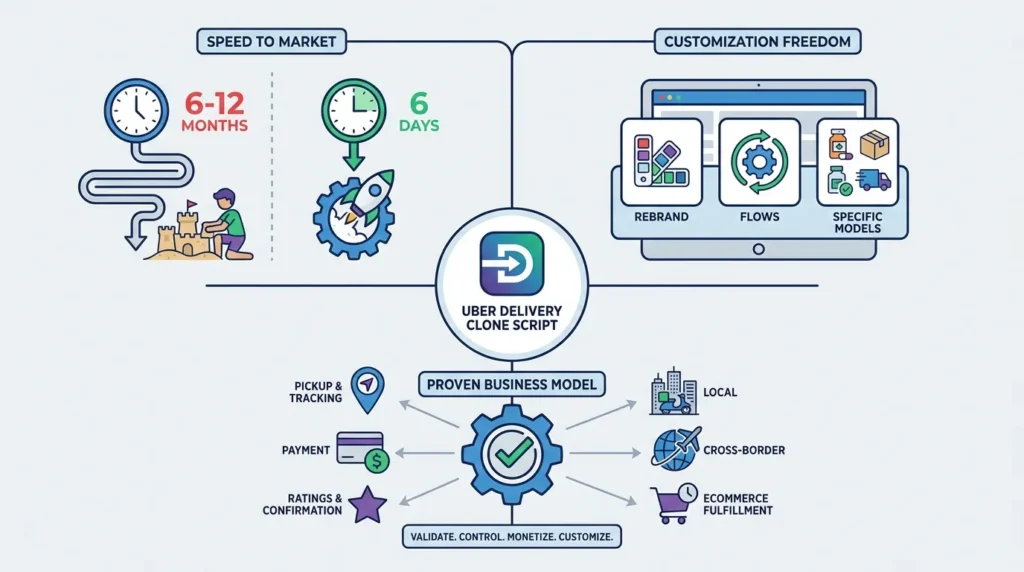
Speed to Market
Launching from scratch can take 6–12 months. A clone script can cut that down to 6 Days with basic customization.
Customization Freedom
Clone apps aren’t just copies. You can rebrand them, modify user flows, and tailor them to specific business models—like express medicine delivery or cross-border logistics.
Proven Business Model
For founders, the real value is not copying Uber. The value is using a proven delivery workflow to reduce product uncertainty. Users already understand pickup, tracking, payment, delivery confirmation, and ratings. Your job is to adapt that model to a sharper market: local courier delivery, business parcel movement, same-day ecommerce fulfillment, reverse logistics, scheduled heavy-item delivery, or hyperlocal delivery services.
A strong Uber-like delivery app should help you validate demand faster, control operations from the admin panel, monetize through multiple revenue streams, and customize the product around your city, region, or niche.
Read More : How to Launch a Successful Logistics & Package Delivery App Business
Must-Have Features in a 2026 Uber Delivery Clone Script
In 2026, building a delivery app isn’t just about connecting senders and couriers—it’s about delivering a fast, seamless, and smart user experience that rivals industry giants. Today’s users demand real-time transparency, convenience, and reliability from every tap on their screen. To meet those expectations and compete effectively, your Uber Delivery Clone must go far beyond basic functionality. Here’s a breakdown of the essential features your platform absolutely must include:
Real-Time Package Tracking
Modern users expect full visibility into the delivery process. That means they should be able to open your app and instantly see where their courier is—live, on an interactive map—not just rely on vague “out for delivery” messages or static timestamps. Real-time GPS tracking gives users confidence, reduces missed deliveries, and improves overall satisfaction by keeping both senders and recipients in the loop throughout the delivery journey.
Route Optimization
Every extra minute spent in traffic or on the wrong route costs money and time. Your platform must integrate smart route optimization algorithms that automatically determine the most efficient delivery path based on real-time traffic, distance, package priority, and delivery windows. This not only increases the number of deliveries a driver can complete in a shift but also reduces fuel consumption, operational costs, and customer complaints about delays.
Contactless Delivery Options
Originally popularized for safety during the pandemic, contactless delivery has become a permanent user preference. It offers convenience for busy customers and peace of mind for health-conscious recipients. Your app should allow users to opt for contactless delivery at checkout, prompting drivers to drop off parcels at designated spots (like doorsteps or reception desks) and confirm delivery digitally—without any physical interaction.
In-App Communication
When something’s not clear—like where to park, how to access a gated building, or where to leave a fragile item—real-time communication becomes crucial. Your clone app must feature a secure in-app chat or call function that connects the courier and the sender or receiver instantly. Importantly, this communication should be privacy-protected, meaning no personal phone numbers are shared and all conversations are logged within the platform for security.
Proof of Delivery (POD)
Accountability is a big deal in delivery. To avoid disputes or fraud, your app needs to include multiple layers of delivery confirmation. This should include digital signatures from the recipient, auto-generated timestamps, and ideally, a geotagged photo of the delivered item at the drop location. A well-documented POD system helps prevent false complaints and ensures customer trust.
Admin Analytics Dashboard
Behind every smooth delivery experience is a powerful backend. Your admin dashboard should give you full operational visibility, including:
- Total and completed orders
- Revenue breakdown by day/week/month
- Fleet performance reports
- User growth and behavior metrics
- Peak hours and demand analysis
These analytics empower you to optimize operations, adjust pricing strategies, incentivize drivers, and identify problem areas before they escalate.
Heatmaps and Demand Zones
Every city has high-demand neighborhoods—business districts, campuses, apartment clusters. Your Uber Delivery Clone should feature heatmaps in the driver dashboard that highlight these zones in real time. This allows drivers to relocate proactively, reduce downtime, and increase completed deliveries per hour. As a business owner, this data also helps with marketing and resource allocation.
Multi-Language and Multi-Currency Support
If you’re aiming for scale—whether regional, national, or international—your app must accommodate linguistic and financial diversity. That means offering the app interface in multiple languages relevant to your target markets and allowing users to transact in local currencies. Currency auto-conversion, locale-specific formatting, and language preferences should be configurable at the user level to enhance accessibility and inclusivity.
Read More: What is Uber Delivery App and How Does It Work?
Feature Depth That Separates a Basic Script From a Real Delivery App
A basic delivery script may let users book a parcel pickup. A stronger Uber delivery clone app should support the full operating system behind the business.
For customers, the app should make booking simple. Users should be able to add pickup and drop-off locations, choose a vehicle type, view estimated pricing, track the courier, communicate inside the app, pay digitally, and receive delivery confirmation.
For delivery partners, the app should support job alerts, route navigation, parcel details, earnings visibility, status updates, proof of pickup, proof of delivery, and support communication.
For admins, the panel should provide control over users, drivers, pricing, commissions, delivery zones, cancelled orders, disputes, payouts, payment methods, promotions, and analytics.
For the business owner, the most important question is not “How many features does the script have?” It is “Can I operate, monetize, customize, and scale this delivery business without depending on developers for every small change?”
Read More : Top 10 Ideas for Profitable Logistics and Courier Services Business Startups
Key Evaluation Metrics for an Uber Delivery Clone Script
When comparing Uber delivery clone script providers, founders should look beyond screens, feature lists, and demo videos. A delivery platform is not just a customer app and driver app. It is a business system that must support operations, monetization, control, trust, and future growth.
Scalability: The platform should be able to handle growing delivery requests, multiple delivery zones, driver availability, real-time tracking, and peak-hour order loads without creating operational bottlenecks.
Customization: A strong solution should allow you to modify branding, delivery categories, pricing rules, vehicle types, customer flows, payment gateways, and local business logic based on your target market.
Admin Control: The admin panel should give the platform operator control over users, drivers, bookings, commissions, refunds, disputes, payouts, reports, and promotional campaigns from one central dashboard.
Monetization Readiness: The script should support multiple revenue streams, including delivery fees, commissions, surge pricing, subscriptions, priority delivery, business accounts, and cancellation charges.
Source Code Ownership: Founders should confirm whether they receive usable source code or only a restricted license. Source-code ownership matters because it affects future customization, scaling, and independence from vendor lock-in.
Security and Trust: The platform should support secure logins, encrypted data transfer, role-based access, driver verification, payment gateway security, proof of delivery, dispute records, and activity logs.
Deployment Readiness: A reliable provider should support app publishing, backend setup, server configuration, payment integration, testing, and launch preparation so the platform can move from demo to real operations smoothly.
Support After Launch: Post-launch support is important for bug fixes, technical guidance, upgrades, and future feature expansion. A delivery business will continue evolving after launch, so the vendor should be able to support that growth.
Read More: How Safe is a White-Label Uber Delivery App? Security Guide 2026
Miracuves Uber Delivery-Like App Solution Cost and Tech Stack
Miracuves Pricing for a Uber Delivery-Like On-Demand Delivery App for $2,499 USD (One-Time Price) in just 6 days
Get a fully developed, deployment-ready delivery platform modeled after Uber Delivery. Built on a stable PHP foundation, this complete package includes everything you need to launch and scale an on-demand delivery business for parcels, packages, documents, groceries, food, and local courier services:
Core Workflows: Customer registration, delivery request creation, pickup and drop-off location setup, courier assignment, delivery acceptance, live delivery tracking, delivery status updates, proof of delivery, cancellation flow, and customer notifications.
Built-in Revenue Logic: Delivery fees, service charges, distance-based pricing, surge pricing, cancellation fees, courier payout setup, promo codes, subscription plans, and platform commission logic.
Management Hub: Centralized admin dashboard, customer management, courier management, delivery request monitoring, pricing controls, payment records, payout tracking, refund handling, support management, and delivery analytics.
Launch-Ready: Fully prepared for your custom branding, configuration, payment gateway setup, map integration, courier onboarding, delivery category setup, and immediate market entry.
Why Is Uber Delivery-Like App Development More Affordable?
Most on-demand delivery apps become expensive when businesses choose fully custom development from scratch. An Uber Delivery-style platform usually needs customer workflows, courier apps, admin controls, pickup and drop-off logic, live tracking, pricing calculation, payment handling, delivery status updates, notifications, refunds, and payout management. Building every component separately can increase both development cost and launch time.
We took a smarter, more practical approach:
You Aren’t Paying for Ground-Up Development: Our on-demand delivery platform engine is already developed, tested, and ready to deploy. You avoid the inflated cost and extended timeline associated with building every delivery workflow from scratch.
The Power of PHP: We built this solution on a reliable and cost-effective PHP architecture. This keeps the upfront price affordable while supporting essential delivery workflows such as order creation, courier assignment, live tracking, distance-based pricing, payment handling, payouts, and admin control.
You get a launch-ready Uber Delivery-like app with practical delivery, monetization, and management features, along with source code access and faster deployment.
Note: This cost is for the solution, re-branding, deployment, and source code only. Payment gateway charges, hosting infrastructure, third-party map services, regional compliance requirements, and custom security integrations are not included.
Read More : FedEx vs Uber Delivery Business Model Comparison
Monetization Options for an Uber-Like Delivery App
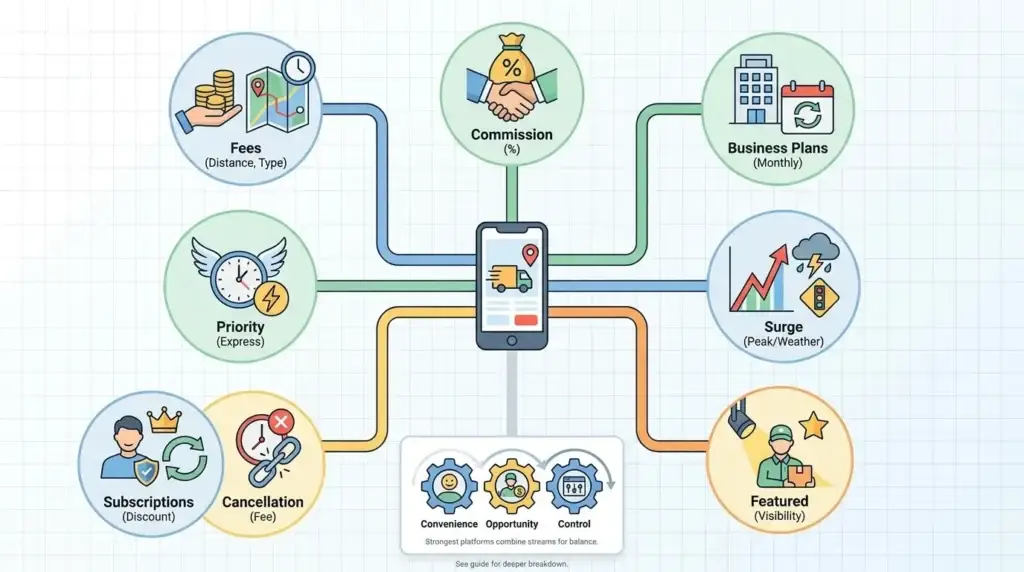
An Uber-like delivery app can generate revenue through multiple channels. The right monetization model depends on the type of customers the platform serves, whether they are individual users, local merchants, ecommerce sellers, pharmacies, offices, or logistics partners.
Delivery Fees: The platform can charge customers based on delivery distance, parcel type, urgency, location, or selected vehicle category.
Commission From Delivery Partners: The platform can earn a percentage from each completed delivery, giving the business a transaction-based revenue model.
Business Account Plans: Ecommerce sellers, retail stores, pharmacies, offices, and local businesses can subscribe to monthly plans for frequent or managed deliveries.
Priority Delivery Fees: Users or businesses can pay extra for express pickup, same-day delivery, urgent dispatch, or high-priority routing.
Surge Pricing: Delivery charges can increase during peak demand, bad weather, high-traffic hours, or limited driver availability.
Subscription Plans: Customers or businesses can pay a monthly fee to access discounted deliveries, faster service, or premium delivery benefits.
Cancellation Charges: The platform can recover operational loss when users cancel deliveries late or after a driver has already been assigned.
Featured Partner Listings: Verified courier partners, merchants, or logistics providers can pay for higher visibility inside the app.
The strongest delivery platforms do not depend on one revenue stream. They combine convenience for users, earning opportunities for delivery partners, and revenue control for the platform owner. A flexible monetization setup allows founders to test different pricing models, optimize margins, and adapt the platform around local demand.
For a deeper business model breakdown, read this guide on the Uber Delivery Clone revenue model.
Security and Trust Features Founders Should Not Ignore
A delivery app handles sensitive operational data, including customer addresses, payment activity, courier movement, parcel status, delivery proof, complaints, and support records. Because of this, security should be treated as a product foundation, not an optional add-on.
A reliable Uber delivery clone app should support secure login, encrypted data transfer, role-based admin access, payment gateway security, driver verification, delivery proof, dispute records, and activity logs. These features help protect user data, reduce misuse, and give the platform operator better visibility into daily operations.
Trust also comes from operational transparency. Customers want to know where their parcel is and when it will arrive. Drivers need clear job records, route details, payout visibility, and proof of completed deliveries. Admins need access to cancelled deliveries, failed payments, refund requests, customer complaints, driver issues, and unusual platform activity.
Security does not only protect data. It protects customer confidence, driver accountability, brand reputation, and long-term retention. For founders building a delivery business, trust becomes one of the strongest growth assets.
Read More: Uber Delivery Clone Revenue Model: How Uber Eats Makes Money in 2026
Business Models an Uber Delivery Clone Script Can Support
An Uber delivery clone script is not limited to general courier delivery. With the right customization, it can support multiple delivery business models across local commerce, logistics, healthcare, ecommerce, and business transportation.
- Local Courier Delivery: Suitable for documents, parcels, gifts, and city-level pickup and drop-off services.
- Ecommerce Last-Mile Delivery: Useful for sellers that want their own delivery network instead of depending completely on third-party logistics providers.
- Medicine and Healthcare Delivery: Designed for pharmacies, healthcare aggregators, or medical delivery businesses that need secure, scheduled, and trackable deliveries.
- Heavy-Item or Vehicle-Based Delivery: Suitable for furniture, appliances, business inventory, or goods that require vans, trucks, or specialized vehicles.
- Reverse Logistics: Useful for ecommerce returns, product exchanges, pickup verification, refund workflows, and warehouse return management.
- Business-to-Business Delivery: Built for offices, retailers, manufacturers, and service businesses that need predictable recurring delivery operations.
- Hyperlocal Marketplace Delivery: Suitable for platforms that connect customers, merchants, and delivery partners inside one local delivery ecosystem.
This is where transportation logistics becomes critical. A delivery app is not only a customer-facing product. It is an operational system for route planning, order visibility, driver coordination, payout control, dispute handling, and service reliability. The better the backend control layer, the easier it becomes for founders to scale delivery operations without solving every issue manually.
Read More: Uber Delivery Clone Revenue Model: How Uber Eats Makes Money in 2026
For broader delivery and logistics technology planning, explore Miracuves’ transportation logistics solutions here.
Tips Before You Invest in a Script
Before purchasing any Uber Delivery Clone script, keep these best practices in mind:
- Request a Live Demo: Interact with both the customer app and admin panel to understand the UX flow and backend robustness.
- Check for Clean Code: Ask if the codebase is modular, readable, and scalable for future additions.
- Understand Ownership Terms: Will you receive full source code or just a limited license?
- Performance Testing: Simulate high order volumes to evaluate system response time and reliability.
- Integration Flexibility: Can the platform connect to APIs from mapping tools, payment gateways, and CRM systems?
Before you decide, ask for a product walkthrough. A good demo should show the customer app, delivery partner app, admin panel, booking flow, tracking flow, payment flow, delivery completion, and reporting dashboard.
You should also ask what is included in the source code, what can be customized, how deployment works, what support is available after launch, and whether the app can be extended for your target market.
If you are already comparing vendors, the next useful step is to view the Miracuves Uber Delivery Clone demo and check whether the existing product foundation matches your delivery model.
Final Thoughts: Choose a Script That Can Become a Delivery Business
An Uber delivery clone script should not be treated as a shortcut to copy another brand. It should be treated as a faster product foundation for launching your own delivery business with the right workflows, admin control, monetization logic, and customization flexibility.
The best script is not the one with the longest feature list. It is the one that helps you launch faster, manage delivery operations clearly, support real users, control payments and disputes, and adapt to your local market.
If you want to move from research to product evaluation, review the Miracuves Uber Delivery Clone page here.
You can compare the app flow, pricing direction, deliverables, tech stack, source-code access, and demo options before deciding whether it fits your launch plan.
FAQs
What is an Uber delivery clone script?
An Uber delivery clone script is a ready-made software foundation for launching an on-demand parcel or courier delivery app. It usually includes customer booking, delivery partner management, real-time tracking, payments, notifications, delivery status updates, and an admin dashboard.
Is an Uber delivery clone script the same as an Uber Delivery Clone app?
Not exactly. A script usually refers to the prebuilt codebase or software foundation. An Uber Delivery Clone app is the branded, configured, and deployed product that users, delivery partners, and admins can actually use.
Who should use an Uber-like delivery app solution?
It is useful for logistics startups, courier companies, ecommerce sellers, local delivery businesses, pharmacy delivery operators, hyperlocal marketplaces, and businesses that want to manage pickup and delivery through their own branded platform.
What features should I check before buying an Uber delivery clone script?
Check customer booking, driver assignment, real-time tracking, route support, proof of delivery, in-app communication, payment gateway integration, delivery status updates, admin analytics, commission control, dispute management, source-code access, and deployment support.
How can an Uber delivery clone app make money?
Revenue can come from delivery fees, platform commissions, surge pricing, subscriptions, business delivery accounts, priority delivery charges, cancellation fees, and partner promotions. The best monetization model depends on your market and delivery category.
How much does an Uber delivery clone script cost?
Pricing depends on modules, integrations, customization, tech stack, admin features, deployment support, and source-code ownership. Miracuves’ Uber Delivery Clone page currently shows a starting offer of $2,499 with a 6-day go-live direction, but final scope should always be confirmed before purchase.
Can I customize the Uber Delivery Clone for my own brand?
Yes. A strong white-label delivery app should allow branding changes, UI customization, local currency, language settings, delivery categories, vehicle types, pricing rules, payment gateways, and business-specific workflows.
Is source-code ownership important for a delivery app?
Yes. Source-code access gives you more control over future customization, integrations, maintenance, scaling, and vendor independence. Without clear ownership or access rights, your platform may become harder to expand later.
What security features should a delivery app include?
A delivery app should support secure logins, encrypted data transfer, role-based admin access, payment gateway security, driver verification, delivery proof, activity logs, dispute records, and privacy-conscious communication between customers and delivery partners.
Related Articles
Miracuves is an independent software development company. We are not affiliated with, connected to, sponsored by, or endorsed by any company or product named in this article.
Terms such as “X Clone” are used descriptively. It is how the software industry refers to building a platform with functionality comparable to a known service, and how clients search for it.
The entire design and codebase of our products is built by our own team. Our products contain no code, design, graphics, or content originating from any third-party website or applications.
All third-party names and marks referenced in this article are the property of their respective owners, referenced solely to identify the services discussed.