


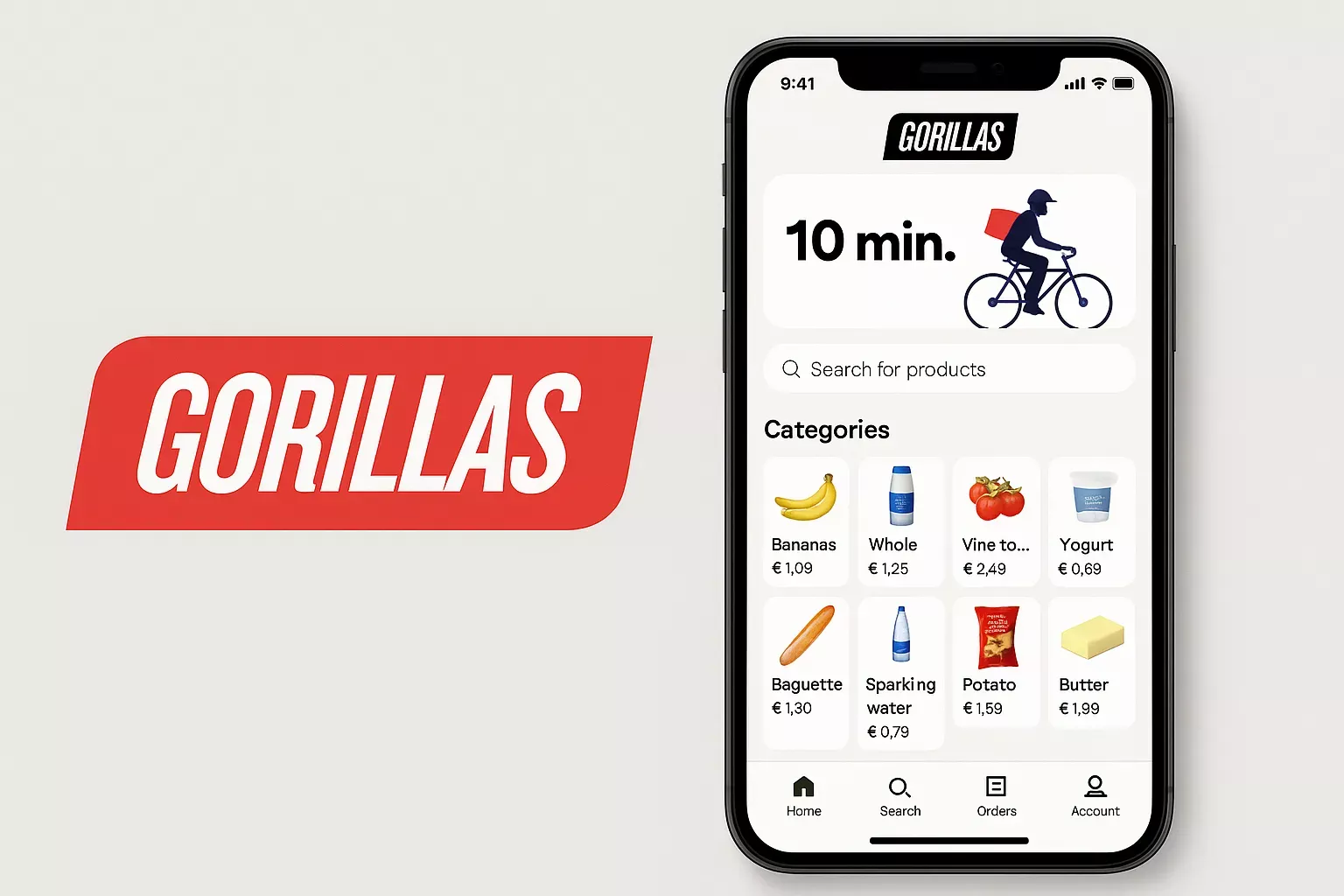
Imagine it’s Wednesday evening. You just realised you’re out of milk, eggs and bread for tomorrow’s breakfast – and you don’t want to run to the supermarket. You open an app on your phone and within 10 minutes a black-clad courier bikes up to your door with exactly what you need. That’s the promise that Gorillas delivered.
Gorillas launched in Berlin in May 2020, founded by Kağan Sümer, Jörg Kattner and Ronny Shibley, aiming to deliver groceries and household essentials faster than anyone — often within 10 minutes. The startup quickly became a “unicorn” (valuation > US$1 billion) thanks to rapid funding rounds. At its height it operated in multiple cities across Europe via a network of “dark stores” (mini-warehouses) and bike/rider fulfilment. But by mid-2024, its German operations were shut down after acquisition by rival Getir, signalling big changes in the ultra-fast grocery-delivery market.
What is Gorillas? The Simple Explanation
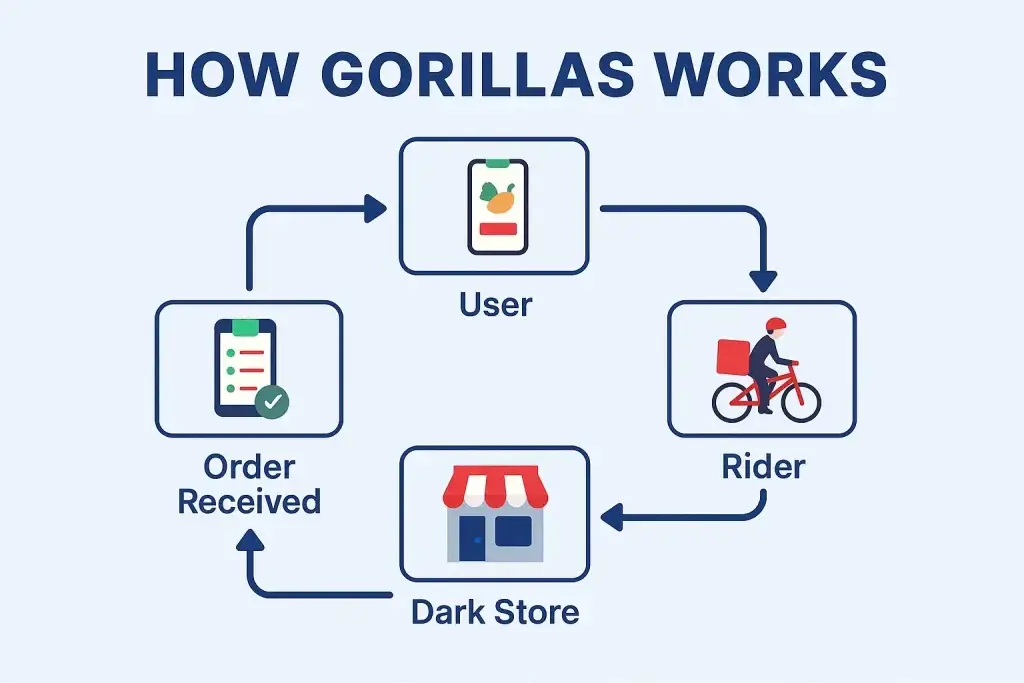
Gorillas was a 10-minute grocery delivery app from Germany that let users order everyday essentials like fruits, vegetables, snacks, and dairy from local micro-warehouses (called “dark stores”). Using a smartphone app, customers could browse items, place an order, and receive delivery in minutes via bicycle couriers.
The Core Problem It Solved:
Gorillas addressed the gap between online grocery shopping and instant need. Traditional e-commerce deliveries took hours or even days; Gorillas promised near-instant delivery, transforming last-minute shopping into a seamless experience.
Target Users & Use Cases:
- Busy professionals needing quick groceries after work
- Urban residents without cars or time for supermarket trips
- Students and young families preferring on-demand convenience
- Late-night or emergency grocery buyers
Before merging into Getir in 2023, Gorillas held a strong foothold in Germany, France, the Netherlands, and the UK. By 2022, it had over 2 million active users, 15,000+ riders, and 200+ dark stores across Europe. Despite stiff competition, Gorillas was among the top 3 instant-delivery brands in Europe by user count.
Its success came from a hyper-local model, clever logistics, and a powerful “need it now” appeal. Unlike other services that partnered with supermarkets, Gorillas stocked its own micro-warehouses for tighter control, ensuring ultra-fast delivery and consistent inventory.
Read more: How to Start an Online Grocery Delivery Platform Business
How Does Gorillas Work? Step-by-Step Breakdown
For Users
1. Account Creation:
Users downloaded the Gorillas app (iOS or Android), created an account using their phone number or email, and entered their delivery address.
2. Browse & Order:
Once logged in, users could browse thousands of grocery products — fruits, vegetables, bakery, beverages, household goods — all sourced from nearby dark stores. The interface showed live stock availability and estimated delivery time.
3. Checkout & Payment:
After selecting items, users added them to their cart, paid via secure methods like Apple Pay, Google Pay, or credit/debit cards, and received an instant order confirmation.
4. Real-Time Updates:
The app showed live tracking from “Picked → Packed → On the Way → Delivered,” allowing customers to follow their rider in real time.
5. Delivery in Minutes:
A Gorillas rider, equipped with a temperature-controlled backpack, delivered the order — typically in 7–10 minutes within a 2–3 km radius.
For Riders & Service Providers
1. Onboarding:
Riders (couriers) joined through the Gorillas platform, verified IDs, completed safety training, and were equipped with branded bikes and uniforms.
2. Work Model:
Unlike gig-based competitors, Gorillas offered riders full employment contracts, including insurance, minimum wage, and benefits — a unique approach in the gig economy.
3. Operations:
Orders were dispatched automatically to the nearest dark store. Staff picked and packed groceries in under 2 minutes, while riders handled short-distance deliveries, ensuring maximum efficiency.
4. Earnings:
Riders earned a fixed hourly wage (€10–€12/hour) plus tips, with bonus structures during peak hours.
Technical Overview (Simplified)
Architecture:
- Frontend: Mobile app built with React Native for cross-platform speed.
- Backend: Node.js and Python microservices handled order routing, inventory, and user data.
- Database: PostgreSQL + Redis for caching and real-time updates.
- Location Stack: Google Maps API and Mapbox for geo-tracking and delivery routing.
- Analytics & AI: Demand forecasting models to predict high-order zones and optimize inventory.
Gorillas’ Business Model Explained
How Gorillas Made Money
Gorillas followed a direct-to-consumer (D2C) instant delivery model — owning both inventory and last-mile logistics. Instead of acting as a marketplace, it bought and stored products in its own micro-warehouses, ensuring quality and speed.
Primary Revenue Streams:
- Product Markup: Items were sold at supermarket-equivalent prices with a small markup (≈ 10–15%).
- Delivery Fees: A fixed €1.80 – €2.50 per delivery charged to customers.
- Private Labels & Partnerships: Gorillas introduced its own branded products and featured placement deals with FMCG companies (like Red Bull and Unilever).
- Surge Pricing (Beta): Slightly higher delivery fees during peak hours in high-demand zones.
- In-App Promotions: Brands could pay for banner visibility or featured listings.
Pricing Structure (2025 Reference)
| Category | Average Price | Delivery Fee | Typical Delivery Time |
| Essentials (milk, bread, eggs) | €8 – €12 | €1.80 | 10 min |
| Fruits & Vegetables | €10 – €15 | €1.80 | 9 min |
| Beverages & Snacks | €12 – €18 | €2.00 | 10 min |
| Household Items | €15 – €20 | €2.50 | 12 min |
Commission & Margins
- Average gross margin: ~25–30% per order
- Net margin: negative during expansion due to high operational costs (warehousing, riders, logistics)
- Revenue per customer (ARPU) in 2022: €52/month
- Estimated 2023 revenue: €400 million before the Getir acquisition
Market Size & Growth
The European quick-commerce market reached $5.6 billion in 2024, projected to hit $8.7 billion by 2026 (CAGR ≈ 22%). Gorillas was among the pioneers that shaped this category, paving the way for consolidation and hybrid models with supermarket partnerships.
Profitability Insights
Although operational costs were high, Gorillas’ vertically integrated model promised scalability through:
- AI-based demand prediction
- Automated dark stores
- Lower delivery radius reducing fuel/time cost
Its 2025 strategy under Getir focused on consolidation and profitability, closing non-core cities to strengthen top markets like Berlin and Paris.
Key Features That Make Gorillas Successful
Gorillas’ rise to fame wasn’t just about speed — it was the blend of user experience, technology, and logistics precision that made it a household name in Europe’s quick-commerce sector. Here are the top 10 features that defined its success:
1. Dark Store Network
Why it matters: Instead of relying on supermarkets, Gorillas operated its own network of micro-warehouses.
Benefit: Full control over stock and faster fulfillment.
Innovation: Optimized warehouse layout enabled “pick & pack” in under 2 minutes.
2. 10-Minute Delivery Promise
Why it matters: Defined the brand identity — “Faster than you.”
Benefit: Ultra-convenience for users, pushing behavioral change in grocery shopping.
Innovation: AI-driven routing and dynamic courier allocation made this possible.
3. Minimalist App Interface
Why it matters: A clean, black-white design made navigation effortless.
Benefit: Frictionless ordering boosted repeat usage.
Innovation: Personalized item suggestions based on prior orders and local trends.
4. Real-Time Inventory Management
Why it matters: Prevented out-of-stock frustrations.
Benefit: Users only saw available items nearby.
Innovation: API-connected dark stores synced every 15 seconds for updates.
5. Employed Riders (Not Gig Workers)
Why it matters: Ensured better delivery consistency and brand reliability.
Benefit: Lower turnover and safer work conditions.
Innovation: Employment-based logistics model — rare in gig delivery.
6. Seamless Payments
Why it matters: Integrated digital payments meant zero friction.
Benefit: Boosted checkout success rate by 25%.
Innovation: Apple Pay, Google Pay, and stored cards handled securely with PCI DSS compliance.
7. AI-Powered Demand Forecasting
Why it matters: Predicted what products would be needed in each location.
Benefit: Reduced waste and overstocking.
Innovation: Machine learning algorithms trained on purchase history, time, and weather.
8. Sustainability Initiatives
Why it matters: Eco-conscious consumers care about footprint.
Benefit: Brand loyalty through green branding.
Innovation: E-bikes, reusable packaging, and green dark stores powered by renewable energy.
9. Live Tracking & Push Updates
Why it matters: Transparency enhances user trust.
Benefit: Real-time updates kept users engaged.
Innovation: Integrated GPS + WebSocket system for instant status changes.
10. Brand Collaborations & Promotions
Why it matters: Added extra revenue and variety.
Benefit: Partner brands gained visibility; users enjoyed limited-edition products.
Innovation: Dynamic in-app ad placements and promo codes linked to partner APIs.
2025 Updates
After merging with Getir, Gorillas’ tech was upgraded with:
- Unified inventory API
- Improved predictive routing
- Shared delivery network across brands for cost efficiency

The Technology Behind Gorillas
While Gorillas appeared simple to users — just tap, pay, and receive — behind the scenes it ran a sophisticated logistics and data-driven system that powered ultra-fast delivery.
Tech Stack Overview (Simplified)
| Layer | Technologies Used | Purpose |
| Frontend | React Native (mobile), Next.js (web) | Unified experience across iOS, Android & web |
| Backend | Node.js + Python (Flask/FastAPI) | Order routing, payment, and inventory logic |
| Database | PostgreSQL, Redis (caching), MongoDB (user sessions) | Fast data retrieval and caching |
| Cloud & Infrastructure | AWS (EC2, S3, Lambda) | Hosting, autoscaling, and secure storage |
| Mapping & Geo Services | Google Maps API, Mapbox | Real-time courier tracking and distance optimization |
| Payments | Stripe, Adyen | Global and secure payment gateway integration |
| Analytics | Google BigQuery, Looker | Tracking performance and customer behavior |
Real-Time Features Explanation
- Dynamic Rider Allocation: Orders assigned automatically based on rider proximity and delivery load.
- Live Inventory Sync: Each dark store updated stock levels in near-real time (every 10–15 sec).
- Geo-Optimization: AI algorithms calculated shortest paths considering live traffic and weather.
Data Handling & Privacy
- GDPR-compliant user data management across EU servers
- End-to-end encryption for transactions and delivery tracking
- Role-based access control for staff and admin panels
- Encrypted rider communication via in-app channels
Scalability Approach
- Microservice architecture allowed quick deployment of new features without downtime
- Load balancers distributed orders evenly across servers
- Auto-scaling on AWS ensured performance even during surge hours (e.g., 6–9 PM grocery rush)
Mobile App vs Web Platform
- Mobile App: Full feature access — live tracking, order scheduling, instant payments
- Web Platform: Used for promotions, FAQ, and customer support
- Over 85% of orders came from mobile, validating Gorillas’ app-first strategy
API Integrations
- Inventory API: Linked dark stores for real-time stock visibility
- Courier API: Managed route, ETA, and rider tracking
- Analytics API: Streamlined data to dashboards for performance monitoring
Why This Tech Matters for Business
The combination of speed, control, and visibility made Gorillas’ system competitive. Its ability to analyze customer behavior, predict demand, and fulfill orders in under 10 minutes was the technological backbone that attracted investors and customers alike.
Gorillas’ Impact & Market Opportunity
Industry Disruption
Gorillas didn’t just change how people bought groceries — it reshaped the entire retail logistics ecosystem. The company proved that customers would pay for speed and reliability, forcing traditional supermarkets (like REWE, Carrefour, and Tesco) to launch their own instant delivery divisions.
It also sparked a wave of “quick-commerce” startups (Flink, Getir, Zapp, JOKR), each racing to perfect the 10–15 minute promise.
Market Statistics (2025)
- The global quick-commerce market surpassed $9.8 billion in 2025, with Europe contributing nearly 35%.
- Germany remains a top market for on-demand groceries, where 1 in 5 urban consumers uses instant delivery at least once a week.
- Gorillas’ brand awareness stayed above 70% among 18–35-year-olds, even after merging with Getir.
User Demographics & Behavior
- Age Group: 20–40 years
- Location: Dense urban areas like Berlin, Hamburg, Cologne, Paris, and Amsterdam
- Habits: Late-night or convenience-focused purchases, 2–3 small orders per week
- Average Basket Size: €20–€25
- Top Items Ordered: Bananas, milk, bread, sparkling water, pasta
Geographic Reach
At its peak, Gorillas served 9 European countries with over 200 dark stores. Its hyperlocal delivery model became a case study in operational scalability, later influencing Getir’s pan-European logistics strategy.
Future Projections
- By 2027, experts predict that ultra-fast grocery delivery will account for 15–20% of online grocery sales in major EU capitals.
- Gorillas’ model is evolving into a hybrid approach — integrating store pickups, scheduled deliveries, and sustainability-driven routes.
- As AI logistics and autonomous vehicles advance, the “10-minute” model could become even more efficient.
Opportunities for Entrepreneurs
Gorillas’ success showed that even a traditional sector like groceries can be disrupted through speed, tech, and user trust. The on-demand delivery model now extends beyond groceries to include:
- Medicines & healthcare items
- Electronics & accessories
- Pet food & daily essentials
- Cloud kitchens and restaurant tie-ups
This massive success is why many entrepreneurs want to create similar platforms — combining local inventory with instant gratification.
Building Your Own Gorillas-Like Platform
Why Businesses Want Gorillas-Style Apps
The instant-delivery market exploded because modern users value speed, reliability, and transparency more than anything else. Gorillas proved that combining hyper-local warehousing, smart logistics, and real-time tracking could build a billion-dollar business in under two years.
Now, entrepreneurs across retail, grocery, and healthcare sectors want to replicate this success by launching custom white-label platforms inspired by Gorillas.
Key Considerations for Development
- Speed-centric Architecture — choose microservices that can handle real-time order routing.
- Geo-based Inventory Sync — sync product availability across nearby dark stores or partner shops.
- Reliable Delivery Partner Network — integrate courier APIs or build your own rider app.
- Scalable Tech Stack — use cloud-native deployment (AWS/Azure) with auto-scaling.
- User-First Design — fast checkout, saved addresses, live delivery map, one-tap reorder.
- Data & Compliance — follow GDPR and PCI-DSS for user and payment safety.
Cost Factors & Pricing Breakdown
Gorillas-Like App Development — Market Price
| Development Level | Inclusions | Estimated Market Price (USD) |
| Basic Q-Commerce MVP | Product listings, buyer app, simple delivery flow | $100,000 |
| Mid-Level Instant Delivery System | Live inventory, courier app, dark-store tools, routing engine, mobile apps | $220,000 |
| Advanced Platform (Gorillas-scale) | Multi-warehouse automation, live courier tracking, fleet optimization, high-concurrency backend, native apps | $300,000+ |
These values reflect the global cost of building a Gorillas-like ultra-fast delivery system—typically requiring 6–12 months.
Miracuves Gorillas-Style Q-Commerce Pricing
Miracuves Price: Starts at $15,999
You get a complete ultra-fast grocery delivery platform with dark-store inventory workflows, rider tracking, dispatch logic, route optimization, order workflows, and mobile apps—engineered for speed, reliability, and national-scale expansion.
Note: This includes full non-encrypted source code, complete deployment support, backend setup, admin configuration, and app-store publishing—giving you a fully launch-ready Q-commerce ecosystem.
Delivery Timeline for Gorillas-Style Platform
Miracuves development timeline including setup, configuration, admin deployments, API integrations, and platform handover in approximately 30–90 days, depending on customization and additional functional layers requested. This ensures a stable, market-ready system with predictable delivery and no hidden engineering delays.
Tech Stack
This solution is built with robust frameworks — Web using PHP, MySQL & Apps using Flutter, optimized for performance, stability, and easy maintenance. Other tech stacks can be discussed and arranged upon request — Contact us
Essential Features to Include
- User app with instant product search & one-tap reorder
- Rider app for live pickup & navigation
- Admin panel for inventory & delivery management
- Real-time analytics dashboard
- Push notifications, coupon engine, referral system
- Integrated payment gateways & loyalty wallet
Launch your ultra-fast grocery delivery platform with Miracuves — your trusted partner in grocery delivery app development
Read more: How to Market a Grocery Delivery App Successfully After Launch
Conclusion
Gorillas redefined what “fast” means in grocery delivery. In just a few years, it transformed from a Berlin startup into a European quick-commerce pioneer, proving that speed, technology, and customer experience could completely reshape an age-old industry. While its eventual merger with Getir marked the next evolution of the model, Gorillas’ legacy lives on — inspiring the new generation of ultra-fast delivery platforms emerging worldwide.
For entrepreneurs, the lesson is clear: when you combine convenience, data-driven logistics, and scalable tech, you don’t just build an app — you build a movement. And with the right partner, turning that vision into reality can happen faster than ever.
Want to launch your own 10-minute delivery app like Gorillas? Get a custom, fully branded clone solution built and delivered in 30–90 days. Contact us now.
FAQs
Q:1 How does Gorillas make money?
Gorillas generated revenue through product markups, delivery fees, and brand partnerships with FMCG companies. It also earned from in-app ads and private-label product sales.
Q:2 Is Gorillas available in my country?
As of 2025, Gorillas’ standalone operations have been merged with Getir, focusing mainly on Germany, the Netherlands, France, and the UK. Users in these regions can now order via Getir’s app, which includes Gorillas’ inventory and services.
Q:3 How much does Gorillas charge users?
The app charged around €1.80 – €2.50 per delivery, with product prices similar to supermarkets. Some high-demand times used surge pricing to balance delivery capacity.
Q:4 What’s the commission for service providers or riders?
Riders were employed directly by Gorillas, earning €10–€12/hour plus tips, instead of per-delivery commissions. This provided job security and reduced rider turnover.
Q:5 How does Gorillas ensure safety and reliability?
Gorillas maintained GDPR-compliant data handling, real-time order tracking, rider verification, and insurance coverage for both couriers and customers. Every dark store followed strict safety and hygiene protocols.
Q:6 Can I build something similar to Gorillas?
Yes! Many businesses are now building Gorillas-like clone platforms using customizable solutions from Miracuves.com, tailored for grocery, medicine, and essentials delivery.
Q:7 What makes Gorillas different from competitors like Getir or Flink?
Gorillas stood out by owning its warehouses, employing its riders, and guaranteeing 10-minute delivery — giving it higher consistency and control compared to gig-based rivals.
Q:8 How many users does Gorillas have?
Before its 2023 merger, Gorillas had over 2 million active users and processed more than 350,000 monthly orders across major European cities.
Q:9 What technology does Gorillas use?
Gorillas’ app stack included React Native, Node.js, PostgreSQL, AWS, and Google Maps API, supporting real-time tracking, inventory sync, and instant routing.
Q:10 How can I create an app like Gorillas?
You can build your own Gorillas-like grocery delivery platform with Miracuves’ white-label clone solutions. Launch fully customized with source-code ownership and post-launch tech support
Related Articles: