


Key Takeaways
What You’ll Learn
- Zappos’ business model is built around customer-first eCommerce retail combining online footwear and fashion sales with premium customer service and loyalty-driven experiences.
- The company earns primarily through online product sales across shoes, apparel, accessories, activewear, and lifestyle fashion categories.
- Customer experience is Zappos’ biggest competitive advantage because fast shipping, easy returns, and strong customer support improve long-term loyalty.
- Brand trust and convenience improve retention through reliable fulfillment, customer-centric policies, and frictionless online shopping experiences.
- The biggest takeaway for founders is that eCommerce brands scale successfully when customer satisfaction, logistics efficiency, digital convenience, and trust-based retention work together.
Stats That Matter
- The article positions Zappos as a customer-centric online fashion retailer focused on footwear, apparel commerce, and service-driven eCommerce growth.
- Core revenue comes from direct online product sales including shoes, fashion accessories, clothing, sportswear, and lifestyle products.
- Operational efficiency supports long-term profitability through streamlined fulfillment, inventory management, customer support, and return handling systems.
- The platform benefits from growing digital shopping adoption as consumers increasingly prefer online fashion retail with fast delivery and easy return experiences.
- Zappos’ customer service strategy strengthens retention because positive shopping experiences improve repeat purchases and brand loyalty.
Real Insights
- Zappos succeeds because it prioritizes customer loyalty over short-term transactions creating trust through service quality, convenience, and user satisfaction.
- The strongest growth driver is customer retention because satisfied users are more likely to make repeat purchases and recommend the platform.
- Logistics and fulfillment directly affect competitiveness since fast delivery, smooth returns, and inventory reliability strongly influence eCommerce success.
- Customer support becomes a brand differentiator because responsive service and frictionless shopping experiences improve long-term trust in online retail.
- For entrepreneurs, the biggest lesson is to build a Zappos-style eCommerce platform around customer-first experiences, reliable logistics, trust-based retention, scalable fulfillment, and seamless digital shopping infrastructure.
Zappos didn’t win ecommerce by simply selling shoes. It won by selling trust, happiness, and an unforgettable customer experience—at scale. This business model of Zappos shows how a customer-first strategy can outperform price wars and ad-heavy growth. Founded in 1999 as an online shoe retailer, Zappos grew from a struggling startup into a $1.2 billion acquisition by Amazon.
A key reason behind its success was loyalty. Zappos achieved repeat customer rates exceeding 75%, treating customer service as a growth investment rather than an expense. In a category where returns, sizing issues, and hesitation are common, the company removed friction through fast support, easy returns, and consistent reliability.
This business model of Zappos matters even more in 2026 because customer acquisition costs are rising, product differentiation is shrinking, and long-term profitability depends on experience, retention, and brand trust. For founders building D2C, marketplace, or ecommerce platforms, At Miracuves, we see this clearly—strong experience architecture compounds growth.
How the Zappos Business Model Works
Zappos operates on a direct-to-consumer ecommerce model, but calling it “just an online retailer” misses the point.
Its real business model is a customer experience engine supported by logistics, culture, and trust-based economics.
Instead of optimizing for short-term margins, Zappos optimizes for lifetime customer value—even if that means losing money on individual orders.
Core Business Model Overview
At its foundation, Zappos follows a Hybrid D2C + Experience-Led Retail Model:
- Products are sold directly to consumers
- Inventory is owned and controlled
- Fulfillment and returns are handled in-house
- Customer service is a strategic pillar, not a support function
This gives Zappos full control over quality, delivery, returns, and post-purchase experience—areas most ecommerce brands outsource.
Type of Business Model
- Primary Model: Direct-to-Consumer (D2C) Ecommerce
- Supporting Layer: Experience-led brand loyalty model
- Not a marketplace: Zappos does not connect buyers and sellers—it curates and controls the entire journey
Value Proposition by User Segment
For Customers
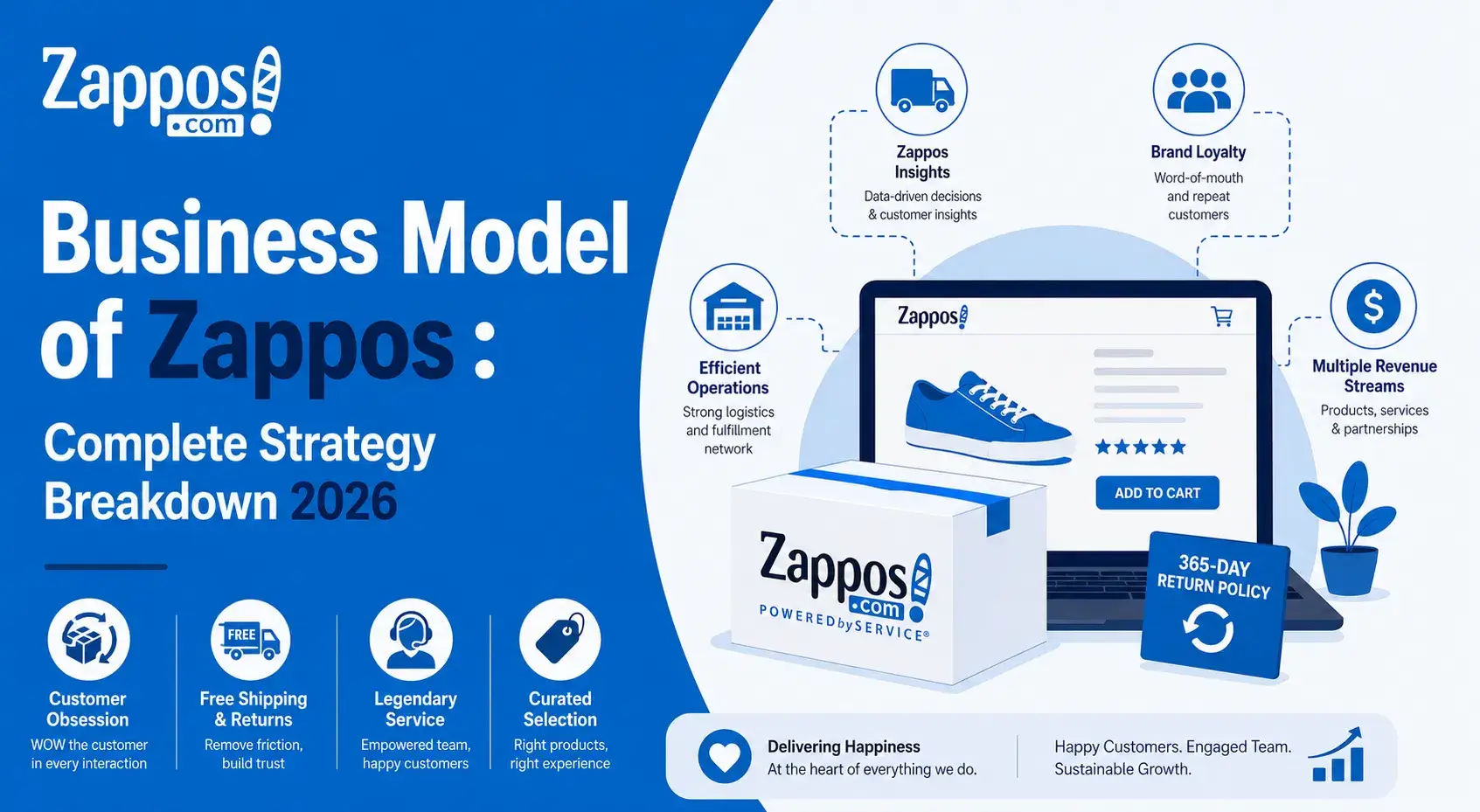
- Free shipping both ways
- 365-day return policy
- 24/7 human customer support
- Zero-pressure buying experience
For Brands & Suppliers
- Reliable demand forecasting
- Strong brand representation
- Predictable wholesale partnerships
For Employees
- Empowered decision-making
- Culture-driven incentives
- Long-term career alignment
Zappos understands that happy employees create happy customers, which in turn drives sustainable revenue.
Key Stakeholders & Their Roles
- Customers: Drive repeat purchases and word-of-mouth growth
- Customer Service Teams: Act as brand ambassadors, not call-center agents
- Warehouse & Logistics Teams: Enable speed, accuracy, and reliability
- Suppliers & Brands: Provide assortment depth and product consistency
- Amazon (Parent Company): Provides infrastructure leverage without cultural interference
Why the Zappos Model Still Works in 2026
- Consumers value frictionless returns more than discounts
- Brand trust reduces paid marketing dependency
- Loyalty-driven economics outperform ad-driven growth
- Experience-led models create defensible differentiation
Zappos shows that customer experience is not a cost center—it’s the business model itself.
Read more : What is Zappos and How Does It Work?
Target Market & Customer Segmentation Strategy
Zappos didn’t scale by trying to sell to everyone.
It scaled by becoming the default online store for people who value reliability, comfort, and trust—especially in categories where fit and returns matter most.
In ecommerce, customer segmentation is not just “who buys.”
It’s who returns, who repeats, and who tells others. Zappos designed its entire model around those behaviors.
Primary Customer Segments (Core Buyers)
1) Convenience-First Online Shoppers
These customers don’t want to spend time comparing 10 websites.
Behavior traits
- Want fast delivery + easy returns
- Prefer trusted platforms over unknown brands
- Repeat purchases based on past satisfaction
Why they stay
- Zappos removes buying anxiety through free returns + support
2) Footwear-Heavy Households
Families buying shoes regularly (kids, working professionals, parents).
Behavior traits
- High purchase frequency across the year
- Multiple sizes/styles per order (trial buying)
- Value durability and known brands
Why they stay
- Zappos becomes a “reorder platform” for household needs
3) Comfort & Fit-Sensitive Buyers
People who struggle with sizing, foot pain, or need specific footwear.
Behavior traits
- Higher return rates (testing multiple options)
- Strong loyalty once they find the right brand/fit
- Prefer guidance and human support
Why they stay
- Zappos reduces risk and supports decision-making
Secondary Customer Segments (Growth Layers)
4) Fashion + Lifestyle Shoppers
Not only shoes—also apparel, accessories, bags, seasonal products.
Behavior traits
- Influenced by trends and styling
- Respond to curation and category expansion
- Moderate repeat rates
Why they stay
- Zappos becomes a trusted “shopping destination,” not a one-time shoe store
5) Gift Buyers
Customers shopping for birthdays, holidays, or special occasions.
Behavior traits
- Need reliability and delivery assurance
- Often purchase without perfect size certainty
- Return-friendly policies reduce fear of gifting wrong items
Customer Journey: Discovery → Conversion → Retention
1) Discovery
How users find Zappos:
- Organic search (“best running shoes,” “Nike size guide,” etc.)
- Word-of-mouth referrals (experience-driven sharing)
- Brand recall from consistent service reputation
2) Conversion
Zappos improves conversion by reducing friction:
- Clear product pages + reviews
- Fast checkout experience
- Strong trust triggers (returns, support, shipping clarity)
3) Retention
Retention is where Zappos wins long-term:
- Easy reordering behavior
- Loyalty through emotional satisfaction (service)
- Strong post-purchase trust loop
Market Positioning & Competitive Edge (2026 View)
Zappos positions itself as:
- Premium service, not premium pricing
- Trust-first ecommerce
- “The easiest place to buy shoes online”
Differentiation strategy
- Competitors compete on discounts and ads
- Zappos competes on experience + loyalty + culture
That’s a strong advantage in 2026 because consumers are exhausted by:
- Fake reviews
- Poor return experiences
- Delayed delivery and hidden policies
Zappos reduces uncertainty, and in ecommerce, certainty sells.
Revenue Streams and Monetization Design
Now that we know who Zappos serves, the next question is simple:
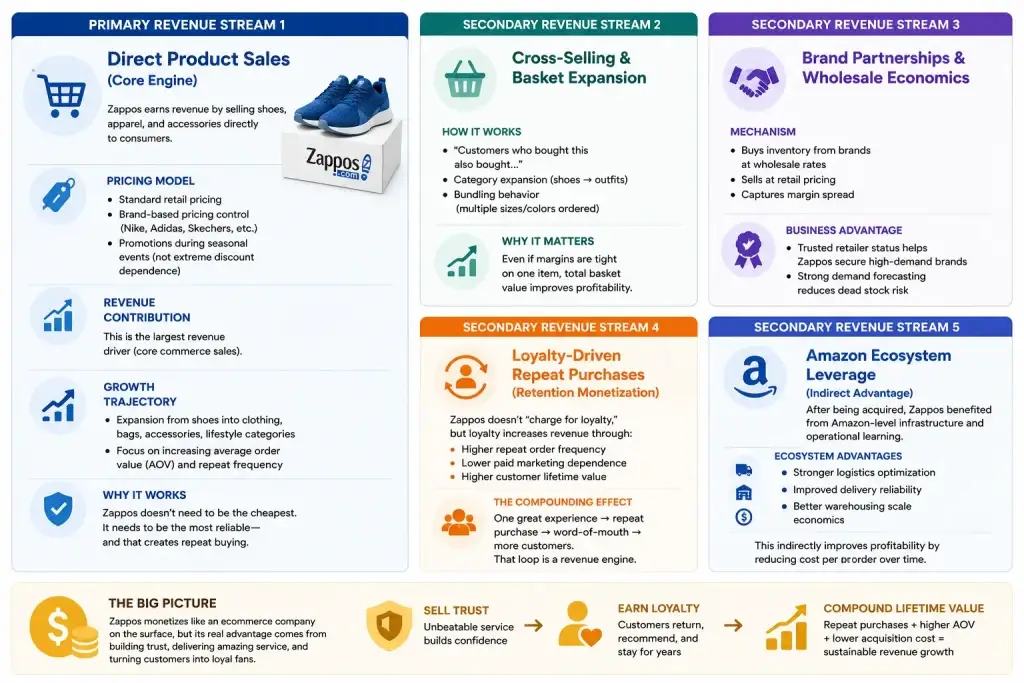
How does Zappos actually make money — and why is its monetization model so stable?
Zappos monetizes like a classic ecommerce company (selling products), but the real strategy is deeper.
It uses service and returns to increase conversion and retention, which then boosts repeat purchases and lowers acquisition costs over time.
So the revenue model is not just “sell shoes.”
It’s sell trust → earn loyalty → compound lifetime value.
Primary Revenue Stream 1: Direct Product Sales (Core Engine)
Mechanism
Zappos earns revenue by selling shoes, apparel, and accessories directly to consumers.
Pricing Model
- Standard retail pricing (similar to offline stores)
- Brand-based pricing control (Nike, Adidas, Skechers, etc.)
- Promotions during seasonal events (but not extreme discount dependence)
Revenue Contribution
- This is the largest revenue driver (core commerce sales)
Growth Trajectory
- Expansion from shoes into:
- clothing
- bags
- accessories
- lifestyle categories
- clothing
- Focus on increasing average order value (AOV) and repeat frequency
Why it works
Zappos doesn’t need to be the cheapest.
It needs to be the most reliable—and that creates repeat buying.
Secondary Revenue Stream 2: Cross-Selling & Basket Expansion
Zappos increases revenue per customer through product mix.
How it works
- “Customers who bought this also bought…”
- Category expansion (shoes → outfits)
- Bundling behavior (multiple sizes/colors ordered)
Why it matters
Even if margins are tight on one item, total basket value improves profitability.
Secondary Revenue Stream 3: Brand Partnerships & Wholesale Economics
Even though Zappos sells directly to customers, it operates with strong supplier economics.
Mechanism
- Buys inventory from brands at wholesale rates
- Sells at retail pricing
- Captures margin spread
Business advantage
- Trusted retailer status helps Zappos secure high-demand brands
- Strong demand forecasting reduces dead stock risk
Secondary Revenue Stream 4: Loyalty-Driven Repeat Purchases (Retention Monetization)
This is the hidden monetization layer most founders miss.
Zappos doesn’t “charge for loyalty,” but loyalty increases revenue through:
- Higher repeat order frequency
- Lower paid marketing dependence
- Higher customer lifetime value
The compounding effect
- One great experience → repeat purchase → word-of-mouth → more customers
That loop is a revenue engine.
Secondary Revenue Stream 5: Amazon Ecosystem Leverage (Indirect Advantage)
After being acquired, Zappos benefited from Amazon-level infrastructure and operational learning.
While Zappos still runs as a distinct brand, the ecosystem advantage shows up in:
- stronger logistics optimization
- improved delivery reliability
- better warehousing scale economics
This indirectly improves profitability by reducing cost per order over time.
Read more : Zappos Revenue Model: How Zappos Makes Money in 2026
Operational Model & Key Activities
If Zappos’ business model is built on customer trust, then its operations are the machine that keeps that trust running daily.
Most ecommerce companies compete on:
- ads
- discounts
- influencer campaigns
Zappos competes on something harder to copy:
Operational excellence + service consistency at scale.
That means Zappos isn’t just a retailer.
It’s a logistics + customer experience company disguised as an ecommerce store.
Core Operations (What Runs Every Day)
1) Platform Management
Zappos must keep the shopping experience fast, clean, and reliable.
Key activities:
- product catalog management (thousands of SKUs)
- search, filters, and personalization
- mobile-first browsing optimization
- checkout and payment stability
2) Inventory Planning & Assortment Control
Zappos succeeds because it maintains high availability across popular sizes and brands.
Key activities:
- demand forecasting by region + season
- size-level inventory planning (critical for footwear)
- vendor coordination and replenishment cycles
- controlling out-of-stock rates (lost revenue risk)
3) Fulfillment & Logistics Execution
This is where Zappos protects its promise.
Key activities:
- warehouse operations (picking, packing, dispatch)
- delivery speed optimization
- packaging accuracy (wrong size = broken trust)
- reverse logistics (returns processing)
Zappos treats returns as part of the product experience, not as a problem to avoid.
4) Customer Service as a Growth Function
Zappos customer support is famous because it is designed differently.
Key principles:
- support teams are empowered to solve issues without scripts
- customer satisfaction is prioritized over “average handling time”
- service is treated as brand marketing
In most ecommerce companies, customer support is a cost center.
In Zappos, it is a loyalty-building engine.
5) Marketing & Retention Systems
Zappos doesn’t rely only on acquisition. It invests in retention loops.
Key activities:
- email personalization and product recommendations
- seasonal campaigns (without aggressive discounting)
- loyalty triggers through consistent experience
- brand storytelling through culture
Resource Allocation Strategy (How the Business Invests)
Zappos is operationally heavy, meaning it must allocate resources intelligently.
Typical strategic focus areas:
- Technology investment: ecommerce performance + inventory systems
- Logistics investment: warehouse efficiency + delivery consistency
- Customer experience investment: training + service empowerment
- Brand investment: culture-driven marketing rather than pure ads
Even when ecommerce brands cut costs in downturns, Zappos protects:
- service quality
- delivery reliability
- return experience
Because those are the foundations of repeat revenue.
What Entrepreneurs Should Notice (The Real Operational Lesson)
Zappos proves a powerful truth:
Your operations are your product.
If your platform promises convenience but delivers friction, the business model collapses.
That’s why at Miracuves, when founders come to build ecommerce or marketplace apps, we don’t just focus on UI screens—we help architect:
- the order flow
- return workflows
- customer support systems
inventory + fulfillment integrations
so the experience stays consistent as you scale.
Strategic Partnerships & Ecosystem Development
Zappos may look like a simple ecommerce brand from the outside, but behind the scenes it operates like an ecosystem.
Because to deliver a world-class customer experience consistently, Zappos must coordinate multiple moving parts:
- product supply
- inventory planning
- payments
- shipping carriers
- technology platforms
- customer service operations
In other words, Zappos doesn’t scale alone.
It scales through smart partnerships that protect experience quality.
Zappos’ Partnership Philosophy (What They Optimize For)
Many ecommerce companies choose partners based on the lowest cost.
Zappos chooses partners based on:
- reliability
- service consistency
- customer satisfaction impact
- long-term scalability
Because one weak partner can break the entire trust loop.
Key Partnership Types in the Zappos Ecosystem
1) Brand & Supplier Partnerships (Assortment Power)
Zappos works closely with major brands to ensure:
- consistent product availability
- access to high-demand SKUs
- strong seasonal assortment planning
Why this partnership matters
- Brands want controlled representation online
- Zappos offers trust, premium positioning, and reliable sales volume
This makes Zappos a preferred retail partner for many well-known labels.
2) Technology & Platform Partners
Even though Zappos is part of Amazon, ecommerce still requires strong tech alliances and integrations.
Partnership areas include:
- ecommerce analytics tools
- inventory forecasting systems
- personalization and recommendation engines
- fraud prevention and security systems
- customer experience and CRM tools
Why it matters
Technology partners help Zappos improve conversion and retention without constantly rebuilding everything internally.
3) Payment & Fintech Partnerships
Payments must be smooth and secure, or customers abandon carts instantly.
Key partnership roles:
- payment gateways and processors
- fraud monitoring and chargeback protection
- checkout optimization solutions
Strategic benefit
- better payment success rates = higher revenue
- strong fraud control = lower losses
4) Logistics & Shipping Alliances
Logistics is one of the biggest reasons Zappos wins customer trust.
Key partnerships include:
- last-mile delivery providers
- regional shipping carriers
- reverse logistics (returns pickup and processing)
Why it matters
Fast delivery builds trust, but fast returns build loyalty.
Zappos treats returns like a core feature of the brand.
5) Regulatory & Expansion Alliances (Indirect Ecosystem Support)
As ecommerce grows, legal and compliance support becomes critical.
Partnership focus areas:
- tax compliance and ecommerce regulations
- consumer protection policies
- regional distribution strategy support
Growth Strategy & Scaling Mechanisms
Zappos didn’t scale like a typical ecommerce company.
Most brands grow by spending more on ads.
Zappos grew by building a system where customers came back on their own—and brought others with them.
That’s why Zappos is one of the best examples of retention-led scaling in digital commerce.
Growth Engines (How Zappos Scales)
1) Organic Growth Through Customer Experience
Zappos’ biggest growth engine is not marketing.
It’s customer satisfaction.
When customers receive:
- fast delivery
- easy returns
- human support
- no-hassle problem resolution
They remember the brand and recommend it.
What this creates
- word-of-mouth referrals
- repeat buying behavior
- long-term brand trust
This is powerful because it reduces dependence on paid acquisition over time.
2) Referral Loops & Loyalty Compounding
Zappos’ model creates a natural referral loop:
- Customer buys
- Customer feels safe because returns are easy
- Customer has a positive experience
- Customer tells friends/family
- New customers arrive with higher trust
- Conversion rates improve
That’s a growth loop every founder wants.
3) Assortment Expansion (More Reasons to Buy)
Zappos started with shoes, but scaling required expanding the product universe.
Growth came from:
- increasing brands and SKUs
- adding apparel and accessories
- building a lifestyle shopping identity
Why this works
If a customer trusts you for shoes, they’re more likely to buy:
- jackets
- bags
- sportswear
- seasonal products
This expands lifetime value without needing new customers constantly.
4) Operational Scaling (Logistics as a Growth Lever)
Zappos scaled by mastering operations—because customer experience only works when delivery and returns work.
Scaling activities include:
- warehousing efficiency improvements
- faster order processing systems
- improved return workflows
- inventory planning upgrades
In ecommerce, growth is limited by operations.
Zappos treated operations as its competitive advantage.
5) Brand Identity + Culture-Led Growth
Zappos didn’t build a brand through celebrity ads.
It built a brand through culture.
The company became known for:
- customer happiness
- employee happiness
- service obsession
That brand identity creates long-term trust—which improves conversion rates without constant discounting.
Geographic & Market Expansion Strategy
Zappos didn’t expand like a global marketplace, but it did scale by:
- strengthening logistics reach
- improving delivery speed across regions
- optimizing warehouse distribution
The key was ensuring service quality remained consistent across expansion.
Because Zappos understood:
bad scaling is worse than slow scaling.
Competitive Strategy & Market Defense
Zappos operates in one of the most brutal markets in the world: ecommerce retail.
Here, competitors can copy:
- product listings
- discounts
- delivery promises
- website UI
So the real question is:
Core Competitive Advantages
1) Trust as a Competitive Moat
In ecommerce, customers don’t just buy products.
They buy confidence.
Zappos builds confidence through:
- free shipping both ways
- long return windows
- reliable delivery experience
- strong customer support
Once customers trust Zappos, they stop “shopping around” as much.
That trust becomes a moat.
2) Switching Barriers (Emotional + Habit-Based)
Zappos doesn’t lock users in with subscriptions.
It locks them in with habit and comfort.
Switching costs come from:
- knowing Zappos will solve issues instantly
- confidence in return process
- emotional loyalty from service moments
- saved preferences and repeat purchase behavior
This is a subtle but powerful form of retention.
3) Customer Service as Brand Differentiation
Most brands treat customer support like an expense to reduce.
Zappos treats it like a product feature.
Competitive edge comes from:
- empowered support teams
- no-script, human-first problem solving
- service that creates memorable moments
This creates something competitors struggle to copy:
a reputation that spreads naturally.
4) Operational Reliability (Delivery + Returns)
Zappos defends market share by being consistent.
Consistency beats hype.
Key reliability strengths:
- accurate fulfillment
- smooth reverse logistics
- predictable delivery experience
- fewer “bad surprises”
In 2026, consumers are more impatient than ever.
Reliability is a competitive weapon.
5) Data-Driven Personalization
Even as a retail brand, Zappos benefits from ecommerce data intelligence:
- product recommendations
- sizing behavior insights
- category affinity tracking
- purchase timing and seasonality
This improves:
- conversion rates
- average order value
- customer satisfaction
Market Defense Tactics (How Zappos Handles Threats)
1) Competing Against Discount Wars
When competitors slash prices, Zappos doesn’t always try to win on cost.
Instead, it wins on:
- service certainty
- return safety
- brand trust
This protects profitability and prevents a race to the bottom.
2) Handling New Entrants
New ecommerce brands often compete using:
- influencer marketing
- aggressive ads
- flash sales
Zappos responds by doubling down on what new brands lack:
- long-term credibility
- proven service consistency
- repeat purchase loyalty
New entrants can buy traffic.
Zappos has earned loyalty.
3) Feature Rollouts & Timing Strategy
Zappos doesn’t chase every trend.
It focuses on improvements that reduce friction, such as:
- better product discovery
- improved category navigation
- faster fulfillment workflows
- smoother returns experience
This is defensive innovation—small upgrades that protect the core model.
4) Ecosystem Leverage Through Amazon
Zappos benefits from Amazon-level operational learning and scale advantages.
Even while maintaining brand identity, Zappos can defend itself through:
- supply chain resilience
- logistics efficiencies
- infrastructure strength
This makes it harder for mid-sized competitors to match Zappos reliability.
Competitive Strategy Summary
Zappos stays ahead by owning what matters most in ecommerce:
- trust
- experience
- reliability
- loyalty compounding
And in 2026, those are the strongest defenses in digital commerce.
Lessons for Entrepreneurs & Implementation
If you’re a founder, Zappos is one of the best examples of a business model that proves this:
Zappos didn’t invent ecommerce.
It invented a better way to make customers feel safe buying online—and that emotional safety became a growth engine.
Here are the most important lessons entrepreneurs can take from Zappos and apply to their own platform or ecommerce app.
Key Factors Behind Zappos’ Success
1) Customer Experience Was the Product
Zappos treated customer experience as a feature, not a department.
That includes:
- easy returns
- fast resolution
- friendly human support
- predictable delivery
Founder lesson:
If your app is “easy to use” but the experience after payment is stressful, you won’t retain customers.
2) Retention Beat Acquisition
Zappos understood that scaling is cheaper when customers return on their own.
Instead of endlessly buying traffic, they built:
- repeat purchase behavior
- word-of-mouth loops
- trust-based loyalty
Founder lesson:
A business model is strongest when your users become your marketing.
3) Trust Removed Buying Friction
Footwear has high uncertainty:
- sizing issues
- comfort concerns
- return risk
Zappos removed that fear with policies that felt “too good to be true,” such as:
- free shipping
- free returns
- long return window
Founder lesson:
The fastest way to increase conversion is to remove risk, not add persuasion.
4) Operations Created the Competitive Moat
Zappos’ model worked because its backend supported its promise.
That means:
- strong inventory planning
- reliable fulfillment
- efficient returns processing
- customer service empowerment
Founder lesson:
Your operations are your growth limit. Build them early.
5) Culture Scaled the Brand
Zappos didn’t just hire staff. It hired believers.
That created:
- consistent service quality
- strong internal ownership
- brand reputation through people
Implementation & Investment Priorities
Phase 1 : Foundation
- Build a clean product catalog + search
- Set up checkout and payment flow
- Design return/refund policy logic
- Define customer support workflow
Phase 2 : Trust & Retention Layer
- Add order tracking + notifications
- Add customer support chat/call system
- Launch referral and repeat purchase triggers
- Improve product pages with reviews and sizing clarity
Phase 3 : Scale Systems
- Optimize fulfillment speed
- Improve reverse logistics for returns
- Add personalization and recommendations
- Expand categories and brand partnerships
Ready to implement Zappos’ proven business model for your market? Miracuves builds scalable platforms with tested business models and growth mechanisms. We’ve helped entrepreneurs launch profitable apps. Get your free business model consultation today.
Miracuves Zappos-Like Ecommerce Platform Solution Cost and Tech Stack
Miracuves Pricing for a Zappos-Like Ecommerce Platform developed using JavaScript architecture is available on request. Final pricing depends on ecommerce workflows, inventory management systems, customer experience features, payment integrations, scalability requirements, AI-powered recommendation systems, and deployment scope. Estimated delivery timeline: 30 to 90 days.
Get a fully developed, custom ecommerce platform modeled around Zappos-style online retail and customer-first shopping experiences. Built on a modern JavaScript foundation, this solution can be customized for ecommerce startups, fashion retailers, footwear brands, lifestyle marketplaces, D2C businesses, multi-category online stores, and enterprise retail operations.
- Core Workflows: Product catalog management, customer accounts, shopping cart systems, order processing, inventory tracking, payment handling, returns management, customer support workflows, personalized recommendations, and loyalty systems.
- Built-in Revenue Logic: Product sales, subscription programs, premium memberships, featured brand placements, advertising systems, marketplace commissions, loyalty-driven retention models, and white-label ecommerce monetization.
- Management Hub: Admin dashboard, inventory management, customer analytics, order monitoring, payment reporting, promotion management, product moderation, customer support controls, and ecommerce analytics.
- AI-Ready Architecture: Prepared for AI product recommendations, smart search optimization, customer behavior analytics, personalized shopping experiences, automated inventory insights, scalable ecommerce infrastructure, and enterprise-grade scalability.
Why Does a Zappos-Like Platform Require JavaScript Architecture?
A modern ecommerce platform requires more than a basic online store. It handles customer engagement, inventory synchronization, payment processing, product discovery, loyalty systems, recommendation engines, support workflows, and scalable ecommerce operations. A modern JavaScript architecture helps manage these highly interactive ecommerce experiences smoothly across customers, admins, support teams, and retail systems.
We recommend JavaScript architecture for this type of platform because:
- Built for Interactive Ecommerce Experiences: JavaScript supports real-time product browsing, smooth checkout systems, instant inventory updates, live order tracking, and dynamic shopping experiences.
- Advanced Frontend Experience: React.js or similar JavaScript frameworks can power modern storefronts, recommendation panels, customer dashboards, analytics systems, loyalty programs, and admin controls.
- Scalable Backend Logic: JavaScript-based backend systems can efficiently manage transactions, inventory operations, customer sessions, analytics workflows, API traffic, and high-volume ecommerce requests.
- Flexible Integration Layer: The platform can connect with payment gateways, logistics providers, CRM systems, analytics platforms, AI recommendation tools, cloud infrastructure, customer support systems, and third-party ecommerce services.
You get a scalable ecommerce platform designed for customer engagement, recurring revenue growth, ecommerce automation, and long-term retail scalability.
Tech Stack
We preferably will be using JavaScript for building the entire solution (Node.js/Nest.js/Next.js for the web backend + frontend) and Flutter / React Native for mobile apps, considering scalability, ecommerce workflow efficiency, customer experience optimization, and the advantage of one codebase serving multiple platforms.
Note: Final pricing depends on selected ecommerce modules, AI capabilities, scalability goals, payment systems, infrastructure requirements, security layers, and custom feature development.
Conclusion :
Zappos is proof that the strongest business models don’t always win by being the biggest, the cheapest, or the loudest. They win by being the most trusted.
In a world where ecommerce brands can copy each other’s products overnight, Zappos built something far harder to replicate:
a customer experience that feels safe, human, and consistent—every single time.
The bigger lesson for entrepreneurs is this:
Innovation gets attention, but execution earns loyalty.
And in 2026 and beyond, platform economies will be shaped by companies that don’t just deliver products or services—they deliver confidence, convenience, and long-term customer relationships at scale.
FAQs
What type of business model does Zappos use?
Zappos follows a D2C ecommerce business model where it sells products directly to customers. It adds an experience-led layer through fast delivery, easy returns, and strong customer service.
How does Zappos’ model create value?
Zappos creates value by removing customer risk in online shopping. Free shipping, free returns, and quick support build trust and make customers comfortable buying again.
What are Zappos’ key success factors?
Its biggest strengths are customer-first service, operational excellence, and retention-driven growth. Zappos focuses on repeat customers instead of depending only on ads and discounts.
How scalable is the Zappos business model?
It’s scalable because it builds loyalty and repeat purchases over time. But scaling needs strong inventory planning, logistics, and return management to stay profitable.
What are the biggest challenges in Zappos’ model?
The main challenges are high return costs, shipping expenses, and inventory risk. Maintaining the same service quality while growing bigger is also difficult.
How can entrepreneurs adapt it to their region?
Founders can copy the trust model by offering easy returns, fast local delivery, and WhatsApp support. Local payment options like UPI/COD also improve conversion in many regions.
What are alternatives to this model?
Alternatives include marketplaces (commission-based), dropshipping (low inventory risk), and subscription commerce. Each model changes how you control quality, delivery, and margins.
How has Zappos evolved over time?
Zappos started with drop-shipping to test demand, then shifted to owning inventory for better control. Over time, it strengthened logistics and service to build long-term customer loyalty.
Related Article :
- Best BigCommerce Clone Scripts 2025: Build a Scalable SaaS Ecommerce Platform
- Best Wish Clone Scripts 2025: Build a High-Profit Social Commerce App
- Best DHgate Clone Scripts 2025: Build a Global B2B Wholesale Marketplace Faster
- What is SHEIN and How Does It Work?
- What is Farfetch and How Does It Work?