



Key Takeaways
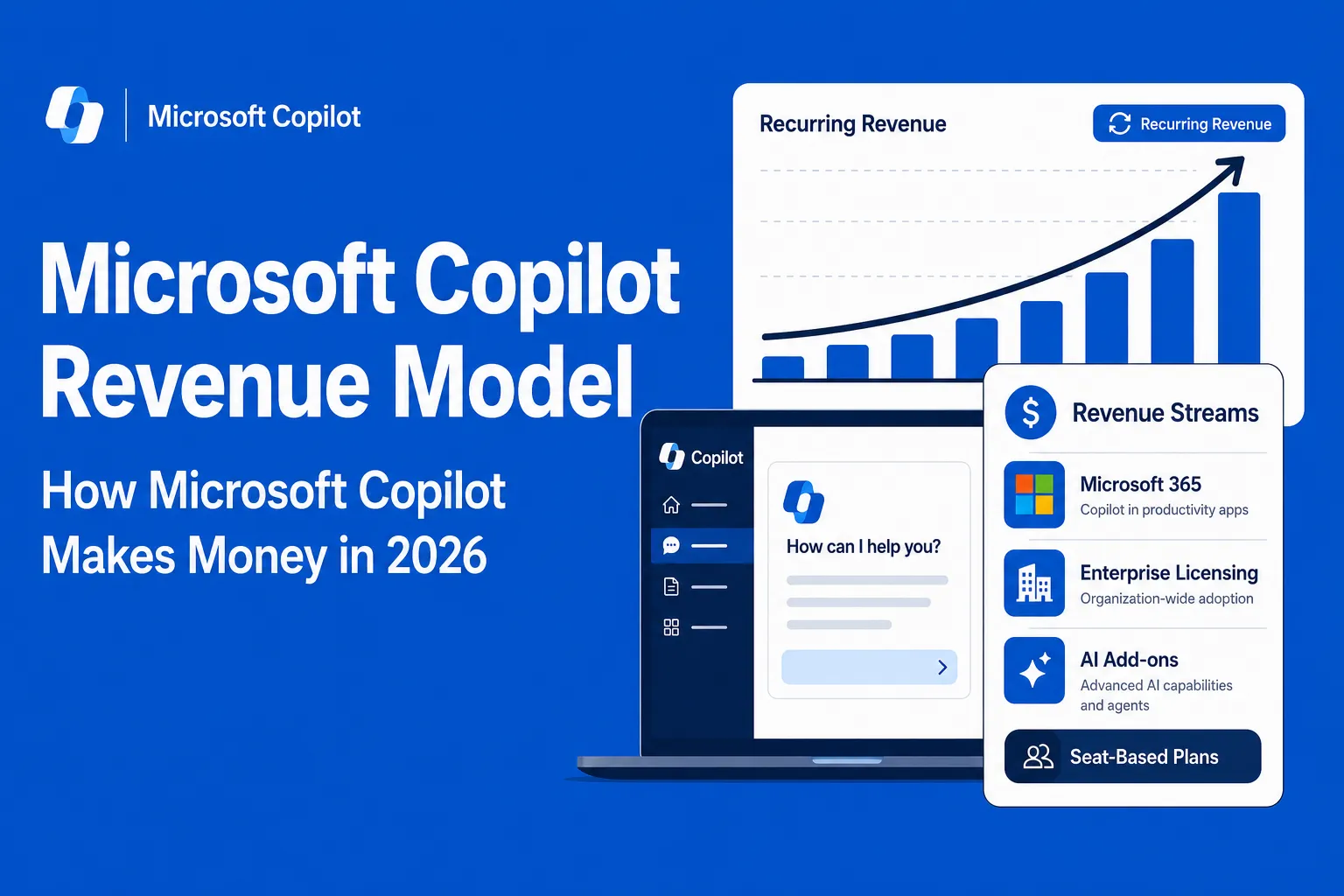
- Microsoft Copilot’s revenue model is built around AI-powered productivity, enterprise subscriptions, Microsoft 365 upgrades, cloud usage, and workflow automation.
- Its main revenue stream comes from paid Copilot plans added on top of Microsoft 365, Windows, GitHub, Dynamics 365, and enterprise cloud products.
- Copilot helps Microsoft increase average revenue per user by turning AI into a premium layer across existing business software.
- The model works because Copilot is deeply integrated into daily work tools like Word, Excel, PowerPoint, Outlook, Teams, GitHub, and business applications.
- For founders, the biggest lesson is clear: AI products monetize better when they become part of repeated workflows, not just standalone chatbot experiences.
Revenue Signals
- Subscription add-ons create predictable recurring revenue because businesses pay monthly or annually for Copilot access across users and departments.
- Enterprise licensing increases revenue through large team deployments, admin controls, security features, compliance support, and organization-wide AI adoption.
- Azure cloud usage benefits from Copilot because AI workloads require compute, storage, model access, integrations, and backend infrastructure.
- GitHub Copilot creates developer-focused revenue by helping engineering teams write code, review logic, improve productivity, and reduce repetitive tasks.
- Copilot also strengthens customer retention because companies become more dependent on Microsoft’s ecosystem for documents, meetings, emails, coding, analytics, and automation.
Real Insights
- Microsoft Copilot is not just an AI assistant; it is a monetization layer built on top of Microsoft’s existing software and cloud ecosystem.
- The strongest part of the model is distribution because Microsoft can sell Copilot directly to millions of existing business users.
- AI becomes more valuable when it is connected with documents, calendars, emails, meetings, code repositories, CRM data, and internal business knowledge.
- Founders can learn from Copilot by building AI tools around workflow depth, product integration, user productivity, and measurable business outcomes.
- The future of Copilot-style revenue will depend on AI agents, enterprise trust, automation depth, cloud consumption, security controls, and productivity-driven pricing.
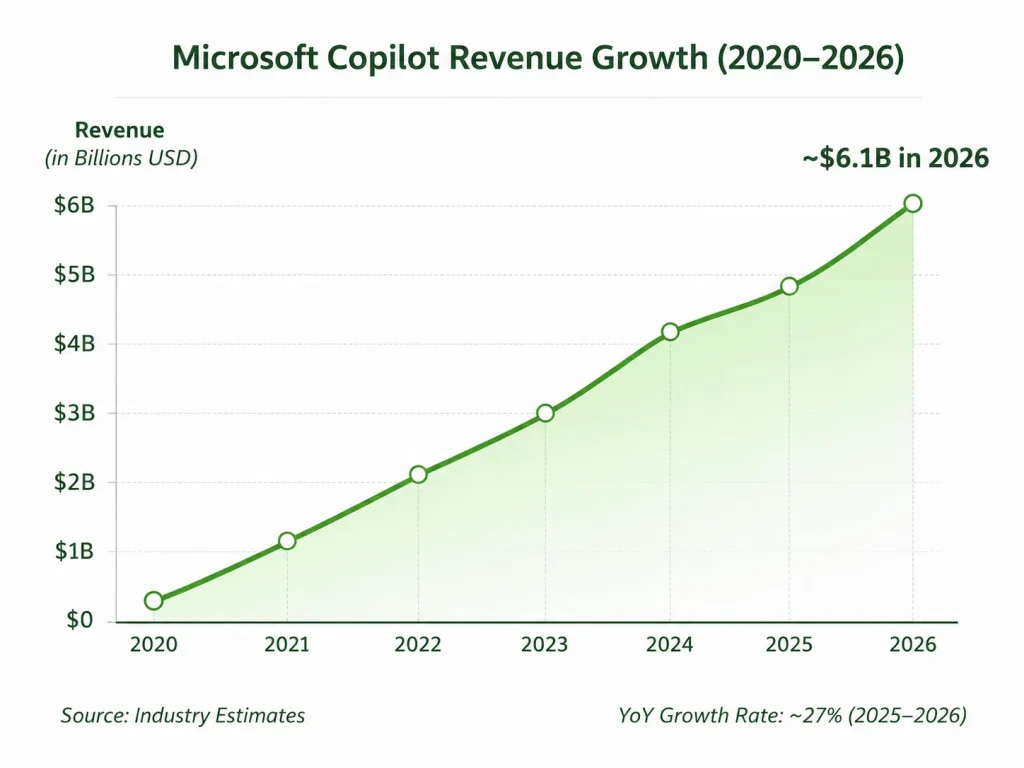
Microsoft Copilot crossed an estimated $4.8 billion in global revenue in 2026, becoming one of the fastest-scaling AI productivity platforms in enterprise history. What began as an AI assistant embedded inside Microsoft 365 evolved into a full commercial layer across Office, Windows, GitHub, and Azure.
For founders, Microsoft Copilot’s rise demonstrates how AI becomes exponentially more valuable when integrated directly into daily workflows. Instead of selling AI as a standalone tool, Microsoft turned productivity, code, and cloud usage into compounding revenue streams.
Understanding this model helps entrepreneurs design platforms where AI is not a feature, but the financial engine driving subscriptions, usage-based billing, and long-term enterprise contracts.
Microsoft Copilot Revenue Overview – The Big Picture
2026 Revenue: ~$4.8B
Valuation Impact: Part of Microsoft’s multi-trillion-dollar ecosystem, with Copilot cited as a major growth driver for cloud and productivity revenue
YoY Growth: ~70% (2024–2026)
Revenue by Region:
- North America: 48%
- Europe: 27%
- Asia-Pacific: 21%
- Rest of World: 4%
Profit Margins: Estimated 30–38% (benefiting from bundled subscriptions and cloud infrastructure leverage)
Competition Benchmark: Competes with Google Gemini, Salesforce Einstein, Notion AI, and standalone enterprise AI copilots
Read More: What Is Microsoft Copilot? A Simple Guide for Work and Productivity
Primary Revenue Streams Deep Dive
Revenue Stream #1 — Microsoft 365 Copilot Subscriptions (40%)
Enterprises pay per user for Copilot inside Word, Excel, Outlook, Teams, and PowerPoint. Pricing averages $30 per user per month, making this the single largest revenue stream in 2026. Large enterprises often deploy tens of thousands of licenses, creating predictable, high-margin recurring revenue.
Revenue Stream #2 — Azure AI Consumption (28%)
Copilot drives backend compute usage on Azure. Every prompt, document generation, or code suggestion increases cloud inference and storage consumption. Enterprises are billed on usage-based cloud pricing, contributing over $1.3B in indirect revenue.
Revenue Stream #3 — GitHub Copilot (18%)
Developers pay $10–$39 per user per month for AI-assisted coding. Adoption across software companies and enterprises made this one of Microsoft’s highest-margin AI products.
Revenue Stream #4 — Copilot Pro & Windows Integration (9%)
Individual and SMB users subscribe to Copilot Pro for premium AI features inside Windows and personal Microsoft accounts.
Revenue Stream #5 — Enterprise AI Customization & Consulting (5%)
Custom copilots, private data integrations, and compliance-driven deployments for regulated industries.
Revenue Streams Percentage Breakdown (2026)
| Revenue Stream | % Share | Annual Revenue (USD) | Pricing Model |
|---|---|---|---|
| Microsoft 365 Copilot Subscriptions | 40% | ~$1.92B | Per-user monthly |
| Azure AI Consumption | 28% | ~$1.34B | Usage-based cloud billing |
| GitHub Copilot | 18% | ~$864M | Monthly subscription |
| Copilot Pro / Windows | 9% | ~$432M | Consumer subscription |
| Enterprise Customization | 5% | ~$240M | Project / contract-based |
The Fee Structure Explained
User-Side Fees
- Copilot Pro (consumer): $20/month
- GitHub Copilot Individual: $10–$39/month
- Microsoft 365 Copilot: $30/user/month
Provider-Side Fees
- Enterprises pay for Azure compute usage
- Organizations pay for data storage and AI workload scaling
Hidden Revenue Layers
- Increased Microsoft 365 retention
- Higher Azure cloud lock-in
- Premium security and compliance add-ons
Regional Pricing Variation
- North America & Europe: Full enterprise pricing
- Emerging Markets: Discounted enterprise bundles and volume pricing
Complete Fee Structure by User Type
| User Type | Access Level | Pricing Model | Annual Cost Range |
|---|---|---|---|
| Consumers | Copilot Pro, Windows AI | Monthly subscription | $240 |
| Developers | GitHub Copilot | Monthly subscription | $120–$468 |
| SMBs | M365 Copilot (5–300 users) | Per-user monthly | $1,800–$108K+ |
| Enterprises | M365 + Azure AI | Subscription + usage | $100K–$5M+ |
How Microsoft Copilot Maximizes Revenue Per User
Microsoft segments users by role: consumers, developers, knowledge workers, and enterprise teams. Each segment starts with a basic Copilot experience and is upsold into higher-value tiers through workflow dependence.
Cross-selling happens naturally inside the Microsoft ecosystem — Teams drives Microsoft 365 licenses, which drive Copilot seats, which increase Azure usage. Dynamic pricing is applied through volume-based enterprise agreements and cloud consumption tiers.
Retention monetization is driven by data lock-in and productivity dependency. In 2026, enterprise Copilot users showed 4–6x higher lifetime value (LTV) compared to standard Microsoft 365 users without AI.
Psychological pricing plays a role by positioning Copilot as a “productivity multiplier” rather than a software cost, making $30 per user per month feel small relative to employee output gains.
Cost Structure & Profit Margins
Infrastructure Cost
AI inference and cloud compute represent ~35% of direct costs, largely absorbed by Azure’s scale efficiencies.
CAC & Marketing
Enterprise sales cycles and channel partnerships average $8,000–$25,000 per large client.
Operations
Compliance, security, and enterprise support account for ~15% of operating expenses.
R&D
Model development, product integration, and AI safety research consume ~20% of revenue reinvestment.
Unit Economics
Each enterprise Copilot user becomes profitable within 2–3 months due to high-margin subscription pricing.
Margin Optimization
Bundling Copilot with Microsoft 365 reduces churn and increases overall contract value.
Profitability Path
Margins improve as AI workloads migrate to long-term Azure enterprise contracts.
Miracuves Microsoft Copilot-Like Platform Solution Cost and Tech Stack
Miracuves Pricing for a Microsoft Copilot-Like AI Productivity and Automation Platform developed using JavaScript architecture is available on request. Final pricing depends on AI assistant modules, enterprise integrations, document workflows, automation features, subscription logic, security requirements, scalability needs, and deployment scope. Estimated delivery timeline: 30 to 90 days.
Get a fully developed, custom AI productivity platform modeled around Microsoft Copilot-style workflow automation. Built on a modern JavaScript foundation, this solution can be customized for SaaS founders, enterprises, internal teams, agencies, productivity startups, CRM platforms, HR tools, project management products, and business automation companies.
- Core Workflows: AI chat assistant, document drafting, email generation, meeting summaries, task automation, file interaction, knowledge search, workflow suggestions, team collaboration, and productivity-based AI actions.
- Built-in Revenue Logic: Subscription plans, per-user pricing, enterprise licensing, team plans, usage-based AI credits, premium automation modules, API access, workflow add-ons, and white-label SaaS monetization.
- Management Hub: Admin dashboard, user management, role-based access control, workspace management, prompt logs, AI usage tracking, subscription control, billing records, integration monitoring, and analytics.
- AI Productivity-Ready Architecture: Prepared for LLM integration, document intelligence, enterprise data workflows, automation logic, secure user permissions, third-party app connections, scalable AI requests, and long-term SaaS growth.
Why Does a Microsoft Copilot-Like Platform Require JavaScript Architecture?
A Microsoft Copilot-like platform needs more than a simple AI chatbot. It handles user prompts, business documents, emails, files, workspace data, automation workflows, team permissions, AI usage limits, billing logic, and enterprise integrations. A modern JavaScript architecture helps manage these interactive productivity workflows smoothly across users, admins, teams, and connected business systems.
We recommend JavaScript architecture for this type of platform because:
- Built for AI Productivity Workflows: JavaScript-based backend systems can manage AI API calls, prompt requests, document processing, task automation, workspace actions, and high-volume user activity.
- Advanced Frontend Experience: React.js or other JavaScript frameworks can power smooth AI chat interfaces, document editors, workspace dashboards, automation panels, team controls, and admin views.
- Scalable Backend Logic: JavaScript architecture supports user permissions, subscription limits, team workspaces, usage tracking, request queues, response history, billing systems, and enterprise-level productivity operations.
- Flexible Integration Layer: The platform can connect with LLM APIs, cloud storage, CRM systems, email tools, calendar tools, project management apps, HR platforms, payment gateways, analytics tools, and enterprise authentication systems.
You get a scalable AI productivity platform designed for workflow automation, team efficiency, recurring revenue, and long-term SaaS business growth.
Note: Final pricing depends on selected AI model/API, productivity modules, workflow automation features, enterprise integrations, security layers, deployment infrastructure, and custom feature development.
Future Revenue Opportunities & Innovations
Microsoft is expanding Copilot into industry-specific copilots for healthcare, legal, finance, and manufacturing. AI agents that automate workflows across CRM, ERP, and development pipelines will unlock new monetization models.
Between 2025–2027, predictive copilots and autonomous task execution will shift pricing from per-user models to value-based pricing tied to business outcomes. Risks include AI regulation, cloud competition, and enterprise data privacy concerns.
For founders, vertical AI copilots that integrate deeply into one industry’s workflows present the biggest opportunity for differentiation and premium pricing.
Lessons for Entrepreneurs & Your Opportunity
What works is embedding AI into daily operations instead of selling it as an add-on. Copilot becomes indispensable, not optional, which drives long-term revenue stability.
What to replicate is ecosystem thinking — every product strengthens the next revenue stream instead of competing for attention.
Market gaps exist in localized and industry-specific copilots for emerging markets and regulated sectors where global platforms move slowly.
Final Thought
Microsoft Copilot’s growth shows how AI becomes most valuable when it disappears into everyday work. Users don’t “use AI” — they write emails, analyze data, and build software faster, while the platform quietly captures recurring revenue.
For entrepreneurs, the real advantage lies in building AI that lives inside workflows, not dashboards. This creates natural upselling paths and long-term customer dependency.
As businesses demand automation over assistance, platforms that deliver measurable productivity gains will define the next era of enterprise AI monetization.
FAQs
1. How much does Microsoft Copilot make per transaction?
It doesn’t charge per transaction; revenue comes from per-user subscriptions and cloud usage tied to AI activity.
2. What’s Microsoft Copilot’s most profitable revenue stream?
Microsoft 365 Copilot subscriptions deliver the highest and most predictable margins.
3. How does Copilot’s pricing compare to competitors?
It’s priced higher than standalone AI tools but delivers deeper enterprise workflow integration.
4. What percentage does Microsoft Copilot take from providers?
There’s no marketplace cut — revenue flows through subscriptions and Azure usage billing.
5. How has Copilot’s revenue model evolved?
It shifted from a feature add-on to a core subscription driver across Microsoft’s ecosystem.
6. Can small platforms use similar models?
Yes, especially by bundling AI into core SaaS workflows instead of selling it separately.
7. What’s the minimum scale for profitability?
Platforms typically reach breakeven after securing 1,000–3,000 paying business users.
8. How to implement similar revenue models?
Start with per-user subscriptions and layer in usage-based AI pricing as adoption grows.
9. What are alternatives to Copilot’s model?
Flat-rate SaaS AI tools, outcome-based pricing, or marketplace-based AI services.