

Key Takeaways
- Niche OTT Streaming Platforms can compete by serving a clearly defined audience with relevant content instead of trying to match the catalogue size of mass-market streaming services.
- A focused content library built around specific languages, genres, communities, interests, or viewing needs can make discovery easier and strengthen perceived platform value.
- Competitive advantage comes from content relevance, audience understanding, differentiated positioning, personalized discovery, pricing, and consistent viewer engagement rather than catalogue volume alone.
Niche Content Strategy Signals
- Operators can focus on regional entertainment, independent films, education, fitness, faith, children’s programming, specialist genres, or other underserved audience segments.
- Curated collections, strong metadata, category pages, personalized recommendations, watchlists, search, and editorial discovery can help a smaller catalogue feel deeper and easier to explore.
- Content licensing, originals, creator partnerships, scheduled releases, exclusivity, and audience feedback should be planned around relevance and retention rather than simply increasing title count.
Growth & Retention Insights
- Operators should track content discovery, search success, completion rates, repeat viewing, subscriber conversion, renewal rates, and engagement by category to understand whether the niche is working.
- Community features, targeted recommendations, new-release alerts, flexible subscriptions, regional personalization, and consistent content drops can increase loyalty without requiring a massive library.
- Miracuves develops customizable niche OTT streaming platforms with content management, subscriptions, recommendations, multilingual discovery, streaming, payments, analytics, engagement tools, and admin controls.
Building a streaming business does not automatically mean building the largest content catalogue possible.
For niche OTT streaming platforms, the opposite strategy can often make more sense.
A viewer interested in regional cinema, specialist sports analysis, professional education, independent documentaries, fitness instruction, children’s learning, faith-based programming, creator-led education, or another focused category does not necessarily need thousands of unrelated titles.
They need enough relevant content to make the platform worth returning to.
That distinction changes the streaming strategy.
Instead of asking:
“How many titles can we add?”
a niche OTT founder should ask:
“How consistently can we satisfy one audience’s reason for watching?”
A smaller catalogue with clear positioning, strong curation, predictable releases, useful discovery and genuine audience relevance can create a much stronger product identity than a huge library filled with content the target viewer rarely wants.
Why a Massive Content Library Is Not the Only Way to Compete
Large catalogues serve a particular purpose.
They try to give broad audiences enough variety that different users, households, age groups and viewing moods can all find something to watch.
A niche streaming product solves a different problem.
It is not trying to satisfy every possible entertainment need. It is trying to become highly useful to a particular group of viewers.
That changes the definition of catalogue quality.
For a specialist audience, 300 highly relevant titles may create more perceived value than 10,000 titles spread across categories they rarely watch.
The goal is therefore not necessarily content abundance.
It is content concentration.
When a viewer opens the service, a high percentage of what they see should feel relevant to the reason they subscribed.
That is a much more useful measure than total catalogue size.
A Narrow Audience Makes Content Decisions Easier
The broader the audience, the more content expectations multiply.
A general entertainment audience may expect drama, comedy, action, children’s programming, documentaries, multiple languages, new releases, older titles, family entertainment and more.
A specialist audience creates a narrower decision space.
Imagine a platform built specifically around:
- independent regional filmmaking
- advanced sports coaching
- specialist professional education
- documentary journalism
- children’s language learning
- fitness instruction
- cultural archives
- expert-led business education
The content team no longer needs to ask what “everyone” wants.
It can ask what this audience wants.
That improves acquisition decisions because every potential title can be evaluated against the same audience promise.
If the content does not strengthen that promise, there may be little reason to acquire it.
Content Relevance Can Matter More Than Content Volume
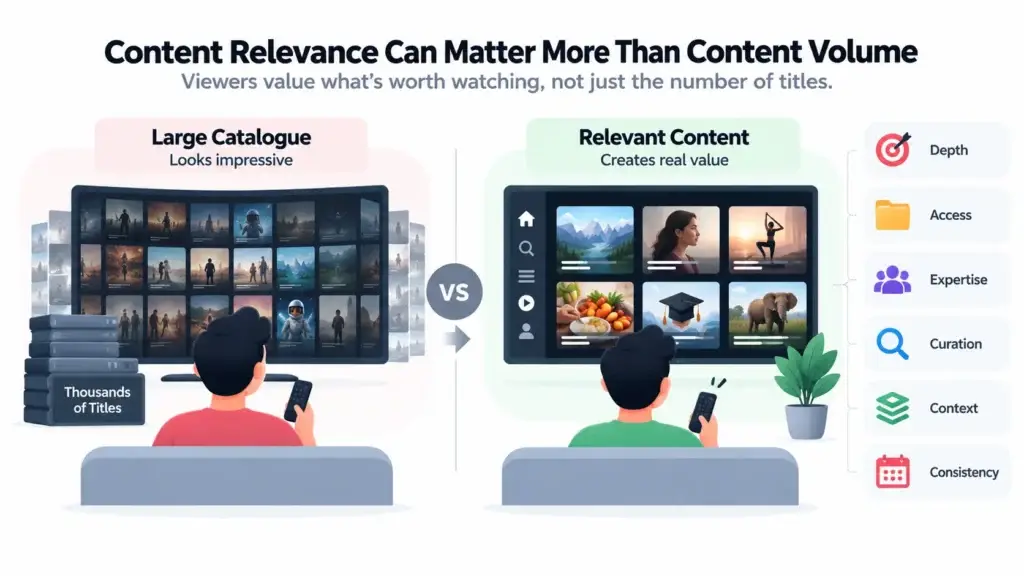
A large catalogue looks impressive as a number.
But subscribers do not watch catalogue numbers.
They watch individual titles.
That means an OTT platform creates value when viewers regularly encounter something worth watching—not merely when the backend contains thousands of assets.
The same principle also affects how viewers judge subscription value. This guide to premium vs value OTT positioning explains why relevance, viewing frequency, discovery, and convenience can matter more than price alone.
For a niche service, content relevance can come from:
Depth: covering one subject better than general platforms.
Access: giving viewers content that is otherwise difficult to find.
Expertise: involving respected educators, creators, coaches, filmmakers or specialists.
Curation: helping users avoid searching through irrelevant material.
Context: organizing videos into collections, series, pathways or themes that make sense to the audience.
Consistency: releasing enough new material to keep the relationship active.
A focused content strategy therefore changes the competitive question.
Instead of asking whether the platform has more titles than broad entertainment services, the viewer asks:
“Is this the best place for the content I specifically care about?”
That is a much more achievable position for a specialist streaming brand.
Smaller Catalogues Can Improve Content Discovery
A large content library creates another challenge: discovery.
Every additional title must be categorized, tagged, described, searched, surfaced and recommended appropriately.
If the discovery experience is weak, catalogue size can actually create more friction.
Viewers scroll through rows without understanding what to watch next.
A focused catalogue gives founders an opportunity to make discovery more intentional.
For example, content can be organized around:
- beginner versus advanced
- regional language
- topic
- creator
- genre
- programme series
- certification path
- live versus recorded
- new releases
- editor’s selections
- member favourites
- seasonal collections
The objective is not to make the homepage look full.
It is to reduce the time between opening the platform and finding something relevant.
Founders who want to go deeper into this layer can explore Miracuves’ video streaming content discovery guide, which covers how rails, genres, search and recommendation logic shape the viewing journey.
Niche OTT Platforms Can Compete Through Content Depth
A focused streaming platform does not need to be shallow simply because its catalogue is smaller.
In fact, depth can become the differentiation.
Consider a specialist training platform.
Instead of purchasing hundreds of unrelated video courses, it could build a deeper content journey around one professional discipline:
introductory lessons → advanced sessions → expert interviews → workshops → case breakdowns → live events → certification content.
A regional-film platform could similarly combine:
films → filmmaker interviews → festival archives → documentaries → commentary → behind-the-scenes material → retrospectives.
The catalogue remains focused while the subscriber experience becomes deeper.
That is the difference between a small library and a thin library.
A small library can be strategically strong.
A thin library fails because the audience quickly runs out of reasons to return.
Content Density Is a Better Question Than Catalogue Size
Founders often count how many videos they can launch with.
A stronger question is:
What percentage of the catalogue is genuinely relevant to the target subscriber?
Think of this as content density.
A platform can have thousands of titles but low relevance for any one audience.
Another can have a few hundred carefully selected titles and high relevance.
The second product may be easier to explain, easier to market and easier for subscribers to navigate.
| Decision Area | Massive General Library | Focused Niche Library |
|---|---|---|
| Audience | Broad and varied | Clearly defined |
| Content Goal | Offer variety across many interests | Deliver depth around a specific interest |
| Acquisition | Requires many categories and licensing decisions | Can prioritize only content that strengthens the niche |
| Discovery | More titles require stronger recommendation systems | Focused taxonomy can make relevant content easier to find |
| Positioning | Needs a broad entertainment promise | Can communicate a clear audience-specific promise |
| Marketing | Multiple audience segments may need different campaigns | Messaging can focus on one community or need |
| Retention Risk | Viewers may struggle to see why the service is unique | Viewers may leave if the niche library becomes stale |
| Expansion Logic | Continuous breadth | Add adjacent content only after demand becomes clear |
Content Exclusivity Does Not Always Mean Expensive Originals
Niche OTT founders sometimes assume differentiation requires producing large volumes of original content.
That is only one option.
A catalogue can become difficult to replace through other forms of exclusivity.
These may include:
- specialist creator partnerships
- limited distribution rights
- expert interviews
- event recordings
- local productions
- archived material
- premium workshops
- community-generated programming
- behind-the-scenes access
- early releases
- curated collections unavailable elsewhere
The key is not simply whether a title is technically exclusive.
The stronger question is whether losing access would matter to the subscriber.
If a viewer can easily replace the entire experience elsewhere, the niche positioning is weak.
If the content combination, curation or expertise is difficult to reproduce, the service becomes more defensible.
A Predictable Release Rhythm Can Matter More Than Constant Volume
A niche streaming service does not need new content every hour.
It does need to set subscriber expectations.
One audience may respond well to several releases each week.
Another may prefer one high-value expert session every Friday.
A specialist documentary platform may work around monthly premieres.
A training service may release structured modules in learning sequences.
What matters is predictability.
Viewers should understand why they should return.
Without a release rhythm, even a good catalogue can begin to feel static.
This is where niche OTT founders need to think beyond the initial library.
The launch catalogue creates the first reason to subscribe.
The publishing calendar creates the reason to remain subscribed.
Strong Curation Can Become Part of the Product
General streaming platforms often compete through abundance.
Niche platforms can compete through judgement.
Good curation tells the viewer:
“You do not need to search through everything. We already understand what matters in this category.”
That curation can appear through:
- editor picks
- learning pathways
- seasonal collections
- expert recommendations
- creator spotlights
- themed libraries
- watch-next sequences
- beginner collections
- advanced collections
- frequently updated topical sections
Curation reduces discovery friction and strengthens brand identity at the same time.
A viewer begins trusting not only the individual videos, but also the platform’s ability to select what is worth watching.
Audience Identity Can Create Stronger Retention Than Library Size
The strongest niche platforms often represent more than a video catalogue.
They represent an audience identity.
A filmmaker may want to belong to an independent-cinema community.
A professional may value a streaming library built specifically around their discipline.
A language community may value a platform that consistently surfaces culturally relevant programming.
A sports enthusiast may return because the platform provides specialist analysis unavailable in general entertainment libraries.
When the content reinforces identity, the subscriber relationship becomes more meaningful.
That can also improve acquisition.
Marketing becomes more precise because the platform can communicate exactly who it serves and why.
Instead of:
“Thousands of videos for everyone.”
the positioning becomes:
“The streaming library built specifically for this interest.”
The second message is narrower, but much clearer.
Niche Platforms Still Need Enough Content to Prevent Exhaustion
A smaller library is not automatically a competitive advantage.
The catalogue must still be deep enough for the audience.
A founder can go too far in the opposite direction and launch with so little content that subscribers finish the relevant material immediately.
This creates catalogue exhaustion.
The right amount of content depends on:
- average video length
- viewing frequency
- release frequency
- audience type
- subscription price
- whether content is evergreen
- whether content is sequential
- repeat-watch potential
- live programming
- community or expert access
There is therefore no universal number of titles that defines a viable niche OTT catalogue.
The right question is:
“Can the current library support the viewing behaviour and subscription promise we are selling?”
Measure Content Performance Before Expanding the Catalogue
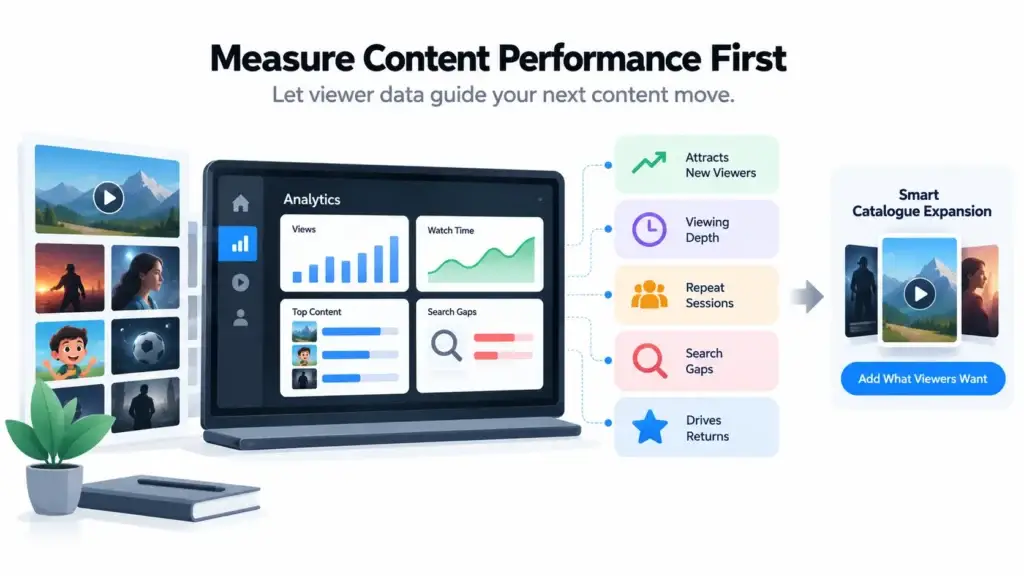
Catalogue growth should be informed by viewer behaviour.
Before acquiring an adjacent category, founders should understand what is already happening.
Useful questions include:
Which titles attract new viewers?
Which collections generate the most viewing depth?
Where do viewers stop?
Which creators drive repeat sessions?
Which searches produce no relevant results?
Which categories are frequently explored but poorly supplied?
Which titles cause subscribers to return?
Which content rarely gets watched?
These signals are more useful than simply deciding to “add more content.”
They tell founders where demand actually exists.
For teams planning product and operational requirements around these behaviours, Miracuves’ OTT feature planning guide explains how discovery, analytics, playback, retention and platform operations should connect to audience strategy.
Expand Sideways Only When the Core Niche Is Working
Niche does not have to mean small forever.
It means focused at the beginning.
Once a platform has a stable audience, founders can expand into adjacent categories.
A regional cinema service might add documentaries and filmmaker interviews.
A fitness platform might add nutrition education.
A professional training library might introduce adjacent skills.
A children’s language platform might expand into stories, songs and interactive learning.
The important principle is sequencing.
Core audience first. Adjacent demand second. Broad expansion later.
This protects the original positioning while allowing the catalogue to grow logically.
Expanding too early can weaken the very relevance that helped the service stand out.
The Business Model Should Follow the Content Relationship
Different niches create different willingness-to-pay patterns.
A professional audience may pay for expertise.
An entertainment audience may value frequent releases.
A regional audience may value access to hard-to-find programming.
A creator-driven audience may value closeness, exclusivity and early access.
That means pricing and access should follow what the content relationship is actually worth.
The goal is not to imitate a generic streaming subscription.
It is to match the revenue model to the reason subscribers value the catalogue.
Founders evaluating subscriptions, rentals, premium access or other revenue structures can review Miracuves’ OTT Streaming Platform business model framework rather than turning this content-strategy article into a detailed monetization guide.
The Right Features Should Support the Niche, Not Distract From It
A focused streaming business does not need every possible feature at launch.
It needs the features that protect its content promise.
If discovery is central, search, categories and curated collections matter.
If viewers watch long-form programmes, playback reliability and resume behaviour matter.
If the catalogue changes frequently, content operations matter.
If different audience groups receive different access, subscriptions and permissions matter.
If creator partnerships drive supply, contributor workflows may matter.
Feature planning should therefore follow the niche rather than dictate it.
Founders who want to inspect the product layer more deeply can review these OTT Streaming Platform features and compare them against their audience, catalogue and retention priorities.
Founder Decision Signals
Audience Clarity
If you cannot explain exactly who the platform serves and why that audience needs it, the niche may still be too broad.
Content Depth
If viewers can exhaust the relevant catalogue quickly, strengthen depth and release consistency before expanding into unrelated categories.
Discovery
If relevant content exists but viewers struggle to find it, improve taxonomy, search, curated collections, metadata, and recommendation paths.
Expansion
If the core audience is engaging consistently, use viewing and search behaviour to identify the next adjacent content category instead of expanding blindly.
Mistakes Niche OTT Founders Should Avoid
Using Catalogue Size as the Main Success Metric
A growing title count can look impressive without improving subscriber value. Measure whether viewers actually discover, watch, complete, and return to the content.
Choosing a Niche That Is Still Too Broad
“Entertainment,” “education,” or “sports” are categories, not necessarily niches. The positioning should identify a specific audience, need, interest, or content promise.
Launching a Small but Shallow Library
Focused does not mean incomplete. The initial catalogue still needs enough depth, variety, and release momentum to support the subscription promise.
Expanding Into Unrelated Categories Too Early
Adding broad content before the core audience is established can weaken positioning, increase acquisition costs, and make discovery less relevant.
Ignoring Discovery Because the Catalogue Is Small
Even focused libraries need useful categories, metadata, search, collections, watchlists, and clear paths to the next relevant title.
Building the Product Before Proving the Content Promise
Technology cannot compensate for a catalogue that viewers do not value. Validate the audience, content supply, creator relationships, and willingness to pay before overinvesting in unnecessary product complexity.
How Miracuves Helps Turn a Focused Content Strategy Into an OTT Product
A clear niche and a strong catalogue strategy should come before unnecessary product complexity.
Once founders understand who the audience is, why viewers will subscribe, what content will keep them returning, and how the library should grow, the next challenge is turning that strategy into a usable streaming product.
Once the audience, catalogue, and required product scope are clear, founders can review the factors influencing OTT platform development cost, including the product foundation, content, infrastructure, bandwidth, and customization requirements.
Miracuves helps founders begin with a ready-made OTT platform foundation rather than rebuilding standard streaming workflows from zero.
That can allow more launch attention to stay on the areas that actually differentiate a niche streaming business: content acquisition, curation, creator partnerships, pricing, branding, discovery, and subscriber retention.
For applicable ready-made solution scopes, Miracuves supports a six-day standard delivery approach. Additional customization, integrations, infrastructure requirements, or specialized applications may require broader implementation.
Once the audience, content strategy, and catalogue direction are clear, founders can explore a white-label video streaming platform to turn that strategy into a branded OTT product without rebuilding every core streaming workflow from zero.
Founders evaluating other video-platform formats can also explore Miracuves’ video content platform solutions to understand how different audience and content models can require different product foundations.
Final Thoughts: Relevance Can Be a Stronger Advantage Than Volume
A niche OTT streaming platform does not win by pretending catalogue size does not matter.
It wins by understanding what catalogue size is supposed to achieve.
Content exists to give the target viewer a reason to subscribe, watch, return and remain engaged.
If a smaller library can accomplish those goals through relevance, depth, exclusivity, curation and consistent releases, adding thousands of unrelated titles may contribute very little.
The stronger niche strategy is therefore not:
“Build the smallest possible streaming catalogue.”
It is:
“Build the most relevant catalogue you can for a clearly defined audience, then expand only when viewer behaviour gives you a reason.”
That keeps content acquisition disciplined, positioning clear and product decisions connected to actual demand.
Founders comparing implementation options should also understand what to evaluate in an OTT development partner, including source-code ownership, infrastructure responsibilities, platform control, and post-launch flexibility.
FAQ
Can a niche OTT platform succeed with a small content library?
Yes, provided the catalogue is sufficiently relevant and deep for its intended audience. A small catalogue becomes a problem when subscribers quickly exhaust the useful content, not simply because its title count is lower than a broad entertainment service.
How much content does a niche OTT platform need at launch?
There is no universal title count. The right launch library depends on viewing frequency, video length, release cadence, audience expectations, pricing, evergreen value and how quickly subscribers are likely to consume the relevant content.
What makes a niche streaming catalogue valuable?
Strong niche catalogues usually combine audience relevance, depth, useful curation, distinctive content, reliable discovery and a predictable release strategy. Viewers should understand why the library deserves their attention.
Should a niche OTT platform add multiple content categories?
Not immediately. Start with the category that creates the clearest subscription reason. Adjacent categories can be introduced after viewing, search and retention behaviour reveals genuine demand.
How can niche OTT platforms improve subscriber retention?
Retention can improve through consistent releases, strong content discovery, curated collections, watchlists, relevant recommendations, creator or expert relationships, useful notifications and enough catalogue depth to provide recurring viewing reasons.
Is exclusive content necessary for niche streaming?
Not all content needs to be exclusive. A platform can differentiate through curation, expert access, specialist creators, local content, archives, structured learning paths, events or combinations of material that are difficult to reproduce elsewhere.
Does a niche streaming platform need advanced recommendations?
Not always at the beginning. A highly focused catalogue may benefit first from strong metadata, categories, curated rails, search and manually managed collections. More advanced recommendation logic can become valuable as catalogue size and viewer data grow.
When should a niche OTT platform expand its catalogue?
Expansion makes sense when the existing audience is engaging consistently and behavioural data identifies adjacent unmet demand. Search activity, viewing patterns, completion, repeat sessions and subscriber feedback can all help guide the next content category.
Miracuves is an independent software development company. We are not affiliated with, connected to, sponsored by, or endorsed by any company or product named in this article.
Terms such as “X Clone” are used descriptively. It is how the software industry refers to building a platform with functionality comparable to a known service, and how clients search for it.
The entire design and codebase of our products is built by our own team. Our products contain no code, design, graphics, or content originating from any third-party website or applications.
All third-party names and marks referenced in this article are the property of their respective owners, referenced solely to identify the services discussed.