


Key Takeaways
What You’ll Learn
- EatNow-style platforms operate as online food ordering and delivery marketplaces connecting customers with restaurants.
- The business model generates revenue through restaurant commissions, delivery fees, subscriptions, and advertising.
- Marketplace scalability increases as more restaurants, users, and delivery partners join the ecosystem.
- Modern food delivery apps also expand into cloud kitchens, groceries, and logistics services.
- Long-term growth depends on operational efficiency, customer retention, and strong restaurant partnerships.
Stats That Matter
- Food delivery marketplaces commonly earn through commissions, subscriptions, delivery charges, and advertising.
- Order-and-delivery systems manage customer orders and delivery logistics in one platform.
- Subscription models help improve recurring revenue and customer loyalty.
- Mobile app adoption and convenience-driven behavior continue to grow the food delivery industry.
- Real-time delivery tracking and logistics optimization improve customer satisfaction and scalability.
Real Insights
- Commission-based marketplaces scale efficiently without owning restaurant inventory.
- Integrated logistics systems improve delivery speed and operational control.
- Sponsored listings and advertising create additional high-margin revenue opportunities.
- Cloud kitchens and delivery-only operations are reshaping food delivery businesses.
- Long-term success depends on balancing delivery efficiency, restaurant profitability, and customer retention.
In 2014, EatNow emerged in Australia, aiming to simplify food ordering and delivery. Today, it stands as one of the key players in the online food delivery space, offering streamlined services that link hungry customers with local restaurants. EatNow’s rapid growth from a startup to a prominent market leader is a direct result of its well-executed business model of EatNow, which has transformed how consumers interact with their favorite eateries.
But how did EatNow pull this off? In a crowded food delivery market, full of fierce competitors like UberEats, DoorDash, and Menulog, EatNow’s success comes down to its effective hybrid business model, exceptional customer-centric approach, and partnerships with restaurants.
In this article, we’ll break down EatNow’s business strategy, revenue generation, market segmentation, and scaling mechanisms, offering entrepreneurs valuable lessons that can be applied to their own ventures.
How the EatNow Business Model Works
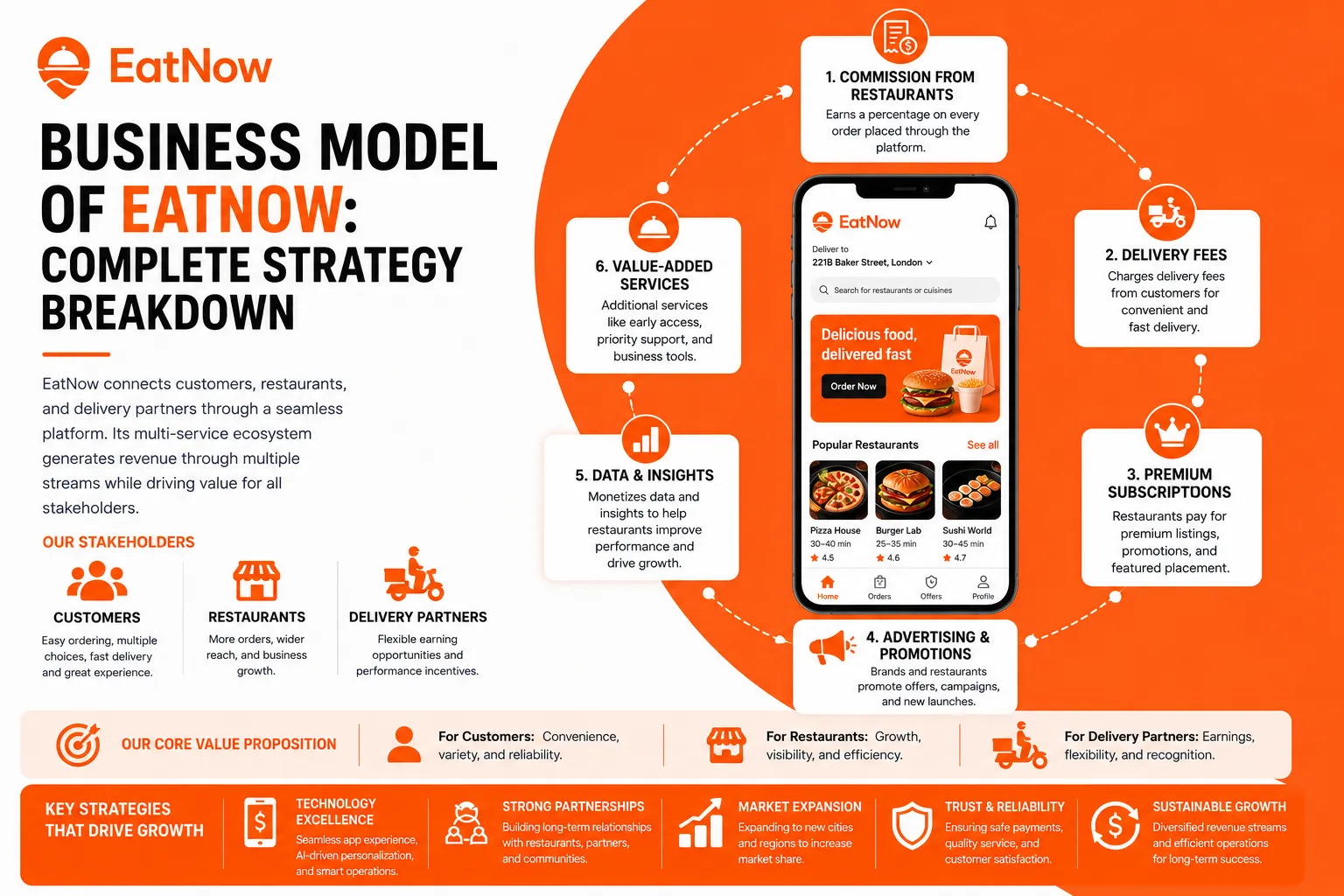
EatNow’s business model operates as a hybrid marketplace platform. It connects customers, restaurants, and delivery partners to provide a seamless food ordering and delivery experience. The company’s model isn’t just focused on transactions; it’s also built on creating long-term value for both users and restaurant partners.
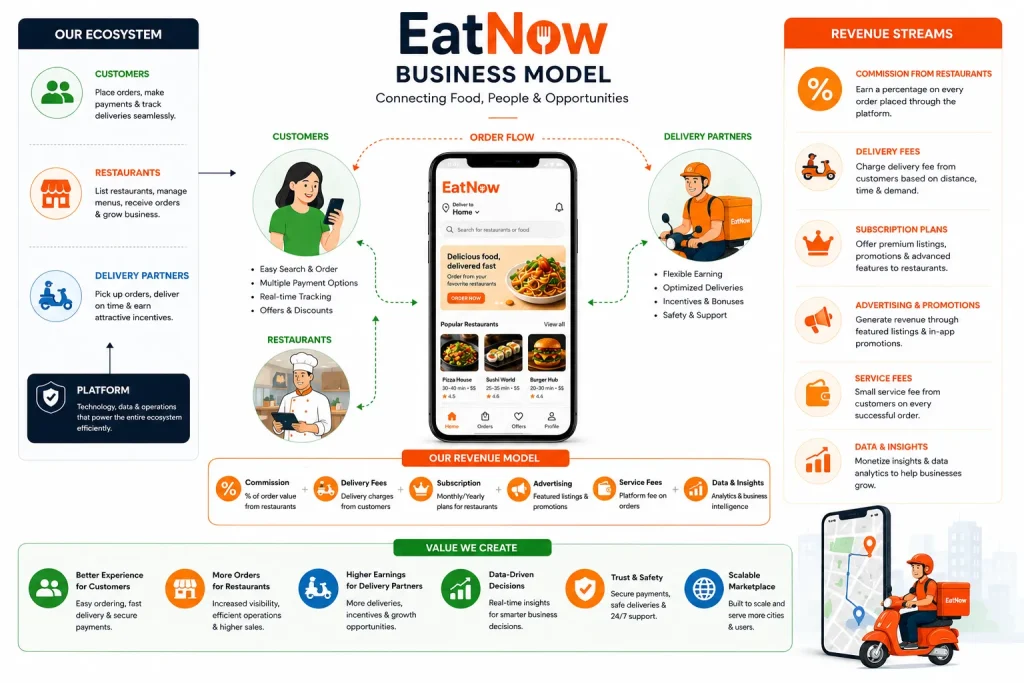
Type of Model: Hybrid Marketplace
EatNow combines features of a marketplace and a delivery service, which makes it a hybrid model. Here’s how it works:
- Marketplace: Customers browse and order from a variety of restaurants in their location, while restaurants list their menus and availability.
- Delivery Service: EatNow also integrates a food delivery system, allowing it to manage logistics and connect customers with delivery drivers.
Value Proposition: What Each User Segment Gains
EatNow serves three key segments:
- Consumers (Customers):
- Convenience: Order from a wide variety of restaurants with just a few taps.
- Variety: Access to local favorites and specialized cuisine not readily available through other platforms.
- Personalized Experience: Recommendations based on order history and preferences.
- Convenience: Order from a wide variety of restaurants with just a few taps.
- Restaurants (Partners):
- Increased Orders: Visibility to a larger customer base through EatNow’s platform.
- Marketing Support: Tools for promotions and special deals to attract more customers.
- Efficient Management: Integrated solutions for managing orders and payments.
- Increased Orders: Visibility to a larger customer base through EatNow’s platform.
- Delivery Drivers (Partners):
- Flexible Income: Drivers earn based on completed deliveries, providing flexibility to work as much or as little as they want.
- Operational Support: Clear navigation and logistics via the platform’s tech infrastructure.
- Flexible Income: Drivers earn based on completed deliveries, providing flexibility to work as much or as little as they want.
Why It Works Today: 2026 Market Conditions and Consumer Behavior
- Consumer Demand for Convenience: With an increasing number of customers preferring convenience, the demand for food delivery services has grown. People want the ease of browsing and ordering food from their favorite restaurants without stepping out of their homes.
- Restaurant’s Need for Digital Solutions: With the rise of digital transformation, many restaurants are seeking online platforms that help them manage their orders, delivery logistics, and customer data more efficiently.
Read more : How Safe is a White-Label EatNow App? Security Guide 2026
Target Market & Customer Segmentation Strategy
Understanding EatNow’s target market is key to recognizing its sustained success. The company is strategic in targeting multiple segments, ensuring it captures a wide consumer base while serving restaurant partners effectively.
Primary and Secondary Customer Segments
- Primary Customer Segment: Consumers (End Users)
- Demographics:
- Age: 18-45 years old
- Income: Middle to high-income households
- Tech-savviness: Comfortable with digital platforms and mobile apps
- Lifestyle: Urban dwellers who value convenience and fast access to food options.
- Age: 18-45 years old
- Behavior:
- Typically make impulse decisions or order for convenience after work or during social activities.
- Often loyal to a specific set of restaurants but may explore new places based on promotions or recommendations.
- Typically make impulse decisions or order for convenience after work or during social activities.
- Demographics:
- Secondary Customer Segment: Restaurants
- Demographics:
- Small to medium-sized independent restaurants, local chains, and even larger franchises.
- Range of cuisines from fast food to fine dining.
- Small to medium-sized independent restaurants, local chains, and even larger franchises.
- Behavior:
- Need a reliable platform to increase visibility and receive orders online, reducing their reliance on traditional marketing methods.
- Seek tools for better order management and customer insights, especially as competition grows.
- Need a reliable platform to increase visibility and receive orders online, reducing their reliance on traditional marketing methods.
- Demographics:
- Tertiary Customer Segment: Delivery Drivers
- Demographics:
- Individuals seeking flexible work opportunities, such as students or gig economy workers.
- Individuals seeking flexible work opportunities, such as students or gig economy workers.
- Behavior:
- They prioritize flexibility and easy access to orders. Many are looking for a side income rather than full-time employment.
- They prioritize flexibility and easy access to orders. Many are looking for a side income rather than full-time employment.
- Demographics:
Customer Journey: Discovery → Conversion → Retention
- Discovery:
- Customers typically discover EatNow via word-of-mouth, social media ads, or Google searches. With its broad restaurant partner base and strong online presence, it’s easy for customers to stumble upon EatNow when looking for food delivery services.
- Customers typically discover EatNow via word-of-mouth, social media ads, or Google searches. With its broad restaurant partner base and strong online presence, it’s easy for customers to stumble upon EatNow when looking for food delivery services.
- Conversion:
- EatNow offers an intuitive app interface that makes ordering fast and simple. It promotes first-time user discounts and targeted ads based on customer preferences, which drives conversions.
- EatNow offers an intuitive app interface that makes ordering fast and simple. It promotes first-time user discounts and targeted ads based on customer preferences, which drives conversions.
- Retention:
- The company uses personalized recommendations, loyalty programs, and special deals to keep customers coming back. Regular users are encouraged to engage through notifications and email marketing, keeping EatNow top of mind when they decide to order.
- The company uses personalized recommendations, loyalty programs, and special deals to keep customers coming back. Regular users are encouraged to engage through notifications and email marketing, keeping EatNow top of mind when they decide to order.
Customer Segment Analysis Table:
| Segment | Key Characteristics | Acquisition Strategies | Retention Strategies |
| Consumers (End Users) | Urban, tech-savvy, value convenience | Digital marketing, referrals | Personalized recommendations, loyalty programs |
| Restaurants (Partners) | Small-medium, looking for visibility & order management | Platform tools, analytics | Marketing support, special promotions |
| Delivery Drivers | Flexible workers, students, gig economy | Easy sign-up process | Flexibility and timely payments |
Revenue Streams and Monetization Design
EatNow’s business model is driven by several key revenue streams, which together create a highly profitable and scalable platform. The company capitalizes on both transactional fees and value-added services that benefit all stakeholders in its ecosystem — from consumers to restaurants, and even delivery drivers.
Primary Revenue Stream: Commission-Based Model
- Mechanism:
EatNow generates the bulk of its revenue by charging restaurants a commission on each order placed through the platform. This is typically a percentage of the total transaction, ranging from 10% to 30% depending on the restaurant type and agreement. - Pricing Model:
The commission varies based on several factors, such as:
- Restaurant size and volume of orders: Larger restaurants or chains might negotiate lower fees for high-volume orders.
- Promotions: Discounts or promotional partnerships can also affect the commission structure.
- Restaurant size and volume of orders: Larger restaurants or chains might negotiate lower fees for high-volume orders.
- % of Revenue:
Commissions from restaurants make up 50-60% of EatNow’s total revenue. This is the most stable and predictable stream, as it depends on the volume of orders processed through the platform.
Secondary Revenue Streams
- Delivery Fees
- Mechanism:
EatNow charges consumers a delivery fee, which typically varies based on the distance from the restaurant, delivery time, and demand. - Pricing Model:
Delivery fees are dynamically set by the platform, considering factors like delivery location and time. - % of Revenue:
Delivery fees account for about 15-20% of EatNow’s total revenue.
- Mechanism:
- Subscription Services for Restaurants
- Mechanism:
Restaurants can subscribe to premium services that offer enhanced visibility, marketing tools, and analytics. These services include targeted promotions, customer insights, and dynamic menu management. - Pricing Model:
EatNow offers several subscription tiers, with pricing based on features offered. - % of Revenue:
Subscription revenue represents 10-15% of total income, creating a consistent and predictable stream.
- Mechanism:
- Advertising Revenue
- Mechanism:
EatNow runs advertisements on the platform, particularly targeting users and restaurant partners. This could include sponsored listings or targeted ads for food items. - Pricing Model:
Restaurants or third-party advertisers pay for placement and visibility. - % of Revenue:
Advertising contributes around 10% of EatNow’s revenue, though this is expected to grow as the platform expands its user base and restaurant partners.
- Mechanism:
Operational Model & Key Activities
EatNow’s operational model is built around delivering a seamless customer experience while ensuring efficient processes for restaurants and delivery drivers. Its platform relies heavily on technology, real-time data, and streamlined workflows to handle a high volume of transactions and maintain a smooth user experience.
Core Operations
- Platform Management & Tech Infrastructure:
- Tech Infrastructure: EatNow relies on a robust cloud-based platform that handles everything from user interaction to restaurant order management and delivery logistics.
- App and Website Maintenance: Continuous updates and optimizations ensure a smooth and user-friendly interface. The platform is optimized for both mobile and desktop users to cater to a wide audience.
- Tech Infrastructure: EatNow relies on a robust cloud-based platform that handles everything from user interaction to restaurant order management and delivery logistics.
- Order Management System:
- Real-time Tracking: Once an order is placed, the system tracks it in real-time, notifying customers of their order status. This is crucial for maintaining customer trust and satisfaction.
- Restaurant Dashboard: Restaurants receive an easy-to-navigate dashboard for managing orders, inventory, and customer feedback.
- Real-time Tracking: Once an order is placed, the system tracks it in real-time, notifying customers of their order status. This is crucial for maintaining customer trust and satisfaction.
- Quality Control & Customer Support:
- Customer Support: EatNow provides round-the-clock support for both customers and restaurant partners to address any issues with orders, payments, or technical glitches.
- Quality Control: Regular checks and audits ensure that restaurant listings maintain high quality and that all delivery processes meet operational standards.
- Customer Support: EatNow provides round-the-clock support for both customers and restaurant partners to address any issues with orders, payments, or technical glitches.
- Marketing and Growth:
- In-house Marketing Team: EatNow has an internal team dedicated to creating promotional campaigns and partnerships with restaurants.
- Advertising Partnerships: The company runs ad campaigns targeting users and restaurants to drive engagement and new customer acquisition.
- In-house Marketing Team: EatNow has an internal team dedicated to creating promotional campaigns and partnerships with restaurants.
Resource Allocation
- Tech Budget:
- A significant portion of EatNow’s revenue is reinvested into tech infrastructure, with estimates suggesting around 30-40% of operational costs are allocated to maintaining and improving its platform, particularly the app and backend system.
- Marketing Spend:
- Marketing, both for customer acquisition and restaurant promotion, takes up about 20-30% of the budget. This includes digital ads, referral bonuses, and promotional partnerships with high-profile restaurant chains.
- HR Focus:
- The company maintains a lean, efficient team with a focus on product development and data science to improve user experience, predictive recommendations, and logistics optimization.
- Delivery drivers are recruited on a contract basis, allowing flexibility and scalability as needed.
- R&D Investments:
- EatNow dedicates a portion of its resources to research and development to stay ahead of market trends, optimize delivery routes, and improve its AI-driven recommendation engine. This allows the platform to offer more personalized experiences and maximize operational efficiency.
- Regional Expansion Strategy:
- Although it began in Australia, EatNow has gradually expanded to other countries and cities with high demand for food delivery services. Localization and partner onboarding are key parts of this strategy, ensuring that the platform is tailored to the needs of each new market.
- Although it began in Australia, EatNow has gradually expanded to other countries and cities with high demand for food delivery services. Localization and partner onboarding are key parts of this strategy, ensuring that the platform is tailored to the needs of each new market.
Strategic Partnerships & Ecosystem Development
EatNow’s success isn’t just about having a great app—it’s also about how well it builds and nurtures relationships with key partners. Its strategic partnerships form the backbone of its ecosystem, providing the company with the resources, reach, and reliability needed to maintain its competitive edge.
Collaboration Philosophy
EatNow has built an ecosystem that thrives on synergistic partnerships with key players in the food delivery, tech, and logistics industries. The platform prioritizes long-term alliances over one-off collaborations, ensuring that all stakeholders benefit and that the ecosystem remains scalable.
The platform’s business model is designed to maximize network effects. As the platform grows, the value for both restaurants and customers increases, creating a self-reinforcing loop. Here’s how these partnerships function:
Key Partnership Types
- Technology and API Partners:
- Tech Infrastructure: EatNow partners with cloud service providers (e.g., AWS) and data analytics platforms to manage the scale and speed of transactions. These partnerships help optimize the user experience and support real-time tracking.
- Payment Processors: Partnerships with payment gateway providers like Stripe or PayPal ensure secure and efficient payment processing for customers and restaurants.
- Tech Infrastructure: EatNow partners with cloud service providers (e.g., AWS) and data analytics platforms to manage the scale and speed of transactions. These partnerships help optimize the user experience and support real-time tracking.
- Payment and Logistics Alliances:
- Payment Gateways: As mentioned, EatNow partners with trusted payment gateways to process transactions safely. These integrations are crucial to build customer trust.
- Delivery Fleet Partnerships: While EatNow has its own drivers, it also partners with third-party logistics services (e.g., Uber Eats or local courier services) during peak demand periods or in areas with limited delivery resources. This partnership model increases flexibility and scalability.
- Payment Gateways: As mentioned, EatNow partners with trusted payment gateways to process transactions safely. These integrations are crucial to build customer trust.
- Marketing and Distribution Partners:
- Restaurant Chains: EatNow has forged exclusive partnerships with large restaurant chains to boost its visibility in the market. These restaurant partners often bring new users through their brand recognition.
- Food Influencers and Digital Ads: Collaborations with food bloggers, influencers, and social media platforms help spread awareness and promote deals to a wider audience.
- Affiliate Programs: EatNow also collaborates with affiliate marketers and local bloggers to increase its reach through affiliate sales and commissions.
- Restaurant Chains: EatNow has forged exclusive partnerships with large restaurant chains to boost its visibility in the market. These restaurant partners often bring new users through their brand recognition.
Growth Strategy & Scaling Mechanisms
EatNow’s growth strategy has evolved from being a regional food delivery service to a global player that continually expands its reach, acquires new customers, and maximizes revenue streams. Let’s break down how the platform has successfully scaled and maintained momentum, as well as how it plans to continue growing.
Growth Engines
- Organic Virality and Referral Loops:
- Referral Programs: EatNow has implemented a highly effective referral program where users earn rewards or discounts for referring new customers to the platform. This has encouraged users to share the platform with friends and family, accelerating growth with minimal marketing spend.
- Social Media Engagement: The platform leverages its social media presence by engaging users with exciting offers, customer reviews, and content that encourages users to share their experiences. This organic word-of-mouth has proven to be a powerful tool for viral growth.
- Referral Programs: EatNow has implemented a highly effective referral program where users earn rewards or discounts for referring new customers to the platform. This has encouraged users to share the platform with friends and family, accelerating growth with minimal marketing spend.
- Paid Marketing and Acquisition Strategies:
- Targeted Ads: EatNow uses social media platforms, Google Ads, and SEO strategies to attract new customers. Targeting local food enthusiasts and urban dwellers through personalized digital ads has helped increase customer acquisition rates.
- Promotions and Discounts: Offering special promotions for new customers and creating time-limited deals has been an effective strategy for attracting first-time users.
- Targeted Ads: EatNow uses social media platforms, Google Ads, and SEO strategies to attract new customers. Targeting local food enthusiasts and urban dwellers through personalized digital ads has helped increase customer acquisition rates.
- New Product Lines and Market Entries:
- Subscription Services for Restaurants: As the platform matured, EatNow started offering premium subscription services to restaurants, including enhanced data analytics, visibility in search results, and marketing support. This service increases EatNow’s revenue while also helping restaurants scale.
- Expansion into New Regions: EatNow has entered several new markets, focusing on local adaptation. By collaborating with regional delivery services, adjusting pricing models, and integrating local restaurant preferences, the platform has been able to tailor its offerings to each unique market.
- Subscription Services for Restaurants: As the platform matured, EatNow started offering premium subscription services to restaurants, including enhanced data analytics, visibility in search results, and marketing support. This service increases EatNow’s revenue while also helping restaurants scale.
Scaling Challenges & Solutions
- Operational Complexity:
- As EatNow scaled, it faced challenges in managing a larger volume of orders. To address this, the company invested heavily in automation and AI-driven logistics, which helped optimize delivery routes, reduce wait times, and streamline customer service.
- Solution: By implementing a more automated, data-driven platform, EatNow reduced operational overhead and improved its ability to handle a higher number of transactions.
- As EatNow scaled, it faced challenges in managing a larger volume of orders. To address this, the company invested heavily in automation and AI-driven logistics, which helped optimize delivery routes, reduce wait times, and streamline customer service.
- Tech Infrastructure Limits:
- With growth came the need for larger-scale infrastructure. In the early stages, EatNow faced issues with server crashes and slow processing times during peak hours.
- Solution: The company partnered with cloud service providers like AWS to scale its tech infrastructure. This allowed EatNow to handle traffic spikes and increase reliability as the user base expanded.
- With growth came the need for larger-scale infrastructure. In the early stages, EatNow faced issues with server crashes and slow processing times during peak hours.
- Regulatory Barriers:
- Entering international markets often presents legal hurdles, from navigating labor laws to handling food safety regulations. Adapting to local rules was a critical part of EatNow’s expansion process.
- Solution: EatNow worked closely with local regulators and set up region-specific compliance teams to ensure that the platform met all regulatory requirements in new markets.
- Entering international markets often presents legal hurdles, from navigating labor laws to handling food safety regulations. Adapting to local rules was a critical part of EatNow’s expansion process.
Competitive Strategy & Market Defense
In a highly competitive space like food delivery, staying ahead of the curve is critical. EatNow has adopted several strategies to defend its market position, fend off new entrants, and continuously innovate to maintain its edge over competitors. Here’s a breakdown of how it stays competitive and shields itself from market threats.
Competitive Advantages
- Network Effects and Switching Barriers:
- Network Effects: As more customers join the platform, more restaurants are encouraged to list their offerings, which in turn attracts even more customers. This self-reinforcing loop increases EatNow’s value proposition over time, making it harder for competitors to replicate the same level of ecosystem integration.
- Switching Barriers: Once customers have used EatNow, it becomes challenging for them to switch to a competitor. The platform’s personalized experience, loyalty programs, and familiarity with customer preferences create switching costs that are not easily replicated.
- Network Effects: As more customers join the platform, more restaurants are encouraged to list their offerings, which in turn attracts even more customers. This self-reinforcing loop increases EatNow’s value proposition over time, making it harder for competitors to replicate the same level of ecosystem integration.
- Brand Equity and Customer Trust:
- Reputation for Reliability: EatNow has built a strong reputation for timely deliveries, quality service, and a wide variety of food options. This brand trust is a major competitive asset that allows it to retain customers even when faced with aggressive pricing wars.
- Customer-Centric Approach: The platform’s focus on customer service and user experience helps build trust and loyalty, ensuring that users are more likely to return rather than experiment with other platforms.
- Reputation for Reliability: EatNow has built a strong reputation for timely deliveries, quality service, and a wide variety of food options. This brand trust is a major competitive asset that allows it to retain customers even when faced with aggressive pricing wars.
- Innovation in Technology and Algorithms:
- AI-Powered Recommendations: EatNow invests heavily in artificial intelligence to power personalized recommendations, helping consumers find food they’ll love based on past orders and preferences.
- Efficient Logistics: By continuously improving its delivery optimization algorithms, EatNow ensures faster delivery times, better route management, and more efficient use of delivery resources, which enhances both customer satisfaction and operational efficiency.
- AI-Powered Recommendations: EatNow invests heavily in artificial intelligence to power personalized recommendations, helping consumers find food they’ll love based on past orders and preferences.
Market Defense Tactics
- Handling New Entrants and Pricing Wars:
- Aggressive Pricing Models: EatNow can respond to new competitors or aggressive pricing moves by adjusting its own pricing models, offering targeted discounts to retain customers.
- Brand Loyalty: Rather than competing purely on price, EatNow emphasizes loyalty programs and customer satisfaction as its core differentiators, creating stickiness that pricing alone can’t replicate.
- Aggressive Pricing Models: EatNow can respond to new competitors or aggressive pricing moves by adjusting its own pricing models, offering targeted discounts to retain customers.
- Strategic Feature Rollouts and Timing:
- EatNow regularly introduces new features that enhance user and partner experiences, such as order scheduling, contactless delivery options, and subscription services for restaurants. The timing of these rollouts is crucial, as they anticipate market demands and customer needs before competitors can act.
- EatNow regularly introduces new features that enhance user and partner experiences, such as order scheduling, contactless delivery options, and subscription services for restaurants. The timing of these rollouts is crucial, as they anticipate market demands and customer needs before competitors can act.
- Partnerships or Acquisition Moves:
- To bolster its position, EatNow forms strategic alliances with key players in both the food industry and logistics. By integrating delivery services with local partners, it strengthens its ecosystem and builds an insurmountable advantage over smaller players.
- To bolster its position, EatNow forms strategic alliances with key players in both the food industry and logistics. By integrating delivery services with local partners, it strengthens its ecosystem and builds an insurmountable advantage over smaller players.
Lessons for Entrepreneurs & Implementation
As an entrepreneur, studying EatNow’s business model offers invaluable lessons in how to build a scalable platform that thrives in a competitive market. From customer acquisition to partnership strategies, EatNow’s success can provide actionable insights for anyone looking to develop a successful platform-based business.
Key Factors Behind EatNow’s Success
- Customer-Centric Focus:
- EatNow’s consistent focus on user experience is a core driver of its success. By prioritizing the needs of consumers, from easy navigation to personalized recommendations, the platform ensures high levels of customer satisfaction and retention.
- Lesson for Entrepreneurs: Always design with the customer in mind. Understanding their pain points and meeting their needs is crucial for long-term success.
- EatNow’s consistent focus on user experience is a core driver of its success. By prioritizing the needs of consumers, from easy navigation to personalized recommendations, the platform ensures high levels of customer satisfaction and retention.
- Effective Monetization Strategy:
- The hybrid model—combining commissions, delivery fees, and premium subscriptions—gives EatNow multiple revenue streams, which cushions against market fluctuations and diversifies income sources.
- Lesson for Entrepreneurs: Don’t rely on a single revenue stream. Mix and match different models to increase financial stability.
- The hybrid model—combining commissions, delivery fees, and premium subscriptions—gives EatNow multiple revenue streams, which cushions against market fluctuations and diversifies income sources.
- Strategic Partnerships:
- EatNow has built a robust network of tech partners, logistics providers, and restaurant chains to scale its operations. This ecosystem strengthens its position and expands its reach.
- Lesson for Entrepreneurs: Building the right partnerships can accelerate growth and give you a competitive edge. Focus on long-term collaborations that benefit all parties.
- EatNow has built a robust network of tech partners, logistics providers, and restaurant chains to scale its operations. This ecosystem strengthens its position and expands its reach.
Replicable Principles for Startups
- Focus on a Niche: EatNow found its competitive advantage by serving local markets before expanding. Similarly, focus on a smaller, well-defined segment before attempting broad market expansion.
- Leverage Technology: Automation, AI, and cloud-based platforms have been key to EatNow’s success. Early adoption of technology can give you an edge, whether it’s in logistics, user experience, or marketing.
- Think Long-Term: Building a sustainable business model with long-term vision will help you stay resilient in the face of challenges. For EatNow, this meant focusing on customer loyalty, creating reliable partnerships, and continually upgrading its platform.
Common Mistakes to Avoid
- Underestimating Operational Complexity: Scaling too quickly without the right infrastructure can lead to poor service, which can alienate customers. Invest in back-end systems and scalable solutions early on to avoid bottlenecks.
- Ignoring Market Adaptation: Expanding without adapting to regional preferences and regulations can lead to failure in new markets. Research and localization should be a key part of your strategy when expanding geographically.
- Overlooking Partnerships: Relying solely on your own platform can limit growth. Strategic alliances with restaurants, delivery services, and other businesses can help accelerate growth and ensure scalability.
Implementation and Investment Priorities
To replicate EatNow’s business model, focus on these key steps:
- Phase 1: Platform Development and Market Research :
- Investment Priority: Tech infrastructure and user experience design.
- Action: Build a minimal viable product (MVP) and test it in a local market. Research the specific needs of your target audience.
- Investment Priority: Tech infrastructure and user experience design.
- Phase 2: Initial Market Expansion and Partnerships :
- Investment Priority: Marketing, customer acquisition, and partnership-building.
- Action: Launch in new cities or regions. Build relationships with restaurant partners and delivery services.
- Investment Priority: Marketing, customer acquisition, and partnership-building.
- Phase 3: Scaling and Diversification :
- Investment Priority: R&D, technology upgrades, and international expansion.
- Action: Expand to larger cities or countries. Diversify your revenue streams with premium services for restaurants and customers.
- Investment Priority: R&D, technology upgrades, and international expansion.
- Phase 4: Brand Consolidation and Innovation :
- Investment Priority: Brand loyalty programs, continuous innovation, and technology upgrades.
- Action: Reinforce your market position through customer loyalty programs, new product offerings, and cutting-edge technology.
- Investment Priority: Brand loyalty programs, continuous innovation, and technology upgrades.
Ready to implement EatNow’s proven business model for your market? Miracuves builds scalable platforms with tested business models and growth mechanisms. We’ve helped entrepreneurs launch profitable apps. Get your free business model consultation today.
Conclusion
EatNow’s business model is a prime example of how innovation and execution come together to create sustainable growth in today’s fast-evolving platform economies. The company’s success underscores the importance of understanding consumer needs, building strategic partnerships, and diversifying revenue streams. By focusing on customer loyalty, data-driven decisions, and continuous innovation .
As we move into 2026 and beyond, platform businesses will need to adapt to the ever-changing landscape of consumer behavior, technological advancements, and global market shifts. The future of platform economies lies in agility—the ability to pivot quickly while maintaining the integrity of the business model.
EatNow’s journey is a blueprint for scaling a platform, but it also serves as a reminder that success is a marathon, not a sprint. Whether you are building a food delivery service, an on-demand platform, or any other scalable business, learning from EatNow’s strategic focus on growth, partnerships, and customer-centricity will set you on the path to long-term success.
FAQs
What type of business model does EatNow use?
EatNow uses a hybrid marketplace model that combines food delivery and restaurant management services, connecting customers, restaurants, and delivery partners.
How does EatNow’s model create value?
EatNow provides value by simplifying food delivery for consumers, offering restaurants increased visibility, and giving delivery drivers flexible earning opportunities.
What are its key success factors?
Key success factors include customer-centric innovation, strategic partnerships, and data-driven decisions that enhance user experience and operational efficiency.
How scalable is it?
EatNow is highly scalable due to its cloud-based platform, automated logistics, and ability to expand into new markets with localized adaptations.
What are the biggest challenges?
The biggest challenges include operational complexity, regulatory compliance in new markets, and maintaining consistent service quality as it scales.
How can entrepreneurs adapt it to their region?
Entrepreneurs can adapt EatNow’s model by localizing the platform, forging regional partnerships, and addressing unique customer needs and preferences in their area.
What are alternatives to this model?
Alternatives include pure food delivery models like UberEats or reservation-only platforms like OpenTable, depending on the market segment you target.
How has it evolved over time?
EatNow has evolved from a simple ordering platform to a hybrid service offering delivery, restaurant subscriptions, and customer loyalty programs to increase engagement and revenue.