


Key Takeaways
What You’ll Learn
- Forsage operated as a blockchain-based referral and recruitment system using smart contracts.
- The platform promoted income generation through decentralized crypto participation and member growth.
- Revenue flow depended heavily on recruiting new participants into the network.
- Smart contracts automated transactions and payouts across blockchain networks.
- The platform became widely discussed due to legal and regulatory scrutiny around its structure.
Stats That Matter
- The platform processed large volumes of crypto transactions through automated smart contracts.
- Referral-driven growth played a major role in platform expansion.
- Many participants reportedly faced financial losses over time.
- The system relied on blockchain automation for payouts and transaction execution.
- Regulatory investigations focused on the sustainability and legality of the model.
Real Insights
- Blockchain automation increased transaction transparency but did not remove operational risks.
- Referral-based systems become difficult to sustain without continuous user growth.
- Crypto platforms often use decentralization and smart contracts to build user trust.
- Regulatory compliance and sustainable monetization are critical for long-term stability.
- Financial participation platforms require strong legal, security, and transparency frameworks.
In the world of blockchain startups, few platforms have generated as much attention—and controversy—as Forsage. Launched in 2020 as a decentralized smart-contract platform, Forsage reportedly attracted millions of users across Ethereum, Tron, and Binance Smart Chain networks within a short period.
At its peak, blockchain analysis firms estimated over $1 billion in transaction volume flowing through its smart contracts, making it one of the most discussed decentralized referral systems in crypto history.
However, the Business Model of Forsage has also drawn intense scrutiny. Regulators in multiple countries—including the U.S. SEC in 2022—identified the platform as a crypto pyramid scheme operating through smart contracts. Despite this, the project became an important case study in tokenized referral economics and decentralized network marketing models.Because behind the controversy lies a fascinating example of how blockchain technology, network effects, and incentive design can rapidly scale digital platforms—for better or worse.
How the Forsage Business Model Works
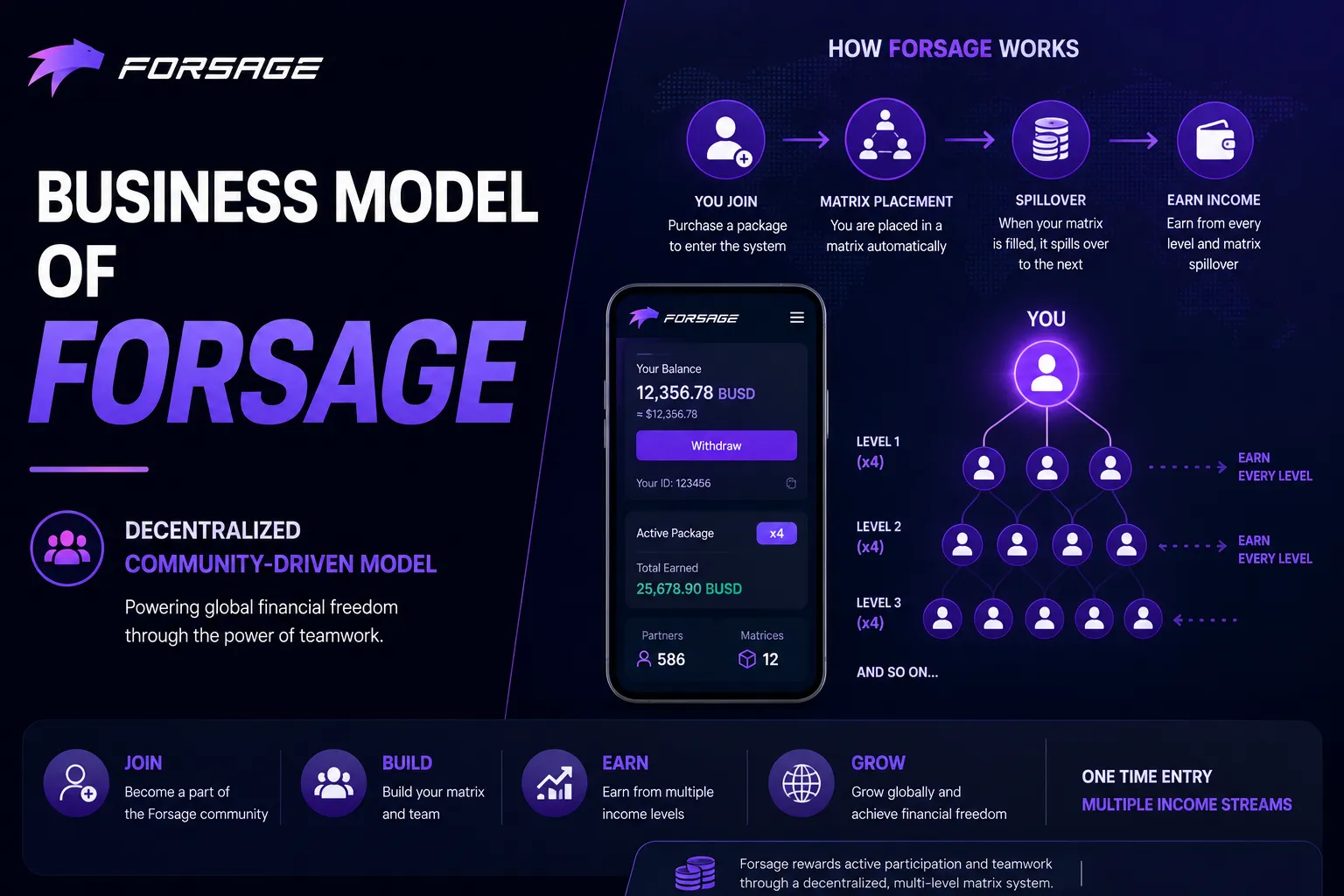
At its core, Forsage operates as a decentralized referral-based platform built on blockchain smart contracts. Instead of a traditional centralized company managing payments or membership systems, Forsage uses self-executing smart contracts deployed on blockchains like Ethereum, Tron, and Binance Smart Chain.
This design means that all transactions, referrals, and payouts are automatically executed through blockchain code, eliminating intermediaries. Participants join the platform by purchasing a slot in the system and then earn rewards by referring new participants.
The structure combines elements of network marketing, decentralized finance (DeFi), and smart contract automation.
Type of Business Model
The Forsage model can be described as a hybrid of several structures:
- Decentralized Referral Network
- Blockchain Smart Contract Platform
- Peer-to-Peer (P2P) Commission Model
- Network Marketing / Matrix Model
Unlike traditional apps that generate revenue through subscriptions or ads, Forsage’s system relies on participant-driven financial flows inside the network.
Core Value Proposition
Forsage targeted individuals interested in earning cryptocurrency through referrals and decentralized systems.
For Participants (Users):
- Opportunity to earn crypto rewards through referrals
- No central authority controlling funds
- Transparent transactions on blockchain
- Access to global crypto communities
For Network Builders / Influencers:
- Ability to grow large referral networks
- Potential for exponential earnings through matrix expansion
- Incentives for community recruitment
For Crypto Enthusiasts:
- Exposure to decentralized smart contract platforms
- Experimentation with blockchain-based earning systems
Key Stakeholders in the Ecosystem
Several actors keep the Forsage ecosystem running:
1. Participants / Members
- Purchase entry slots
- Refer new members
- Earn commissions from network expansion
2. Promoters and Network Leaders
- Drive community growth
- Build large referral trees
- Act as evangelists for the platform
3. Blockchain Infrastructure
- Ethereum, Tron, and BNB Chain networks host the smart contracts
- Ensure transparency and automated payouts
4. Smart Contracts
- Core engine of the platform
- Automatically distribute payments across the matrix structure
How the Matrix System Works
Forsage introduced two primary smart-contract matrices:
X3 Matrix
- 3 referral slots per level
- After filling slots, the matrix cycles and generates payouts
X4 Matrix
- 2 levels of referrals
- Allows earnings from deeper network expansion
Participants upgrade through multiple levels, each requiring additional cryptocurrency payments.
As more users join under a participant’s network, funds automatically flow upward through the matrix structure.
Why the Model Spread Rapidly
Despite its controversies, the system scaled quickly due to several factors:
- Low entry barrier for crypto users
- Global accessibility through blockchain
- Viral referral incentives
- Community-driven marketing
- Automated smart contract payouts
These elements created strong network effects, allowing the platform to grow rapidly without traditional advertising.At Miracuves, we often study platforms like Forsage to understand how incentive design and network effects can scale digital ecosystems globally—while also highlighting the importance of sustainable monetization models and regulatory compliance.
Read more : How Safe is a White-Label Forsage App? Security Guide 2026

Target Market & Customer Segmentation Strategy
Forsage’s rapid growth was largely driven by carefully aligned audience targeting and viral community marketing. Unlike traditional apps that target broad consumer groups, Forsage focused heavily on crypto-savvy users, online entrepreneurs, and individuals seeking alternative income streams.
Its marketing strategy relied on peer-driven recruitment and community evangelism, which allowed the platform to expand globally without heavy advertising budgets.
Primary Customer Segments
1. Crypto Enthusiasts
These users were already active in the blockchain ecosystem and understood how to use wallets, smart contracts, and decentralized platforms.
Key characteristics:
- Age group: 20–40
- Familiar with DeFi and cryptocurrencies
- Active in Telegram, Discord, and crypto forums
- Comfortable making blockchain transactions
Motivation
- Exploring new crypto earning opportunities
- Early adoption of decentralized platforms
2. Online Entrepreneurs & Network Marketers
Forsage strongly appealed to individuals with experience in multi-level marketing (MLM) or digital referral systems.
Key characteristics:
- Experienced in building referral networks
- Active on social media marketing platforms
- Skilled in community building
Motivation
- Potential to generate recurring referral income
- Opportunity to scale earnings through network growth
3. Emerging Market Participants
A large percentage of users reportedly came from developing regions, where digital earning opportunities were attractive.
Regions where adoption was high:
- Southeast Asia
- Africa
- Eastern Europe
Customer Journey: Discovery → Conversion → Retention
Forsage’s growth depended heavily on a viral customer journey.
1. Discovery
Users typically discovered the platform through:
- Referral invitations from friends
- YouTube explainers
- Telegram and WhatsApp groups
- Crypto influencers
2. Conversion
Once interested, users would:
- Create a crypto wallet
- Send cryptocurrency to activate their Forsage slot
- Join a referral network
The low entry cost helped reduce friction at this stage.
3. Retention
Retention was driven by incentive-based participation, including:
- Upgrading to higher levels
- Recruiting new members
- Expanding referral networks
The system encouraged continuous participation because earnings depended on network activity.
Customer Segment Analysis
| Segment | Motivation | Acquisition Channel | Retention Strategy |
| Crypto Enthusiasts | Explore DeFi earning models | Crypto forums, influencers | Upgrades and network growth |
| Network Marketers | Referral income | Social media communities | Team building incentives |
| Emerging Market Users | Alternative income streams | Word-of-mouth | Continuous participation rewards |
| Influencers | Monetize audience | YouTube, Telegram | Community leadership |
At Miracuves, analyzing platforms like Forsage highlights how community-driven growth strategies can scale apps globally—but also demonstrates why balanced monetization and sustainable incentives are essential for long-term platforms.
Revenue Streams and Monetization Design
Understanding how money flows inside the Forsage ecosystem is crucial to decoding its business model. Unlike traditional digital platforms that generate revenue through subscriptions, advertising, or service fees, Forsage’s monetization design relied on user participation and referral-driven transaction flows inside smart contracts.
The platform itself did not operate like a centralized company collecting fees. Instead, payments were distributed automatically through blockchain smart contracts according to predefined matrix rules.
This structure created a peer-to-peer commission flow, where new participants’ payments moved through the network and were distributed to earlier participants based on the matrix structure.
Primary Revenue Stream: Entry-Level Matrix Activation
The first and most important transaction in the Forsage system was the initial entry payment.
When a new participant joined, they had to activate a matrix level using cryptocurrency.
Mechanism
- User connects a crypto wallet (MetaMask, Trust Wallet, etc.)
- User sends cryptocurrency to activate the first matrix level
- Smart contract distributes the payment through the referral structure
Typical entry characteristics
- Payment made in Ethereum, TRX, or BNB
- Automatically distributed via smart contract
- Referrals above the user receive commissions
Economic structure
- Early participants earn more due to network positioning
- New users fund the payout flows
Growth trajectory
This model allowed Forsage to scale rapidly because every new participant triggered multiple payouts across the network.
Secondary Revenue Stream: Matrix Level Upgrades
Forsage introduced multiple earning levels inside its system.
Participants could unlock higher earning potential by purchasing additional levels in the matrix.
How it works
- Each level requires a higher crypto payment
- Unlocks additional referral earning opportunities
- Enables deeper matrix placement benefits
Strategic effect
- Encouraged continuous reinvestment
- Increased lifetime transaction volume per participant
Overall Monetization Strategy
Forsage’s monetization system relied entirely on network participation and matrix expansion.
The design created a self-perpetuating transaction system, where:
- New users generated payouts
- Existing users reinvested earnings
- Network leaders scaled their teams
Unlike typical platform businesses, the model did not depend on selling services, subscriptions, or products.
Instead, its financial flows were tied directly to network growth and participation activity.
At Miracuves, we emphasize a key lesson from studying models like Forsage:
Sustainable platform businesses require monetization tied to real value creation, whether through services, digital products, or marketplace transactions.While incentive-driven systems can generate rapid growth, long-term platforms succeed when users remain because of value—not just financial incentives.
Read more : Forsage Revenue Model: How Forsage Makes Money in 2026
Operational Model & Key Activities
Behind every digital platform is an operational engine that keeps the system functioning. In Forsage’s case, operations were fundamentally different from traditional tech companies because the platform relied heavily on blockchain smart contracts and decentralized infrastructure rather than centralized operational teams.
Instead of managing transactions manually, Forsage automated its ecosystem through self-executing code deployed on blockchain networks. This reduced operational overhead while enabling global participation without traditional financial intermediaries.
Core Operations
Despite its decentralized structure, several core operational activities were necessary for the ecosystem to function.
1. Smart Contract Development & Maintenance
Smart contracts formed the foundation of the platform.
Key responsibilities included:
- Designing the matrix structure logic
- Deploying contracts on blockchain networks
- Ensuring compatibility with Ethereum, Tron, and BNB Chain
- Updating or launching new versions when required
These contracts automatically handled:
- Payment distribution
- Matrix cycling
- Referral reward allocation
2. Platform Infrastructure Management
Although payments occurred on-chain, users still needed tools and interfaces to interact with the system.
Operational tasks included:
- Maintaining the Forsage website and dashboards
- Wallet integration support
- Blockchain transaction monitoring
- Smart contract interaction interfaces
This layer allowed users to track their referrals, earnings, and matrix positions.
3. Community Management & Marketing
One of the most important operational pillars was community-driven marketing.
Growth was largely powered through:
- Telegram groups
- Facebook communities
- YouTube training channels
- Influencer-led onboarding sessions
Community leaders acted as regional growth drivers, helping onboard new participants and train them on how to use the system.
4. User Education & Support
Because blockchain transactions can be complex for beginners, educational content became a key operational activity.
Typical resources included:
- Video tutorials explaining wallet setup
- Step-by-step joining guides
- Matrix earning explanations
- Community Q&A sessions
This education system helped reduce friction for new participants entering the crypto ecosystem.At Miracuves, we often highlight how automation and scalable infrastructure are critical components of modern platform businesses. However, sustainable digital platforms also require long-term operational governance, compliance, and product value creation.
Strategic Partnerships & Ecosystem Development
No digital platform scales alone. Even decentralized platforms depend on a network of technologies, communities, and service providers to sustain growth. In the case of Forsage, the ecosystem was built around blockchain infrastructure, crypto wallets, community leaders, and digital communication platforms.
Rather than forming traditional corporate partnerships, Forsage developed an ecosystem of technology integrations and community alliances that enabled the platform to expand rapidly across global markets.
Collaboration Philosophy
Forsage’s ecosystem strategy was based on open blockchain infrastructure and decentralized participation.
Key principles included:
- Leveraging existing blockchain networks instead of building proprietary infrastructure
- Encouraging community-driven promotion and onboarding
- Integrating with widely used crypto tools and wallets
This approach allowed the platform to scale without centralized operational partnerships.
Technology & API Partners
The most important partnerships were with blockchain ecosystems that hosted Forsage’s smart contracts.
Key blockchain networks used:
- Ethereum – original launch platform
- Tron – enabled lower transaction fees and faster transactions
- Binance Smart Chain (BNB Chain) – expanded reach within DeFi ecosystems
These networks provided:
- Smart contract execution
- Transaction verification
- Global decentralized access
Forsage leveraged these networks rather than building its own blockchain infrastructure.
Crypto Wallet Integrations
To interact with the platform, users needed compatible crypto wallets.
Popular wallets used by participants included:
- MetaMask
- Trust Wallet
- TokenPocket
These wallets enabled users to:
- Connect to the platform interface
- Send cryptocurrency payments
- Interact directly with smart contracts
Wallet integration was critical for user accessibility and onboarding.
Community and Distribution Alliances
Forsage’s real distribution engine came from community leaders and online influencers.
Promotional channels included:
- Telegram groups
- YouTube tutorials
- TikTok crypto creators
- Facebook network marketing communities
Community leaders effectively acted as regional partners, helping to:
- Educate new users
- Organize onboarding sessions
- Expand referral networks
This decentralized promotion model created rapid viral expansion without large advertising budge
At Miracuves, we help founders build healthy digital ecosystems where technology partners, payment systems, and community growth strategies work together to create long-term platform value.
Growth Strategy & Scaling Mechanisms
Forsage’s rapid expansion demonstrates how viral incentives and decentralized distribution models can drive explosive platform growth. Within a short time after launch, the platform expanded across multiple continents, largely fueled by community-driven marketing and referral loops rather than traditional advertising.
The growth strategy revolved around network effects, where each new participant had a strong incentive to recruit others, accelerating the expansion of the ecosystem.
Growth Engines
1. Viral Referral Loops
The most powerful growth mechanism was the referral matrix system.
Every participant benefited when:
- New users joined under their referral network
- Matrix levels filled and cycled
- Additional participants activated higher levels
This created a self-reinforcing growth loop, where each participant effectively became a marketer for the platform.
2. Community-Led Expansion
Instead of relying on corporate marketing teams, Forsage’s growth was driven by independent community leaders.
These leaders built local and international communities through:
- Telegram and WhatsApp groups
- YouTube education channels
- Social media training sessions
Community leaders often organized webinars and onboarding sessions, helping new users understand how to join and participate.
3. Social Media and Influencer Promotion
Crypto influencers played a key role in spreading awareness.
Common promotional channels included:
- YouTube explainers on how to join Forsage
- TikTok crypto tutorials
- Facebook MLM-style community groups
- Telegram announcements and earnings screenshots
This strategy created high visibility within crypto communities, enabling rapid adoption.
4. Multi-Blockchain Expansion
Another important scaling strategy was deploying Forsage on multiple blockchain networks.
Key milestones included:
- Launch on Ethereum
- Expansion to Tron for lower transaction fees
- Integration with BNB Chain to reach additional users
Supporting multiple networks allowed Forsage to:
- Reduce transaction costs for participants
- Increase accessibility across crypto ecosystems
- Expand globally without geographic limitations
At Miracuves, analyzing growth stories like Forsage highlights a critical insight: viral growth can accelerate adoption, but sustainable platforms ultimately depend on long-term value creation, compliance, and user trust.
Competitive Strategy & Market Defense
Even though Forsage did not operate like a traditional startup competing in a clearly defined market, it still had to differentiate itself from other crypto earning platforms, DeFi projects, and network marketing systems.
Its competitive positioning relied on a combination of technology, community influence, and decentralized branding to maintain user attention and expand its ecosystem.
Key Competitive Advantages
1. Smart Contract Automation
One of Forsage’s strongest differentiators was the use of blockchain smart contracts to automate financial flows.
This provided several perceived advantages:
- Transparent transaction records on the blockchain
- Automatic reward distribution without manual processing
- No centralized authority controlling payouts
For many crypto users, this automation increased trust because payments were executed through code rather than intermediaries.
2. Strong Network Effects
Forsage’s matrix referral system created powerful network-driven growth effects.
As more users joined the platform:
- Referral networks expanded
- Matrix cycles triggered additional payouts
- Community engagement increased
This type of growth loop made the platform difficult for competitors to replicate quickly.
3. Community-Led Brand Growth
Unlike traditional tech platforms that rely heavily on paid marketing, Forsage’s brand grew through community promotion.
Participants often shared:
- Referral links
- Educational videos
- Earnings testimonials
These community-driven campaigns helped build strong online visibility in crypto communities.
4. Global Accessibility
Because the platform operated on blockchain infrastructure, it was accessible to anyone with an internet connection and cryptocurrency wallet.
This removed many traditional barriers such as:
- Banking requirements
- Geographic restrictions
- Currency limitations
As a result, Forsage could attract users from multiple regions simultaneously.
Market Defense Tactics
As other crypto platforms and referral systems emerged, Forsage participants relied on several tactics to maintain interest and protect network momentum.
1. Continuous System Upgrades
New versions and matrix structures were introduced over time to:
- Extend earning opportunities
- Keep participants engaged
- Refresh the platform’s growth narrative
2. Community Engagement
Regular online events helped sustain community activity:
- Webinars explaining earning strategies
- Training sessions for new participants
- Social media updates from community leaders
This maintained high engagement levels within the network.
3. Narrative of Decentralization
Promoters frequently emphasized the platform’s decentralized nature, positioning it as:
- Independent from traditional corporate control
- Resistant to centralized shutdowns
- Transparent through blockchain technology
This narrative helped strengthen community loyalty among crypto supporters.
At Miracuves, we help entrepreneurs build platforms that combine powerful growth engines with stable, long-term business models.
Lessons for Entrepreneurs & Implementation
Forsage’s story offers one of the most important case studies in modern digital platform economics. While the platform demonstrated how incentive-driven growth can rapidly scale a global user base, it also revealed the risks of building systems that rely primarily on network recruitment rather than sustainable value creation.
For entrepreneurs and startup founders, the key is not to replicate the structure of Forsage—but to learn from the mechanics behind its growth, distribution, and ecosystem design.
Key Factors Behind Forsage’s Rapid Growth
Several strategic elements contributed to Forsage’s fast adoption:
1. Simple Onboarding Process
The platform reduced friction by allowing users to join with just:
- A crypto wallet
- A small entry payment
- A referral invitation
This simplified onboarding helped accelerate global adoption.
2. Strong Incentive Structures
Participants were motivated to grow the network because:
- Earnings increased with referrals
- Higher levels unlocked additional opportunities
- Community leaders could scale large teams
Well-designed incentives can significantly accelerate platform growth.
3. Community-Led Marketing
Instead of expensive marketing campaigns, Forsage relied on community evangelists.
These users promoted the platform through:
- Social media tutorials
- Telegram communities
- YouTube content
- Online training sessions
This created viral distribution with minimal marketing costs.
Ready to implement a scalable platform business model for your market?
Miracuves specializes in building high-growth digital platforms with proven monetization and ecosystem strategies.
We’ve helped many entrepreneurs launch profitable apps across multiple industries. Get your free business model consultation today and turn your platform idea into a scalable digital product.
Conclusion
Forsage’s rise is one of the most fascinating—and controversial—stories in the evolution of blockchain platforms. In just a few years, the project demonstrated how smart contracts, viral incentives, and community-driven distribution can scale a digital ecosystem across the world at extraordinary speed.From a strategic perspective, the platform demonstrated how automated financial infrastructure, decentralized participation, network-driven growth, and low-friction global onboarding can rapidly scale a digital ecosystem.
However, the broader lesson for entrepreneurs is equally important. Platforms that scale sustainably usually combine innovative technology with real value creation, regulatory awareness, and long-term user trust.Forsage reminds founders that growth mechanics alone are not enough. True platform success comes when innovation, governance, and customer value evolve together.
As we move deeper into the platform economy of 2026 and beyond, the next generation of digital products will likely combine blockchain, AI, decentralized ecosystems, and marketplace models to create entirely new forms of value exchange.
For entrepreneurs building the next big platform, the question isn’t simply how fast you can grow, but how sustainably your ecosystem can deliver value over time.
FAQs
What type of business model does Forsage use?
Forsage uses a blockchain-based referral network model powered by smart contracts. Participants join by activating levels with cryptocurrency and earn rewards through referral matrix structures.
How does Forsage’s model create value?
The platform creates value through automated crypto reward distribution using smart contracts. Participants receive payouts when new users join their referral network within the matrix system.
What are the key success factors behind Forsage’s growth?
Forsage grew quickly due to viral referral incentives, community-driven marketing, and blockchain automation. These factors enabled rapid global adoption without traditional advertising.
How scalable is the Forsage model?
Technically, the model is scalable because it runs on decentralized blockchain infrastructure. However, long-term sustainability depends on continuous participation and regulatory acceptance.
What are the biggest challenges of this model?
Major challenges include regulatory scrutiny, sustainability concerns, and trust issues. Platforms relying heavily on recruitment-driven rewards often face legal and economic risks.
How can entrepreneurs adapt lessons from Forsage?
Entrepreneurs can adopt ideas like network effects, automated systems, and community-driven growth. However, successful platforms must focus on real product value and sustainable monetization.
What are alternatives to this model?
More sustainable alternatives include marketplace platforms, subscription-based SaaS models, creator economy platforms, and DeFi services with real utility.
How has the model evolved over time?
Forsage launched on Ethereum and later expanded to Tron and Binance Smart Chain to reduce fees and increase accessibility. It is now widely discussed as a case study in decentralized referral systems.
Related Article :