


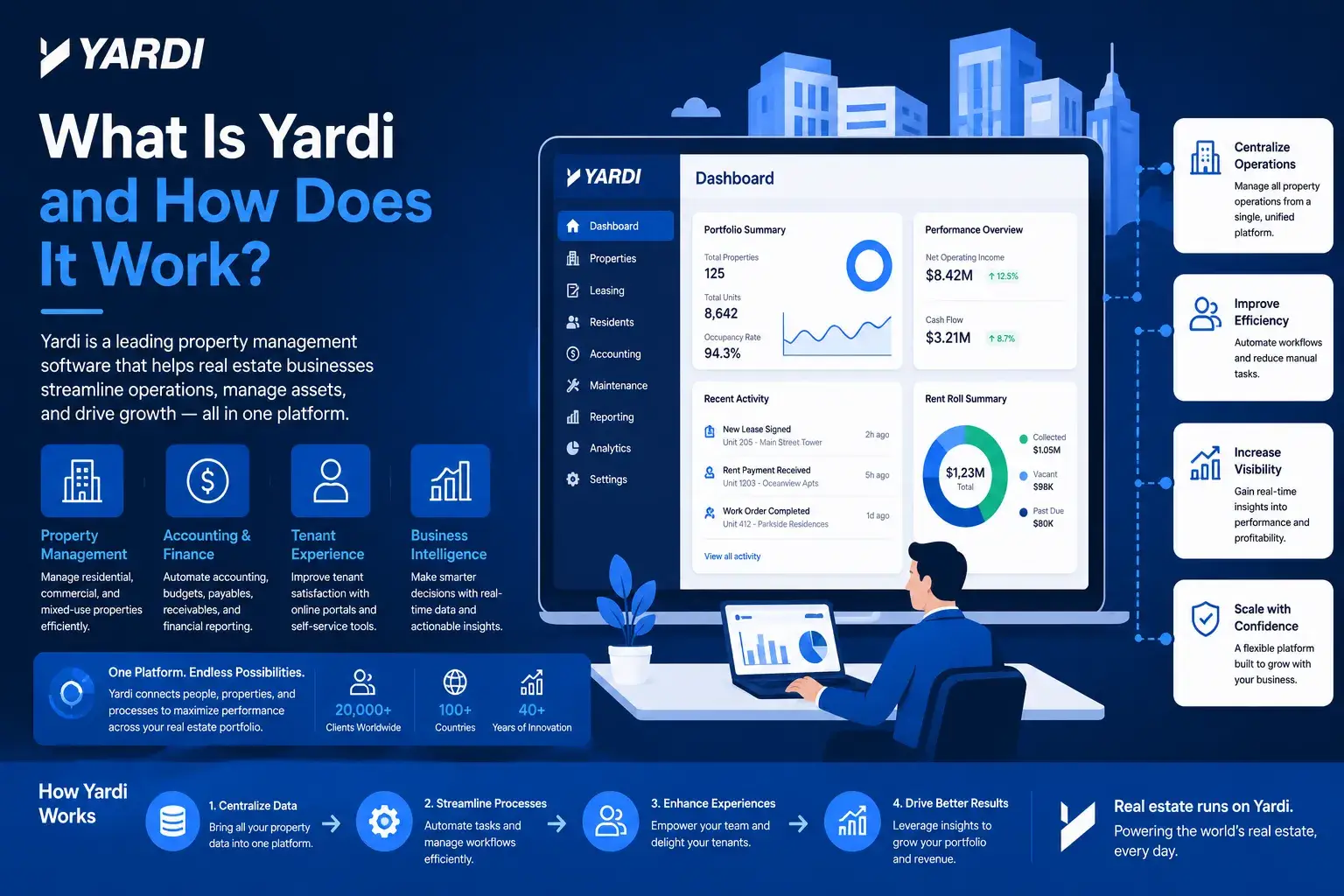
Key Takeaways
What You’ll Learn
- Yardi is a property management and real estate software platform used by businesses worldwide.
- The platform helps manage accounting, leasing, maintenance, tenants, and real estate operations.
- Cloud-based property management systems improve automation and operational efficiency.
- Yardi supports residential, commercial, student housing, and enterprise real estate management.
- Integrated analytics and automation tools help property businesses scale more effectively.
Stats That Matter
- Yardi serves real estate businesses across residential, commercial, and enterprise property sectors.
- Property management software adoption continues increasing with real estate digital transformation.
- Cloud-based real estate platforms improve operational visibility and tenant management efficiency.
- Automation and analytics tools are becoming standard in modern property management systems.
- Real estate businesses increasingly rely on SaaS platforms for centralized property operations.
Real Insights
- Property management platforms succeed when they simplify complex operational workflows.
- Centralized dashboards help businesses manage multiple properties more efficiently.
- Tenant communication and maintenance automation improve customer satisfaction.
- Scalable SaaS infrastructure is essential for enterprise-level real estate management.
- Long-term growth depends on automation, compliance, reporting accuracy, and user experience.
Imagine you manage dozens or even hundreds of rental units across multiple buildings. Every day you deal with tenant applications, rent payments, maintenance requests, lease renewals, accounting, and reporting.
Handling all of this manually or with spreadsheets quickly becomes overwhelming.
That’s where Yardi comes in.
Yardi is a powerful property management platform that helps real estate companies manage properties, tenants, finances, and operations in one centralized system. Instead of juggling multiple tools, property managers can handle everything from leasing to accounting through a single digital platform.
How Yardi Started and Why It Matters
Yardi was founded in the United States in 1984 with the goal of creating software that simplifies real estate and property management operations. Over time, the company developed a full suite of cloud-based solutions used by property managers, real estate investors, and housing organizations around the world.
Today, Yardi is one of the most widely used property management technology providers. Its software supports residential properties, commercial real estate, student housing, senior living communities, and large real estate investment portfolios.
What You’ll Learn in This Guide
By the end of this guide, you’ll understand what Yardi is, how the platform works for property managers and tenants, how its business model generates revenue, the features that make it successful, the technology behind the system, and how businesses can build similar property management platforms.
What Is Yardi? The Simple Explanation
What Is Yardi ?
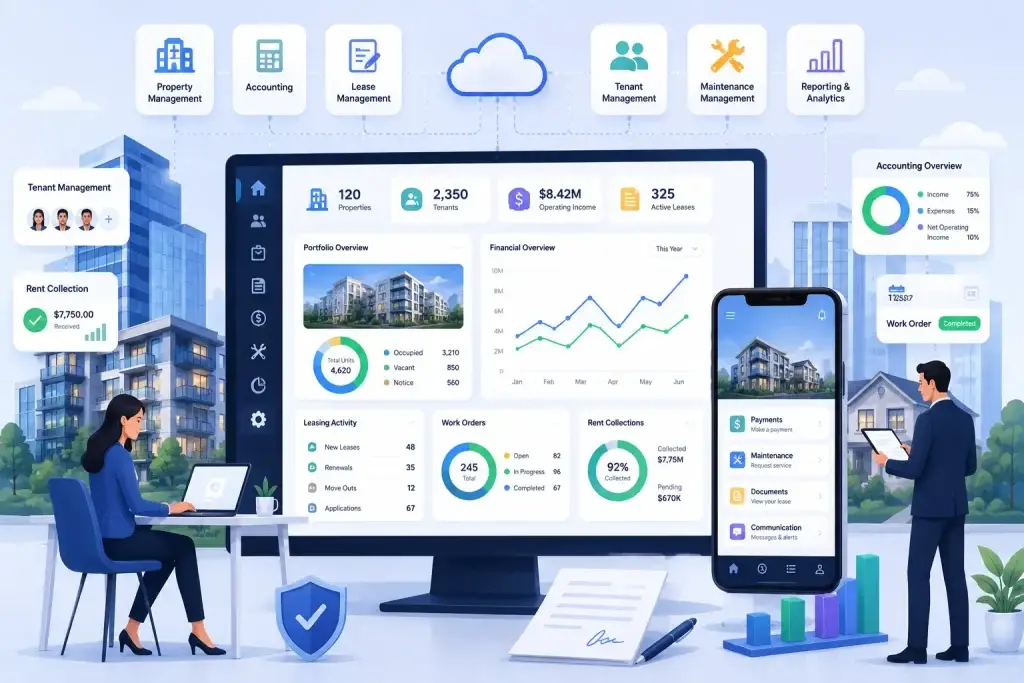
Yardi is a cloud-based property management and real estate software platform used by property managers, landlords, and real estate companies to manage properties, tenants, leases, accounting, and maintenance operations. It centralizes property management tasks into a single system, allowing organizations to track financial performance, manage tenant relationships, and streamline property operations efficiently.
The Core Problem Yardi Solves
Managing properties involves many operational challenges. Property managers must track rent payments, maintain tenant records, handle lease agreements, manage maintenance requests, and keep financial accounts updated.
Without a centralized system, these tasks often require multiple tools or manual processes, which can lead to errors and inefficiencies.
Yardi solves this problem by providing an all-in-one property management platform where managers can handle leasing, accounting, reporting, maintenance tracking, and tenant communication from a single dashboard.
In simple terms, Yardi simplifies complex property management workflows.
Who Uses Yardi?
Yardi serves a wide range of users within the real estate industry:
• Property management companies
• Real estate investment firms
• Commercial property managers
• Residential housing operators
• Student housing providers
• Senior living community managers
Because of its flexible system architecture, Yardi can support both small property portfolios and large global real estate organizations.
Yardi’s Market Position
Yardi is considered one of the leading property management software providers in the real estate technology (PropTech) industry. Many large real estate companies and property management firms rely on Yardi’s solutions to manage their property portfolios and operational processes.
The platform supports millions of rental units and commercial spaces across various markets worldwide.
Why Did Yardi Become Successful?
Yardi gained widespread adoption because it addresses the operational complexity of property management.
Its success is driven by several factors:
• Comprehensive property management tools
• Strong accounting and financial reporting capabilities
• Cloud-based accessibility
• Integration with property listing and leasing platforms
• Scalable solutions for different property types
These capabilities make Yardi a preferred solution for real estate organizations managing large property portfolios.
What Makes Yardi Different from Traditional Property Management Methods?
Traditional property management often relies on spreadsheets, separate accounting tools, and manual tenant communication processes.
Yardi replaces these fragmented workflows with a centralized digital platform that integrates leasing, accounting, operations, and reporting.
This allows property managers to automate routine tasks, track property performance, and improve tenant service.
How Does Yardi Work? Step-by-Step Breakdown
Yardi works as a property management and real estate operations platform that helps property managers, landlords, and real estate companies manage their entire portfolio from a centralized system. It integrates leasing, tenant management, accounting, maintenance, and reporting into one digital platform.
How Yardi Works for Property Managers
Account Setup and System Configuration
• Property management companies subscribe to the Yardi platform
• Administrators configure company settings, property portfolios, and user roles
• Properties, units, and financial structures are added to the system
Once configured, managers can oversee all properties through a centralized dashboard.
Property and Unit Management
• Managers add property details such as buildings, units, and amenities
• Rental pricing, lease terms, and availability calendars are configured
• Property data is organized for easy access and reporting
This helps property managers keep track of available units and rental information across multiple properties.
Tenant and Lease Management
• Tenants apply for rentals through integrated leasing systems
• Lease agreements are stored and managed digitally
• Tenant profiles include contact information, payment history, and lease terms
Managers can easily track lease expirations, renewals, and tenant communication.
Rent Collection and Payment Processing
• Tenants can pay rent through online portals
• Payments are automatically recorded in the accounting system
• Late fees and reminders can be generated automatically
This automation reduces manual rent collection tasks and improves financial tracking.
Maintenance Request Management
• Tenants submit maintenance requests through tenant portals
• Property managers assign tasks to maintenance teams
• Work orders are tracked until completion
This feature improves response time and ensures property maintenance tasks are documented.
How Yardi Works for Tenants
Tenant Portal Access
• Tenants create accounts through property portals powered by Yardi
• They can view lease details, payment history, and property announcements
The portal acts as a communication channel between tenants and property managers.
Online Rent Payments
• Tenants can pay rent digitally using available payment methods
• Payment confirmations are stored in their account
This reduces the need for manual rent payments and simplifies record keeping.
Maintenance Requests
• Tenants submit repair requests through the portal
• They can track request status and communicate with property management
This helps ensure maintenance issues are handled efficiently.
Technical Overview Explained Simply
Yardi operates as a cloud-based property management system that stores property data, tenant records, and financial transactions in centralized databases.
Core platform components include:
• Property management databases
• Tenant relationship management systems
• Accounting and financial reporting tools
• Maintenance tracking systems
• Web and mobile applications
Property managers input data about properties and tenants, and the platform organizes this information to automate operations such as rent collection, reporting, and maintenance management.
In simple terms, Yardi acts as the digital backbone of property management operations, helping real estate organizations manage properties efficiently while improving tenant services.
Yardi’s Business Model Explained
Yardi operates as a software-as-a-service (SaaS) platform that provides property management and real estate management tools to organizations. Instead of charging per transaction like travel marketplaces, Yardi generates revenue by offering subscription-based software solutions to property managers, real estate companies, and housing organizations.
How Yardi Makes Money
• Subscription fees for software usage
• Licensing for enterprise property management solutions
• Add-on modules and specialized tools
• Implementation and onboarding services
• Data analytics and reporting tools
Most of Yardi’s revenue comes from organizations paying recurring fees to access its property management platform.
Subscription-Based Software Fees
Companies subscribe to Yardi’s software to manage their property portfolios. The pricing often depends on the number of properties, units, or users within the system.
For example:
• Property management companies pay based on the size of their portfolio
• Enterprise clients may pay for customized software packages
• Housing organizations subscribe to industry-specific modules
Why It Matters: Subscription-based pricing provides predictable recurring revenue for the company.
Technical Innovation: Cloud-based SaaS infrastructure allows clients to access the platform securely from anywhere.
Enterprise Property Management Solutions
Yardi provides enterprise-level software solutions for large real estate companies managing thousands of properties.
These solutions often include:
• Advanced financial management systems
• Asset and investment management tools
• Portfolio performance analytics
• Multi-property operational dashboards
Why It Matters: Large real estate companies require scalable systems to manage complex property portfolios.
Technical Innovation: Scalable cloud architecture designed to support large property databases and enterprise workflows.
Add-On Modules and Specialized Tools
Yardi offers specialized modules for different property sectors and operational needs.
Examples include:
• Residential property management tools
• Commercial real estate management systems
• Student housing management solutions
• Senior living property software
• Maintenance and facility management tools
Why It Matters: Organizations can customize the platform to match their operational requirements.
Technical Innovation: Modular software architecture allows organizations to activate specific tools when needed.
Implementation and Onboarding Services
When organizations adopt Yardi software, they often require onboarding services to configure the platform for their operations.
These services may include:
• Data migration from existing systems
• Staff training programs
• System configuration and customization
Why It Matters: Proper implementation ensures the platform integrates smoothly into property management operations.
Technical Innovation: Structured onboarding workflows and data migration tools simplify system deployment.
Market Size and Industry Demand
The global property management software market continues to grow as real estate organizations move toward digital operations.
Platforms like Yardi benefit from:
• Increasing real estate portfolio complexity
• Demand for automated financial reporting
• Growing adoption of cloud-based property management systems
• Expansion of real estate investment and property development
As the real estate industry becomes more technology-driven, property management platforms continue to play a crucial role.
Revenue Model Breakdown
| Revenue Stream | How It Works | Why It Matters |
|---|---|---|
| SaaS Subscriptions | Recurring software access fees | Core revenue driver |
| Enterprise Solutions | Custom software packages for large firms | Supports large real estate portfolios |
| Add-On Modules | Specialized tools for property sectors | Flexible customization |
| Implementation Services | Setup, training, and system deployment | Smooth client onboarding |
Yardi’s business model focuses on providing comprehensive property management software solutions that help real estate companies operate efficiently while generating recurring subscription revenue.
Read More :- Business Model for Real Estate App
Key Features That Make Yardi Successful
Yardi has become one of the most widely used property management platforms because it offers a comprehensive set of tools that cover nearly every aspect of real estate operations. These features help property managers streamline workflows, track financial performance, and improve tenant experiences.
Centralized Property Management Dashboard
Yardi provides a unified dashboard where property managers can oversee multiple properties and portfolios from one interface.
Why It Matters: Managers can monitor operations, occupancy rates, and financial performance without switching between systems.
Technical Innovation: Cloud-based data aggregation systems that combine property, tenant, and financial data in real time.
Integrated Accounting and Financial Management
The platform includes built-in accounting tools that track rent payments, expenses, budgets, and financial reports.
Why It Matters: Property managers can manage finances without needing separate accounting software.
Technical Innovation: Automated financial reporting engines integrated with property transaction records.
Tenant and Lease Management
Yardi stores tenant information, lease agreements, and payment histories in one centralized system.
Why It Matters: Property managers can easily track lease terms, renewals, and tenant communication.
Technical Innovation: Tenant relationship management systems connected to lease lifecycle automation tools.
Online Rent Payment System
Tenants can pay rent digitally through secure online portals powered by Yardi.
Why It Matters: Digital rent payments reduce administrative work and improve payment efficiency.
Technical Innovation: Secure payment gateways integrated with property accounting systems.
Maintenance Request Tracking
Tenants can submit maintenance requests through online portals, and property managers can assign work orders to maintenance teams.
Why It Matters: Maintenance issues can be tracked and resolved more efficiently.
Technical Innovation: Automated work order management systems with real-time status tracking.
Property Marketing and Leasing Tools
Yardi offers tools for advertising rental units, managing applications, and screening tenants.
Why It Matters: Property managers can attract and approve tenants more quickly.
Technical Innovation: Integration with property listing platforms and automated tenant screening systems.
Tenant Communication Portals
Tenants can access portals to view lease details, submit maintenance requests, and receive property updates.
Why It Matters: Clear communication improves tenant satisfaction and retention.
Technical Innovation: Secure cloud-based tenant portals with messaging and notification systems.
Data Analytics and Reporting Tools
Yardi generates reports on property performance, occupancy rates, revenue, and operational efficiency.
Why It Matters: Real estate organizations can make data-driven decisions about property investments and management strategies.
Technical Innovation: Advanced analytics engines that process large real estate datasets.
Mobile Access for Property Managers
Yardi provides mobile applications that allow property managers to manage properties remotely.
Why It Matters: Managers can respond to tenant issues, track maintenance, and review reports from anywhere.
Technical Innovation: Mobile-optimized applications connected to cloud-based property databases.
Scalable Enterprise Property Management
The platform supports both small property portfolios and large global real estate organizations.
Why It Matters: Real estate companies can scale operations without changing management systems.
Technical Innovation: Modular software architecture designed to support enterprise-level property portfolios.
What Sets Yardi Apart
Yardi stands out because it combines property management operations, financial accounting, tenant services, and reporting tools into one integrated platform. This all-in-one approach helps real estate organizations manage complex property portfolios more efficiently.
The Technology Behind Yardi
Yardi operates as a cloud-based enterprise software platform designed to support complex real estate operations. Behind the user-friendly interface is a robust technology infrastructure that manages property data, financial records, tenant information, and operational workflows across thousands of properties.
Tech Stack Overview Simplified
Yardi runs on a scalable cloud infrastructure that connects property managers, tenants, and financial systems through centralized software.
The system typically includes:
• Web-based property management applications
• Mobile apps for property managers and tenants
• Backend servers managing property and financial data
• Databases storing lease agreements, tenant records, and accounting transactions
• Cloud hosting infrastructure supporting secure global access
These components allow real estate companies to manage large property portfolios from anywhere.
Property and Tenant Data Management
Yardi handles massive amounts of property and tenant data. Each property in the system includes details such as:
• Building and unit information
• Lease agreements and tenant records
• Rental pricing and payment history
• Maintenance requests and work orders
• Financial transactions and accounting data
Why It Matters: Property managers can access all operational data from one centralized platform.
Technical Innovation: Enterprise-grade relational databases optimized for real estate management workflows.
Financial and Accounting Infrastructure
One of Yardi’s strongest technological capabilities is its built-in accounting system.
The platform automatically tracks:
• Rent payments
• Property expenses
• Financial statements
• Budget reports
• Investment performance metrics
Why It Matters: Property management companies can manage accounting without using external financial software.
Technical Innovation: Integrated financial engines designed specifically for real estate accounting standards.
Real-Time Operational Automation
Yardi automates many operational processes that property managers previously handled manually.
Examples include:
• Automated rent reminders
• Lease expiration notifications
• Maintenance work order tracking
• Financial reporting generation
Why It Matters: Automation reduces administrative workload and improves operational efficiency.
Technical Innovation: Workflow automation systems connected to real-time property databases.
Mobile and Web Platform Integration
Property managers and tenants often access the platform through both web browsers and mobile apps.
The mobile system allows users to:
• Submit maintenance requests
• Track property performance
• Review financial reports
• Communicate with tenants
Why It Matters: Managers can operate properties even when they are not physically on-site.
Technical Innovation: Cloud-synchronized applications that update property data across devices instantly.
Data Analytics and Reporting
Yardi collects operational and financial data from properties and converts it into actionable insights.
Analytics tools provide reports such as:
• Occupancy rates
• Rental income trends
• Maintenance costs
• Portfolio performance
Why It Matters: Real estate companies can make informed investment and management decisions.
Technical Innovation: Data analytics engines that process real estate performance metrics across large property portfolios.
Scalability and Enterprise Infrastructure
Many Yardi clients manage thousands of rental units or commercial properties. The platform’s architecture is designed to support large-scale real estate operations.
Infrastructure features include:
• Cloud-based server clusters
• Data security systems
• Load balancing for high performance
• Scalable storage for property and financial records
Why It Matters: Large property management companies can scale operations without switching platforms.
API Integrations
Yardi integrates with many third-party tools and systems used in the real estate industry.
Examples include:
• Online property listing platforms
• Payment processing services
• Tenant screening services
• Accounting and tax reporting tools
• Smart building and facility management systems
Why It Matters: Integrations allow Yardi to function as the central technology hub for property management operations.
Why This Technology Matters for Business
The technology behind Yardi enables real estate organizations to automate property management, centralize financial data, and streamline operations across large property portfolios.
By combining cloud infrastructure, automation systems, and integrated accounting tools, Yardi helps real estate companies manage properties more efficiently while improving tenant services.
Also Read :- How to Develop a Real Estate App
Yardi’s Impact & Market Opportunity
Yardi has played a significant role in transforming how real estate companies manage properties and tenants. By digitizing property management operations, the platform helped shift the industry from manual processes to data-driven property management systems.
How Yardi Disrupted Property Management
Before property management software became common, many property managers relied on spreadsheets, paper documents, and separate accounting systems. This made it difficult to track property performance, tenant records, and financial data efficiently.
Yardi introduced a centralized digital platform that integrates property operations, financial accounting, tenant management, and reporting into one system.
This transformation introduced several improvements to the real estate industry:
• Automated rent collection and financial tracking
• Centralized tenant and lease management
• Faster maintenance request handling
• Data-driven property performance analysis
• Scalable tools for managing large real estate portfolios
These innovations helped property managers improve efficiency and reduce operational complexity.
Market Size and Growth Potential
The global property management software market has grown rapidly as real estate companies increasingly adopt digital management tools.
Growth in this sector is driven by several factors:
• Expansion of real estate investment portfolios
• Rising demand for rental housing
• Increasing complexity of property operations
• Adoption of cloud-based software systems
• Growth of real estate technology (PropTech)
As property portfolios become larger and more complex, software platforms like Yardi play an essential role in managing operations efficiently.
User Demographics and Industry Adoption
Yardi is widely used across multiple segments of the real estate industry.
Typical users include:
• Residential property management companies
• Commercial real estate operators
• Real estate investment firms
• Student housing providers
• Senior living community operators
• Government housing agencies
These organizations rely on property management software to handle large property portfolios and maintain efficient operational workflows.
Global Reach
Yardi’s software solutions are used by real estate organizations in many countries around the world. The platform supports various property types and operational models.
Properties managed through Yardi systems may include:
• Apartment complexes
• Commercial office buildings
• Retail properties
• Student housing communities
• Senior living facilities
This flexibility allows the platform to serve a wide range of real estate sectors.
Future Trends in Property Management Technology
The future of property management platforms is likely to include:
• AI-driven property analytics
• Predictive maintenance systems
• Smart building integrations
• Automated tenant communication tools
• Advanced financial forecasting for property portfolios
As real estate technology continues evolving, property management platforms will play a larger role in optimizing property operations.
Opportunities for Entrepreneurs
The success of Yardi highlights the growing demand for digital tools in the real estate industry. Entrepreneurs can explore opportunities such as:
• Property management software platforms
• Rental property automation tools
• Tenant experience apps
• Real estate portfolio analytics platforms
• Smart building management systems
By combining property data, automation tools, and financial management systems, new platforms can serve specialized segments of the real estate technology market.
This growing demand is why many entrepreneurs want to build platforms similar to Yardi that help property managers streamline operations through technology-driven solutions.
Building Your Own Yardi-Like Platform
After understanding how Yardi works, many entrepreneurs and real estate technology startups consider building similar property management platforms. As the real estate industry continues to digitize operations, the demand for property management software keeps increasing.
Why Businesses Want a Yardi Clone
Property management software solves complex operational challenges for real estate companies. A well-built platform can become the central system for managing properties, tenants, finances, and maintenance operations.
Businesses are interested in this model because it offers:
• Recurring subscription-based revenue
• High demand from real estate companies
• Long-term enterprise clients
• Scalable SaaS infrastructure
• Opportunities to expand into real estate analytics and automation
Instead of managing properties directly, the platform provides tools that help property managers run their operations more efficiently.
Key Considerations Before Development
Before building a property management system like Yardi, businesses should evaluate several factors:
• Target property segment (residential, commercial, student housing, etc.)
• Core features required by property managers
• Integration with payment processing systems
• Data security and tenant privacy compliance
• Scalability for managing large property portfolios
• Customer onboarding and training processes
A successful property management platform must support both operational workflows and financial management.
Miracuves Yardi-Like Property Management Platform Solution Cost and Tech Stack
Miracuves Pricing for a Yardi-Like Property Management Platform developed using Node.js / React.js Architecture is available on request. Contact Miracuves for custom pricing based on platform features, scalability requirements, integrations, and deployment scope. Estimated delivery timeline: 30 to 90 Days.
Build a powerful property management and real estate operations platform designed for startups, real estate companies, property managers, housing enterprises, and large-scale real estate operations.
Core Workflows: Property listing management, tenant management, lease tracking, rent collection, maintenance request handling, accounting workflows, and real estate operations management.
Built-in Finance: Rent payment processing, accounting systems, expense tracking, financial reporting, invoice management, budgeting workflows, transaction monitoring, and real estate financial analytics.
Management Hub: Admin dashboards, tenant management systems, property analytics, maintenance controls, document management, reporting dashboards, audit logs, and centralized property operations management.
Enterprise-Ready: Fully customizable architecture prepared for secure scaling, multi-property management, enterprise real estate workflows, cloud infrastructure expansion, compliance-ready systems, and long-term platform growth.
Why does a Yardi-Like Platform require Node.js / React.js architecture?
Property management platforms process large volumes of tenant data, financial operations, lease workflows, maintenance requests, and real-time property management activities. These platforms require scalable infrastructure, secure data handling, and highly responsive dashboards for property managers and administrators.
We recommend a modern JavaScript-based architecture for this type of platform because:
Built for Real-Time Operations: Node.js enables scalable backend operations for rent tracking, lease management workflows, maintenance systems, payment processing, and concurrent property management activities.
Advanced Dashboard Experience: React.js supports highly interactive interfaces for property analytics, tenant management dashboards, accounting systems, maintenance workflows, and operational reporting.
Enterprise Scalability: This architecture is well-suited for handling large property portfolios, multi-location operations, enterprise housing ecosystems, and growing real estate platforms.
Flexible Integration Layer: Easily integrates with payment gateways, accounting software, CRM systems, IoT property tools, document management platforms, analytics systems, and tenant communication services.
You get a scalable, enterprise-grade property management platform designed for long-term operational growth.
Note: Final pricing depends on platform modules, property management workflows, third-party integrations, deployment infrastructure, enterprise requirements, and custom feature development. can be discussed and arranged upon request — Contact us
Essential Features to Include
A strong property management platform should include:
• Property and unit management systems
• Tenant and lease management tools
• Online rent payment systems
• Maintenance request tracking
• Financial accounting and reporting tools
• Tenant communication portals
• Admin dashboards for portfolio oversight
• Data analytics and performance reports
Advanced features may include:
• AI-powered property analytics
• Predictive maintenance alerts
• Smart building integrations
• Automated lease renewal systems
• Mobile apps for property managers and tenants
Read More :- How to Market a Real Estate App Successfully After Launch
Conclusion
Yardi demonstrates how technology can transform traditional property management into a streamlined, data-driven process. By bringing leasing, accounting, tenant communication, and maintenance management into one integrated platform, it helps real estate organizations operate more efficiently and scale their portfolios with greater control.
For entrepreneurs and technology companies, the bigger lesson is the value of building industry-specific SaaS platforms. When software successfully solves complex operational problems for businesses, it becomes an essential tool that companies rely on every day. As real estate continues to embrace digital transformation, platforms like Yardi will remain central to modern property management.
FAQs :-
What is Yardi?
Yardi is a cloud-based property management software platform used by real estate companies, landlords, and property managers to manage properties, tenants, leases, finances, and maintenance operations in one centralized system.
How does Yardi make money?
Yardi generates revenue mainly through subscription-based software services. Property management companies pay recurring fees to use the platform’s tools for managing their real estate portfolios.
Who typically uses Yardi?
Yardi is used by property management companies, real estate investors, commercial property managers, student housing operators, senior living communities, and government housing agencies.
Is Yardi only for large real estate companies?
No. While many large real estate firms use Yardi, the platform also supports smaller property managers who manage residential or commercial property portfolios.
What features does Yardi provide?
Yardi offers features such as property management dashboards, tenant and lease tracking, online rent payments, maintenance request management, financial accounting tools, and advanced reporting systems.
Can tenants interact with Yardi systems?
Yes. Many properties using Yardi provide tenant portals where residents can pay rent online, submit maintenance requests, view lease information, and communicate with property managers.
What makes Yardi different from other property management software?
Yardi stands out because it combines property management operations, financial accounting, tenant services, and reporting tools into one integrated cloud platform.
What technology does Yardi use?
Yardi uses cloud-based infrastructure, enterprise databases, automation workflows, analytics systems, and web and mobile applications to manage real estate operations efficiently.
How many properties are managed through Yardi?
Yardi software is used by real estate organizations managing millions of residential units and commercial properties across many countries worldwide.
Can I build software similar to Yardi?
Yes. Businesses can build property management platforms that provide tools for managing properties, tenants, finances, and maintenance operations. Companies like Miracuves help entrepreneurs launch customized property management software solutions with scalable features for real estate businesses.