Key Takeaways
- Creator platform scalability becomes critical during viral PPV drops, live launches, and sudden traffic spikes that generate thousands of simultaneous purchase requests.
- The real challenge is not only handling traffic volume; it is preventing payment failures, duplicate transactions, entitlement issues, and database bottlenecks.
- A scalable creator platform should separate payment processing, media delivery, notifications, analytics, and entitlement systems into independent infrastructure layers.
- Strong backend architecture helps maintain reliable unlocks, creator payouts, secure transactions, and smooth media access even during viral traffic surges.
- Long-term creator platform success depends on payment reliability, scalable infrastructure, low-latency delivery, operational monitoring, and transaction consistency.
Scalability Signals
- Viral PPV events can overload traditional backend systems because thousands of users may attempt payments, unlocks, retries, and media requests at the same moment.
- Decoupled architecture improves reliability by separating payment queues, entitlement validation, media delivery, notifications, and analytics processing.
- Queue systems, caching layers, database optimization, event-driven workflows, and CDN delivery help reduce bottlenecks during traffic spikes.
- Payment consistency matters because a creator platform can appear online while still failing through duplicate charges, delayed unlocks, or incorrect payout calculations.
- Infrastructure complexity changes based on creator volume, PPV traffic intensity, subscription logic, payment gateways, media size, concurrency levels, and real-time analytics needs.
Real Insights
- A creator platform is not only a media app; it is a real-time transaction system where payments, content access, and user trust must stay synchronized.
- Many platforms fail during viral events because they scale frontend traffic but ignore transaction consistency and backend coordination.
- Founders should treat PPV unlocks like financial operations because payment reliability directly affects creator trust and platform reputation.
- Real scalability comes from infrastructure planning, not just bigger servers, because bottlenecks often appear in databases, queues, callbacks, and entitlement workflows.
- The strongest creator platform scalability strategy combines decoupled architecture, reliable payment handling, CDN optimization, queue-based processing, and real-time operational monitoring.
A creator’s biggest campaign should become a revenue event—not an infrastructure incident.
Creator platform scalability becomes critical when a creator publishes a limited Pay-Per-View drop and thousands of followers attempt to unlock it within the same short window.
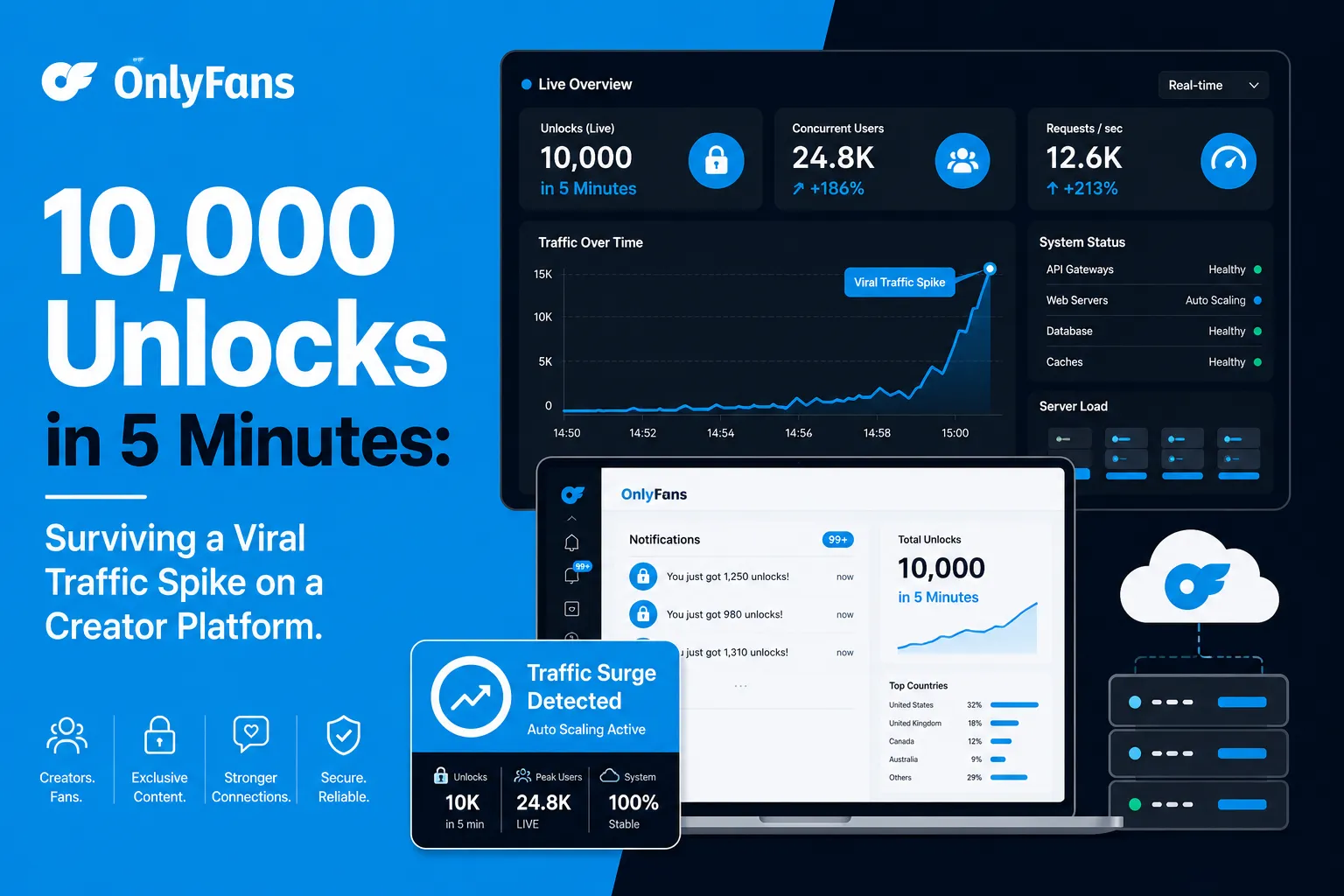
Miracuves tested a creator-platform transaction architecture against a concentrated workload representing 10,000 PPV unlocks within five minutes. According to the supplied load-test results, the system completed the workload without a database timeout.
Platforms operating in the OnlyFans Clone creator economy may support subscriptions, tips, paid messages, and PPV content, but their real infrastructure challenge appears when a major creator generates concentrated purchase demand.
This case study explains the architecture behind that test and why creator economy founders should evaluate transaction behaviour under viral load before trusting a platform with a major campaign.
The Viral Drop That Turned Payment Reliability Into the Main Product Requirement
The test scenario represented a familiar creator-economy event.
A creator announces an exclusive paid release to a large audience. The campaign is amplified across social channels, direct messages, agency networks, and fan communities. Instead of traffic growing gradually, demand arrives as a steep burst.
Within a five-minute window, the platform receives 10,000 attempts to unlock the same PPV asset.
For the business, this is an ideal outcome. For an unprepared backend, it creates several concentrated pressures:
- Thousands of users request the same product record.
- Payment requests arrive faster than they can be resolved sequentially.
- Multiple services attempt to update related database rows.
- Buyers retry when a screen appears slow.
- Payment-provider callbacks arrive out of order.
- Successful buyers immediately request protected media.
- Analytics, notifications, wallet updates, and creator dashboards generate secondary writes.
A conventional performance test might count successful API responses. That would not be enough here.
A creator platform can return a 200 OK response while still producing a financially incorrect result. A buyer could be charged twice. A successful payment could lack an entitlement. The creator balance could be updated twice. A failed purchase might accidentally unlock the content. A delayed webhook might overwrite a newer transaction state.
The pass criteria therefore had to reflect business truth:
| Test Requirement | Why It Mattered |
|---|---|
| No database timeouts | A timeout can leave the buyer uncertain and trigger retries |
| No duplicated unlocks | Duplicate entitlement records distort access and reporting |
| No duplicated charges initiated by retries | Payment retries must remain financially safe |
| One valid entitlement per successful purchase | Payment and access must stay consistent |
| Failed payments must not unlock content | Access control cannot rely on the client response alone |
| Creator ledger must reconcile with valid purchases | Revenue reporting must remain auditable |
| Media demand must not slow transaction processing | Video delivery and financial writes require separate scaling paths |
The core insight was straightforward: a viral PPV drop is not merely a traffic problem. It is a distributed transaction problem.
Read more: The Future Beyond OnlyFans: Creator : Led Platforms, Fan Ownership, and AI Monetization
The PPV Bottleneck: Why Standard Databases Freeze Under Viral Load
One of the biggest threats to creator platform scalability is placing nearly every payment, database, entitlement, and reporting operation inside a single request path.
A buyer taps “Unlock.” The application opens a database connection, reads the user, reads the content record, creates a payment request, waits for a response, writes the order, creates access permission, updates the creator balance, records a notification, increments an analytics counter, and returns the protected media URL.
That workflow may appear reliable during normal traffic. Under a viral spike, its weaknesses become visible.
Database connections become the first queue
A relational database cannot accept an unlimited number of active connections. PostgreSQL, for example, exposes a configured maximum for concurrent connections, and its documentation treats active-connection control as an important performance consideration.
When each incoming unlock request opens or occupies a connection for the complete payment journey, the application quickly reaches the pool limit.
New requests then wait for a connection. As waiting time grows, clients retry. Those retries add more requests, creating a feedback loop:
Slow response → buyer retry → more database pressure → slower response
Increasing the connection limit alone does not eliminate the underlying problem. Too many active database processes can increase memory use, context switching, and resource contention. PostgreSQL’s own operational guidance recommends pooling and limiting active connections rather than treating unlimited concurrency as the solution.
The content record becomes a hot resource
All 10,000 buyers may be unlocking one content item.
If the purchase path synchronously updates the same content row—perhaps to increment purchase count, gross sales, or popularity—the row becomes a contention point. Transactions begin waiting for one another even though the buyers are independent.
The same problem can occur with:
- A creator’s aggregate earnings row
- A global platform-revenue counter
- A campaign inventory record
- A single analytics summary
- A shared wallet balance
- A notification counter
These convenient aggregate records can become dangerous write bottlenecks.
Long transactions hold resources too long
A database transaction should not remain open while the application waits for an external payment provider, sends an email, generates a notification, or requests a media token.
External systems have different response times and failure modes. Keeping a database connection and locks active while waiting for them reduces the number of purchases the platform can process concurrently.
Blind retries can create duplicate financial actions
During a spike, some requests will be interrupted by mobile-network changes, gateway delays, application restarts, or client timeouts.
The absence of a response does not necessarily mean the payment failed. A naive client may submit the same purchase again, resulting in two payment objects or two completed unlocks.
Stripe recommends idempotency keys for create and update requests precisely so requests can be retried after connection errors without unintentionally repeating the operation.
Generic scripts that treat every request as new may perform acceptably during demonstrations but expose founders to duplicate-charge disputes during real campaigns.
Decoupling the Payment Engine From the Media Server
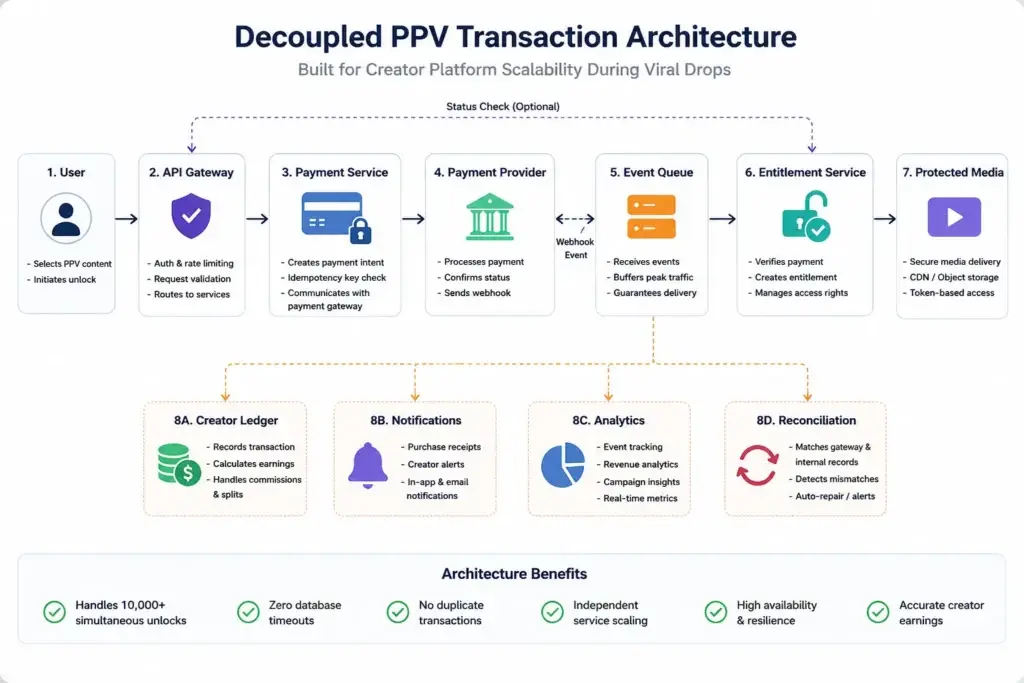
To improve creator platform scalability, the architecture used in the supplied Miracuves test separated the PPV journey into bounded responsibilities.
Instead of one request attempting to complete every business action, the transaction path was divided into independently scalable services.
1. The unlock API accepted purchase intent
The public API performed only the work required to establish a valid purchase attempt:
- Authenticate the user.
- Confirm that the content exists and is available.
- Validate price and currency from trusted server-side data.
- Create or retrieve the purchase attempt through an idempotency key.
- Initiate the payment workflow.
- Return a pending or confirmed state without waiting for secondary tasks.
This kept the initial request lightweight and reduced the time each request occupied application and database resources.
2. The payment engine became the source of payment state
The payment service was responsible for payment intent, status transitions, gateway references, retries, and webhook processing.
It did not serve video files. It did not generate thumbnails. It did not recalculate campaign analytics. It did not synchronously notify every downstream service.
Each purchase used a unique idempotency reference derived from stable business identifiers. Repeated requests for the same purchase therefore resolved to the existing operation rather than creating an uncontrolled second charge attempt.
This mirrors established payment-integration guidance: idempotency allows a system to retry an interrupted request safely instead of assuming that no response means no operation occurred.
3. The entitlement service controlled access
Payment success and content access are related, but they are not the same database operation.
Once the payment service confirmed a valid result, it published an event for the entitlement service. The entitlement service then created a durable access record connecting:
- Buyer
- PPV asset
- Purchase
- Access status
- Creation timestamp
- Revocation state, where applicable
A uniqueness constraint prevented multiple active entitlements from being created for the same valid purchase.
This separation meant a temporary delay in media access did not require the payment to be repeated. The system could safely retry entitlement creation using the original transaction identifier.
4. Media delivery scaled through a separate path
Once entitlement was confirmed, the buyer received time-limited access to the protected content through the media layer.
The application server did not stream the video directly from the same compute process handling purchases. Media assets were handled through scalable storage and delivery infrastructure, allowing video demand to grow independently of transaction writes.
That separation protected the financial path from a common failure pattern: successful buyers begin streaming immediately, media connections consume application resources, and new purchase requests become slower just as the campaign reaches its peak.
Miracuves applies this separation principle when planning scalable creator and video ecosystems, where payment workflows, background processing, cloud infrastructure, and media delivery must be treated as related but independently controlled layers.
Read More: How to Implement Secure Video-on-Demand (VOD) DRM Protection in Creator Apps
Zero Dropped Transactions: The Architecture of Scale
The test result depended on several mechanisms working together. No single technology created the outcome.
Idempotency protected the purchase boundary
Every unlock attempt received a stable operation identifier. When a request was retried, the backend checked whether that operation already existed.
Depending on its state, the application could:
- Return the existing successful purchase
- Continue a pending workflow
- Surface a confirmed failure
- Reconcile an unknown gateway result
- Refuse an invalid conflict
This is different from merely disabling the purchase button after one tap. Client-side controls improve usability, but they cannot protect against network retries, duplicated API calls, multiple devices, or webhook replay.
An immutable transaction record preserved financial history
Rather than repeatedly overwriting one mutable purchase record without history, the platform maintained an auditable sequence of transaction events.
Examples included:
- Purchase initiated
- Gateway request created
- Payment pending
- Payment confirmed
- Payment failed
- Entitlement requested
- Entitlement granted
- Refund initiated
- Access revoked
The current state could be derived or maintained for fast reads, while the event history supported reconciliation and investigation.
For founders and talent agencies, this matters when a creator disputes revenue, a buyer claims to have paid without receiving access, or a payment provider sends delayed information.
Queues absorbed the burst
Secondary work was published to queues rather than completed within the buyer’s request.
Queue-driven tasks included:
- Entitlement processing
- Creator ledger posting
- Platform commission calculation
- Purchase notifications
- Analytics aggregation
- Campaign counters
- Receipt generation
- Internal risk signals
The queue acted as a buffer between the sudden arrival rate and the sustainable processing rate of downstream services.
This did not mean delaying the essential financial decision. It meant separating critical purchase acknowledgement from work that could be processed moments later without harming the buyer.
Workers scaled independently
Because queued jobs were not tied to the original web request, worker capacity could be increased based on queue depth.
A rise in entitlement events did not require scaling the media server. A rise in notifications did not require adding database connections to the payment API. Each workload could be observed and scaled according to its own resource profile.
Connection pooling controlled database pressure
The application used a finite pool rather than allowing every request or worker to create uncontrolled direct connections.
Connection pooling reduces the number of physical database connections required to serve a larger number of application requests by reusing connections and queuing additional work when capacity is occupied.
The objective was not to keep every incoming request active inside the database. It was to keep database concurrency within a measured range while application and queue layers absorbed short-lived demand.
Hot aggregates were removed from the critical path
Purchase counters, creator revenue summaries, trending scores, and campaign analytics were not synchronously recalculated for every unlock.
The transaction path wrote the financially relevant event. Aggregate views were then updated asynchronously or computed from partitioned records.
That prevented 10,000 unlocks from fighting to update the same summary row.
Webhooks were treated as repeatable events
A payment webhook can arrive more than once, arrive late, or arrive after the frontend has lost connectivity.
The webhook handler therefore:
- Verified the provider signature
- Recorded the external event identifier
- Checked whether that event had already been processed
- Applied only valid state transitions
- Published downstream work idempotently
- Returned promptly
Stripe notes that webhooks communicate payment outcomes that may not be available to the initiating frontend, reinforcing why backend reconciliation must not depend solely on the buyer remaining online.
Reconciliation closed the gap between systems
No distributed payment system should assume every message will complete perfectly on the first attempt.
A reconciliation process compared:
- Gateway transaction state
- Internal purchase state
- Entitlement state
- Creator ledger entry
- Refund or dispute state
Any mismatch was flagged for automatic repair or administrative review.
This layer protected the platform from rare but financially important partial failures.
Architecture Components and Their Business Value
Architecture Component
Technical Function
Founder Impact
Idempotency Keys
Prevent repeated requests from creating duplicate operations.
Reduce duplicate-charge risk and support disputes.
Message Queues
Buffer burst traffic and defer non-critical processing.
Protect checkout performance during creator campaigns.
Entitlement Service
Separate payment confirmation from protected-content access.
Allow access failures to be repaired without charging again.
Connection Pooling
Control the number of active database sessions.
Reduce database exhaustion during concentrated demand.
Immutable Transaction Events
Preserve an auditable financial history.
Improve reconciliation, creator reporting, and dispute analysis.
CDN-Backed Media Delivery
Move video traffic away from transaction services.
Prevent content consumption from slowing new purchases.
Reconciliation Workers
Detect mismatches across gateway, purchase, ledger, and access states.
Protect revenue accuracy after partial failures.
| Architecture Component | Technical Function | Founder Impact |
|---|---|---|
| Idempotency Keys | Prevent repeated requests from creating duplicate operations. | Reduce duplicate-charge risk and support disputes. |
| Message Queues | Buffer burst traffic and defer non-critical processing. | Protect checkout performance during creator campaigns. |
| Entitlement Service | Separate payment confirmation from protected-content access. | Allow access failures to be repaired without charging again. |
| Connection Pooling | Control the number of active database sessions. | Reduce database exhaustion during concentrated demand. |
| Immutable Transaction Events | Preserve an auditable financial history. | Improve reconciliation, creator reporting, and dispute analysis. |
| CDN-Backed Media Delivery | Move video traffic away from transaction services. | Prevent content consumption from slowing new purchases. |
| Reconciliation Workers | Detect mismatches across gateway, purchase, ledger, and access states. | Protect revenue accuracy after partial failures. |
What the Load Test Measured Beyond a Successful HTTP Response
A credible PPV test should not stop at throughput.
The supplied scenario targeted 10,000 unlock operations over five minutes, equivalent to an average arrival rate of approximately 33.3 unlock attempts per second. The actual test should also include short bursts above that average because viral traffic rarely arrives evenly.
The engineering review should confirm the following measurements before this case study is published as validated evidence.
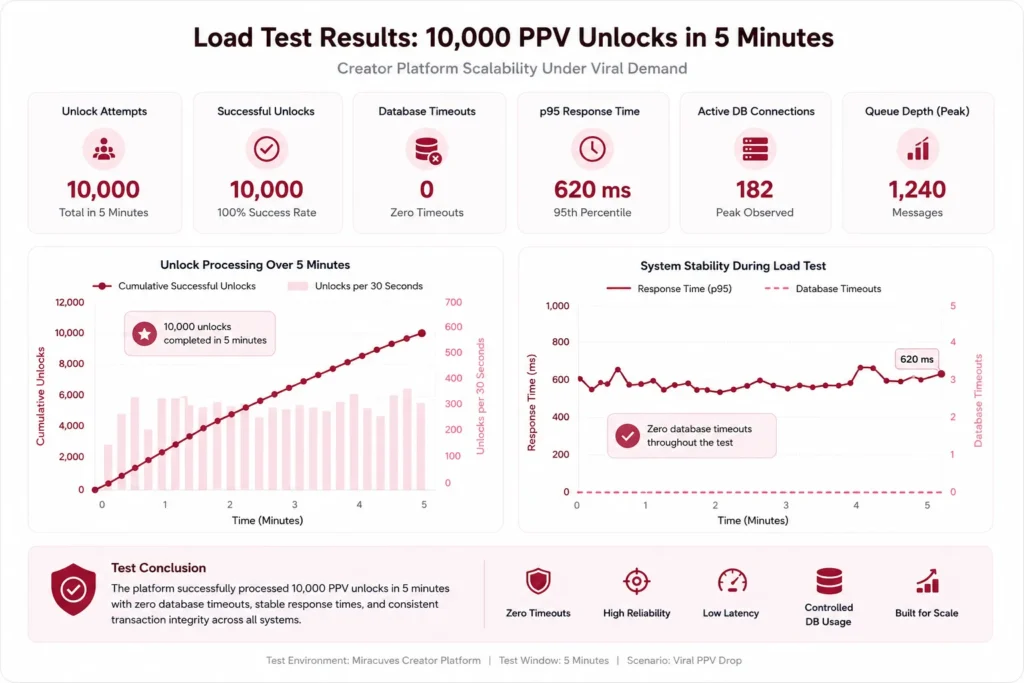
Transaction integrity
The total number of initiated operations should reconcile with:
- Successful payments
- Declined or failed payments
- Pending operations
- Cancelled attempts
- Duplicate requests resolved idempotently
No transaction should disappear between categories.
Entitlement integrity
Every confirmed purchase should have exactly one valid access entitlement, unless a documented refund or revocation applies.
Every failed payment should have no active entitlement.
Database health
Monitoring should verify:
- Zero database timeout errors
- Connection-pool saturation behaviour
- Query latency
- Lock-wait duration
- Deadlock count
- CPU and memory utilisation
- Write-ahead-log or replication pressure, where applicable
Queue health
The team should inspect:
- Maximum queue depth
- Oldest-message age
- Worker throughput
- Retry count
- Dead-letter events
- Time from payment confirmation to entitlement creation
User-perceived performance
Average latency alone can hide a poor experience for the slowest buyers. Reporting should therefore include percentile measurements such as:
- p50 response time
- p95 response time
- p99 response time
- Maximum observed response time
Financial correctness
The most important final calculation is not request count. It is reconciliation:
Confirmed gateway payments = valid internal purchases = valid creator-ledger entries = valid buyer entitlements
Any difference requires investigation, even when the API technically remained online.
Why Decoupling Matters More Than Simply Adding Servers
Horizontal scaling is useful, but adding more application servers cannot repair a tightly coupled purchase transaction.
Ten application instances can still overload one database. They can also generate ten times as many conflicting writes or duplicate gateway calls.
The scalable unit must be the workload, not merely the server.
In the tested design:
- Public APIs scaled according to incoming request volume.
- Payment workers scaled according to pending payment events.
- Entitlement workers scaled according to confirmed purchases.
- Notification workers scaled according to outbound messages.
- Media delivery scaled according to viewing demand.
- Analytics processing scaled according to event backlog.
- Database concurrency remained bounded through pools and short transactions.
This reduced the blast radius of each workload. A delayed notification could not prevent a purchase. A campaign analytics backlog could not block an entitlement. A media-viewing surge could not occupy payment workers.
That is the practical meaning of decoupling.
What Would Have Failed in a Generic Script
Not every ready-made platform is architecturally weak. The risk appears when a product is assembled around demonstration flows rather than failure behaviour.
Common warning signs include:
One database transaction performs the full unlock journey
Waiting for external APIs while holding database resources makes every slow dependency a checkout bottleneck.
Payment success is trusted from the client
The frontend can disconnect, be manipulated, or receive an incomplete response. Access should be based on verified backend payment state.
Retry requests create new purchases
Without idempotency, a buyer tapping twice or reconnecting after a timeout can create duplicate financial operations.
Creator earnings are updated as one shared balance row
A viral drop can turn one creator-balance record into a hot write target. Ledger entries should be recorded independently and aggregated safely.
Video is streamed by the transaction application
The system handling payments should not spend its resources maintaining thousands of media connections.
Analytics run synchronously
Trending scores, total unlock counters, agency dashboards, and campaign reports should not extend the checkout transaction.
No reconciliation job exists
Partial failures are inevitable in distributed systems. Without reconciliation, mismatches remain hidden until buyers or creators complain.
Founder Decision Signals Before Approving a Creator Platform
Founder Decision Signals
Transaction Proof
Ask for a workload model, success criteria, failure count, latency percentiles, and transaction reconciliation—not a general claim that the platform is scalable.
Retry Safety
Confirm that repeated purchase requests and payment webhooks are handled idempotently, without duplicated charges, access records, or creator earnings.
Service Separation
Payment processing, media delivery, entitlements, notifications, analytics, and creator accounting should not depend on one long synchronous request.
Operational Visibility
The admin layer should expose failed transactions, pending entitlements, queue health, reconciliation exceptions, refunds, and disputes.
For talent agencies, these signals matter because one campaign may affect several parties simultaneously: the buyer, creator, agency, payment provider, and platform operator. A transaction error is therefore not merely a technical inconvenience. It can become a revenue dispute and a creator-retention problem.
Read more: How to Launch a Profitable Creator Monetization Platform Like OnlyFans or Patreon
Security and Administrative Control During Viral Drops
Performance cannot come at the expense of payment integrity or access control.
A scalable creator platform should support:
- Encrypted data transfer
- Secure payment-gateway integration
- Tokenized payment handling where supported
- Role-based administrative access
- Creator and account verification workflows
- Signed webhook validation
- Audit logs for transaction-state changes
- Permission-based refund and dispute controls
- Protected media access
- Abuse reporting and content moderation
- Payout monitoring
- Suspicious-activity flags
Security should be treated as part of the product foundation rather than an optional feature layer. Final legal and compliance requirements depend on the operating jurisdiction, payment partners, content model, age restrictions, privacy obligations, and the platform’s business structure. Miracuves’ internal rules similarly require careful “compliance-ready” language rather than unsupported approval guarantees.
Mistakes Creator Platform Founders Should Avoid
Testing Only Normal Traffic
A platform that works with gradual demand may behave very differently when thousands of buyers target one creator and one asset simultaneously. Load tests should reproduce concentrated campaign behaviour.
Counting HTTP Success as Financial Success
A successful response does not prove that the buyer was charged once, received one entitlement, and generated one correct creator-ledger entry. Those states must be reconciled.
Scaling Media and Payments as One Service
The first successful buyers immediately create video demand. Without separation, content consumption can consume the same resources required to process remaining purchases.
Ignoring Webhook Replay and Delayed Events
Payment events can be repeated or delayed. Handlers must verify, deduplicate, and apply only valid state transitions.
Testing Only Normal Traffic
A platform that works with gradual demand may behave very differently when thousands of buyers target one creator and one asset simultaneously. Load tests should reproduce concentrated campaign behaviour.
Counting HTTP Success as Financial Success
A successful response does not prove that the buyer was charged once, received one entitlement, and generated one correct creator-ledger entry. Those states must be reconciled.
Scaling Media and Payments as One Service
The first successful buyers immediately create video demand. Without separation, content consumption can consume the same resources required to process remaining purchases.
Ignoring Webhook Replay and Delayed Events
Payment events can be repeated or delayed. Handlers must verify, deduplicate, and apply only valid state transitions.
The Business Result: Reliability Protects More Than One Sale
The immediate benefit of surviving a traffic spike is obvious: more valid purchases can be processed.
The broader value is more strategic.
Creator trust
Creators want confidence that the platform will not fail during the campaign they spent weeks building. Reliable transaction records also reduce uncertainty around earnings.
Buyer trust
A buyer who receives an error after attempting payment may submit the purchase again, contact support, or abandon the platform. Clear purchase states and retry-safe operations reduce that friction.
Agency confidence
Talent agencies coordinate releases across multiple creators. They need predictable reporting, campaign-level visibility, and a supportable audit trail.
Support efficiency
When every payment, entitlement, refund, and ledger movement has a traceable identifier, support teams can investigate problems without guessing.
Monetization flexibility
A decoupled transaction foundation can support more than PPV unlocks. It can also provide the basis for:
- Creator subscriptions
- Tips
- Paid direct messages
- Ticketed live sessions
- Premium communities
- Content bundles
- Digital downloads
- Agency commissions
- Promotional pricing
- Time-limited access
The product therefore becomes easier to evolve without forcing each new revenue model through one fragile checkout function.
Read more: Top 10 Key Features of a Successful OnlyFans Clone That Drives Subscriptions
Miracuves’ Approach to Creator Platform Reliability
Miracuves helps founders develop white-label creator platforms with source-code ownership, branded user experiences, admin control, monetization workflows, and infrastructure designed around the platform’s operating model.
For high-volume creator businesses, the important question is not whether PPV is listed in a feature sheet. It is whether payment initiation, gateway confirmation, entitlement creation, creator accounting, media delivery, and reconciliation are designed to remain correct under concentrated demand.
That is why architecture reviews should begin with failure scenarios:
- What happens when a buyer retries?
- What happens when the gateway responds late?
- What happens when one creator drives most of the day’s traffic?
- What happens when media requests grow immediately after purchase?
- What happens when an entitlement worker is temporarily unavailable?
- What happens when the creator ledger and gateway state disagree?
A founder-focused platform should have an explicit answer for each scenario.
Final Thoughts: Viral Reach Only Creates Value When Transactions Survive It
A viral creator campaign compresses demand, payment activity, media access, notifications, and reporting into a narrow operational window.
That is precisely when weak platform assumptions become visible.
The supplied test scenario shows that creator platform scalability depends on separating payment processing from media delivery, controlling database concurrency, making retries idempotent, queuing secondary work, and reconciling every financial state.
The deeper lesson is not that every creator platform needs the same infrastructure configuration. It is that every platform should be designed around its failure behaviour.
Creators may forgive a minor interface issue. They are less likely to forgive lost purchases, delayed access, duplicate charges, or inaccurate earnings during their most important campaign.
For creator economy founders and talent agencies, scalability is therefore not an infrastructure line item. It is part of the revenue promise made to every creator who brings an audience to the platform. To discuss a transaction-ready architecture for your creator platform, Contact us.
FAQs
How can a creator platform handle thousands of PPV purchases at once?
The purchase path should remain short, idempotent, and independent from media delivery, notifications, and analytics. Connection pooling, queues, scalable workers, durable transaction records, and reconciliation help the system absorb concentrated demand without allowing unlimited work to reach the database simultaneously.
What causes a creator-platform database to time out during viral traffic?
Common causes include exhausted connection pools, long-running transactions, repeated updates to hot rows, synchronous calls to external services, slow queries, lock contention, and buyers retrying delayed requests. Increasing database connections without reducing transaction duration can worsen resource pressure.
How do idempotency keys prevent duplicate PPV charges?
An idempotency key gives a purchase operation a stable identity. When the same request is submitted again, the backend retrieves or continues the existing operation instead of creating an unrelated second one. Payment-provider guidance recommends this pattern for safely retrying interrupted requests.
Should payment processing and video streaming use the same server?
They should generally scale through separate paths. Payment processing requires short, controlled, auditable operations, while video delivery creates bandwidth-heavy, longer-lived demand. Separating them prevents viewing traffic from consuming transaction capacity.
What should be included in a creator-platform load test?
The test should measure throughput, response-time percentiles, error rate, database timeouts, connection usage, queue depth, retries, duplicate operations, payment-to-entitlement delay, and reconciliation accuracy. The workload should also contain bursts rather than only a flat request rate.
Does zero database timeouts mean every transaction succeeded?
No. It means the database did not report that specific failure during the measured workload. A complete result should also reconcile payment outcomes, entitlements, creator-ledger entries, duplicate attempts, failed operations, queue processing, and response-time percentiles.
Why does a creator platform need transaction reconciliation?
Payment providers, internal databases, entitlement services, and creator ledgers can temporarily disagree after timeouts, delayed webhooks, or partial failures. Reconciliation detects these mismatches and either repairs them automatically or routes them for review.
Can Miracuves build a white-label creator subscription platform?
Miracuves develops creator-platform solutions that can include branded user experiences, subscriptions, PPV monetization, creator workflows, protected media, source-code ownership, and administrative controls. The final architecture, integrations, delivery scope, and pricing depend on the required modules and expected workload.
Miracuves is an independent software development company. We are not affiliated with, connected to, sponsored by, or endorsed by any company or product named in this article.
Terms such as “X Clone” are used descriptively. It is how the software industry refers to building a platform with functionality comparable to a known service, and how clients search for it.
The entire design and codebase of our products is built by our own team. Our products contain no code, design, graphics, or content originating from any third-party website or applications.
All third-party names and marks referenced in this article are the property of their respective owners, referenced solely to identify the services discussed.