



Key Takeaways
What You’ll Learn
- Hopper is a travel booking app that helps users book flights, hotels, homes, and car rentals.
- The app uses price prediction to help travelers decide when to book or wait.
- Features like Price Freeze, Price Watch, and flexible booking make Hopper different from normal travel apps.
- Its model focuses on convenience, savings, and mobile-first travel planning.
- Hopper shows how travel apps can grow by combining data, automation, and user-friendly booking tools.
Stats That Matter
- Hopper helps users compare and book travel options through a mobile-first experience.
- Its price prediction system supports smarter booking decisions for flights and hotels.
- Price Watch alerts users when prices change for selected trips.
- Price Freeze lets users lock a fare or rate for a limited time before booking.
- Flexible travel products help improve user confidence and reduce booking hesitation.
Real Insights
- Hopper works because it reduces uncertainty in travel booking.
- Data-driven pricing makes the app more useful than simple travel search.
- Alerts and flexible booking tools help users feel more in control.
- A strong travel app needs fast search, clean UX, reliable pricing, and secure payments.
- The strongest Hopper-style platforms combine prediction, booking, alerts, flexibility, and smooth mobile experience.
Imagine you find a flight you like, but you hesitate for a day because you are not sure whether the price will drop. The next time you check, the fare has jumped. Then you start wondering if you should have booked earlier, used a different app, or waited longer.
That kind of uncertainty is exactly where Hopper becomes useful.
Hopper is designed to help travelers not just book flights, hotels, homes, and car rentals, but also decide when to book. On its official site, Hopper says users can book hotels, flights, car rentals, and more, and it invites travelers to “get the best price” while planning trips through the app. Hopper’s official homepage also says 120 million travelers use the platform to plan trips.
How Hopper Started and Why It Matters
Hopper positions itself as a mobile-first travel platform focused on smarter booking decisions. Its official help center says Hopper is an award-winning app that does not just let users book flights, hotels, and car rentals from their phones, but also tells them when is the best time to buy. Hopper’s price-prediction help page adds that the company analyzes more than one billion individual real-time flight prices each day to help predict how prices may move.
What makes Hopper especially important is that it goes beyond basic booking. It has built a strong layer of fintech-style travel products around booking flexibility, such as Price Freeze, Change For Any Reason, Cancel For Any Reason, and other protection-style services. Hopper’s current help center categories show these tools are still central parts of the product today.
What You’ll Learn in This Guide
By the end of this guide, you’ll understand what Hopper is, how Hopper works for travelers, how it makes money, which features make it successful, what technology powers its price predictions and flexibility products, and why many businesses want to build similar travel-booking platforms. Hopper’s live product already shows why the model is attractive: it combines booking, price prediction, price freezing, and travel flexibility in one app-centered experience.
What Is Hopper? The Simple Explanation
What Is Hopper ?
Hopper is a mobile-first travel booking app that helps people search, predict, and book flights, hotels, homes, and car rentals. What makes it different from a basic travel app is that it is built around timing and flexibility. Hopper does not just show travel options. It also tells users whether they should book now or wait, and it offers products like Price Freeze and flexible cancellation or change options to reduce booking risk. Hopper’s official site says travelers can book hotels, flights, car rentals, and more, while its help center says the app helps users know the best time to buy.
The Core Problem Hopper Solves
Travelers often struggle with two big questions: “Is this a good price?” and “Should I book now or wait?” Traditional booking sites usually help with the booking itself, but not with the decision. That creates stress, especially when flight and hotel prices change quickly. Hopper solves that by combining travel search with price prediction and booking-flexibility tools. Its help center says the platform analyzes more than one billion individual real-time flight prices each day to help predict how prices may move.
In simple terms, Hopper tries to reduce the fear of booking at the wrong time.
Who Uses Hopper?
Hopper is especially useful for:
• budget-conscious travelers trying to get a better deal
• travelers who are willing to wait for the right booking time
• mobile-first users who prefer planning in an app
• travelers who want more flexibility after they book
• people booking flights, hotels, homes, and cars in one place
Because Hopper combines prediction with booking, it appeals strongly to users who care about price timing, not just inventory search. Hopper’s official homepage positions the platform around getting the best price and planning trips in-app.
Hopper’s Market Position
Hopper is one of the best-known mobile-first travel apps in the U.S. market. On its homepage, Hopper says 120 million travelers use the platform to plan trips. Its help pages also present the product as an award-winning travel app built around booking flights, hotels, and car rentals from a phone while helping users understand when to buy.
That matters because Hopper is not trying to be just another online travel agency. It is positioned more as a booking app plus a travel-finance and prediction layer.
Why Did Hopper Become Successful?
Hopper became successful because it focused on a real traveler anxiety: price uncertainty. Instead of making users guess when to book, it built a product around prediction and protection. Its help center categories show how central those features still are, including Price Freeze, Cancel For Any Reason, Change For Any Reason, Flight Disruption Guarantee, and Price Drop Guarantee.
That mix of travel inventory plus protection products gives Hopper a different feel from a basic fare-comparison app.
What Makes Hopper Different from Traditional Travel Booking?
Traditional travel booking platforms usually do one main thing: help users search and book. Hopper adds another layer: it helps users decide when to book and whether to pay for more flexibility. That is why the app feels closer to a travel-decision engine than a plain booking site. Hopper’s live product and help pages make that clear by emphasizing prediction, Price Freeze, and flexibility products alongside normal booking categories.
How Does Hopper Work? Step-by-Step Breakdown
Hopper works like a mobile-first travel booking app with a prediction layer on top. Instead of only helping users search and book, it also tries to answer a more important question: should you book now or wait? Hopper’s help center says the app helps travelers book flights, hotels, and car rentals from their phones while also telling them the best time to buy. It also says Hopper analyzes more than one billion individual real-time flight prices each day to support its predictions.
How Hopper Works for Travelers
Searching and Watching Trips
• Users open the Hopper app and search for flights, hotels, or car rentals
• They can compare available options for their destination and dates
• If they are not ready to book, they can watch a trip for price notifications
Hopper’s help center has a dedicated Price Watch area, which shows that price monitoring is a core part of the product, not just a side feature.
Getting a Price Prediction
After a search, Hopper may recommend whether to:
• book now
• wait for a better price
• freeze the price
This is one of the main reasons people use Hopper in the first place. The app is designed to reduce uncertainty around timing, especially for flights. Hopper’s official help center says its data-science team works from a huge historical archive of flight, hotel, and car-rental prices.
Booking Flights
• Users search departure and arrival cities, select airports, and choose one-way or round-trip
• They review flight options and select the one they want
• They complete the booking directly in Hopper
Hopper’s flight-booking help page says the app makes it easy to shop for flights and guides users through narrowing down the best options for their destination and dates.
Using Price Freeze
One of Hopper’s best-known tools is Price Freeze.
Here is how it works:
• A traveler pays a fee to freeze a specific flight price for a limited period
• If the fare goes up during that window, Hopper covers the increase up to a shown cap per traveler
• If the traveler books within the freeze window, they can redeem that frozen price
• If they do not book before expiry, the Price Freeze fee is non-refundable
Hopper’s help page says Price Freeze is app-exclusive, tied to a specific itinerary and passenger count, and the fee is not deducted from the ticket price if the traveler later books.
Booking Hotels and Cars
Hopper also supports hotels, homes, and car rentals through the same app workflow. Its help center specifically groups these under the main product categories and says users can use Hopper to book hotels, flights, and car rentals with exclusive deals.
Adding Flexibility Products
During or after booking, users may be offered extra services such as:
• Cancel For Any Reason
• Change For Any Reason
• disruption-related protections
For example, Hopper’s flight flexibility pages say Change For Any Reason can allow changes to date, time, origin or destination, or even airline, up to 3 hours before departure, with up to 100% of the original base fare and taxes covered, though users may still pay any fare difference.
Its Cancel For Any Reason flow is handled directly from the app or website through the trip summary and Help section.
How Hopper Works After Booking
Managing Trips
• Users can open their booking inside the Hopper app
• They can access support, cancellation, change, or refund options depending on the booking and product purchased
• Hopper’s help center has dedicated sections for flights, hotels, cars, and support workflows
That means Hopper is not only for discovery. It also acts as a post-booking management layer.
Contacting Support
If something goes wrong, Hopper routes support through the booking itself. Its support page says users can find their Support ID by opening the booking, choosing Contact Support, and then following the support flow.
Technical Overview Explained Simply
At a simple level, Hopper works like this:
• A traveler searches a trip in the app
• Hopper compares available travel options
• The app may predict whether to book now or wait
• The user can book immediately or use a tool like Price Freeze
• After booking, the user can manage the trip and, if eligible, use products like Cancel For Any Reason or Change For Any Reason
That combination is what makes Hopper different. It is not just a booking tool. It is a booking-plus-decision app built around price timing and flexibility.
Hopper’s Business Model Explained
Hopper makes money from more than just travel bookings. That is one of the biggest reasons it stands out in travel tech. The app still earns from flights, hotels, homes, and car rentals, but a major part of its model comes from selling flexibility and prediction-based products on top of those bookings. Hopper’s live help center shows entire product categories built around Price Freeze, Cancel For Any Reason, Change For Any Reason, and other trip-protection-style offerings. Its B2B division, HTS (Hopper Technology Solutions), also says it combines a travel agency, fintech provider, and e-commerce platform to help partners earn more.
How Hopper Makes Money
• Travel booking revenue from flights, hotels, homes, and cars
• Fees from fintech-style add-ons like Price Freeze
• Revenue from flexibility products like Cancel For Any Reason and Change For Any Reason
• B2B revenue through HTS, which powers travel products for partners
• Ancillary and partner monetization tied to Hopper’s travel-fintech layer
This means Hopper is not just a booking app. It is also a travel-fintech platform.
Booking Revenue from Travel Inventory
Like many travel platforms, Hopper earns value when users book flights, hotels, homes, and rental cars through the app. Its homepage says travelers can book hotels, homes, flights, and car rentals, and its help center describes it as a travel app for booking those products from a phone.
Why It Matters: Core booking activity gives Hopper a large base of demand and repeat travel intent.
Technical Innovation: Mobile-first booking workflows connect search, prediction, checkout, and trip management inside one app.
Price Freeze as a Paid Product
One of Hopper’s most distinctive revenue streams is Price Freeze. Hopper’s help page explains that users pay a fee to freeze a specific flight price for a limited time, and that the fee is non-refundable and not deducted from the cost of the ticket if the user later books. Hopper also says the freeze covers a price increase up to a displayed cap per traveler.
Why It Matters: Hopper monetizes uncertainty itself. Travelers pay for confidence that the price will not rise during the freeze window.
Technical Innovation: Prediction models and risk pricing allow Hopper to sell a time-limited fare-protection product on top of normal flight search.
Flexibility Products as Fintech Ancillaries
Hopper’s help center shows multiple paid flexibility services, including Cancel For Any Reason and Change For Any Reason. For example, Hopper says flight Cancel For Any Reason lets travelers cancel up until the policy’s expiration date, while Change For Any Reason can let users change date, time, origin, destination, or even airline up to 3 hours before departure, with up to 100% of original base fare and taxes covered, though fare differences may still apply.
Hotel versions exist too. Hopper says hotel Cancel For Any Reason lets a traveler cancel up until check-in time and get 100% of base room rate and taxes back.
Why It Matters: These products create higher-margin revenue on top of each booking and make Hopper more than a standard OTA.
Technical Innovation: Hopper packages flexibility into embedded travel-fintech products that sit directly inside booking flows.
HTS: Hopper’s B2B Revenue Engine
Hopper’s business is no longer only consumer-facing. HTS, its B2B division, says it offers world-class travel products to power partners’ businesses and combines a travel agency, fintech provider, and modern e-commerce platform. HTS specifically promotes fintech ancillaries, stays, cars, loyalty portals, AI solutions, and partner-facing travel tools.
HTS also says its proprietary AI models dynamically price its fintech products and that partners benefit from incremental ancillary revenue when they offer those products.
Why It Matters: Hopper can monetize not only its own app users, but also partners who want Hopper-style fintech and travel-commerce tools.
Technical Innovation: SDK-based integrations and AI-priced ancillary products turn Hopper’s internal product strengths into a scalable B2B business.
Why This Model Is So Strong
Hopper’s model is powerful because it earns from both the booking and the uncertainty around the booking.
A normal travel app might earn only when a trip is sold. Hopper can also earn when a traveler wants:
• to freeze a fare
• to protect against cancellation
• to buy extra change flexibility
• to access disruption help
• to use a partner’s Hopper-powered travel experience through HTS
That makes the business broader and more defensible than a standard booking app. This is an inference based on Hopper’s live product structure and HTS positioning, supported by its help center and B2B site.
Revenue Model Breakdown
| Revenue Stream | How It Works | Why It Matters |
|---|---|---|
| Travel Bookings | Hopper earns from flights, hotels, homes, and cars booked in-app | Core booking engine |
| Price Freeze Fees | Users pay a non-refundable fee to hold a price temporarily | Monetizes price uncertainty |
| Flexibility Products | Users buy cancellation/change/disruption protections | High-value ancillary revenue |
| HTS B2B Platform | Partners use Hopper’s travel and fintech products | Expands beyond consumer app revenue |
| AI-Priced Ancillaries | Hopper dynamically prices fintech products for partners and users | Strengthens margins and scalability |
Hopper’s business model works because it blends OTA-style travel booking with fintech-style ancillary revenue. That combination is what makes it one of the most interesting travel platforms in the market today.
Key Features That Make Hopper Successful
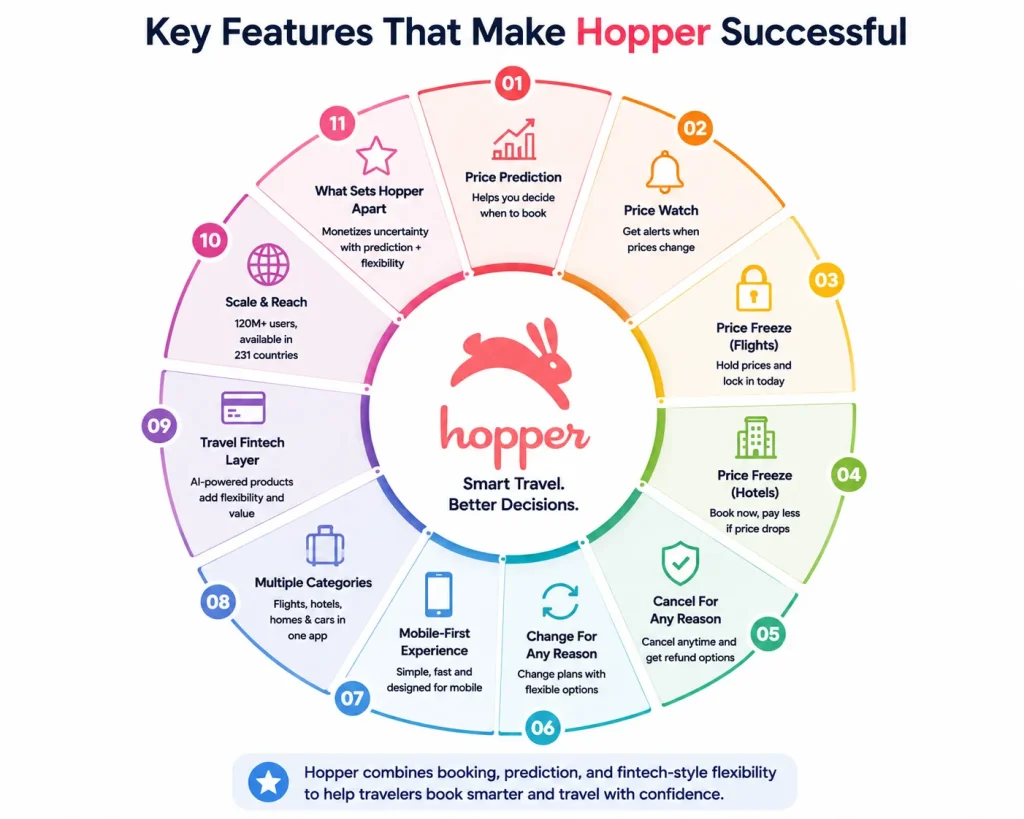
Hopper stands out because it is not just a booking app. It mixes travel search, price prediction, and flexibility products into one mobile-first experience. That combination is what makes it feel very different from a standard OTA. Hopper’s own help center and homepage show that the live product still centers around booking flights, hotels, homes, and cars, while also offering Price Freeze, Cancel For Any Reason, Change For Any Reason, and price-watch tools.
Price Prediction
Hopper says it analyzes more than one billion individual real-time flight prices each day to help predict how prices may move.
Why It Matters: Travelers get help deciding whether to book now or wait instead of guessing.
Technical Innovation: Large-scale price modeling and data-science algorithms turn raw airfare data into timing advice.
Price Watch Notifications
Hopper lets users watch flights or hotels and get notifications when prices change. Its help center has a dedicated Price Watch section.
Why It Matters: Travelers do not need to manually recheck the same trip every day.
Technical Innovation: Automated fare-monitoring systems track selected itineraries and trigger app alerts when pricing moves.
Price Freeze for Flights
Hopper’s Price Freeze lets users pay a fee to hold a flight price for a limited time. Hopper says the freeze covers fare increases up to a displayed cap per traveler, and the fee is non-refundable.
Why It Matters: It reduces the stress of losing a fare while you decide.
Technical Innovation: Risk-priced travel fintech turns fare volatility into a sellable protection product.
Price Freeze for Hotels
Hopper also offers Price Freeze for hotels. Hopper says if the hotel price drops after the freeze, the user pays the lower price, and if it rises, Hopper covers the difference up to $300.
Why It Matters: This extends Hopper’s “book smarter later” model beyond flights.
Technical Innovation: Dynamic hotel-price protection uses capped coverage logic inside the booking flow.
Cancel For Any Reason
Hopper offers Cancel For Any Reason for flights and hotels. For flights, Hopper says travelers can cancel up until the policy expiration date and choose between refund options such as cash or airline credit, depending on availability.
Why It Matters: Travelers can book with less fear that plans will change.
Technical Innovation: Embedded post-booking flexibility products add optional risk protection directly at checkout.
Change For Any Reason
Hopper’s Change For Any Reason for flights allows users to change dates, time, origin or destination, or even airline, up to 3 hours before departure, with up to 100% of original base fare and taxes covered, though fare differences may still apply.
Why It Matters: This gives travelers much more control after booking.
Technical Innovation: Rules-based flexibility products convert change risk into a paid ancillary service.
Mobile-First Booking Experience
Hopper’s own help pages say the app was created to make travel simple and mobile-friendly.
Why It Matters: Many travelers now search, track, and book trips directly on their phones.
Technical Innovation: App-centered workflows connect search, prediction, booking, alerts, and support in one mobile interface.
Booking Across Multiple Categories
Hopper supports flights, hotels, homes, and car rentals through the same app.
Why It Matters: Users can handle more of their trip without leaving the platform.
Technical Innovation: Shared account, checkout, and trip-management flows connect multiple travel categories into one ecosystem.
Travel Fintech Layer
Hopper’s B2B division, HTS, says it combines a travel agency, fintech provider, and e-commerce platform, and that its proprietary AI models dynamically price fintech products.
Why It Matters: This makes Hopper more than a booking app — it becomes a travel-fintech business.
Technical Innovation: AI-priced ancillary products create additional revenue and partner value beyond the booking itself.
Scale and Reach
Hopper says 120 million travelers use the platform, while HTS says its fintech products have been sold across 231 countries and territories.
Why It Matters: Scale increases trust, data quality, and the size of the monetization opportunity.
Technical Innovation: Large-scale data collection and global distribution strengthen both consumer and partner products.
What Sets Hopper Apart
What really sets Hopper apart is that it monetizes uncertainty better than most travel apps. Many platforms help you search and book. Hopper also helps you decide when to book, and then sells optional protection if your plans or prices change. That mix of booking, prediction, and fintech-style flexibility is the core reason it has become so distinctive in travel.
The Technology Behind Hopper
Hopper runs on a travel-commerce platform built around three core layers: search and booking, price prediction, and travel-fintech products. That combination is what makes the app feel different from a normal OTA. Hopper’s own help center says its data-science team has collected a huge historical archive of trillions of flight, hotel, and car-rental prices, and that it analyzes more than one billion individual real-time flight prices each day to support predictions.
Large-Scale Price Prediction Engine
Hopper’s prediction layer is one of its biggest technical differentiators. The company says it uses massive real-time and historical pricing data to predict whether prices are likely to rise or fall.
Why It Matters: Travelers want help deciding when to buy, not just where to buy.
Technical Innovation: Machine-learning-style pricing algorithms analyze huge volumes of airfare and travel-price data to generate booking timing recommendations.
Continuous Price Monitoring
Hopper’s Price Watch tools monitor selected trips and notify users when prices move. Its help center has a full Price Watch section for flights and hotels.
Why It Matters: Travelers do not need to repeat the same search manually every day.
Technical Innovation: Automated fare- and rate-monitoring systems track watched itineraries and trigger app alerts when conditions change.
App-Exclusive Price Freeze Infrastructure
Hopper’s Price Freeze for flights and hotels is more than a UX feature — it is a risk-managed fintech product. Hopper says the flight version is app-exclusive, covers price increases up to a displayed cap, and charges a non-refundable service fee. For hotels, Hopper says it will cover price increases up to $300, while still letting the user pay the lower price if the hotel rate drops.
Why It Matters: This gives users more confidence when they are not ready to book immediately.
Technical Innovation: Hopper uses pricing-risk logic and capped exposure models to turn volatility into a sellable product layer.
Embedded Flexibility Products
Hopper’s help center shows products like Cancel For Any Reason, Change For Any Reason, and disruption-related protections across flights and hotels.
Why It Matters: These features extend Hopper from booking into post-booking risk management.
Technical Innovation: Rules-based ancillary products are embedded directly in the booking flow, allowing users to purchase flexible travel services at checkout or manage them later in-app.
Mobile-First Booking Architecture
Hopper’s own support pages describe the app as being designed to make travel simple and mobile-friendly.
Why It Matters: Hopper’s core audience is app-first, and much of its value depends on fast notifications, in-app booking, and trip management.
Technical Innovation: Mobile-centered workflows connect search, prediction, watchlists, booking, alerts, support, and flexibility products in one interface.
HTS: Hopper’s B2B Technology Stack
Hopper’s B2B division, HTS, shows that the company’s technology is not limited to its own consumer app. HTS says it combines a travel agency, fintech provider, and e-commerce platform, and that its proprietary AI models dynamically price fintech products for partners.
Why It Matters: Hopper’s technology can be sold and embedded into other companies’ booking flows, not just used in its own app.
Technical Innovation: SDK-based travel-commerce and fintech products let banks, airlines, and travel brands plug Hopper’s pricing and ancillary tools into their own channels. )
AI-Priced Travel Fintech Products
HTS says its proprietary AI models dynamically price its fintech products and manage payments due directly to the customer.
Why It Matters: This allows Hopper to price flexibility products based on risk instead of treating them like static add-ons.
Technical Innovation: Dynamic ancillary pricing turns travel protections into data-driven products rather than fixed-fee extras.
Unified Trip Management and Support
Hopper routes support and many booking changes through the app itself. Its help pages tell users to open the booking and use the Contact Support flow tied to the trip.
Why It Matters: This keeps the post-booking experience inside Hopper instead of pushing users into disconnected support systems.
Technical Innovation: Centralized booking records and in-app support flows create a persistent service layer after checkout.
Why This Technology Matters for Business
The technology behind Hopper matters because it turns uncertainty into product value. Most travel apps can show you a fare. Hopper goes further by helping predict where the price is going, letting users freeze it, and selling optional flexibility if plans change later. Add HTS on top, and Hopper becomes more than a consumer app — it becomes a travel-tech and travel-fintech platform that can power other businesses too.
Hopper’s Impact & Market Opportunity
Hopper has had a major impact on travel because it reframed booking as a timing and risk problem, not just a search problem. Many travel apps help people find flights or hotels. Hopper went further by helping users decide when to book and whether to pay for more flexibility. That shift matters because price uncertainty is one of the biggest pain points in travel. Hopper’s own help center says the company analyzes more than one billion individual real-time flight prices each day, while its homepage says 120 million travelers use the platform to plan trips.
How Hopper Changed Travel Booking
One of Hopper’s biggest contributions is that it turned airfare anxiety into a product category. Instead of simply listing options, it built prediction, watchlists, price freezes, and change or cancellation flexibility directly into the app experience. Hopper’s help center makes clear that tools like Price Freeze, Cancel For Any Reason, Change For Any Reason, and other protection products are still core parts of the live platform today.
That changed the user experience in a big way. A traveler no longer had to ask only, “What can I book?” They could also ask:
• Should I wait?
• Can I lock this fare now?
• What if my plans change later?
• What happens if the price rises before I decide?
That is a very different product philosophy from a traditional OTA.
Market Size and Why the Opportunity Is So Big
The market opportunity around Hopper is large because it sits at the intersection of travel commerce and fintech. Travel alone is a huge category, but Hopper’s model becomes more powerful because it adds ancillary revenue on top of the booking itself. HTS, Hopper’s B2B division, says it combines a travel agency, fintech provider, and e-commerce platform, and that its proprietary AI models dynamically price fintech products. That means Hopper is not just monetizing bookings — it is monetizing uncertainty, flexibility, and protection.
HTS also says its fintech products have been sold in 231 countries and territories, which shows how broad the distribution opportunity has become beyond Hopper’s own consumer app.
Why Travelers Keep Using It
Hopper stays relevant because it solves several traveler problems at once:
• finding a lower price
• knowing whether to book now or wait
• getting notified when prices move
• protecting against price increases
• paying for flexibility if plans change
That combination is why Hopper feels more like a travel decision engine than a normal booking app. Its help content around Price Watch, prediction, Price Freeze, and flexible change and cancellation services makes that very clear.
Why the Model Is Still Strong
Hopper’s model is still strong because travel remains unpredictable, and unpredictability creates room for products that reduce risk. Most travel platforms earn mainly when a booking is completed. Hopper can earn from the booking and from the products layered around it.
That is also why HTS matters so much. The company is not only selling to consumers anymore. It is also selling Hopper-style travel-fintech infrastructure to partners through a B2B platform. HTS says it helps partners unlock incremental ancillary revenue with fintech products, loyalty portals, AI solutions, and other travel-commerce tools.
Opportunities for Entrepreneurs
This is exactly why many entrepreneurs want to build Hopper-like products. There is room for:
• flight-price prediction apps
• travel-price watch platforms
• fintech-style booking-protection products
• mobile-first travel apps with flexible booking options
• B2B travel-commerce tools for banks, airlines, and OTAs
The bigger lesson is simple: if a platform can reduce booking uncertainty and turn that into a product, it can become much more valuable than a standard booking site. Hopper is one of the clearest examples of that model working in travel today.
This massive success is why many entrepreneurs want to create similar platforms that connect travel booking, prediction, and flexibility in one app.
Building Your Own Hopper-Like Platform
Hopper’s success shows that a modern travel app can be much more than a booking engine. The real opportunity is in combining travel commerce with decision support and flexibility. Hopper does not just help users search and book. It helps them decide when to book, freeze a fare, watch a route, and add optional protections if plans change. Its live product and help center make that very clear through features like Price Prediction, Price Watch, Price Freeze, Cancel For Any Reason, and Change For Any Reason.
Why Businesses Want a Hopper Clone
Entrepreneurs are attracted to this model because it creates several revenue layers from one trip.
A Hopper-like platform can create value through:
• core travel bookings such as flights, hotels, homes, and cars
• price-prediction and fare-watch engagement
• paid flexibility products like Price Freeze
• ancillary revenue from cancellation and change protections
• B2B distribution of the same fintech-style products to partners
That last part is especially important. Hopper’s B2B division, HTS, says it combines a best-in-class travel agency with proprietary fintech products to help users travel better and partners earn more.
Key Considerations Before Development
Before building a Hopper-style platform, a business needs to decide what kind of travel problem it wants to solve.
Important questions include:
• Will the product focus on flights first, or include hotels, cars, and homes from day one?
• Will it emphasize booking, prediction, or flexibility products most strongly?
• Will it be app-first like Hopper, or web-first?
• Will it sell protections such as price freezes, cancellations, and changes?
• Will the company also build B2B distribution tools for partners?
• How will price predictions and ancillary pricing be modeled and updated?
These choices matter because Hopper’s biggest strength is not just travel inventory. It is the extra layer of confidence and optional protection wrapped around the booking.
Miracuves Hopper-Like Platform Solution Cost and Tech Stack
Miracuves pricing for a Hopper-like travel booking and price prediction platform built with JavaScript architecture is available on request. The final cost depends on platform modules, travel API integrations, booking workflows, price prediction logic, payment systems, scalability needs, and deployment scope. Estimated delivery timeline: 30 to 90 days.
Build a smart travel booking platform designed for travel startups, online travel agencies, hotel booking businesses, flight booking platforms, trip planning companies, and travel marketplace operators.
- Core Workflows: Flight search, hotel booking, trip planning, fare comparison, booking management, user profiles, travel alerts, cancellation workflows, and payment processing.
- Prediction Logic: Price forecasting, fare drop alerts, demand-based pricing insights, historical travel data analysis, booking recommendations, and smart notification triggers.
- Management Hub: Admin dashboards, booking management, supplier controls, user management, payment tracking, refund handling, offer management, analytics, and customer support workflows.
- Enterprise Readiness: Customizable architecture for multi-location travel operations, high-volume searches, third-party travel API integrations, real-time availability, and long-term platform growth.
Why a Hopper-Like Platform Requires JavaScript Architecture
A Hopper-like platform handles real-time travel searches, flight and hotel availability, booking workflows, payment processing, price prediction, user alerts, and customer support operations. It requires fast API handling, smooth frontend performance, scalable backend logic, and interactive dashboards for both users and administrators.
We recommend a modern JavaScript-based architecture for this type of platform because:
- Built for API-Heavy Operations: JavaScript-based backend systems support flight APIs, hotel APIs, fare comparison engines, booking requests, payment gateways, and real-time availability checks.
- Advanced User Experience: React.js or other JavaScript frontend frameworks can power smooth travel search pages, booking flows, price calendars, alert screens, trip dashboards, and admin panels.
- Scalable Travel Logic: This architecture is suitable for handling large search volumes, dynamic pricing data, customer bookings, trip recommendations, and multi-region travel marketplace operations.
- Flexible Integration Layer: The platform can connect with flight APIs, hotel suppliers, payment gateways, map services, email/SMS tools, CRM systems, analytics platforms, and customer support tools.
You get a scalable, travel-ready booking platform designed for smart price discovery, smooth booking experiences, and long-term marketplace growth.
Note: Final pricing depends on selected platform modules, travel API integrations, prediction features, payment workflows, deployment infrastructure, and custom feature development.
Essential Features to Include
A strong Hopper-like platform should include:
• flight, hotel, and car rental search and booking
• price-watch notifications
• price-prediction guidance such as book now or wait
• price freeze or rate hold functionality
• flexible cancellation and change products
• in-app booking management and support
• mobile-first user experience
• trip-level alerts and post-booking tools
• admin controls for ancillary products and service rules
More advanced features should include:
• AI-driven pricing models for ancillaries
• capped-risk protection products
• partner-facing APIs or SDKs
• white-label or embedded B2B travel solutions
• loyalty and wallet features
• disruption assistance and recovery tools
Hopper’s current live ecosystem already points this way. HTS says its proprietary AI models dynamically price its fintech products, and its partner stack includes travel loyalty portals, AI solutions, stays, cars, and fintech ancillaries.
Conclusion
Hopper proves that the future of travel is not just about showing inventory — it is about reducing uncertainty. By combining booking with price prediction, watchlists, fare freezes, and optional flexibility products, Hopper turned one of travel’s most stressful moments into a product advantage. That is a big reason it stands out from standard travel apps. Its live platform and help center still center the experience around prediction, Price Watch, Price Freeze, and change or cancellation flexibility, while HTS shows how that same model can scale beyond the consumer app into partner products.
For entrepreneurs, the bigger lesson is simple: the strongest travel platforms do not just help users book — they help users feel safer about booking. When a product can answer “Should I wait?”, “Can I lock this in?”, and “What happens if my plans change?” it creates value before and after checkout. That is exactly why so many founders want to build Hopper-like platforms today.
FAQs :-
What is Hopper?
Hopper is a mobile-first travel booking app that helps users search and book flights, hotels, homes, and car rentals, while also offering tools that suggest when to book and whether to wait. Hopper says 120 million travelers use the platform to plan trips.
How does Hopper make money?
Hopper makes money from travel bookings, but also from paid add-on products such as Price Freeze, Cancel For Any Reason, and Change For Any Reason. Its B2B division, HTS, also generates revenue by offering Hopper-powered travel and fintech products to partners.
Is Hopper only for flights?
No. Hopper supports flights, hotels, homes, and car rentals through the app. Its homepage and help center both describe it as a broader travel-booking platform, not just a flight app.
What is Hopper’s price prediction feature?
Hopper’s price prediction feature is designed to help users decide whether to book now or wait. Hopper says it analyzes more than one billion individual real-time flight prices each day to support those predictions.
What is Price Freeze on Hopper?
Price Freeze lets a traveler pay a non-refundable fee to hold a specific flight or hotel price for a limited time. Hopper says that if the flight price rises during the freeze window, it will cover the increase up to a displayed cap, and for hotels it says it can cover increases up to $300.
Does Hopper offer cancellations and changes?
Yes. Hopper offers products such as Cancel For Any Reason and Change For Any Reason. Hopper’s help center says these services can allow eligible users to cancel or change bookings under the terms of the protection they purchased.
How does Hopper’s Change For Any Reason work?
Hopper says Change For Any Reason for flights can allow users to change date, time, origin or destination, or even airline, up to 3 hours before departure, with up to 100% of the original base fare and taxes covered, although any fare difference may still need to be paid.
Does Hopper have price alerts?
Yes. Hopper has Price Watch tools that let users watch flights or hotels and receive notifications when prices change. Its help center has a dedicated Price Watch category.
What makes Hopper different from other travel apps?
Hopper stands out because it combines travel booking with prediction and flexibility products. Many travel apps help users search and buy, but Hopper also helps users decide when to book and offers paid protections like Price Freeze, Cancel For Any Reason, and Change For Any Reason.
What is HTS by Hopper?
HTS stands for Hopper Technology Solutions. It is Hopper’s B2B division, and it says it combines a travel agency, fintech provider, and e-commerce platform to power travel and ancillary products for partners.
Can I build a platform like Hopper?
Yes. A Hopper-like platform would usually need travel booking, fare and rate monitoring, price-prediction tools, price-freeze or protection logic, mobile-first support, and optional B2B or partner integrations. Hopper’s current product setup shows that the biggest opportunity comes from combining booking with prediction and flexible travel-fintech features.