


Key Takeaways
What You’ll Learn
- A Binance clone should be built as exchange infrastructure, not just a trading UI.
- Trading engine quality shapes trust through speed, matching accuracy, and balance consistency.
- Cold wallet security protects user funds through layered wallet access and controlled approvals.
- Liquidity APIs improve market quality with better pricing, spreads, and execution flow.
- KYC and AML readiness support serious growth through verification, monitoring, and operational credibility.
Stats That Matter
- The article is built around five core pillars: trading engine logic, cold wallet security, liquidity APIs, KYC/AML readiness, and performance-focused architecture.
- Trading engine responsibilities include order matching, low-latency execution, real-time synchronization, and clean balance updates.
- Cold wallet protection layers include reserve storage, withdrawal approvals, internal access controls, and unusual activity monitoring.
- Liquidity APIs support live pricing, tighter spreads, lower slippage, and better order fulfillment.
- KYC/AML functions include identity verification, transaction monitoring, suspicious activity flagging, and admin-side review controls.
Real Insights
- Speed is a trust factor because slow or inconsistent execution quickly reduces trader confidence.
- Security is part of the product because fund protection matters more than visual polish.
- Liquidity affects retention because weak pricing and slippage make the exchange feel unreliable.
- Compliance should be built early to avoid onboarding friction and future scaling problems.
- Long-term success depends on performance, protection, liquidity, and operational control.
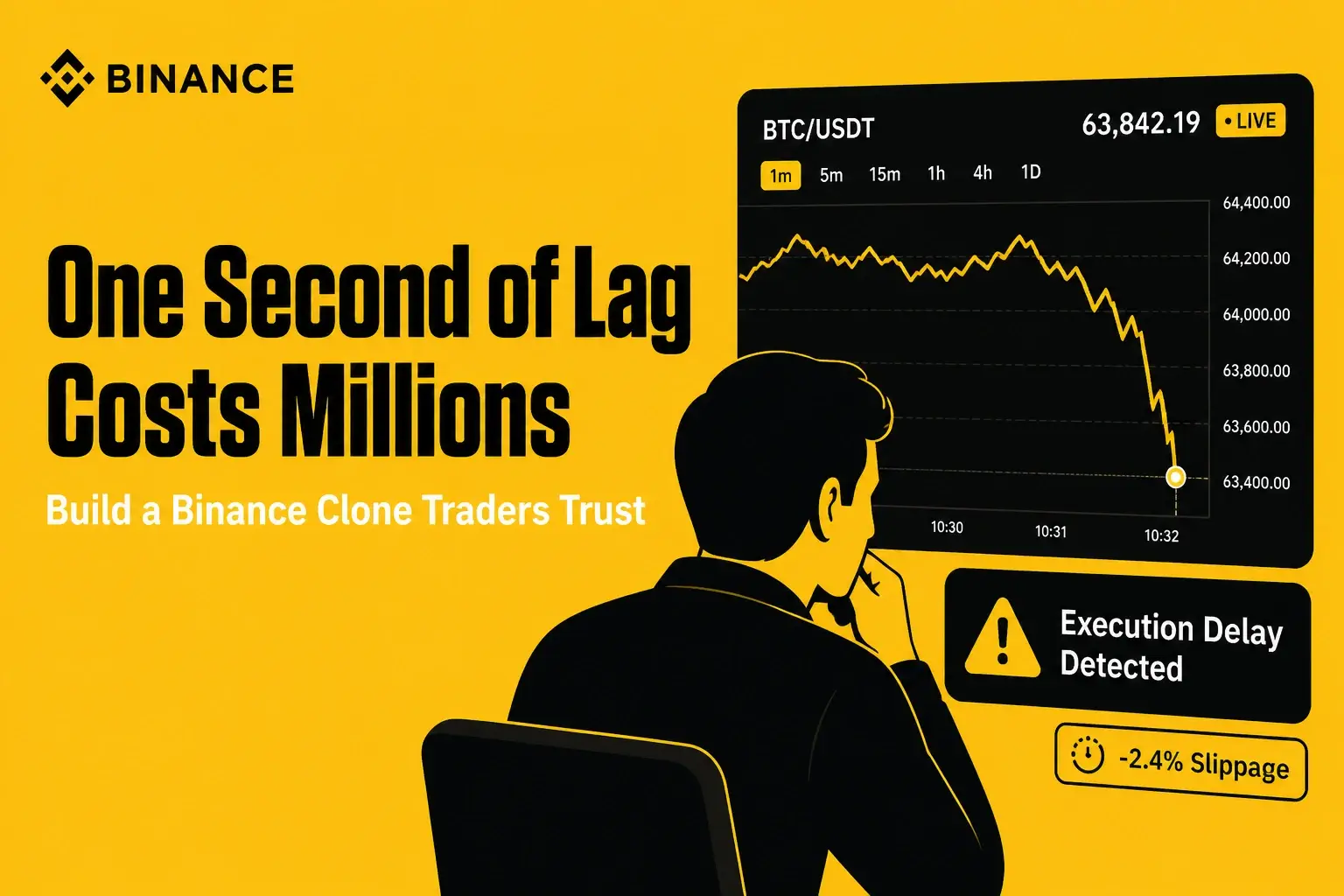
In a normal digital product, a one-second delay may feel like a small usability issue.
In a crypto exchange, that same delay can affect price execution, user confidence, trading activity, and long-term retention.
That is what makes exchange products different from most other apps. Users do not judge them only by visual quality or smooth navigation. They judge them by how reliably the system performs when money is moving, markets are shifting, and trading activity rises.
This is where many founders misread the product challenge.
A Binance Clone is not trusted because it copies the interface of a known exchange. It becomes trusted when the platform executes orders quickly, protects funds properly, handles liquidity intelligently, supports compliance readiness, and remains stable under pressure.
That is the real difference between a surface-level trading product and a serious exchange business.
For founders planning crypto exchange development, the core question is not whether the platform looks complete. The real question is whether the infrastructure underneath can support trust, retention, and scale.
This is why a strong Binance Clone should be evaluated through five essential pillars:
- trading engine logic
- cold wallet security
- liquidity APIs
- KYC/AML readiness
- performance-focused product architecture
Each one directly influences how the platform is experienced by traders and how the business performs over time.
Read More: What is Binance App and How Does It Work?
Why Exchange Products Are Judged by Performance
Exchange products operate in a more demanding environment than most digital platforms.
Users are not only browsing, scrolling, or consuming content. They are placing orders, monitoring prices, managing balances, and reacting to market movement. That changes the standard by which the product is judged.
Trust in trading platforms works differently
Trust in an exchange is built through system behavior.
Users want to know that:
- orders are processed correctly
- pricing reflects live market conditions
- balances remain accurate
- withdrawals feel secure
- the system does not fail during volatility
When these expectations are not met, the damage is immediate. The user does not experience it as a backend issue. They experience it as a trust issue.
Why visible UI is only the outer layer
The interface may be what attracts the user first, but it is not what keeps them trading.
What keeps traders active is:
| Visible Layer | Trust Layer Underneath |
|---|---|
| Charts and dashboards | Order matching stability |
| Buy and sell screens | Execution quality |
| Wallet pages | Asset protection logic |
| Price display | Liquidity-backed market depth |
| Onboarding flow | KYC/AML readiness |
A polished interface may create a good first impression.
A reliable infrastructure creates long-term user confidence.
What founders must understand before building a Binance Clone
A Binance Clone should not be treated as a front-end replication project.
It should be approached as an exchange infrastructure product with direct business consequences tied to performance, security, and operational control.
That is why exchange quality is not measured by how closely the app resembles a popular brand. It is measured by how well the system behaves when users are trading with real expectations and real financial exposure.
Trading Engine Logic: The Core of Exchange Trust
The trading engine is the foundation of any serious exchange platform.
It sits behind the charts, order forms, order books, and balance displays, and determines whether the entire exchange behaves with consistency and credibility.
If this layer is weak, the rest of the product becomes difficult to trust.
Why the trading engine matters more than the interface
From a user perspective, placing an order may look simple.
From a product perspective, that action triggers a sequence of critical events:
- order request is received
- account and balance are validated
- order conditions are processed
- matching logic is applied
- execution result is generated
- balances are updated
- order history and UI states are synchronized
If this process is not handled cleanly, the exchange starts losing credibility.
Core trading engine responsibilities
A strong trading engine in a Binance Clone should support:
- accurate order matching
- low-latency execution
- real-time transaction synchronization
- clean balance updates
- consistency between UI and backend states
- smooth handling of cancellations and partial fills
- stable performance during higher activity
Fast Exchange vs Weak Exchange Experience
| Factor | Fast Exchange | Weak Exchange |
|---|---|---|
| Order execution | Feels immediate and dependable | Feels delayed or uncertain |
| Backend consistency | Stable and aligned | Inconsistent across screens and records |
| Balance updates | Clear and timely | Delayed or confusing |
| User confidence | Stronger trust in trading flow | Doubt around platform reliability |
| Retention | Higher likelihood of repeat activity | Increased churn risk |
Why engine quality is a business issue
When order flow feels unreliable, traders reduce their trust quickly.
That affects the business in multiple ways:
- lower trading frequency
- weaker retention
- reduced on-platform balances
- increased complaints and support pressure
- damage to platform reputation
A weak trading engine does not only create technical problems. It directly influences user activity and revenue confidence.
What this means for your product
If a Binance Clone cannot execute reliably, it becomes difficult to position it as a serious trading platform. In exchange development, speed and consistency are not cosmetic product upgrades. They are part of the trust foundation.
Read More: Reasons startup choose our Binance clone over custom development
Cold Wallet Security: Fund Protection Builds Confidence
In crypto exchange development, users care deeply about how funds are protected.
They may appreciate clean design and easy navigation, but when money is stored on-platform, security becomes far more important than visual polish.
That is why wallet architecture plays such a critical role in exchange trust.
What cold wallet security means in simple product terms
Cold wallet security refers to keeping a significant portion of digital assets in a more protected storage layer with reduced exposure to active operational environments.
This creates a more controlled asset structure instead of keeping all funds equally accessible.
In product terms, that usually means separating storage by usage type and risk level.
Wallet protection layers
A serious exchange often includes multiple protection layers such as:
- active wallet access for controlled transaction flow
- more protected reserve storage for reduced exposure
- withdrawal approval logic
- permission-based internal access controls
- multi-step action verification
- monitoring for unusual wallet activity
- operational visibility into fund movement
Hot Layer vs Cold Layer Purpose
| Layer | Main Role | Security Value |
|---|---|---|
| Hot layer | Supports active transactions and withdrawal operations | Enables speed with controlled exposure |
| Cold layer | Holds a more protected reserve of assets | Reduces risk concentration |
Why security architecture matters to exchange trust
Users may not inspect infrastructure directly, but they react strongly to security confidence.
A strong security structure helps communicate that the platform is:
- operationally serious
- risk-aware
- better prepared for asset protection
- more credible for long-term use
Weak wallet controls can do the opposite. They can reduce confidence, increase perceived risk, and weaken brand trust.
Why this matters for your product
Security architecture is not only a technical decision. It is part of how an exchange presents seriousness to traders, partners, and businesses considering platform use.
A Binance Clone that treats wallet protection as a core design layer is better positioned for credibility than one that treats it as a secondary feature.
Liquidity APIs: Better Market Access, Better User Experience
Liquidity plays a central role in how a crypto exchange feels to users.
Even when the platform looks strong and the engine is stable, poor liquidity can still make the trading experience feel weak, expensive, or unreliable.
That is why liquidity APIs matter so much inside a serious Binance Clone.
What liquidity APIs do inside a Binance Clone
Liquidity APIs help support the exchange’s ability to access live pricing, improve trade execution, and create a more responsive trading environment.
They strengthen the market side of the product by helping the platform deliver:
- more usable live price feeds
- better order fulfillment
- stronger depth perception
- smoother trading conditions
- more competitive exchange feel
Business benefits of liquidity integration
Strong liquidity infrastructure can support:
- better pricing stability
- improved order execution quality
- tighter spreads
- lower slippage pressure
- stronger user confidence
- better retention through smoother trading experience
Strong Liquidity Setup vs Poor Liquidity Setup
Liquidity quality has a direct effect on how a trading platform feels in daily use. Traders may not study the infrastructure behind the exchange, but they notice the outcome immediately through price quality, execution smoothness, and overall market confidence.
| Factor | Strong Liquidity Setup | Poor Liquidity Setup |
|---|---|---|
| Live pricing | More stable, competitive, and closer to real market conditions | Less consistent, less reliable, and harder to trust |
| Execution | Smoother order fills with less friction | Delays, weaker fills, and more execution friction |
| Spread quality | Tighter spreads that feel more tradable | Wider spreads that feel less efficient |
| Slippage | Better controlled during active trading | More noticeable, especially in volatile conditions |
| User perception | Feels active, credible, and professionally managed | Feels thin, weaker, and less dependable |
Competitive Pricing ➜ Better Execution Quality ➜ Stronger Trader Confidence ➜ Higher Retention and Trading Volume
This connection matters because exchange trust is often built through experience, not explanation.
Most users will never describe the issue in technical language. They will not talk about liquidity infrastructure, order routing quality, or market depth logic. But they will feel the difference in every trade. When pricing feels weak, spreads feel uncompetitive, or execution feels inconsistent, the platform starts losing credibility very quickly.
Why liquidity affects exchange quality
Liquidity is not just a market connector in the background. It directly shapes perceived exchange performance.
That is especially important for newer platforms. A new exchange needs strong liquidity infrastructure to reduce friction, support trust, and compete with more established players.
What this means for your product
A Binance Clone with better liquidity integration does not just function better technically. It feels stronger commercially because traders experience better pricing, better fills, and better confidence in trade outcomes.
Read More: How to Build an App Like Binance: A Developer’s Guide
KYC/AML: Compliance Infrastructure for Serious Growth
Compliance infrastructure is one of the clearest signals that an exchange is being built for serious operation rather than short-term launch appearance.
KYC and AML are often misunderstood as slow-moving legal requirements. In reality, they are product and operational systems that help build trust, control risk, and support sustainable growth.
KYC as identity control and onboarding trust
KYC helps verify who is entering the platform.
From a product perspective, this supports:
- cleaner onboarding control
- stronger user verification
- safer account access logic
- more credible exchange operations
A trading platform that verifies users properly feels more structured and reliable.
AML as transaction monitoring and operational risk logic
AML adds the monitoring layer.
Its role is to support:
- detection of suspicious activity
- transaction pattern review
- internal risk control
- more structured operational oversight
This makes the exchange more manageable from both a product and business perspective.
KYC/AML product functions
A strong compliance layer often includes:
- identity verification during onboarding
- account validation workflows
- transaction monitoring logic
- risk-based review triggers
- suspicious activity flagging
- admin-side review controls
- record visibility for operational tracking
Built Early vs Added Later
| Compliance Approach | Built Early | Added Later |
|---|---|---|
| Product integration | Smoothly aligned with onboarding and operations | Often causes friction and rework |
| Operational flow | More structured from the start | Harder to manage consistently |
| Growth readiness | Better for partnerships and scale | Can delay maturity and expansion |
| User trust | Feels more serious and disciplined | May feel reactive or underprepared |
Founder risk
Founders who delay compliance logic often create hidden future problems:
- onboarding redesign
- operational bottlenecks
- higher internal review burden
- weaker business credibility
- more painful scaling adjustments
That is why compliance readiness should be considered early in exchange planning.
What this means for your product
A Binance Clone built with KYC/AML logic from the beginning is better positioned for trust, operational stability, and growth. Compliance is not separate from product quality. It is part of it.
Miracuves Performance: Built for Real Exchange Operations
A serious exchange product needs more than visible functionality. It needs architecture that supports actual usage, administrative control, system stability, and long-term evolution.
That is where Miracuves brings value.
The focus is not only on launching a crypto trading platform. The focus is on building a Binance Clone with practical infrastructure thinking behind it.
Performance-oriented development thinking
Miracuves approaches exchange development with attention to how systems behave in real operational conditions.
That includes thinking around:
- scalable product architecture
- modular platform structure
- secure integration planning
- admin-side visibility and control
- product stability during live use
- readiness for future customization and growth
This matters because exchange platforms are not static digital products. They require continuous operational oversight and the ability to evolve with business needs.
Miracuves strengths
Miracuves supports serious exchange product development through:
- scalable architecture planning
- modular system design
- secure integration structure
- strong admin management visibility
- operationally practical product thinking
- customization readiness for future needs
- balance between launch efficiency and platform stability
Generic Build Approach vs Miracuves Product Approach
| Area | Generic Build Approach | Miracuves Product Approach |
|---|---|---|
| Product focus | Front-end visibility first | Infrastructure and usability together |
| Performance thinking | Often handled later | Considered as part of core planning |
| Security treatment | Added as a feature set | Built into structural thinking |
| Admin operations | Limited management depth | Stronger control and visibility |
| Growth readiness | May require heavy future changes | Better room for scale and iteration |
Why this matters for founders
Founders building a Binance Clone need more than a product that looks complete in a demo.
They need a platform that can support:
- real user activity
- structured exchange operations
- performance expectations
- secure workflows
- future business expansion
That is the difference between launching quickly and launching correctly.
What this means for your product
Miracuves is better positioned for founders who want a Binance Clone built with real product logic behind it, not just surface-level similarity. The value is not only in development output, but in how the exchange is structured for trust, usability, and future growth.
Read More: How Safe is a White-Label Binance App? Security Guide 2026
Conclusion
A Binance Clone is not trusted because it looks polished. It is trusted because it executes well, protects funds, handles liquidity properly, supports compliance, and performs reliably when activity rises.
That is the real standard in crypto exchange development.
For founders, this means the product decision goes far beyond UI. Trading engine logic shapes execution confidence. Cold wallet security shapes fund trust. Liquidity APIs shape pricing and trade quality. KYC/AML shapes operational credibility. Performance-focused architecture shapes whether the platform can hold up as the business grows.
These are not secondary layers. They are the real product.
If you are planning to build a Binance Clone, the goal should not be to copy what traders can see. The goal should be to build what serious traders can trust.
Miracuves is a strong fit for founders who want to build a crypto exchange with that level of product thinking. If you are looking for a platform built around performance, security, and long-term exchange readiness, this is the right time to connect with Miracuves.
FAQs
What is a Binance Clone?
A Binance Clone is a crypto exchange platform built with trading, wallet, liquidity, and admin features similar to leading exchanges. The real value is not in copying the interface, but in building strong exchange infrastructure behind it.
Why is trading engine logic important in a Binance Clone?
Trading engine logic controls order matching, execution speed, balance updates, and transaction consistency. If this layer is weak, users may face delays, mismatched trade states, and lower trust in the platform.
Why does speed matter so much in crypto exchange development?
In a trading environment, even small delays can affect execution quality, user confidence, and retention. Speed is not just a performance factor. It is part of the trust users place in the exchange.
What role does cold wallet security play in a crypto exchange?
Cold wallet security helps protect a larger portion of user assets in a more secure storage layer, while active transaction needs are handled separately. This reduces risk exposure and strengthens confidence in fund protection.
Why are liquidity APIs important for a Binance Clone?
Liquidity APIs help support live pricing, smoother order execution, better market depth, and stronger trade quality. Without good liquidity, traders may experience slippage, poor spreads, and weaker confidence in the exchange.
How do KYC and AML help an exchange platform?
KYC helps verify user identity during onboarding, while AML supports transaction monitoring and risk control. Together, they help make the exchange more trustworthy, operationally structured, and better prepared for long-term growth.
Can a Binance Clone succeed with only a good UI?
No. A clean interface may attract users initially, but long-term trust depends on execution quality, security, liquidity, compliance, and platform stability. In exchange products, infrastructure matters more than appearance alone.
Why should founders build compliance early instead of adding it later?
Building compliance early makes onboarding, monitoring, and operations more structured from the start. Adding it later often creates product rework, internal friction, and slower platform maturity.
What should founders look for in a Binance Clone development partner?
Founders should look for a team that understands trading engine performance, exchange security, liquidity integration, compliance readiness, admin controls, and scalable architecture. A serious exchange needs more than front-end development.
Why is Miracuves a strong choice for Binance Clone development?
Miracuves focuses on building serious digital products with performance-oriented architecture, secure integrations, modular systems, and practical operational logic. For founders planning a Binance Clone, that approach supports stronger trust, usability, and future scalability.
Related Articles: