

Key Takeaways
- AI-generated apps can look functional without secure architecture.
- Working syntax does not prove safe product logic.
- Security depends on roles, payments, APIs, and admin controls.
- Prompted code often misses system-wide business rules.
- A clone foundation can reduce patching and rebuild risk.
Security Signals
- Check if backend permissions match frontend rules.
- Review authentication, sessions, and role-based access.
- Verify payment states, refunds, and webhook logic.
- Log admin actions, user activity, and sensitive changes.
- Test APIs, uploads, data validation, and integrations.
Real Insights
- AI writes syntax, but businesses need logic.
- Security debt grows when features are patched prompt by prompt.
- B2B buyers expect source-code ownership and clear architecture.
- Admin dashboards should control operations, not only display data.
- Miracuves builds white-label app foundations with structured product logic.
AI has changed how founders build first product versions. A non-technical founder can now prompt a coding assistant to create login screens, dashboards, API routes, forms, workflows, and even payment logic. That speed feels powerful.
But speed can hide a structural problem.
An AI-generated app may look functional because the syntax works. Buttons respond. Pages load. Users can sign up. Data may even save correctly during a demo. But production security is not about whether a screen works once. It is about whether the entire system behaves safely under pressure.
That is where many AI-generated app builds start to break.
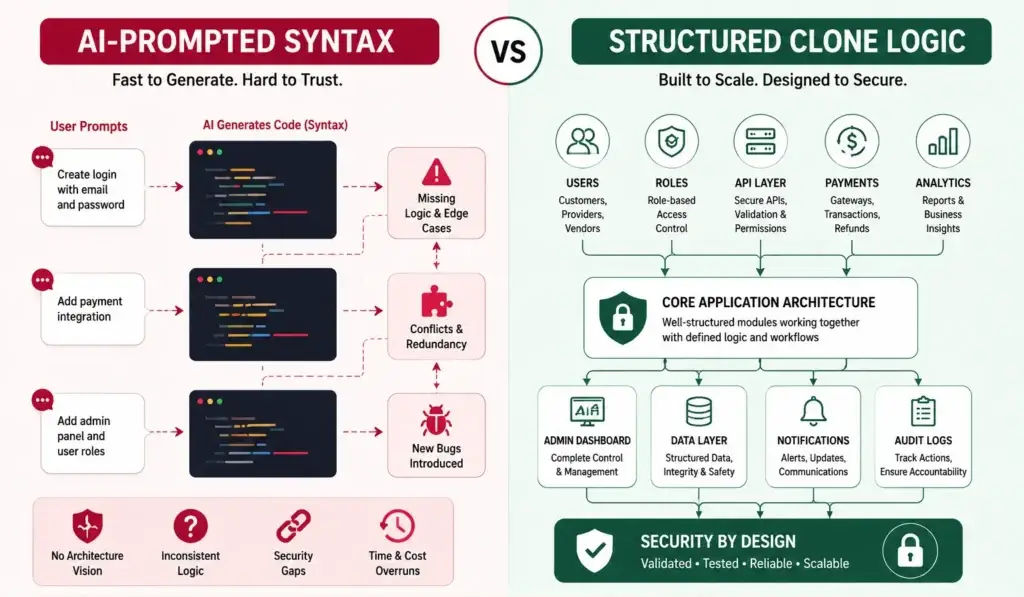
The real comparison is not AI vs traditional development. That framing is too generic. The sharper founder decision is syntax vs logic.
AI writes syntax. A scalable app business needs logic.
For founders deciding whether to keep patching an AI-generated product or move to a ready-made clone foundation, this guide compares the security risk of prompted code against the structured logic of a white-label clone app.
Miracuves helps founders move faster with ready-made, white-label, source-code-owned app solutions where the product foundation is not generated from disconnected prompts. The goal is not to reject AI. The goal is to avoid confusing fast code generation with production-ready architecture.
Syntax is Not Architecture: The LLM Blindspot
An AI coding assistant is excellent at producing language-shaped code. It can predict what a login function should look like, what a dashboard component might include, or how an API route is usually structured.
But architecture is not just a collection of code snippets.
Architecture decides:
- Who can access which data
- What happens when a payment fails
- How admins approve or block users
- How vendors, providers, drivers, creators, or customers interact
- How logs are stored
- How abuse reports are handled
- How roles are separated
- How sensitive data moves through the system
- How business rules are enforced on the backend
- How the app scales when usage grows
AI-generated syntax may solve a local task. Architecture solves the whole system.
That difference matters because security failures rarely happen only because one line of code is ugly. They happen when the product logic is inconsistent. A frontend blocks something but the backend does not. A user role is checked on one endpoint but missed on another. A payment is marked as successful before the gateway confirms it. An admin action changes user data without an audit trail. A file upload accepts unsafe content because validation was only added to the UI.
These are not syntax problems. They are logic problems.
AI can help engineers draft code faster, but founders should not assume prompted code is secure by default. OWASP’s LLM security work highlights risks such as prompt injection, insecure output handling, sensitive information disclosure, and plugin/tooling risks in LLM-powered systems.
For a founder, the blindspot is simple: AI can make a product look built before the business logic is actually safe.
Read More: The Authentication Loop: Analyzing Session Failures in AI-Generated MVPs
The Logic vs. Syntax Variable
The strongest way to evaluate an AI-generated app is to ask one question:
Did AI generate code, or did someone design the product logic?
That question separates a demo from a deployable business.
| Layer | AI-Prompted Syntax | Pre-Built Clone Logic |
| Code generation | Fast snippets, screens, routes, and components | Existing app modules adapted to business requirements |
| Business rules | Often scattered across prompts and files | Mapped into user flows, admin flows, and backend rules |
| Security model | Depends on prompt quality and manual review | Designed around repeatable roles, permissions, and workflows |
| Admin control | Often added later as a patch | Usually part of the core product foundation |
| Payment logic | Can be generated but may miss edge cases | Structured around known transaction states and admin visibility |
| Ownership | Depends on tool, codebase, and implementation process | Source-code ownership can be defined in the delivery scope |
| Buyer trust | Harder to explain if architecture is fragmented | Easier to review when workflows and modules are documented |
The problem with AI-generated development is not that the code is always bad. The problem is that the code is often context-thin.
A prompt may ask for “secure login,” but the AI does not automatically know your user roles, local regulatory exposure, payment provider rules, refund model, dispute workflow, or admin escalation path. It produces what appears statistically likely, not what your business actually requires.
That is why an AI-generated MVP can become expensive after the first version. The founder saves time at the syntax stage but loses time when trying to retrofit security, admin logic, audit trails, and monetization workflows into a product that was never architected around them.
Feature-by-Feature Security Comparison
AI-Prompted Syntax vs. Clone App Logic
| Security Area | AI-Generated App Risk | Clone Logic Advantage | Founder Decision Impact |
|---|---|---|---|
| Authentication | AI may generate login flows without complete session, token, password reset, or device handling logic. | A structured clone foundation can include established authentication workflows adapted to the app model. | Founders reduce the risk of rebuilding basic user access after launch. |
| Authorization | Role checks may be inconsistent across screens, APIs, and admin functions. | Pre-built user roles can separate customer, provider, vendor, driver, creator, and admin permissions. | Better role separation makes the product easier to explain to buyers and internal teams. |
| Payment Logic | Prompted code may mark orders, subscriptions, or bookings incorrectly if edge cases are missed. | Clone workflows can be structured around payment states, refunds, commissions, and admin visibility. | Payment reliability directly affects user trust and revenue protection. |
| Admin Dashboard | AI-generated admin panels are often added late and may expose sensitive controls too broadly. | Admin control can be part of the core platform logic, not a cosmetic afterthought. | Founders get operational control earlier instead of depending on developers for every small change. |
| Data Validation | AI may validate inputs on the frontend while missing backend validation. | A stronger app foundation validates critical actions closer to the backend and business logic layer. | Reduces avoidable abuse, broken records, and unsafe user-generated inputs. |
| Audit Logs | AI-generated apps often skip activity history unless specifically prompted. | Clone systems can include admin activity records, order history, transaction visibility, and user action tracking where scoped. | Useful for disputes, support, compliance workflows, and internal accountability. |
| Scalability | Prompted code may work for demos but fail when traffic, data, or workflow complexity increases. | Clone architecture starts from a known product pattern that can be customized and optimized. | Better foundation for market validation and post-launch iteration. |
Why AI-Generated Apps Often Become Security Debt
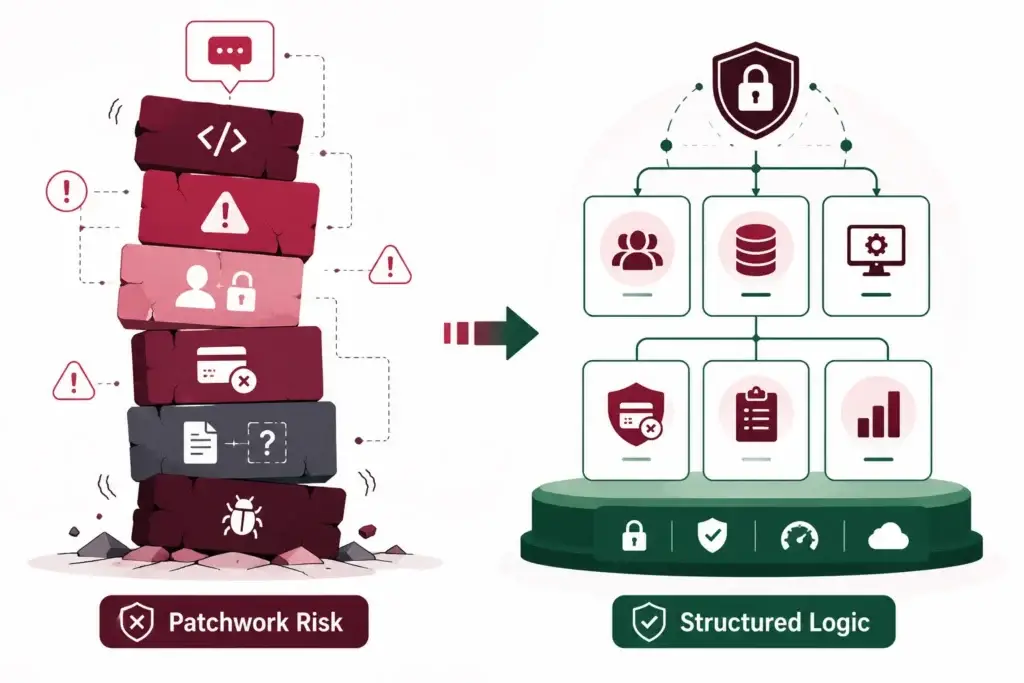
Image Source: AI-generated visual by Miracuves
AI-generated products often begin with the right intention: build fast, validate fast, avoid spending months on development before proving demand.
That logic is reasonable.
The risk begins when founders treat the AI-generated version as a production foundation instead of a prototype. Once real users, payments, files, messages, personal data, vendors, and admin workflows enter the product, the security bar changes.
Security debt appears when:
- Features were generated in separate prompts
- Backend rules were added after frontend screens
- No one documented role permissions
- Admin actions are not logged
- Payment edge cases are unclear
- Sensitive data flows are not mapped
- Error handling leaks too much information
- Third-party integrations are wired without review
- AI-generated fixes introduce new problems elsewhere
Security research has repeatedly warned that generated code can contain weaknesses and that mitigation strategies vary by model, language, and technique. One 2026 academic paper found that no approach consistently eliminates weaknesses across all models and scenarios, while another large-scale study found a high vulnerability rate across generated programs.
For founders, this means the issue is not “AI is bad.” The issue is AI does not remove the need for architecture, review, testing, and accountability.
Why B2B Buyers Demand Pre-Compiled Logic
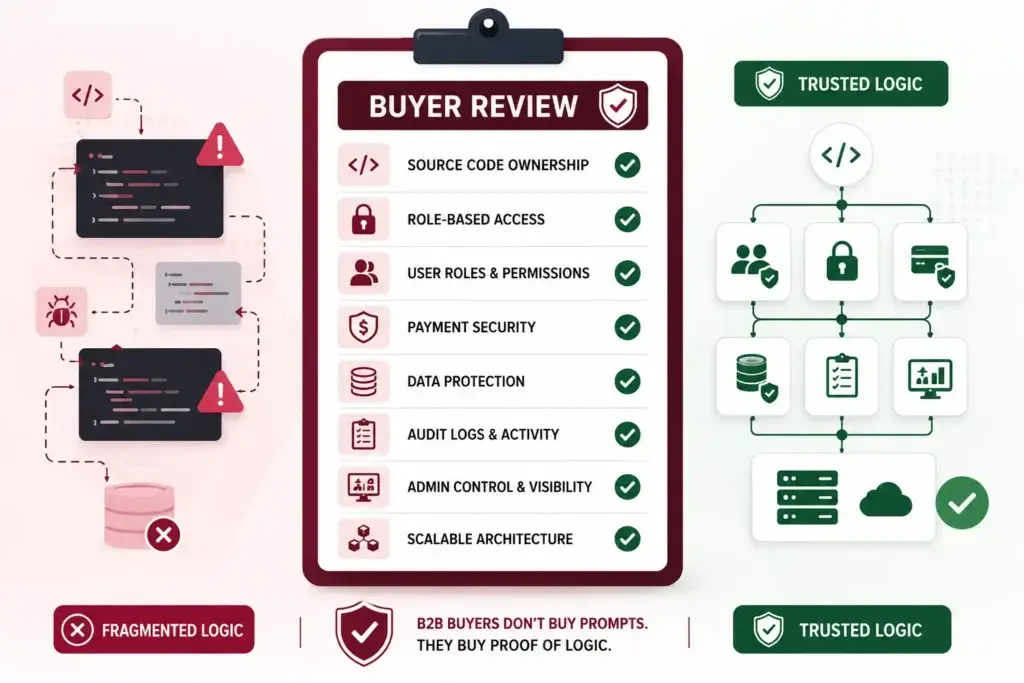
Image Source: AI-generated visual by Miracuves
B2B buyers do not evaluate apps the way early users evaluate demos.
A user may ask, “Does this feature work?”
A B2B buyer asks:
- Who owns the source code?
- How are roles and permissions handled?
- How is customer data protected?
- Can admin actions be audited?
- What happens when a payment fails?
- How are integrations secured?
- Can the product support our workflows?
- Can we review the architecture?
- Can this scale beyond the first few users?
- Who is accountable if something breaks?
This is where a fragmented AI-generated app struggles.
If the product was assembled through scattered prompts, founders may find it difficult to explain the architecture clearly. The code may function, but the system story is weak. B2B buyers want repeatable logic, not improvisation.
A clone app foundation gives founders a clearer product story. Instead of saying, “We generated this and patched it,” the founder can explain that the product is built around known modules, user roles, admin control, monetization workflows, and source-code ownership.
That does not remove the need for security review. But it gives the review process a more structured base.
Miracuves’ custom mobile app development service also positions source-code ownership, IP transfer, support, and clean architecture as important delivery principles, which matters for founders who need buyer confidence and long-term control.
Founder Decision Signals Speed
If you only need a clickable prototype, AI-generated code may help. If you need users, payments, dashboards, and operational control, a clone foundation can reduce rebuilding time.
Cost
AI looks cheaper at the start, but hidden cost appears when teams must patch access control, payment states, admin workflows, and backend logic after launch.
Scalability
Scalability depends on architecture, not just code volume. A structured clone base gives founders a clearer path for workflow expansion and post-launch customization.
Market Fit
Founders should validate demand quickly, but validation becomes risky when the first product version cannot safely handle real users, transactions, or business rules.
Speed
If you only need a clickable prototype, AI-generated code may help. If you need users, payments, dashboards, and operational control, a clone foundation can reduce rebuilding time.
Cost
AI looks cheaper at the start, but hidden cost appears when teams must patch access control, payment states, admin workflows, and backend logic after launch.
Scalability
Scalability depends on architecture, not just code volume. A structured clone base gives founders a clearer path for workflow expansion and post-launch customization.
Market Fit
Founders should validate demand quickly, but validation becomes risky when the first product version cannot safely handle real users, transactions, or business rules.
The Security Weakness of Prompted Syntax
Prompted syntax often fails because each prompt solves a narrow problem.
A founder may ask:
“Build login.”
Then:
“Add subscriptions.”
Then:
“Add admin dashboard.”
Then:
“Add vendor approval.”
Then:
“Fix the bug where users can see each other’s orders.”
Each request may produce code that looks correct in isolation. But product security depends on the relationship between all of those features.
That relationship is where prompted syntax becomes fragile.
1. AI May Create Local Fixes Without System Awareness
A model can patch one file without understanding how the change affects permissions, payment states, or admin reporting across the platform. This can create the illusion of progress while pushing risk into another part of the system.
2. AI Can Repeat Insecure Patterns From Training Data
AI coding tools learn from large volumes of public code, which can include outdated, incomplete, or insecure examples. Academic research has discussed risks from unsanitized training data and the possibility of vulnerable patterns being reproduced in generated code.
3. AI May Hallucinate Libraries, Methods, or Workflows
Hallucination is not only a content problem. In software, hallucinated package names, functions, or integration steps can create direct security and reliability risks. Recent reporting on “HalluSquatting” describes how attackers may exploit hallucinated repository names by creating malicious packages that AI agents might recommend or execute.
4. AI Does Not Automatically Perform Threat Modeling
Threat modeling asks: who might attack this system, what can they access, and where can the business lose money, data, or trust?
A prompt rarely captures that full risk model.
5. AI-Generated Code Still Needs Human Accountability
Even when AI accelerates development, security review, testing, code ownership, and deployment responsibility remain human responsibilities. Industry commentary around AI coding continues to emphasize that human review and security practices cannot be replaced by automation alone.
Read More: AI MVP Security Audit: The 14-Point Checklist for Founder Survival
Where Clone Architecture Changes the Risk Profile
A clone app should not be treated as a magic shortcut. A low-quality clone can still be insecure. A poorly customized app can still break. A rushed launch can still create risk.
The advantage of a strong white-label clone foundation is different: it starts from product logic, not blank prompts.
A clone foundation is usually organized around:
- User app
- Provider, vendor, driver, creator, or merchant panel
- Admin dashboard
- Role-based workflows
- Order, booking, content, transaction, or listing logic
- Monetization controls
- Payment gateway integration
- Notifications
- Reviews, ratings, reports, or moderation
- Dispute and support workflows
- Source-code handoff where included
This matters because clone app security is not just about the codebase. It is about having the right operational layers from the beginning.
For example, a food delivery clone needs customer, restaurant, delivery partner, and admin logic. A freelance marketplace clone needs client, freelancer, contract, payment, dispute, and admin logic. A short video clone needs creator, viewer, moderation, upload, feed, and monetization logic. A fintech clone needs wallet, KYC, transaction monitoring, audit visibility, and compliance-ready workflows.
AI can generate pieces of those systems. But a founder needs the full operating model.
That is why founders exploring ready-made app foundations can review Miracuves’ clone app development service and broader solutions hub before deciding whether to patch an AI-generated app or move to a more structured base.
AI-Generated MVP vs. White-Label Clone: Security Extraction Table
| Decision Variable | AI-Generated MVP | Miracuves-Style White-Label Clone Foundation | Better Fit |
| Early demo | Strong for quick screens and proof-of-concept flows | Can also support demos, but with more setup around actual workflows | AI-generated MVP if no real users are involved |
| Real user launch | Risky if authentication, authorization, and data flows are not reviewed | Stronger if user roles, admin controls, and workflows are scoped clearly | Clone foundation |
| Payment handling | High risk if transaction states and gateway callbacks are improvised | Better when payment flows, commissions, refunds, and admin visibility are mapped | Clone foundation |
| Admin operations | Often patched after the user app | Usually part of the product foundation | Clone foundation |
| B2B buyer review | Harder if architecture is inconsistent | Easier if workflows, modules, and ownership are documented | Clone foundation |
| Custom innovation | Good for experimentation and internal tools | Better for proven business models that need customization | Depends on use case |
| Long-term control | Depends on tool usage, code quality, and handoff process | Stronger when source-code ownership is included in scope | Clone foundation |
| Security confidence | Requires thorough review before production | Still requires review, but starts from structured logic | Clone foundation |
When Founders Should Stop Patching the AI App
Not every AI-generated app needs to be abandoned. Some are useful prototypes. Some can be refactored. Some can become strong products if an experienced team audits and rebuilds the right parts.
But founders should stop patching when the product shows structural symptoms.
Signal 1: Every New Feature Breaks Another Workflow
If adding subscriptions breaks user roles, or adding admin controls breaks vendor approval, the issue is not one bug. The issue is architecture.
Signal 2: The Backend Does Not Match the Frontend
A common AI-generated app problem is that screens appear to enforce rules, but backend APIs do not. This creates security exposure because serious attackers do not follow the UI.
Signal 3: No One Can Explain the Permission Model
If the founder cannot clearly explain who can create, read, update, delete, approve, refund, suspend, publish, or export data, the product is not ready for serious users.
Signal 4: Payments Were Added as a Feature Instead of a System
Payment is not just a button. It includes transaction states, retries, failed payments, refunds, invoices, commissions, disputes, and reconciliation.
Signal 5: The Admin Dashboard Is Cosmetic
A weak admin dashboard shows data. A strong admin dashboard controls operations. If admins cannot manage users, content, transactions, reports, and disputes safely, the app is not operationally ready.
Signal 6: Security Fixes Are Prompted Without Testing
If the team asks AI to “make this secure” but does not run code review, dependency checks, threat modeling, or penetration testing where needed, the founder is only moving risk around.
Mistakes Founders Should Avoid
Confusing working code with secure architecture
A demo can work while the backend remains fragile. Founders should review roles, APIs, payments, data validation, and admin workflows before treating an AI-generated app as production-ready.
Adding admin control too late
Admin logic should not be an afterthought. Without strong admin control, founders struggle to manage users, disputes, payments, content, fraud signals, and operational decisions.
Assuming AI-generated code is secure because it looks modern
Clean syntax, modern frameworks, and polished UI do not prove security. Secure products need backend validation, access control, testing, logging, and accountable review.
What a Secure Clone Foundation Should Include
A founder comparing AI-generated app security against clone logic should evaluate the clone foundation carefully. The goal is not to buy any clone. The goal is to choose a clone architecture that supports real operations.
A stronger clone foundation should include:
| Foundation Layer | What to Check | Why It Matters |
| Source-code ownership | Confirm handoff terms clearly | Avoids vendor lock-in and supports future customization |
| Role-based access | Check user, provider, vendor, admin, and staff permissions | Prevents users from accessing the wrong data or controls |
| Admin dashboard | Review operational controls, not just reports | Lets the founder manage the business after launch |
| Payment workflows | Check payment states, refunds, commissions, and transaction logs | Protects revenue and user trust |
| API security | Review authentication, authorization, rate limits, and validation | Reduces backend abuse |
| Data handling | Check sensitive fields, storage, and access boundaries | Supports privacy-conscious operations |
| Logs and reporting | Review admin actions, transactions, and user activity records | Helps support, disputes, and audits |
| Customization scope | Confirm what can be changed safely | Prevents breaking core logic during branding or feature changes |
| Security testing | Ask what review, QA, and testing steps are included | Helps identify risks before launch |
This is also where founder expectations should stay realistic. A clone foundation can reduce development uncertainty, but final security depends on configuration, hosting, integrations, customization, testing, legal review where applicable, and ongoing maintenance.
For regulated or sensitive industries such as fintech, healthcare, marketplaces, or user-generated content platforms, founders should use compliance-ready language carefully. A secure foundation can support compliance workflows, but final compliance depends on jurisdiction, legal review, integrations, and operating model.
Where AI Still Belongs in the Development Process
This guide is not an anti-AI argument.
AI can be useful when applied in the right layer.
AI can help with:
- Drafting documentation
- Generating test ideas
- Explaining legacy code
- Creating boilerplate under review
- Supporting QA workflows
- Assisting developers with repetitive tasks
- Summarizing logs or support issues
- Improving admin search and automation
- Adding AI features to an already structured product
The danger begins when AI becomes the architect of the entire business system without human design, code review, or security validation.
The stronger model is AI-assisted development on top of structured architecture.
That means founders can still use AI, but not as a substitute for authentication strategy, access control, payment logic, admin workflows, secure APIs, data boundaries, and source-code governance.
Miracuves’ AI development services can support production AI applications, while its clone app development service can help founders start from a more structured app foundation when the business model already matches a proven product category.
Patch the AI App or Buy a Clone? Founder Decision Matrix
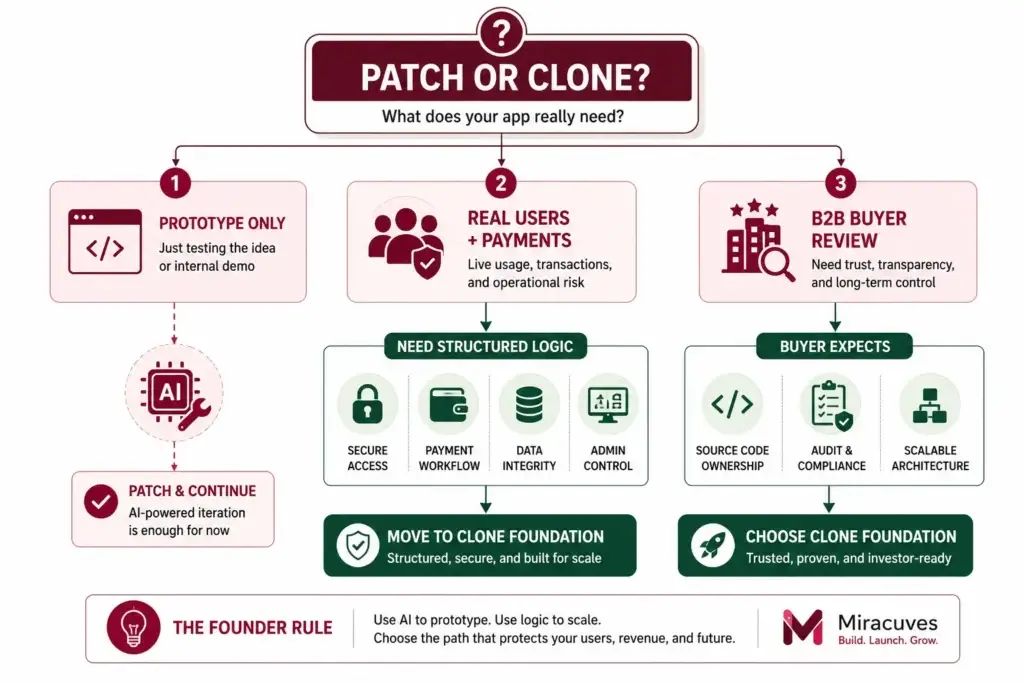
Image Source: AI-generated visual by Miracuves
| Founder Situation | Better Decision | Why |
| You only need a demo for an internal pitch | Patch AI-generated app | Speed matters more than architecture at this stage |
| You are onboarding real users | Move toward structured architecture | Real users create privacy, access, and support risk |
| You are accepting payments | Use clone logic or rebuild carefully | Payment workflows need transaction states and admin control |
| You are selling to B2B buyers | Use structured, documentable logic | Buyers need confidence in permissions, ownership, and operational controls |
| You are building a proven model like delivery, marketplace, ride-hailing, fintech, or creator platform | Consider a white-label clone | The core workflows are already known and can be customized |
| You are building deeply proprietary technology | Consider custom development | Unique logic may require ground-up architecture |
| You have no clear admin workflow | Do not launch yet | Admin control is essential for operations and trust |
Miracuves Perspective: Build Faster, But Do Not Build Blind
The founder advantage is not simply launching fast. It is launching with enough structure to learn safely.
An AI-generated app can help you see the idea. A clone foundation can help you operate the business.
That difference matters when your app involves:
- Users and roles
- Payments and subscriptions
- Vendors or providers
- Admin approvals
- Sensitive user data
- Creator content
- Marketplace transactions
- Delivery workflows
- Wallets or financial activity
- Reviews, reports, and disputes
Miracuves helps founders avoid starting from zero by using ready-made and white-label app foundations with source-code ownership, branded design, admin control, and customization support. For founders who have already experimented with AI-generated code, the next step may not be another prompt. It may be a structured review of whether the product logic is strong enough to launch.
If the current AI-generated product is only a prototype, keep it as a prototype. If it needs to become a business, evaluate whether a clone foundation gives you a safer and faster path.
Final Thoughts: AI Writes Syntax, But Businesses Need Logic
AI-generated development is not going away. It will keep improving, and founders should use it where it creates leverage.
But production apps are not built from syntax alone.
They need role logic, payment logic, admin logic, data logic, compliance-ready workflows, testing, ownership, deployment discipline, and accountability. That is why the strongest founder decision is not whether to use AI. It is where to use AI.
Use AI to accelerate. Do not use it to avoid architecture.
If your AI-generated app is still a prototype, it may be enough for learning. If it is becoming a real product with users, payments, admins, vendors, creators, or B2B buyers, it needs stronger logic. A Miracuves white-label clone foundation can help founders move faster without depending on fragile, prompt-by-prompt fixes.
FAQs
Is AI-generated code secure enough for a production app?
AI-generated code should not be treated as production-ready without review. It may contain insecure patterns, missing validation, weak authorization, or incomplete error handling. Founders should run code review, security testing, dependency checks, and architecture review before using AI-generated code in a real app.
What is the biggest security risk in an AI-generated app?
The biggest risk is inconsistent logic. AI may generate working features, but security depends on how authentication, authorization, payments, admin controls, and data flows work together across the entire system.
Is a clone app safer than an AI-generated MVP?
A high-quality clone app can offer a more structured foundation because core workflows, user roles, admin panels, and monetization logic are already mapped. However, every clone still needs proper customization, configuration, testing, and security review before launch.
Should founders patch an AI-generated app or rebuild on a clone foundation?
If the app is only a demo, patching may be enough. If the app handles real users, payments, marketplace workflows, sensitive data, or B2B buyers, a structured clone foundation may be safer and more scalable than endless AI-generated patches.
Why do B2B buyers prefer structured app logic?
B2B buyers need confidence in permissions, source-code ownership, data handling, auditability, integrations, and long-term support. A fragmented AI-generated app can be harder to explain, review, and trust.
Can AI still be used with clone app development?
Yes. AI can support documentation, testing, automation, admin intelligence, chatbot features, search, recommendations, and developer productivity. The safer approach is using AI as an assistant within a structured architecture, not as the only architect.
What should founders ask before buying a white-label clone app?
Founders should ask about source-code ownership, user roles, admin dashboard controls, payment workflows, customization scope, security testing, hosting, support, and documentation. The goal is to understand the foundation before launch.
How does Miracuves help founders moving beyond AI-generated prototypes?
Miracuves helps founders build ready-made and white-label app solutions with source-code ownership, branded design, admin control, and customization support. This helps founders move from prototype thinking to structured product execution.
Miracuves is an independent software development company. We are not affiliated with, connected to, sponsored by, or endorsed by any company or product named in this article.
Terms such as “X Clone” are used descriptively. It is how the software industry refers to building a platform with functionality comparable to a known service, and how clients search for it.
The entire design and codebase of our products is built by our own team. Our products contain no code, design, graphics, or content originating from any third-party website or applications.
All third-party names and marks referenced in this article are the property of their respective owners, referenced solely to identify the services discussed.