Key Takeaways
- Ephemeris processing powers personalized astrology apps.
- Caching reduces repeated planetary calculations.
- Batch processing improves large-scale transit generation.
- Redis helps accelerate high-volume astrology workloads.
- Scalable architecture supports millions of daily calculations.
Scaling Signals
- Cache ephemeris data for repeated calculations.
- Process transits using background worker queues.
- Separate computation from user-facing APIs.
- Monitor processing time and cache performance.
- Optimize database reads for astronomical datasets.
Real Insights
- Real-time calculations become expensive at scale.
- Caching significantly reduces server workload.
- Background processing improves user experience.
- Backend optimization matters more than UI speed.
- Miracuves builds Co-Star Clone apps with scalable ephemeris processing pipelines.
Most astrology app discussions stop at features: birth charts, zodiac profiles, daily horoscopes, compatibility, push notifications, and AI-generated insights. Those features matter, but they are not where a serious astrology platform wins or fails.
The real pressure begins in the backend.
When an astrology app has to generate personalized daily transits for hundreds of thousands of users, the platform cannot behave like a simple content app. It has to calculate planetary positions, map them against user birth data, produce personalized interpretations, prepare notifications, and do this reliably before users open the app in the morning.
That is the scaling problem Miracuves solved inside its white-label astrology app engine.
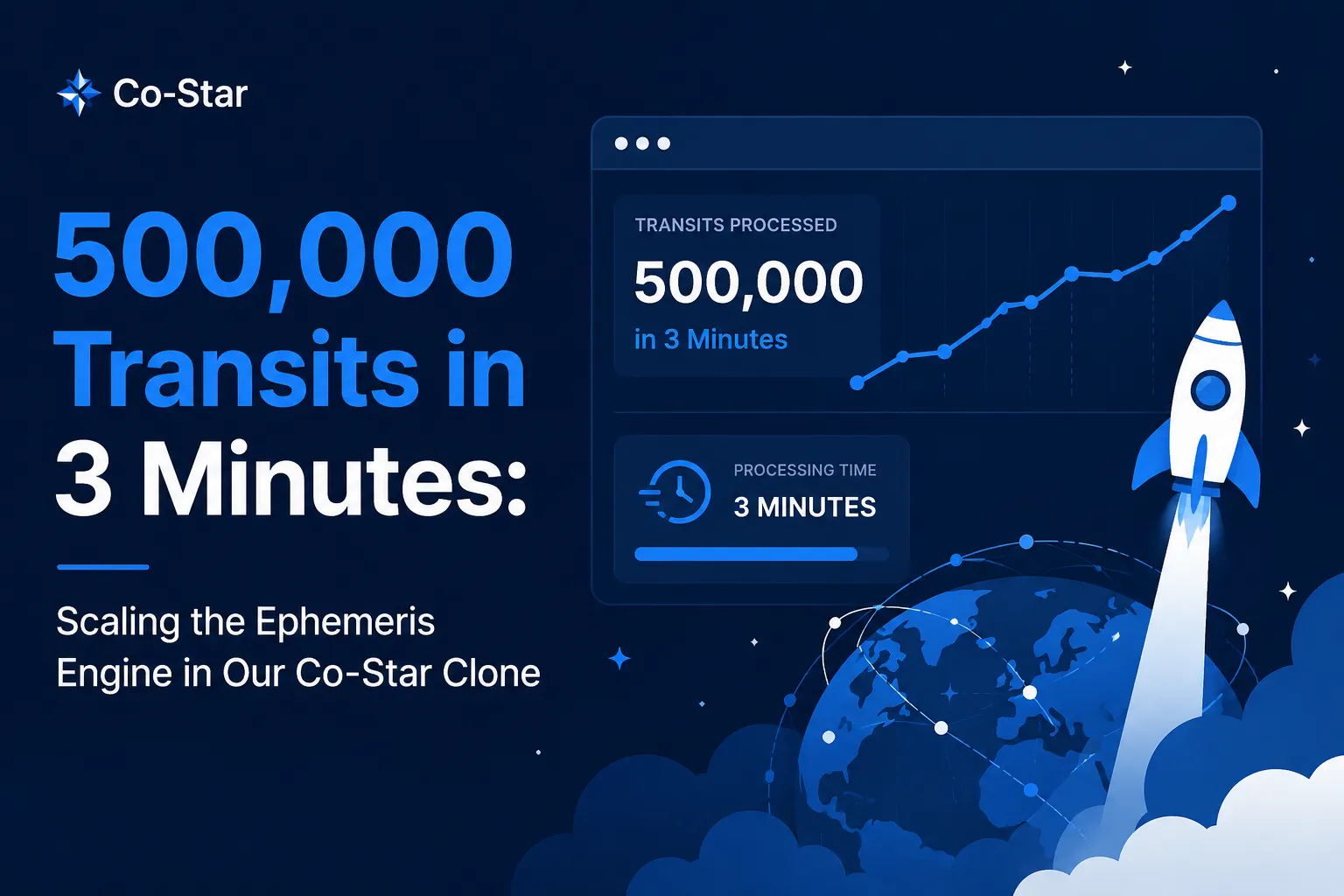
In this case study, we break down how our Ephemeris Caching Pipeline uses server-side Redis caching to process 500,000 personalized daily transit calculations in under 3 minutes without maxing out external API limits or creating crippling latency.
Why Astrology Apps Break When Personalization Scales
A basic horoscope app can serve the same Aries, Taurus, or Gemini content to thousands of users. That model is simple because the backend is mostly content retrieval.
A Co-Star-style astrology app platform is different.
Each user may have a unique birth chart based on date, time, and location. The system then has to compare current planetary movements against that personal chart. That means two users with the same zodiac sign may still receive different transit insights because their moon, rising sign, houses, and planetary placements are different.
That personalization creates a computation problem.
At small scale, the backend can calculate transits on demand. At 10,000 users, this already becomes inefficient. At 500,000 users, on-demand calculation creates three major risks:
| Scaling Risk | What Happens | Founder Impact |
| API dependency | Every transit request hits an external astrology or astronomy API | Higher cost, throttling risk, slower response |
| Latency spikes | Users open the app during the same morning window | Slow feeds, delayed insights, poor retention |
| Batch failure | Daily transit jobs take too long or fail halfway | Inconsistent notifications and user trust issues |
This is why Miracuves does not treat astrology app development as a generic clone build. The product needs a calculation engine, caching logic, batch scheduler, queue control, and failure recovery strategy.
Read more : Astrology App for Saudi Arabia: Features, Payment Gateways, Privacy, and Customization Guide
The Ephemeris Bottleneck: Where the Backend Actually Slows Down
An ephemeris tells the system where planets and celestial bodies are positioned at specific times. Swiss Ephemeris is widely used in astrology software because it provides high-precision planetary calculations and is based largely on JPL planetary ephemerides.
For an astrology app, the ephemeris layer supports calculations such as:
- Current planetary positions
- Natal chart placements
- Daily transits
- Synastry and compatibility logic
- House placements
- Retrograde status
- Moon phase and lunar movement
- Aspect detection between natal and current planets
The bottleneck appears when the system recalculates the same astronomical base data repeatedly.
For example, if 500,000 users need today’s Mars, Venus, Moon, Saturn, and Mercury positions, the raw planetary data for the day does not need to be fetched or recalculated 500,000 separate times. What changes is the comparison between that shared planetary state and each user’s natal chart.
That distinction matters.
The Miracuves engineering approach separates shared astronomical state from user-specific personalization logic. Shared ephemeris values are cached server-side. User-specific transit interpretation runs against cached values.
Server-Side Caching vs. External API Polling
Many early astrology apps use external APIs for speed of development. That can work for prototypes, but it becomes fragile when personalization grows.
External API polling creates a linear dependency: more users mean more API calls. More API calls mean more latency, more cost, and greater exposure to rate limits.
The Miracuves Ephemeris Caching Pipeline takes a different route.
Instead of asking an external service for every user’s transit state, the system precomputes or retrieves core ephemeris data, stores reusable values in Redis, and then runs personalized calculations against those cached values.
Redis is well suited for this kind of workload because in-memory caching stores frequently accessed data closer to the application layer, reducing repeated retrieval from slower storage or remote services. Redis pipelining can also improve throughput by issuing multiple commands together instead of waiting for each command response one by one.
Architecture Difference
| Approach | How It Works | Main Weakness | Better Use Case |
| External API polling | Calls third-party APIs repeatedly for chart or transit data | Rate limits, cost spikes, network latency | Early prototype or low-volume app |
| On-demand calculation | Calculates each user’s transit when they open the app | Morning traffic spikes, inconsistent speed | Small user base with low concurrency |
| Server-side ephemeris caching | Stores reusable planetary data in Redis and runs personalization internally | Requires stronger backend architecture | Scalable astrology platforms |
| Batch precomputation | Processes daily transits before user demand peaks | Requires scheduling and monitoring | High-volume personalized daily insights |
For astrology founders, this is the difference between launching an attractive app and launching a platform that can survive real engagement.
How the Miracuves Ephemeris Caching Pipeline Works
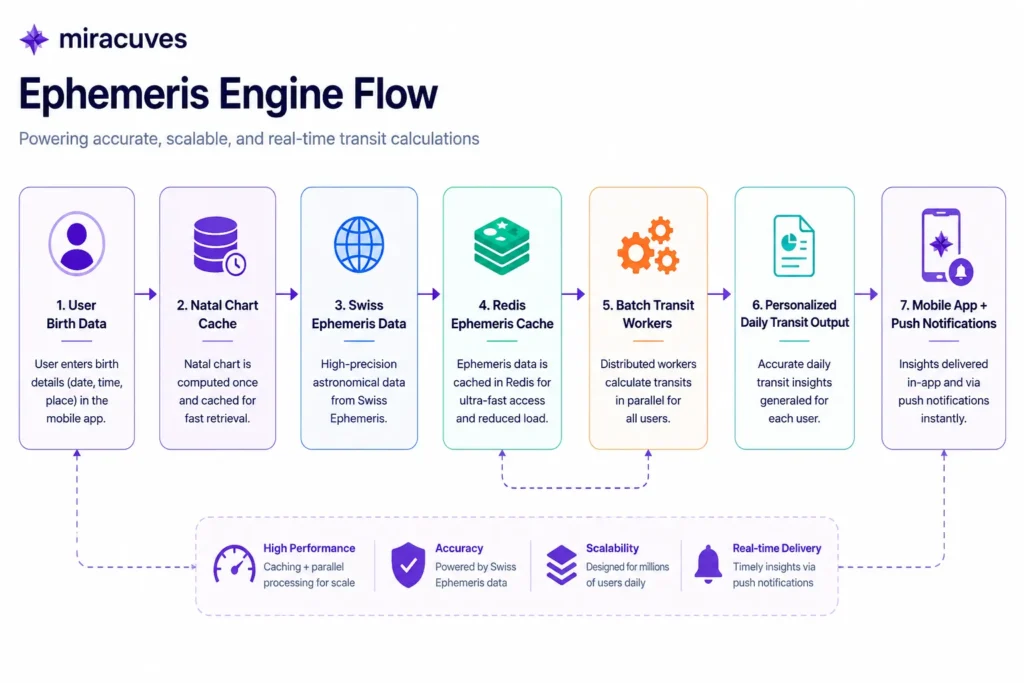
The Miracuves pipeline is built around one core principle: never recompute shared astronomical data unnecessarily.
The backend separates the process into five layers.
1. Ephemeris Source Layer
The system uses high-precision ephemeris data to calculate planetary positions for the required time window. This may include current day, next day, and timezone-adjusted windows depending on user geography.
The key backend decision is to treat ephemeris data as a reusable source layer, not as a per-user API request.
2. Redis Cache Key Design
The cache key structure is designed around date, celestial body, zodiac system, timezone group, and calculation type.
Example cache key logic:
ephem:{date}:{timezone_group}:{planet}:{calculation_type}
This avoids unnecessary duplicate values while still allowing the system to handle localization and calculation variants.
3. User Chart Snapshot Layer
Each user’s natal chart data is normalized into a backend-readable snapshot. Instead of recalculating birth chart foundations every day, the system stores structured natal placements that can be reused for daily transit comparisons.
This reduces CPU load because the daily job only needs to compare today’s planetary movements against already prepared user chart data.
4. Transit Calculation Workers
Worker nodes process users in batches. Each worker reads cached ephemeris data, pulls user chart snapshots, calculates transit relationships, and writes output into a transit result store.
This is where the pipeline produced the case-study benchmark: 500,000 personalized daily transit calculations in under 3 minutes.
5. Notification and Feed Delivery Layer
Once calculations are complete, the app does not need to generate the insight from scratch when the user opens the app. The result is already available for the feed, push notification, or daily insight screen.
That improves perceived speed and gives the product team more control over timing, personalization, and notification campaigns.
The 3-Minute Batch Execution: What Actually Happened
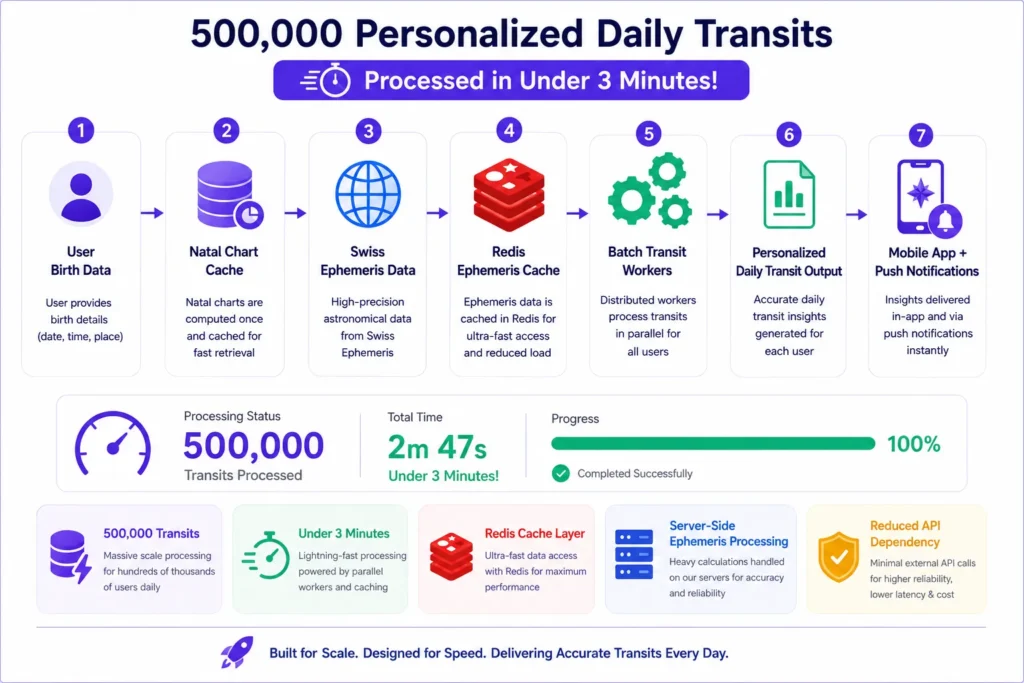
The deployment goal was simple: generate personalized daily transit outputs for 500,000 users before the morning usage spike.
The backend was configured around Redis-backed ephemeris caching, pre-normalized user chart data, and batch workers that could process users in parallel without repeatedly calling external APIs.
Batch Execution Flow
- Scheduler triggers the daily transit job.
- Ephemeris source layer calculates or refreshes required planetary positions.
- Redis stores reusable planetary state for the target date and timezone groups.
- Worker pool pulls user chart snapshots in controlled batches.
- Transit engine compares cached planetary positions with natal placements.
- Results are written into the daily transit store.
- Notification layer prepares personalized delivery.
The key improvement came from preventing the system from treating every user as a fresh astronomical calculation. The pipeline reused shared ephemeris values and reserved compute power for personalization.
Ephemeris Caching Pipeline: Technical Value Breakdown
| Backend Layer | Technical Function | Founder Impact |
|---|---|---|
| Redis ephemeris cache | Stores reusable planetary position data server-side | Reduces API dependency and repeated calculations |
| User chart snapshots | Keeps natal chart data normalized for daily comparison | Improves calculation speed as the user base grows |
| Batch workers | Processes users in parallelized calculation groups | Supports high-volume daily personalization |
| Precomputed transit store | Saves final daily outputs before user demand peaks | Improves app open speed and feed reliability |
| Notification queue | Prepares personalized push delivery after calculation | Enables timely daily engagement campaigns |
Why Redis Was the Right Fit for This Astrology Workload
Redis was not used because it is trendy. It was used because the workload had three clear characteristics:
First, the same planetary state was reused across many users. That makes caching valuable.
Second, daily transit generation is time-sensitive. The system must complete jobs before the user engagement window.
Third, batch execution benefits from reducing round trips. Redis pipelining is designed to batch commands so the client does not wait for a response after every single command.
For this astrology app clone, Redis helped reduce pressure across three areas:
- API pressure: fewer repeated external calls
- Database pressure: fewer repeated reads for shared ephemeris values
- Execution pressure: faster access to high-demand calculation inputs
The result was not just faster backend performance. It created a better product experience because users could receive personalized daily transits without waiting for real-time calculation.
Read more : Why the Middle East Demands a Different Kind of Astrology App — Private, Arabic, Locally Paid & Fully Custom
Founder Decision Signals: When You Need This Architecture
Not every astrology app needs a large-scale ephemeris pipeline on day one. But founders should plan for it when personalization is central to the product.
Founder Decision Signals
Speed
If users expect daily insights immediately after opening the app, precomputed transits are safer than real-time calculation during traffic spikes.
Cost
If every personalized result depends on external API calls, infrastructure cost can rise directly with user growth.
Scalability
If your product roadmap includes compatibility, daily transit feeds, moon reports, and push notifications, caching must be part of the backend foundation.
Market Fit
If personalization is your core retention loop, slow or inconsistent transit delivery can damage trust even if the app design looks premium.
Why This Matters for a Co-Star Clone Business Model
Co-Star became known for personalized astrology, social chart comparison, and daily notifications. Its app listings highlight personalized daily horoscopes, birth chart comparison with friends, compatibility, and push notifications.
A founder entering this category cannot compete only with screens. The product needs a personalization loop strong enough to bring users back daily.
That loop depends on backend execution.
A scalable astrology app can monetize through:
| Monetization Model | Backend Requirement |
| Premium daily insights | Reliable personalized transit generation |
| Compatibility reports | Fast synastry and chart comparison |
| Paid birth chart reports | Accurate natal chart calculation and storage |
| Push notification campaigns | Precomputed personalized message triggers |
| Creator or astrologer content | Matching user chart patterns with expert content |
| Subscription access | Consistent premium insight delivery |
If the backend fails, monetization suffers. Paid users will not tolerate delayed reports, generic insights, or repeated errors in chart-based personalization.
Mistakes Founders Should Avoid
Mistakes Founders Should Avoid
Building the app around external API polling
This may look faster during early development, but it creates scaling risk when daily personalization grows. A strong astrology backend should reduce repeated external dependency wherever possible.
Treating astrology content as static zodiac copy
Modern users expect chart-aware personalization. Generic sun-sign content may help with launch, but it is rarely enough for long-term retention.
Ignoring batch execution until growth
Daily transit generation should be designed before traffic spikes happen. Retrofitting batch workers and cache layers later can slow product growth.
Optimizing UI before backend reliability
A beautiful astrology app still fails if users wait too long for daily insights or receive inconsistent calculations.
Miracuves Perspective: A Co-Star Clone Should Be a Calculation Engine, Not Just a Clone
The strongest astrology platforms are not simply content apps with zodiac filters. They are personalization systems.
That is why Miracuves approaches a Co-Star clone as a white-label astrology app foundation with backend logic for user profiles, natal chart storage, transit calculation, compatibility, notification flows, admin control, and scalable data processing.
For founders, the benefit is not copying Co-Star’s interface. The benefit is launching with a technical foundation that can support serious astrology personalization, then customizing the experience for a specific audience: wellness communities, spiritual influencers, Gen Z astrology users, live astrologer marketplaces, or premium self-reflection products.
Miracuves helps founders build ready-made and white-label app solutions with source-code ownership, admin control, branded design, and faster deployment. For astrology products, the backend architecture matters because personalization is the product.
Final Thoughts
A Co-Star clone is easy to describe but difficult to scale.
The visible product is the horoscope feed, compatibility screen, birth chart, and push notification. The real product is the backend system that turns astronomical data into personalized insight at the right time for every user.
The Miracuves Ephemeris Caching Pipeline proved that a properly designed astrology backend can process 500,000 personalized daily transit calculations in under 3 minutes by caching reusable Swiss Ephemeris-derived data server-side via Redis and running personalization through controlled batch execution.
For astrology startup founders, wellness tech buyers, and spiritual influencers, this is the practical lesson: do not buy screens. Buy the engine. conctact us
FAQs
1. What is a Co-Star clone?
A Co-Star clone is an astrology app inspired by Co-Star’s core product pattern, including birth charts, personalized daily insights, compatibility, friend chart comparison, and push notifications. A serious version should also include a scalable backend for ephemeris data, transit calculations, user chart storage, and personalized content delivery.
2. Why is ephemeris caching important in astrology app development?
Ephemeris caching prevents the backend from recalculating or refetching the same planetary data repeatedly. Since many users share the same current planetary positions, the app can cache that shared data and use it for personalized transit calculations.
3. How did Miracuves process 500,000 transits in under 3 minutes?
Miracuves used a server-side Ephemeris Caching Pipeline with Redis. The system cached reusable planetary data, reused normalized user chart snapshots, and processed personalized transit calculations through batch workers instead of polling external APIs for every user.
4. Is Redis necessary for a Co-Star-style astrology app?
Redis is not mandatory for every small astrology app, but it becomes highly useful when the platform needs fast access to reusable calculation data, batch processing, and high-volume personalization. Redis is commonly used for in-memory caching to reduce slower repeated reads.
5. Can an astrology app rely only on external APIs?
It can during early testing, but external API dependency can become expensive and slow as users grow. A scalable astrology platform should eventually reduce repeated API polling by caching ephemeris data and processing personalization internally.
6. What backend features should a scalable astrology app include?
A scalable astrology app should include user chart snapshots, ephemeris data handling, transit calculation workers, Redis or similar caching, notification queues, admin controls, content management, user segmentation, and monitoring for failed batch jobs.
7. Does Miracuves offer a white-label astrology app?
Miracuves builds ready-made and white-label app solutions with source-code ownership, admin dashboards, custom branding, and faster deployment. For astrology platforms, the solution can be aligned with personalized horoscope, chart, transit, compatibility, and notification workflows.
Miracuves is an independent software development company. We are not affiliated with, connected to, sponsored by, or endorsed by any company or product named in this article.
Terms such as “X Clone” are used descriptively. It is how the software industry refers to building a platform with functionality comparable to a known service, and how clients search for it.
The entire design and codebase of our products is built by our own team. Our products contain no code, design, graphics, or content originating from any third-party website or applications.
All third-party names and marks referenced in this article are the property of their respective owners, referenced solely to identify the services discussed.