
Key Takeaways
- Broad food aggregators are hard to beat with limited capital.
- A closed-loop ghost kitchen focuses on one dense delivery zone.
- Owned apps help founders control customers, menus, and margins.
- 3–4 focused kitchen brands can create stronger repeat orders.
- Profit comes from operational density, not city-wide expansion.
Strategy Signals
- Choose one high-demand neighborhood before scaling wider.
- Build delivery-first menus with strong margins.
- Control kitchen prep, packaging, dispatch, and delivery radius.
- Use aggregators for discovery, not long-term dependency.
- Track repeat orders, delivery cost, prep time, and refunds weekly.
Real Insights
- Do not fight UberEats on discounts and scale.
- Density beats distance in ghost kitchen delivery.
- Customer ownership is stronger than marketplace dependency.
- A smaller controlled zone can become a local monopoly.
- Miracuves builds ghost kitchen delivery apps with owned ordering workflows.
Most food delivery founders are choosing the wrong battlefield.
They look at Uber Eats, DoorDash, Swiggy, Zomato, and Deliveroo, then decide to build a city-wide restaurant aggregator with hundreds of vendors, discount campaigns, driver incentives, referral offers, and a dream that “local execution” will beat global scale.
That is not a strategy. That is a marketing war against companies with deeper capital, stronger consumer habits, bigger logistics datasets, and existing demand density.
DoorDash reported 903 million total orders and $29.7 billion Marketplace GOV in Q4 2025. Uber reported Q4 2025 gross bookings of $54.1 billion across its platform. These companies are not just apps. They are demand machines, logistics networks, advertising platforms, and consumer habit engines.
A bootstrapped founder should not try to outspend them.
The smarter move is to stop building a broad aggregator and start building a closed-loop ghost kitchen delivery app.
That means you do not onboard every restaurant in the city. You do not chase every cuisine. You do not burn cash trying to acquire every hungry customer within 30 kilometers.
You control a private network of 3–4 high-margin ghost kitchen brands in one dense neighborhood. You own the app. You own the customer relationship. You control the menu economics. You manage the delivery radius. You operate the fleet. You use technology as a margin engine, not as a vanity marketplace.
That is the closed-loop ghost kitchen strategy.
Miracuves helps founders build ready-made and white-label food delivery platforms that can support this model with branded ordering, delivery workflows, admin control, real-time tracking, and source-code ownership.
The Aggregator Graveyard: You Cannot Outspend the Giants on Customer Acquisition
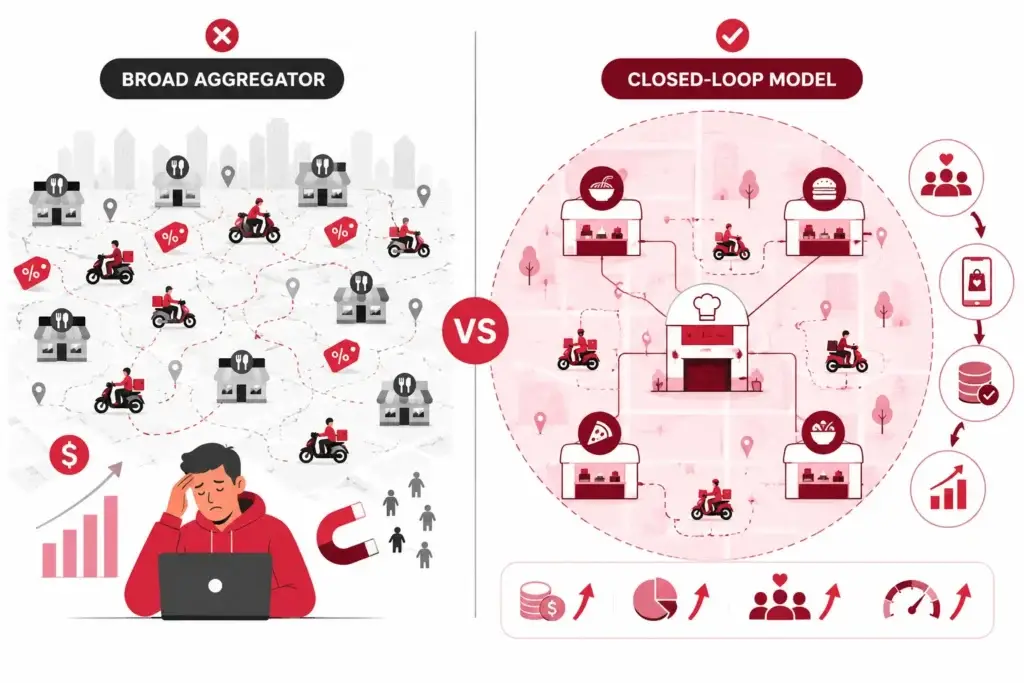
Image Source: AI-generated visual by Miracuves
The most dangerous sentence in food tech is:
“We will build an app like Uber Eats, but for our city.”
It sounds logical. It feels local. It looks fundable on a pitch deck. But operationally, it is often a trap.
A broad food delivery aggregator has three brutal problems from day one.
First, it needs enough restaurants to look useful. Second, it needs enough customers to make restaurants care. Third, it needs enough drivers to keep delivery times acceptable. If any one side fails, the entire marketplace feels empty.
This is the classic marketplace cold-start problem, but food delivery makes it more painful because orders are time-sensitive, location-sensitive, and quality-sensitive.
A user can forgive a slow furniture marketplace. They will not forgive cold biryani, melted ice cream, missing sauce, or a delivery partner who cannot find the building.
Large aggregators can absorb this complexity because they already have demand density, brand recall, and operational data. A local founder does not.
That is why “marketing harder” is not enough.
You can run discounts, influencer campaigns, referral codes, and launch-week offers. But once incentives stop, users return to the apps already installed on their phones.
The giants are not winning only because their apps are better. They are winning because they own customer habits.
A founder with limited capital should not fight habits directly. The founder should build a system where the customer has a reason to bypass the aggregator.
That reason is not “we also deliver food.”
The reason is:
- Better menu control
- Faster neighborhood delivery
- More consistent quality
- Direct loyalty rewards
- Curated food brands
- Lower operating leakage
- Stronger repeat ordering
- A relationship with the brand, not the marketplace
This is where the closed-loop ghost kitchen model becomes powerful.
Why the Closed-Loop Ghost Kitchen Model Changes the Economics
A ghost kitchen is a delivery-focused kitchen without a traditional dine-in storefront. A 2026 report on dark kitchens in England described them as delivery-only food businesses with no customer-facing storefront, and noted that they have become significant enough to create new transparency and regulatory questions.
But a ghost kitchen alone is not a strategy.
A ghost kitchen that depends entirely on third-party marketplaces can still be trapped by commissions, platform rules, customer data loss, and ranking algorithms.
The real strategy is a closed-loop ghost kitchen delivery system.
In this model, the founder controls four layers:
| Layer | Traditional Aggregator Model | Closed-Loop Ghost Kitchen Model |
|---|---|---|
| Supply | Hundreds of third-party restaurants | 3–4 owned or partner kitchen brands |
| Demand | Marketplace users owned by aggregator | Direct customers owned by the brand |
| Logistics | External or marketplace-controlled fleet | Controlled neighborhood delivery fleet |
| Margin | Commission-dependent | Menu margin, delivery fee, loyalty, bundles, repeat orders |
The difference is control.
If you own or tightly manage the kitchen brands, you can design menus around delivery efficiency. You can reduce prep complexity. You can optimize packaging. You can bundle items intelligently. You can schedule prep based on demand patterns. You can limit delivery radius to protect freshness.
That matters because ghost kitchen operations are not just about cooking. They are about synchronizing preparation, dispatch, freshness, and delivery timing. Research on restaurant meal delivery with ghost kitchens highlights the importance of integrated preparation scheduling and vehicle dispatching, especially because demand is spatially and temporally dispersed.
A broad aggregator cannot optimize every restaurant’s kitchen. It can only route demand.
A closed-loop founder can optimize the entire system.
That is the advantage.
Read More: Best UberEats Clone Script in 2026: Features & Pricing Compared
The Micro-Monopoly: Controlling the Kitchen and the Fleet
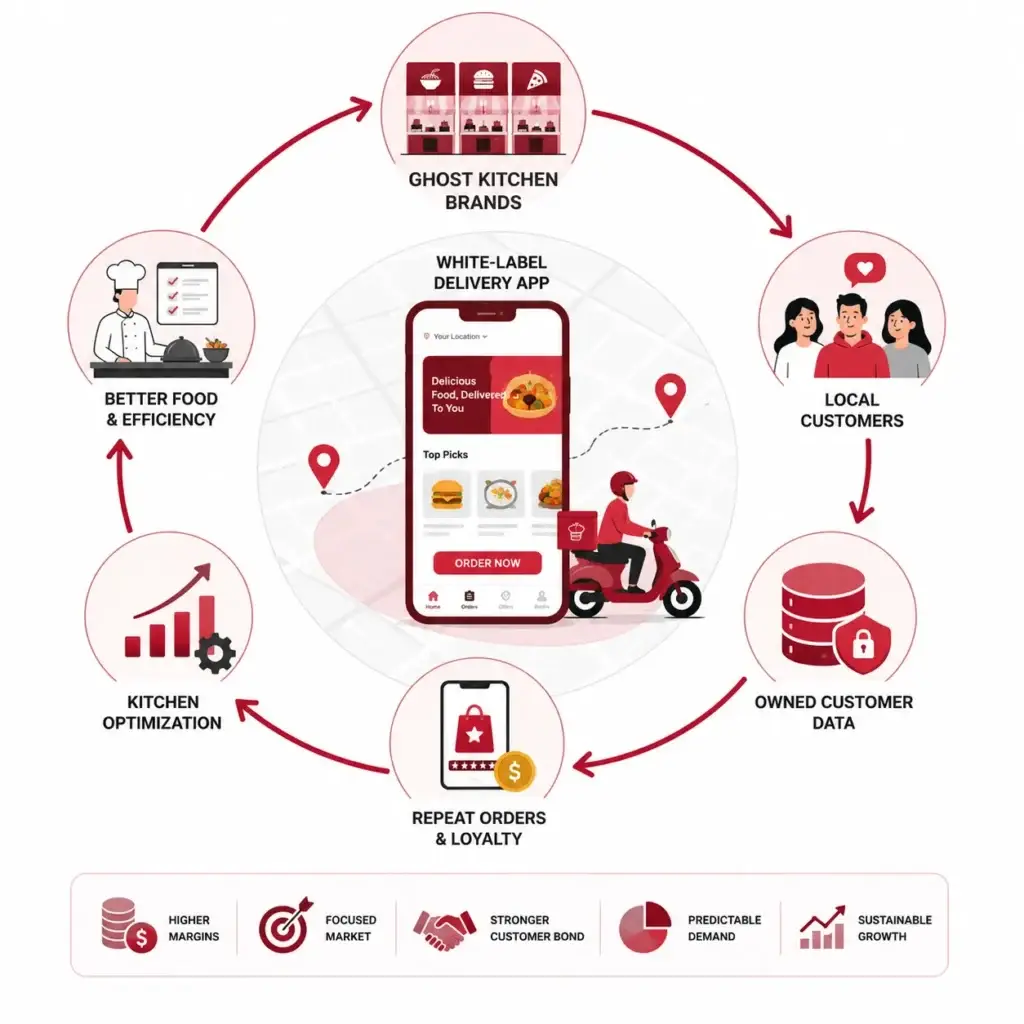
Image Source: AI-generated visual by Miracuves
The goal is not to dominate the city.
The goal is to dominate one dense delivery pocket.
Think of one high-density neighborhood with:
- Apartment clusters
- Office buildings
- Student housing
- Co-working spaces
- Fitness centers
- Late-night demand
- Limited high-quality delivery options
That neighborhood is your battlefield.
Not the whole city. Not the entire metro. Not every suburb. One controlled zone.
Inside that zone, you launch 3–4 high-margin ghost kitchen brands from the same production base or tightly coordinated kitchen network.
For example:
| Ghost Kitchen Brand | Positioning | Why It Works in a Closed Loop |
|---|---|---|
| Bowl brand | Healthy lunch bowls for office workers | Repeat weekday orders |
| Burger or wrap brand | Fast comfort food | High evening and weekend demand |
| Dessert or beverage brand | Add-on and impulse orders | Increases average order value |
| Late-night snack brand | Night demand | Helps utilize kitchen capacity beyond dinner |
This is not random menu expansion. It is demand stacking.
You are not trying to become a food court. You are designing a portfolio where multiple food brands share infrastructure, delivery density, packaging systems, and customer data.
That creates a micro-monopoly.
A micro-monopoly does not mean there are no competitors. It means you control a specific operating niche better than anyone else in a defined location.
The founder’s job is to make the closed loop tighter every week:
- Shorter delivery radius
- Faster driver turnaround
- Better kitchen prep timing
- Stronger direct customer database
- More repeat orders
- Higher average order value
- Lower failed delivery rate
- Better review control
- More predictable inventory
This is how a small food delivery business becomes defensible.
Not by being everywhere.
By being unusually strong somewhere.
Deploying Your White-Label Engine for Maximum Margin in a Single Zip Code
A white-label delivery app is not valuable because it looks like Uber Eats.
It is valuable because it lets you stop renting your customer relationship from Uber Eats.
Many food brands use third-party platforms for discovery, and that can make sense early. CloudKitchens’ restaurant strategy content describes platforms like DoorDash and Uber Eats as acquisition channels because they bring immediate exposure inside large marketplaces.
But acquisition and ownership are not the same thing.
A third-party marketplace may help a customer discover your food once. Your own white-label delivery app should help you own the second, third, fourth, and tenth order.
That is where Miracuves’ white-label food delivery app approach fits the closed-loop ghost kitchen strategy.
Instead of building every module from zero, founders can start with a ready-made delivery foundation and customize it around their kitchen brands, delivery rules, service radius, payment flows, offers, and admin workflows.
A practical closed-loop delivery app needs:
- Customer app for ordering and tracking
- Kitchen or merchant panel for order acceptance and preparation
- Delivery partner app for pickup, routing, and proof of delivery
- Admin dashboard for zones, menus, payouts, users, offers, and reporting
- Payment integration
- Push notifications
- Ratings and feedback
- Promo and loyalty tools
- Order history
- Real-time tracking
- Delivery radius management
Miracuves already positions its food delivery solutions around ready-to-launch infrastructure, real-time order tracking, route optimization, and reduced development time.
For a closed-loop ghost kitchen, that matters because the founder’s bottleneck is not only app development. The real bottleneck is operational learning.
The faster the app is deployed, the faster the founder can test:
- Which menu sells repeatedly
- Which neighborhood converts best
- Which delivery radius protects food quality
- Which offers drive profitable repeat orders
- Which time slots need more kitchen staff
- Which drivers perform reliably
- Which customers are worth remarketing to
A broad aggregator founder is trying to solve 50 problems across a city.
A closed-loop founder is solving 10 problems inside one dense zone until the unit economics work.
That is a better game.
The App Architecture Behind a Closed-Loop Food Delivery Business
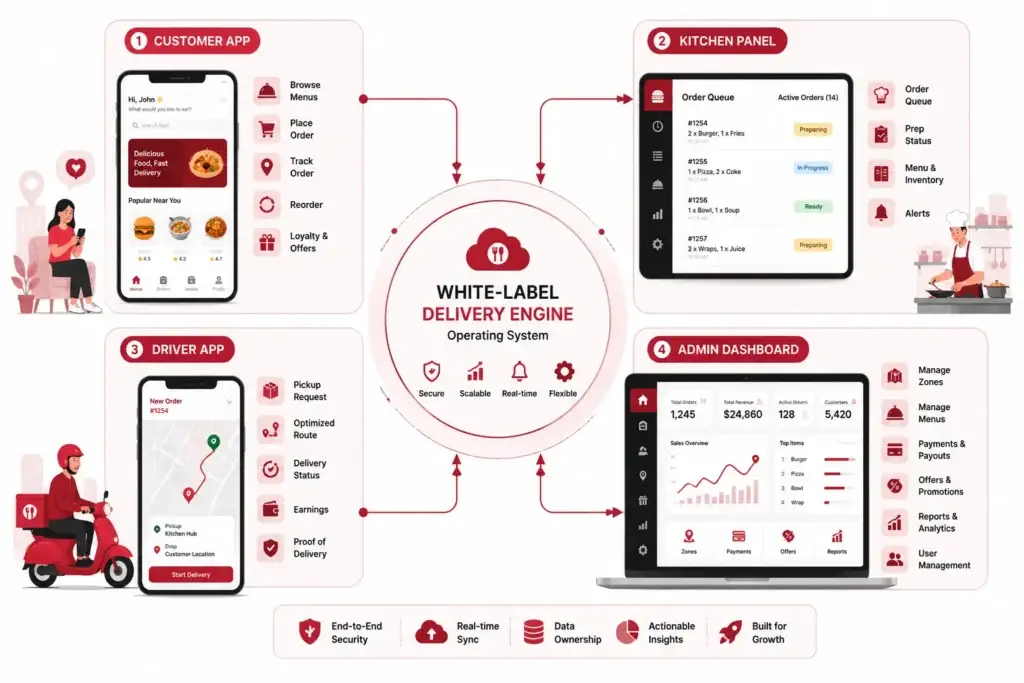
Image Source: AI-generated visual by Miracuves
A closed-loop ghost kitchen delivery app should not be bloated. It should be operationally sharp.
The app ecosystem needs four core panels.
1. Customer App
The customer app is where demand is captured directly. It should make ordering fast, menu browsing simple, and repeat purchases frictionless.
Key features include:
- Brand-specific menus
- Smart search
- Delivery address management
- Real-time order tracking
- Scheduled orders
- Reorder button
- Loyalty offers
- Wallet or saved payment options
- Ratings and feedback
- Push notifications
The reorder button matters more than most founders think. A closed-loop ghost kitchen does not win by making every order feel like a new discovery. It wins by making repeat ordering effortless.
2. Kitchen Panel
The kitchen panel controls prep execution.
For ghost kitchens, this is critical because multiple virtual brands may run from one kitchen or coordinated kitchen network. The panel should help staff see incoming orders, prep times, modifiers, item availability, and order status.
Useful features include:
- Order queue
- Preparation status
- Menu availability
- Item-level modifiers
- Kitchen notes
- Pickup readiness status
- Inventory visibility
- Multi-brand order handling
The kitchen panel should reduce chaos during peak hours. If the kitchen cannot execute consistently, the app will only accelerate complaints.
3. Delivery Partner App
The driver app controls the last-mile experience.
In a tight delivery radius, the goal is not just tracking. The goal is driver efficiency.
Key features include:
- Pickup assignment
- Delivery route visibility
- Status updates
- In-app navigation
- Customer contact masking where needed
- Proof of delivery
- Delivery history
- Earnings or payout view
A closed-loop fleet can be small. But it must be disciplined. Even three unreliable drivers can damage a neighborhood brand.
4. Admin Dashboard
The admin dashboard is the control room.
This is where the founder manages users, kitchen brands, delivery partners, menus, service zones, offers, commissions, payments, refunds, disputes, and performance reports.
For the closed-loop model, the admin dashboard should answer questions like:
- Which kitchen brand has the highest repeat rate?
- Which menu item has the strongest margin?
- Which delivery zone creates the most delays?
- Which driver causes the most complaints?
- Which promo codes attract profitable customers?
- Which time slots need staffing changes?
Without admin visibility, the founder is guessing.
With admin visibility, the founder can tune the business weekly.
Revenue Model: Where the Margin Actually Comes From
A city-wide aggregator usually monetizes through commissions, delivery fees, ads, subscriptions, and merchant services.
A closed-loop ghost kitchen app has a different margin logic.
It can earn from:
| Revenue Lever | How It Works | Why It Matters |
|---|---|---|
| Food margin | Higher control over menu cost and pricing | Better than relying only on commissions |
| Delivery fee | Fee charged within a limited delivery zone | Helps cover controlled fleet costs |
| Bundles | Meal combos, family packs, lunch sets | Increases average order value |
| Subscriptions | Monthly delivery pass or meal membership | Improves repeat revenue |
| Loyalty wallet | Credits for repeat orders | Keeps users inside the owned app |
| Corporate meal plans | Office lunch subscriptions | Adds predictable weekday demand |
| Cross-brand upsells | Dessert, beverage, snack add-ons | Uses multiple kitchen brands to lift basket size |
| Catering/pre-orders | Scheduled group orders | Improves demand planning |
This is the major difference.
An aggregator earns a slice of other people’s food businesses.
A closed-loop ghost kitchen app earns from the food business itself, the delivery experience, and the customer relationship.
That does not automatically make it easy. The model still requires menu discipline, food quality, operational consistency, and strong local marketing.
But it gives the founder more levers to improve profitability.
Founder Decision Signals: When This Strategy Makes Sense
The closed-loop ghost kitchen strategy is not for every founder.
It makes sense when you can answer “yes” to most of these:
| Decision Signal | Good Sign | Warning Sign |
|---|---|---|
| Kitchen control | You own or tightly manage the kitchen brands | You depend on random third-party restaurants |
| Delivery density | You can focus on one dense zone | You want to cover the whole city immediately |
| Menu discipline | You can build delivery-friendly menus | You want hundreds of items from day one |
| Operations | You can manage prep, packaging, and dispatch | You only want to run a software marketplace |
| Customer ownership | You want direct repeat customers | You are comfortable renting demand forever |
| Capital | You need a leaner launch model | You plan to burn heavily on discounts |
| Brand strategy | You can build 3–4 focused food brands | You want to onboard everyone |
If you are a pure software founder with no food operations access, a broad marketplace may feel easier because you do not have to touch the kitchen.
But that is also the weakness.
When you do not control supply, you inherit everyone else’s inconsistency.
When you control the kitchen and the fleet, the operational burden is higher, but so is the ability to improve the business.
Read More: White-Label UberEats App Security: Is It Really Safe in 2026?
Mistakes Founders Must Avoid When Launching a Ghost Kitchen Delivery App
Mistake 1: Launching Too Many Brands Too Early
More brands do not automatically mean more revenue.
If your kitchen team cannot execute four menus consistently, do not launch six. A closed-loop system depends on reliability. Start with a small portfolio and expand only after demand patterns are clear.
Mistake 2: Copying Restaurant Menus Instead of Designing Delivery Menus
Not every food travels well.
A profitable ghost kitchen menu must consider prep time, packaging, temperature retention, ingredient overlap, margin, and repeat demand.
The best delivery menu is not always the most creative menu. It is the menu that arrives well, photographs well, gets reordered, and does not destroy kitchen workflow.
Mistake 3: Expanding the Delivery Radius Too Soon
A bigger map can kill food quality.
Founders often expand delivery coverage because they want more customers. But longer delivery distances increase delays, driver complexity, refund risk, and negative reviews.
In the closed-loop model, density beats distance.
Mistake 4: Treating the App as a One-Time Build
A delivery app is not just a digital menu.
It is an operating system for demand, preparation, logistics, loyalty, payments, and reporting.
The founder should continuously improve app flows based on real customer and operational data.
Mistake 5: Ignoring Safety, Payments, and Dispute Workflows
Food delivery platforms handle personal data, addresses, payments, refunds, driver activity, and customer complaints.
Founders should include secure payment gateway integration, role-based access control, admin approval workflows, activity logs, refund handling, and dispute management from the beginning.
This does not mean claiming automatic compliance everywhere. It means building a safer and more controlled operating foundation.
White-Label vs Custom Build for a Closed-Loop Ghost Kitchen App
| Build Option | Best For | Advantage | Risk |
|---|---|---|---|
| Fully custom app | Funded teams with unique workflow requirements | Maximum flexibility | Higher time, cost, and execution risk |
| No-code ordering tool | Very early food brands testing simple direct orders | Fast and low-cost | Limited logistics and backend control |
| Third-party aggregator only | Discovery and demand testing | Existing marketplace traffic | Lower customer ownership and margin control |
| White-label delivery app | Founders who want branded apps, admin control, and faster launch | Faster deployment with core modules already built | Needs customization discipline and operational readiness |
For most bootstrapped ghost kitchen founders, a white-label delivery app is the practical middle path.
It avoids the cost and delay of building everything from zero, but it gives more ownership than relying only on third-party marketplaces.
Miracuves’ ready-made delivery solutions are designed for founders who want a launch-ready foundation with branding, app workflows, admin control, and faster market entry.
How to Launch the Closed-Loop Ghost Kitchen Model
Step 1: Pick One Dense Neighborhood
Do not start with the city.
Choose one area where delivery demand is frequent, order values are healthy, and travel times are predictable.
Look for apartment density, office clusters, student zones, nightlife pockets, or underserved cuisine demand.
Step 2: Build 3–4 Kitchen Brands Around Demand Occasions
Do not create brands randomly.
Map them to demand occasions:
- Healthy lunch
- Comfort dinner
- Late-night snacks
- Desserts and beverages
- Family meals
- Office group orders
Each brand should have a clear role in the portfolio.
Step 3: Design Delivery-First Menus
Choose items that are operationally friendly.
Prioritize:
- Fast prep
- Ingredient overlap
- Good packaging performance
- High repeat potential
- Strong gross margin
- Easy upsells
- Consistent quality after travel
Step 4: Deploy the White-Label Delivery Engine
This is where the technology foundation goes live.
The platform should include customer ordering, kitchen workflows, delivery partner management, payments, tracking, notifications, offers, and admin reporting.
Miracuves can help founders launch faster with a white-label food delivery app foundation that can be customized around ghost kitchen operations.
Step 5: Use Aggregators for Discovery, Not Dependency
Third-party delivery apps can still play a role.
Use them to test menu demand and acquire first-time customers where practical. But build a strategy to move repeat customers into your owned channel through packaging inserts, QR codes, loyalty offers, direct discounts, and better app-only bundles.
Step 6: Measure Unit Economics Weekly
Track:
- Average order value
- Food cost
- Packaging cost
- Delivery cost per order
- Repeat order rate
- Refund rate
- Prep time
- Delivery time
- Driver utilization
- Customer acquisition cost
- Promo dependency
- Margin by menu item
Read More: The Evolution of Food Delivery App: What It Takes to Compete With Swiggy and UberEats
Final Thoughts: Do Not Build a Bigger Battlefield. Build a Smaller Monopoly.
The food delivery market is not impossible.
But the broad aggregator model is a dangerous starting point for most bootstrapped founders.
Trying to beat Uber Eats or DoorDash city-wide means competing on customer acquisition, restaurant supply, driver liquidity, discounts, logistics, and brand recall all at once.
That is too many battles.
The closed-loop ghost kitchen strategy narrows the battlefield.
You control the brands. You control the kitchen. You control the delivery radius. You control the app. You control the customer relationship. You control the data. You control the margin levers.
That is how a small founder can build a real food delivery business without pretending to be a global monopoly.
The goal is not to become Uber Eats.
The goal is to build a profitable local food engine that the giants cannot easily copy because your advantage is operational density, not just software.
Miracuves helps founders launch that kind of focused delivery platform faster with ready-made, white-label, source-code-owned app solutions built for practical execution.
FAQs
What is a ghost kitchen delivery app?
A ghost kitchen delivery app is a branded ordering and delivery platform built for delivery-only food businesses. It allows customers to place orders, kitchens to manage preparation, delivery partners to handle fulfillment, and admins to control menus, zones, payments, offers, and reports.
How is a closed-loop ghost kitchen model different from Uber Eats?
Uber Eats is a large marketplace aggregator that connects many restaurants with many customers. A closed-loop ghost kitchen model focuses on a private network of owned or closely managed food brands, usually within a limited delivery radius, so the founder can control menu quality, delivery speed, customer data, and margin.
Is it better to build a food delivery aggregator or a ghost kitchen app?
For most bootstrapped founders, a focused ghost kitchen app is often more practical than a broad aggregator. Aggregators require large restaurant supply, customer acquisition budgets, and driver density. A ghost kitchen app can start smaller by controlling a few high-margin food brands in one dense neighborhood.
Can I still use DoorDash or Uber Eats with my own delivery app?
Yes. Many food brands use third-party platforms for discovery while building their own direct ordering channel for repeat customers. The key is not to become dependent on aggregators for every order. Your own app should capture loyalty, customer data, offers, and repeat purchases.
What features should a ghost kitchen delivery app include?
A ghost kitchen delivery app should include customer ordering, menu management, kitchen order queue, delivery partner app, admin dashboard, real-time tracking, payment integration, offers, loyalty tools, ratings, refunds, reports, and delivery zone controls.
Why does delivery radius matter in a ghost kitchen business?
Delivery radius affects food freshness, driver efficiency, delivery time, refund risk, and customer satisfaction. A smaller, denser delivery zone can often produce better economics than a wide delivery map with inconsistent delivery performance.
Can Miracuves build a white-label delivery app for ghost kitchens?
Yes. Miracuves helps founders launch ready-made and white-label food delivery app solutions with branded apps, delivery workflows, admin dashboards, source-code ownership, and faster deployment options for focused food delivery businesses.
Miracuves is an independent software development company. We are not affiliated with, connected to, sponsored by, or endorsed by any company or product named in this article.
Terms such as “X Clone” are used descriptively. It is how the software industry refers to building a platform with functionality comparable to a known service, and how clients search for it.
The entire design and codebase of our products is built by our own team. Our products contain no code, design, graphics, or content originating from any third-party website or applications.
All third-party names and marks referenced in this article are the property of their respective owners, referenced solely to identify the services discussed.