Key Takeaways
What You’ll Learn
- Grab’s revenue model is built on a multi-service ecosystem combining mobility, delivery, and fintech.
- Super app strategy increases retention by connecting daily-use services into one platform.
- Multiple monetization streams include commissions, delivery fees, fintech services, and in-app advertising.
- Fintech integration (GrabPay) plays a major role in improving margins and transaction frequency.
- Grab clone solutions allow startups to replicate this model without building from scratch.
Stats That Matter
- GoTo (Grab’s parent company) generated Rp 4.32 trillion revenue in Q2 2025, showing strong growth momentum.
- Gross Transaction Value (GTV) reached tens of trillions, highlighting massive ecosystem activity.
- Adjusted EBITDA turned positive, marking a shift toward profitability.
- Multi-service usage significantly improves user retention and lifetime value.
- Fintech and payments contribute a major share of overall revenue growth beyond core ride-hailing.
Real Insights
- Multi-service stickiness is the core advantage — users stay when multiple needs are solved in one app.
- Fintech expansion is where real profitability comes from, not just logistics services.
- Merchant-funded ads and promotions help reduce platform costs while driving growth.
- Unit economics must be optimized early to avoid long-term losses.
- Success comes from building a connected ecosystem, not just a single service app.
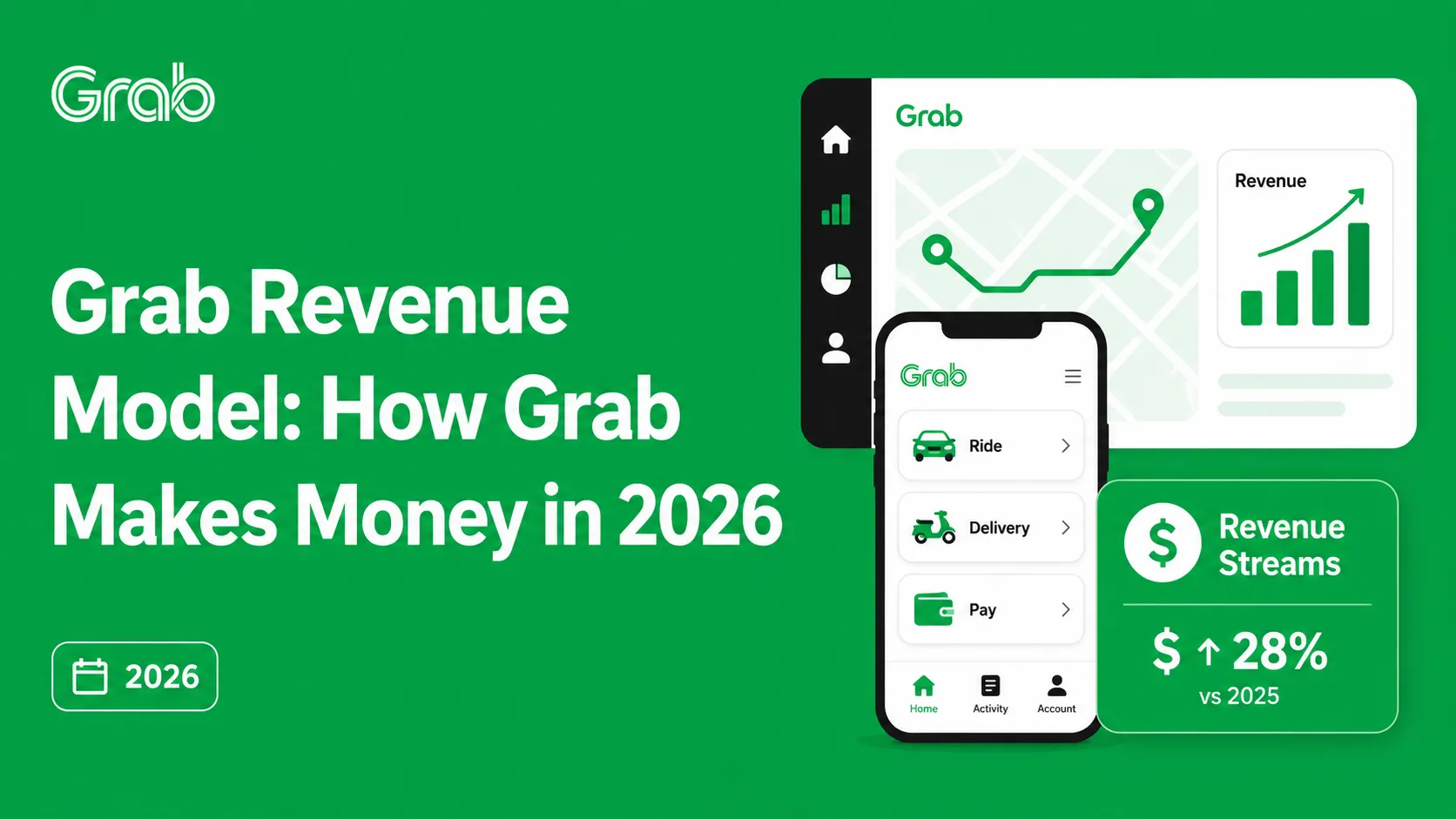
Grab reported $590 million in net revenue in Q2 2026, up nearly 18% year-over-year, pushing its annualized revenue past the $2.3 billion mark. Its fintech arm (Grab Financial Group) and food delivery business are now core profit drivers, while ride-hailing maintains dominance in Southeast Asia.
For entrepreneurs, understanding Grab revenue model is like peeking under the hood of a super-app engine: commissions, fintech, advertising, subscriptions, and AI-powered pricing all working together.
By the end of this guide, you’ll know exactly how Grab like app makes money in 2026, how margins are improving, and what lessons entrepreneurs can apply when building their own platforms with Miracuves.
Grab Revenue Overview — The Big Picture
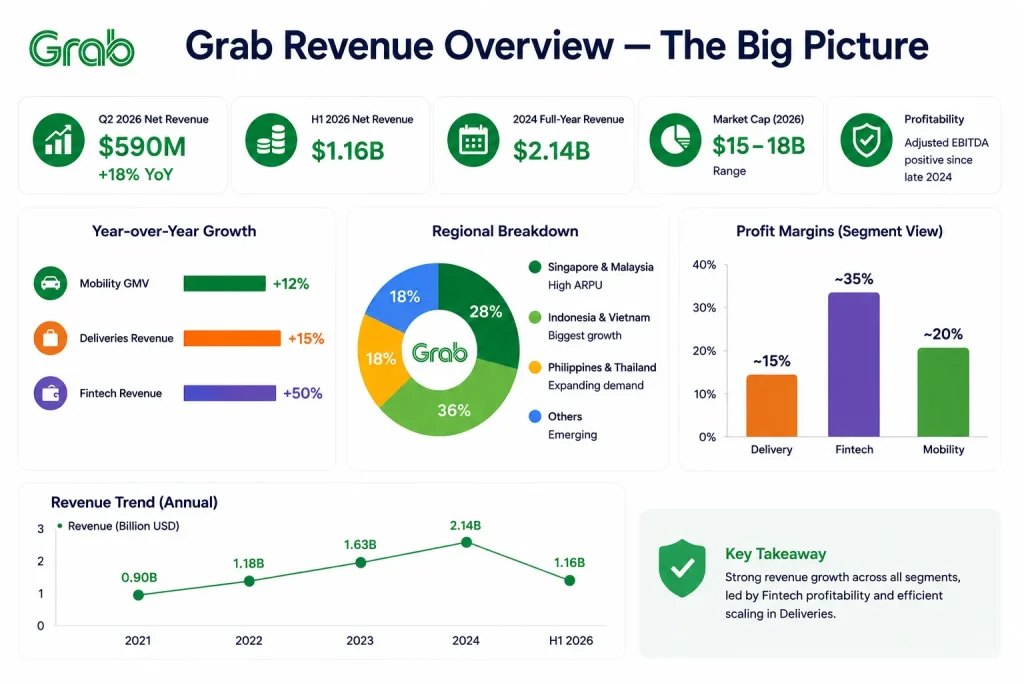
- Q2 2026 Net Revenue: $590M (+18% YoY)
- H1 2026 Net Revenue: $1.16B
- 2024 Full-Year Revenue: $2.14B
- Market Cap (2026): $15–18B range
- Profitability: Adjusted EBITDA positive since late 2024
Year-over-Year Growth
- Mobility GMV +12% YoY
- Deliveries revenue +15% YoY
- Fintech revenue +50% YoY
Regional Breakdown
- Singapore & Malaysia: High ARPU markets
- Indonesia & Vietnam: Biggest growth drivers
- Philippines & Thailand: Expanding demand in rides and delivery
Profit Margins
- Delivery margins rising due to ads + subscriptions
- Fintech driving the highest margins
- Mobility remains profitable but capped by regulations
Read More: What Is Grab and How Does It Work? Complete 2025 Guide
Primary Revenue Streams — Deep Dive
| Revenue Stream | % of Total Revenue | Growth Trend (YoY) |
|---|---|---|
| Deliveries (Food/Mart) | ~40% | +15% |
| Mobility (Ride-hailing) | ~35% | +12% |
| Financial Services (Fintech) | ~20% | +50% |
| Ads & Subscriptions | ~5% | +40% |
| Logistics & Others | <5% | +10% |
- Mobility: 10–20% commission per ride; $10 ride → ~$1.50 for Grab.
- Deliveries: 15–25% merchant commission + delivery fees; $20 food order → ~$6 for Grab.
- Fintech: MDR (1–2%), loan interest spreads, BNPL fees; loan book >$1.5B in 2026.
- Ads & Subscriptions: GrabUnlimited (~$2–3/month) + merchant ads (~3% GMV in 2026).
- Logistics: B2B last-mile delivery, small share but strategic.
The Fee Structure Explained
| User Type | Fee Types | Typical Range |
|---|---|---|
| Customers | Booking fees, surge fares, subscriptions, BNPL interest | $0.50–$2; surge 1.2×–2.0×; subscription $2–3/month |
| Drivers | Platform commission cut | 10–20% per ride |
| Merchants | Order commission, ads, promo co-funding | 15–25% commission; ads 1–3% GMV |
| Fintech Users | MDR, loan interest, insurance premiums | MDR 1–2%; BNPL APR varies |
- User fees: service fees, surge pricing, subscriptions.
- Provider fees: commissions, ads, MDRs.
- Hidden levers: merchant-funded promos, dynamic take rates.
- Regional pricing: higher in Singapore/Malaysia, more competitive in Indonesia/Vietnam.
How Grab Maximizes Revenue Per User
- Segmentation: High-frequency users → subscriptions + credit; occasional users → promos.
- Upselling: Premium rides, bundle orders, BNPL.
- Cross-selling: Food → rides; rides → payments; payments → lending.
- Dynamic pricing: AI-driven surge fares & delivery fees.
- Retention: GrabUnlimited loyalty, gamification, merchant-funded promos.
- LTV optimization: Multi-service users spend 2–3× more monthly.
- Psychological pricing: Free delivery thresholds, discount anchors, micro-installments.
Global Cost Structure & Profit Margins
Grab-Like Super App Development — Market Price by Tech Stack
The tech stack affects the scalability, real-time operations, and multi-service management of a Grab-like super app. PHP/Laravel works well for cost-effective multi-service platform launches, Node.js/React.js supports real-time bookings and concurrent service operations, while Go microservices suit enterprise-grade super apps handling massive user traffic, logistics coordination, and high-volume transactions.
PHP/Laravel is often the most practical choice for launching a Grab clone quickly and affordably. Node.js/Python fits better when real-time workflows and heavier data movement become more important, while Go microservices are better suited for enterprise-scale Grab-like platforms with higher concurrency and more complex infrastructure needs.
Miracuves Grab-Like App Solution Cost and Tech Stack
Miracuves Pricing for a Grab-Like Super App developed in PHP/Laravel with Flutter Apps for $3,399 USD (One-Time Price) in just 6 days
Get a fully developed, deployment-ready platform modeled after Grab. Built on a rock-solid PHP/Laravel foundation, this complete package includes everything you need to launch and scale:
- Core Workflows: Ride-hailing, on-demand delivery, and multi-service categories.
- Built-in Finance: In-app wallet logic, pricing operations, and payout setups.
- Management Hub: Comprehensive provider management and a centralized admin backend.
- Launch-Ready: Fully prepped for your custom branding, configuration, and immediate market entry.
Why Miracuves’s Grab Like App is so affordable?
Most complex super apps force you into expensive architectures like Node.js or Go. Building from scratch with those frameworks requires highly specialized, expensive engineering teams, which drives the cost into the tens or hundreds of thousands of dollars.
We took a smarter, more practical approach:
- You Aren’t Paying for Ground-Up Development: Our multi-service engine is already developed, battle-tested, and ready to deploy. You skip the inflated costs and months of waiting associated with building from scratch.
- The Power of PHP / Laravel: We built this on one of the most reliable, globally adopted frameworks in the world. Not only does this keep our upfront costs down, but it also protects your future budget. PHP has a massive global talent pool, making it incredibly easy and cost-effective for you to find developers for future scaling or customizations.
You get an enterprise-capable, heavy-duty foundation without the inflated Silicon Valley price tag.
Note: The cost mentioned above is for the solution, re-branding, deployment and source code only.
Read More: Best Grab Clone Scripts in 2025 – Features & Pricing Compared
Future Revenue Opportunities & Innovations
- Advertising expansion across rides & fintech.
- SME fintech tools (loans, POS, insurance).
- Subscriptions bundles combining rides, food, and perks.
- Driver ecosystem services (fuel, loans, maintenance).
- Cross-border payments via GrabPay.
Predictions 2025–2027:
- Fintech = >30% of revenue.
- Ads = 5–6% of GMV.
- Subscription bundles = key recurring revenue.
Threats: Regulation, competition (Shopee, Gojek), BNPL default risk, ad fatigue.
Opportunities for new players: Hyperlocal services, niche fintech, Tier-2 city penetration.
Lessons for Entrepreneurs & Your Opportunity
What works: super-app stickiness, fintech margins, ads/subscriptions.
What to replicate: flywheel growth, AI-driven personalization, merchant-funded promos.
What to improve: unit economics early, balance UX with ads, modular subscriptions.
Miracuves helps entrepreneurs build Grab-inspired platforms with built-in monetization models: commissions, ads, subscriptions, fintech integration.
Get a free consultation to map out your revenue strategy.
Final Thought
Grab’s 2026 transformation proves that super-apps can be profitable when built with diversified monetization. The secret? Layering commissions, ads, subscriptions, and fintech on top of high-frequency services.
Entrepreneurs can take this blueprint and, with the right partner like Miracuves, adapt it into their own profitable ecosystem.
FAQs
1) How much does Grab make per transaction?
10–20% from rides, 15–25% from food, plus fees & fintech spreads.
2) What’s Grab’s most profitable stream?
Fintech (GrabPay, BNPL, insurance) — highest margins, fastest growth.
3) How does Grab’s pricing compare?
Comparable to Gojek and ShopeeFood, competitive in fintech rates.
4) What % does Grab take from providers?
Drivers: 10–20%, Merchants: 15–25%, MDR: 1–2%.
5) How has Grab’s model evolved?
From rides → food → fintech & ads (profitable since 2024).
6) Can small platforms use similar models?
Yes — commissions, ads, subscriptions, and payments scale down to niches.
7) Minimum scale for profitability?
Super-apps: tens of millions MAUs; niche apps: profitable earlier with lean ops.
8) How to implement similar models?
Start with commissions → add subscriptions → layer fintech & ads.
9) Alternatives to Grab’s model?
Vertical apps, e-commerce-first fintech, B2B logistics/payment hybrids.
Related Articles:
Miracuves is an independent software development company. We are not affiliated with, connected to, sponsored by, or endorsed by any company or product named in this article.
Terms such as “X Clone” are used descriptively. It is how the software industry refers to building a platform with functionality comparable to a known service, and how clients search for it.
The entire design and codebase of our products is built by our own team. Our products contain no code, design, graphics, or content originating from any third-party website or applications.
All third-party names and marks referenced in this article are the property of their respective owners, referenced solely to identify the services discussed.