

Key Takeaways
- An OTT Streaming Platform Revenue Model can combine subscriptions, advertising, rentals, pay-per-view, premium content, and hybrid monetization within one streaming ecosystem.
- Subscriptions provide recurring revenue, while ads, transactional rentals, premium tiers, and one-time content purchases help operators monetize different viewer segments.
- Revenue performance depends on active viewers, watch time, subscription conversion, retention, ad inventory, content demand, transaction frequency, and pricing strategy.
Revenue Model Signals
- Subscription models can use monthly plans, annual plans, premium tiers, free trials, family access, upgrades, renewals, and subscriber-only content.
- Advertising revenue can come from pre-roll, mid-roll, display placements, sponsorships, free ad-supported viewing, and targeted campaigns across eligible content.
- Rentals, pay-per-view events, premium releases, early access, and transactional video-on-demand allow viewers to pay separately for high-value content without requiring a full subscription.
Monetization Performance Insights
- Operators should track subscriber growth, churn, average revenue per user, ad impressions, fill rate, rental purchases, premium-content conversion, and viewer lifetime value.
- Hybrid monetization gives operators flexibility to match pricing and access with viewer willingness to pay, content type, region, device behavior, and engagement level.
- Miracuves develops customizable OTT streaming platforms with subscriptions, advertising, rentals, premium content, PPV, payments, analytics, content management, and admin controls.
Netflix makes money by turning entertainment into a recurring revenue system. Its business model is not built around one movie, one show, or one payment. It combines subscriptions, pricing tiers, advertising, content investment, personalization, regional expansion, and retention into one connected streaming business engine.
For founders, the real lesson is not to copy Netflix blindly. The smarter lesson is to understand why the model works, what smaller OTT Streaming Platforms can adapt, and what product systems are required before launching a paid streaming business.
Netflix’s official reporting shows that monthly membership fees remain its primary source of revenue, while advertising and other sources continue to grow as supporting revenue layers. In 2025, Netflix reported $45.18 billion in revenue, up 16% year over year, mainly due to membership growth, price increases, and increased advertising revenue.
If you are still learning how the product itself works, this guide on how streaming platforms work can help before you go deeper into the business model.
Netflix Revenue Overview: The Big Picture
Netflix’s business model is built around recurring access. Users pay for a membership that gives them access to a streaming library across supported devices. The company then reinvests revenue into content, product experience, advertising technology, personalization, regional expansion, and new entertainment formats.
The important point is that Netflix is not simply selling video playback. It is selling ongoing entertainment value.
A user does not subscribe because one app has a play button. A user subscribes because the platform gives them enough reasons to return: new releases, local content, original shows, personalized suggestions, familiar profiles, convenient viewing, and a content library that feels worth paying for.
For founders, this is the main takeaway: a streaming business needs more than content uploads. It needs a monetization engine, subscription control, payment workflows, content management, analytics, recommendation systems, and retention features.
Main Ways Netflix Makes Money
Netflix earns primarily from memberships, but its larger business model includes several connected revenue and value-building layers. Subscriptions remain the foundation, while ads, pricing strategy, content IP, partnerships, games, live programming, and regional expansion strengthen the overall ecosystem.
| Revenue Layer | How It Works | Business Value |
|---|---|---|
| Subscription Plans | Users pay recurring membership fees for access to the streaming library. | Creates predictable recurring revenue and supports content investment. |
| Ad-Supported Access | Lower-priced plans include advertising, allowing the platform to monetize price-sensitive users. | Adds a second revenue layer without relying only on premium subscriptions. |
| Content Investment | Original and licensed titles attract users, improve retention, and increase viewing value. | Turns content into a long-term subscriber retention asset. |
| Pricing Strategy | Different plans can vary by ads, quality, devices, downloads, and access rules. | Lets the platform serve different user segments and increase revenue per member. |
| Regional Expansion | Local-language content and market-specific pricing help reach broader audiences. | Improves adoption across countries, languages, and viewer segments. |
| Product Personalization | Recommendations, search, profiles, and viewing history help users find content faster. | Improves engagement, repeat viewing, and retention. |
| New Entertainment Formats | Live programming, games, podcasts, and interactive formats expand the entertainment ecosystem. | Creates more reasons for users to stay inside the platform. |
Netflix’s biggest strength is not just having multiple revenue streams. It is how those streams reinforce one another. Strong content attracts users. More users create more viewing behavior. Better viewing data improves recommendations. Better recommendations increase watch time. Higher watch time supports retention, ad value, and pricing power.
Subscription Plans: Netflix’s Core Revenue Engine
Subscription revenue is the foundation of Netflix’s business model. Users pay recurring membership fees for access to a content library. Plan differences may involve ads, video quality, supported devices, downloads, household rules, and available features.
This is why subscriptions are powerful for streaming platforms. They create recurring revenue instead of relying only on one-time purchases. Recurring revenue also helps a platform forecast income, plan content investment, and understand user behavior over time.
For founders, the subscription model works best when the audience has a recurring reason to return. A regional movie library, fitness video platform, children’s learning channel, sports archive, creator-led streaming platform, or education content platform can all use subscriptions if the content has repeat value.
However, subscription revenue requires strong product control. The business must manage plans, renewals, failed payments, invoices, cancellations, upgrades, downgrades, account access, coupons, refunds, and customer support. Without these systems, subscription revenue becomes difficult to operate at scale.
If you want to connect monetization with platform planning, this OTT streaming business model guide explains how subscriptions, premium access, rentals, and platform costs work together.
Advertising Revenue: Monetizing Price-Sensitive Users
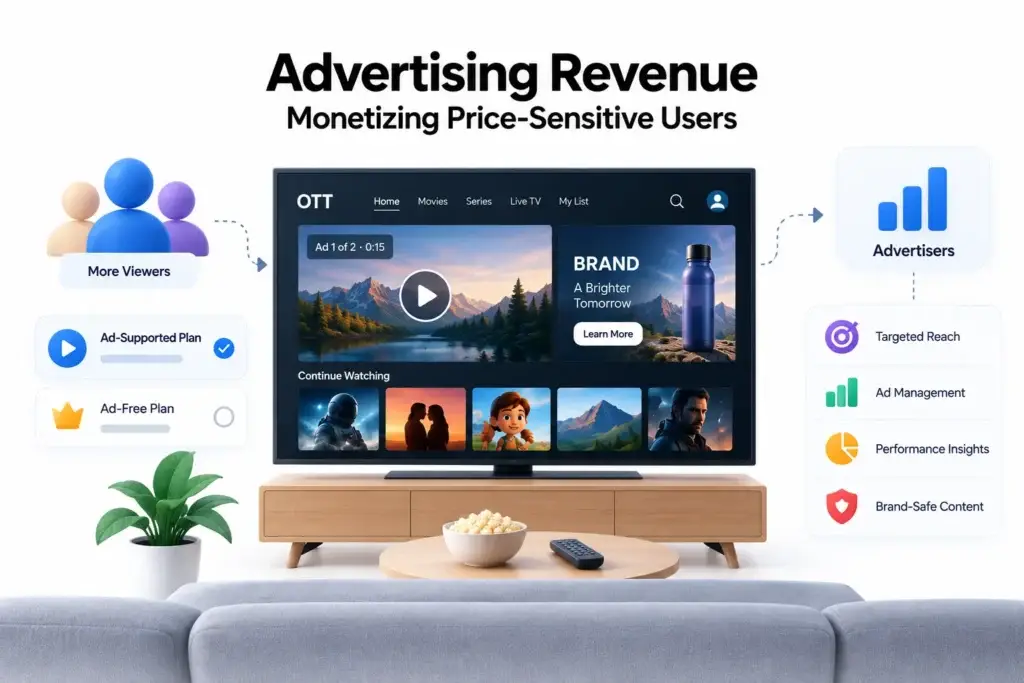
Netflix’s ad-supported model shows how streaming platforms can monetize users who may not want to pay for a higher-priced ad-free plan. Instead of losing those users completely, the platform can offer a lower-priced plan and generate revenue from advertisers.
In its Q2 2026 shareholder letter, Netflix said it remained on track to deliver approximately $3 billion in ads revenue for 2026 and highlighted continued investment in ad tools, programmatic access, and premium ad experiences.
For startup OTT platforms, advertising can work well when the platform has a clear audience. A niche audience can be valuable when advertisers understand who they are reaching. For example, a regional entertainment platform, education video platform, sports streaming app, or children’s content hub can create focused audience segments.
Ad monetization usually requires:
- User segmentation
- Brand-safe content controls
- Ad placement management
- Impression and view reporting
- Performance analytics
- Ad inventory control
- Clear differences between ad-supported and ad-free plans
Advertising should not be added randomly. It should support the user experience without damaging retention.
Content Investment: Why Netflix Spends Heavily on Entertainment Value
Netflix’s model depends on content that gives users a reason to join, stay, and return. This includes original shows, films, licensed titles, documentaries, regional content, live programming, and newer entertainment formats.
The company’s 2025 annual report explains that it acquires, licenses, and produces content to offer members unlimited video entertainment. It also states that its business model is subscription-based rather than tied to revenue from a specific title.
This matters because Netflix monetizes content as a library, not only as individual titles. One title may drive signups. Another may improve retention. Another may support a regional market. Another may strengthen brand perception. The combined library creates the value users pay for.
For founders, the lesson is clear: content should be planned around the business model. If the platform depends on subscriptions, the content library must justify repeat payments. If the platform depends on rentals or premium access, content must feel exclusive enough to unlock. If the platform depends on advertising, content must attract consistent viewing volume and clearly defined audiences.
Pricing Strategy: How Plan Differences Increase Revenue Potential
Netflix does not treat every viewer the same. Different users have different willingness to pay, viewing habits, device needs, household structures, and tolerance for ads.
That is why pricing tiers matter. A platform can offer different plans based on:
- Ad-supported or ad-free viewing
- Monthly or annual billing
- Number of screens
- Video quality
- Download access
- Premium content access
- Household or profile rules
- Regional pricing
- Trial or promotional offers
Netflix’s official annual report says it offers a variety of streaming membership plans, with pricing that varies by country and plan features. It also notes that pricing may change and that the company may test other plan and price variations.
For founders, pricing should not be guessed once and forgotten. It should be tested carefully. Too low, and the platform may struggle to fund content and delivery costs. Too high, and users may cancel before the platform proves value. The right plan structure depends on content depth, audience income level, region, category, exclusivity, and viewing frequency.
Engagement and Recommendations: Turning Viewing Into Retention
Netflix’s revenue model depends heavily on engagement. When users watch more, discover better content, and build viewing habits, they are more likely to keep paying.
Recommendations help reduce decision fatigue. Instead of forcing users to search endlessly, the product surfaces titles based on viewing behavior, preferences, categories, popularity, and personalization signals.
For founders, this is one of the most important lessons from the Netflix model. Monetization is not only about asking users to pay. It is about giving users a reason to keep paying.
A streaming platform should track:
- Watch time
- Completion rate
- Search activity
- Continue Watching usage
- Watchlist activity
- Drop-off points
- Content-level retention
- Category performance
- Subscription conversion
- Cancellation behavior
- Recommendation click-through rate
These insights help founders improve the content library, pricing, homepage layout, recommendation rails, marketing campaigns, and retention strategy.
Regional Expansion: Why Local Content and Market Fit Matter
Netflix’s business model also benefits from serving many regions with different languages, content preferences, pricing expectations, and viewing habits. The company has invested heavily in local and non-English content because entertainment preferences are not the same everywhere.
In H1 2026, Netflix said non-English content drove more than a third of all viewing for the period, with standout titles from countries including Korea, Japan, Spain, and India.
For smaller OTT founders, this creates an important opportunity. You do not need a global catalog to start. A focused regional or niche platform can compete by serving a specific audience better than broad platforms do.
Examples include:
- Regional cinema platforms
- Local-language comedy libraries
- Religious or devotional video platforms
- Fitness and wellness content hubs
- Education and coaching platforms
- Sports archive platforms
- Creator-led subscription video communities
- Independent film libraries
Market fit often comes from focus, not size.
How Founders Can Apply Netflix’s Business Model Without Copying It
Founders should not copy Netflix’s full-scale business model. Netflix operates at a global scale, with massive content investments, mature product systems, advertising infrastructure, and deep user data.
A new OTT platform should adapt the principles, not the scale.
Audience Repeat Value
If users have a recurring reason to return, subscriptions can work well. If demand is occasional, rentals, pay-per-view, or bundles may be more practical.
Content Depth
A subscription model needs enough content variety to justify ongoing payments. A smaller catalog may need premium releases, exclusive access, or niche positioning.
Pricing Flexibility
If your audience has different budgets, plan tiers can help. Ad-supported access, annual plans, family plans, and premium access can serve different segments.
Advertising Readiness
Ads work better when the platform has a focused audience, brand-safe content, placement control, impression reporting, and clear ad-free upgrade options.
A smaller OTT platform may begin with one core monetization model and expand later. For example, a regional film platform can start with subscriptions, then add premium rentals for new releases. An education video platform can start with course access, then add subscriptions for ongoing learning. A creator-led platform can begin with membership access and later introduce live events or exclusive paid content.
Founders planning a branded streaming product can review the Miracuves Netflix clone solution when they need a ready-made OTT foundation with subscriptions, monetization workflows, admin control, and source-code ownership.
Startup OTT Revenue Models Inspired by Netflix
Netflix itself relies primarily on subscriptions, but founders can adapt the business logic into different monetization models depending on content type and market.
Because subscriptions depend on user trust, founders should also review OTT platform security planning to understand how premium content, viewer accounts, and payments should be protected.
| Revenue Model | Best For | Platform Requirements |
|---|---|---|
| Subscription Video Access | Large or frequently updated content libraries | Plan management, renewals, access rules, invoices, and cancellation workflows |
| Ad-Supported Streaming | Price-sensitive audiences and high-viewing content libraries | Ad placements, segmentation, reporting, brand-safe controls, and ad-free upgrade paths |
| Rental Access | Premium films, events, early releases, and limited-time content | Rental expiry, one-time payment, content unlock rules, and purchase history |
| Pay-Per-View | Live events, sports, workshops, concerts, and exclusive releases | Event access control, payment validation, reminders, and stream protection |
| Hybrid Monetization | Platforms with both free and premium content | Plan tiers, ads, premium unlocks, coupons, analytics, and admin control |
| Partner or Producer Revenue Sharing | Platforms that onboard studios, creators, or content partners | Producer dashboard, content approval, watch-minute tracking, payout reports, and revenue rules |
If feature planning is your next step, this OTT platform feature planning page explains how viewer, content, and admin-side modules work together.
Why Retention Matters More Than One-Time Revenue
The biggest mistake founders make when studying Netflix is focusing only on revenue streams. The deeper lesson is retention.
A user who subscribes once and cancels quickly is not enough. A streaming platform needs repeat value. That value may come from exclusive content, strong recommendations, new release scheduling, personalized rows, community, live programming, creator engagement, or niche expertise.
Retention depends on:
- Content quality
- Content freshness
- Personalization
- Search and discovery
- Playback experience
- Pricing fairness
- Payment reliability
- Support experience
- Notifications and re-engagement
- Trust and account safety
This is why an OTT business model cannot be separated from the product experience. Monetization works when the platform gives users a reason to return.
Common Mistakes Founders Should Avoid
1. Copying Netflix Without a Niche Strategy
Netflix works at global scale, but a new OTT platform needs a focused audience, clear content category, and realistic monetization path before expanding.
2. Launching Subscriptions Without Enough Repeat Value
Users will not keep paying unless the platform gives them a reason to return. Content freshness, recommendations, watchlists, and release planning matter.
3. Adding Ads Too Early Without Audience Clarity
Advertising works better when the platform has defined viewer segments, brand-safe content, ad placement control, and reporting that advertisers can trust.
4. Ignoring Content Costs and Delivery Costs
Every viewer costs money to serve through content, storage, bandwidth, payment processing, support, and platform maintenance. Pricing should account for those costs.
5. Treating Monetization as Only a Payment Page
A real revenue engine needs plans, renewals, invoices, coupons, rentals, access rules, analytics, failed payment handling, and admin control.
What Product Systems Are Needed to Monetize an OTT Platform?
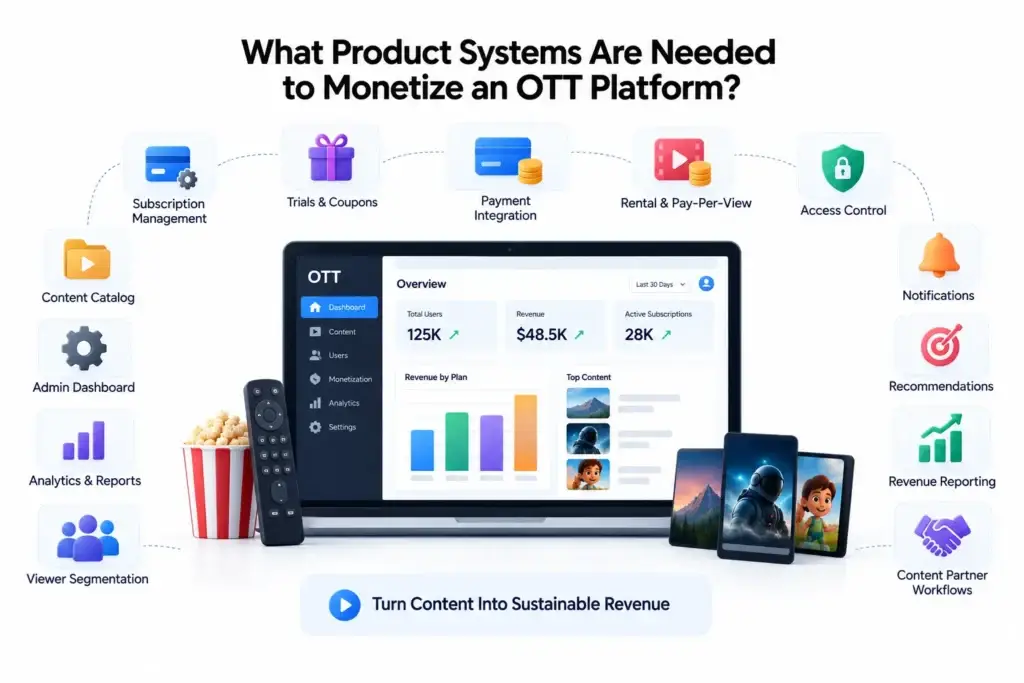
A streaming platform cannot monetize well if the backend is weak. The business needs control over plans, users, payments, access, content, recommendations, and analytics.
Important systems include:
- Subscription plan management
- Trial and coupon setup
- Payment gateway integration
- Failed payment handling
- Rental and pay-per-view access
- Entitlement management
- Content catalog management
- Admin dashboard
- Analytics and reports
- Viewer segmentation
- Notification workflows
- Recommendation rails
- Revenue reporting
- Content partner workflows
- Secure playback and access control
You can also review the OTT Streaming Platform Feature Planning Guide to decide which monetization-related features should be included at launch and which can be added later.
Custom OTT Build vs Ready-Made Platform Foundation
Founders can build a streaming platform from scratch, start with a ready-made foundation, or take a hybrid approach.
For founders who want a branded streaming product without building every workflow from zero, a white-label video streaming platform can provide a faster foundation for testing subscriptions, content access, and monetization.
A custom build gives maximum flexibility but usually requires more time, technical planning, testing, and budget. A ready-made foundation can be more practical when the founder wants to validate the business model faster with core workflows already in place.
If budget planning is your next step, this OTT platform development cost guide can help you understand how features, integrations, monetization scope, and customization influence final pricing.
Founders comparing build partners can also use this guide on choosing the right OTT development partner before deciding between custom development, ready-made deployment, or a hybrid approach.
How Miracuves Helps Founders Launch OTT Platforms Faster
Miracuves helps founders, agencies, studios, and content-led businesses launch ready-made and white-label OTT platforms with branding control, source-code ownership, admin dashboard, content workflows, subscriptions, rental logic, producer options, and monetization-ready foundations.
This matters because founders often lose time rebuilding standard OTT modules from zero: user accounts, catalog management, playback access, subscription flows, payment workflows, analytics, and admin controls. A ready-made foundation helps teams focus faster on content, audience, pricing, retention, and launch strategy.
Where the ready-made scope fits the business requirement, Miracuves can support a 6-day launch path for faster market validation.
Founders exploring broader entertainment and video-first products can also review Miracuves’ video content platform solutions for OTT, creator, short video, and streaming app models.
Related reading: The Evolution of OTT Streaming Platforms.
Final Thoughts: Netflix Makes Money by Connecting Content, Product, and Retention
Netflix makes money because its business model connects several systems: subscriptions, pricing, advertising, content investment, personalization, regional expansion, and retention.
The deeper lesson for founders is that monetization is not only a revenue model. It is a product system. If users cannot discover content, they will not watch. If they do not watch, they will not stay. If they do not stay, subscriptions weaken. If subscriptions weaken, content investment becomes harder.
A startup OTT platform does not need Netflix’s scale to begin. It needs a clear audience, a strong content reason to return, a realistic monetization model, and a platform foundation that can manage payments, access, analytics, and growth.
After the business model is clear, founders should also plan their OTT streaming platform go-to-market strategy so content, subscriptions, retention, and acquisition work together.
FAQs
How does Netflix make money?
Netflix makes money mainly through recurring membership fees. It also earns from advertising, consumer products, live experiences, and other sources, but monthly membership fees remain the primary revenue source according to official company filings.
What is Netflix’s main revenue source?
Netflix’s main revenue source is paid memberships. Users pay recurring fees to access the streaming content library across supported devices and plan types.
Does Netflix make money from ads?
Yes. Netflix has an ad-supported plan and continues investing in its advertising business. In Q2 2026, Netflix said it remained on track to deliver approximately $3 billion in advertising revenue for 2026.
Why is content so important to Netflix’s business model?
Small OTT platforms can adapt parts of Netflix’s model, but they should not copy it exactly. A smaller platform should begin with a focused audience, clear content niche, realistic pricing, and the right monetization model.
Can small OTT platforms use Netflix’s business model?
Small OTT platforms can adapt parts of Netflix’s model, but they should not copy it exactly. A smaller platform should begin with a focused audience, clear content niche, realistic pricing, and the right monetization model.
What OTT revenue model is best for startups?
The best OTT revenue model depends on the content and audience. Subscriptions work for repeat-value libraries, rentals work for premium releases, pay-per-view works for events, and ads work when the platform has enough viewing volume and audience clarity.
Why does personalization matter in streaming monetization?
Personalization helps users find content faster. Better discovery can improve watch time, retention, and subscription value because users are more likely to keep paying when the platform feels relevant.
Can Miracuves help launch a monetization-ready OTT platform?
Yes. Miracuves helps founders launch ready-made and white-label OTT platforms with source-code ownership, branded apps, admin control, subscriptions, rental workflows, payment setup, and faster deployment. A 6-day launch may apply where the ready-made scope fits the business requirement.
Miracuves is an independent software development company. We are not affiliated with, connected to, sponsored by, or endorsed by any company or product named in this article.
Terms such as “X Clone” are used descriptively. It is how the software industry refers to building a platform with functionality comparable to a known service, and how clients search for it.
The entire design and codebase of our products is built by our own team. Our products contain no code, design, graphics, or content originating from any third-party website or applications.
All third-party names and marks referenced in this article are the property of their respective owners, referenced solely to identify the services discussed.