Key Takeaways
- Moving from a travel business idea to first booking requires a clear audience, focused inventory, dependable suppliers, and a practical transaction flow.
- Founders should validate one strong travel category before adding flights, stays, activities, transfers, packages, and other services.
- Travel inventory can come from direct supplier agreements, aggregators, global distribution systems, or third-party APIs.
- Search, availability, pricing, checkout, confirmation, cancellation, refunds, and customer support must operate as one connected journey.
- The first booking should validate the business hypothesis—not simply prove that the website or application works.
Launch Planning Signals
- Define the first customer segment, travel need, destination, supplier type, transaction, revenue source, and support process.
- Confirm how availability, prices, taxes, markups, commissions, booking rules, and cancellation policies will remain accurate.
- Decide whether the business will serve direct travelers, agents, corporate accounts, suppliers, or a combination of these groups.
- Test payments, booking confirmations, failed transactions, amendments, cancellations, refunds, and supplier reconciliation.
- Track search-to-booking conversion, payment success, cancellations, support requests, supplier performance, and repeat customers.
Real Insights
- A large travel catalogue does not create value when availability, pricing, or booking confirmation cannot be trusted.
- Launching too many travel categories can make it harder to identify which audience, supplier, and acquisition channel actually work.
- The customer journey continues after payment through confirmation, reminders, changes, cancellations, refunds, and support.
- A ready-made foundation can reduce software preparation time, but it cannot replace supplier onboarding, demand generation, or operational planning.
- Miracuves develops white-label travel platforms with supplier connectivity, search and booking workflows, payments, commissions, agent tools, admin controls, and source-code ownership.
Starting an online travel business can look deceptively simple from the outside. Find hotels or tours, put them online, accept payments, and start attracting travelers.
The difficult part is everything between the idea and the first confirmed reservation.
Which traveler should you serve first? What should you sell? Where will the inventory come from? How will you make money on each reservation? What happens when availability changes after a customer starts checking out? Who handles a cancellation? And how much technology actually needs to be built before you can test whether travelers want what you are offering?
For a founder, the first milestone should not be building the largest possible travel marketplace. It should be creating a focused business capable of taking a real customer from discovery to a successful reservation—and supporting that customer afterward.
A white-label foundation can shorten the technology part of that journey, but software alone does not create the business. Your positioning, supplier relationships, pricing, operations, customer acquisition and service model still determine whether the platform reaches its first booking.
This guide takes the founder’s perspective: from deciding what kind of travel business to build to preparing the platform, supply and operations required to earn that first transaction.
Start With the Travel Problem, Not the Platform
One of the easiest ways to overbuild a travel startup is to begin with a list of features.
A stronger starting point is a customer problem.
Perhaps travelers visiting a particular region struggle to discover reliable local activities. Maybe pilgrimage travelers need accommodation and transfers arranged around fixed dates. A group of boutique properties may want a direct digital distribution channel. An established offline agency might want customers to make straightforward reservations themselves while retaining assisted service for complex trips.
Each represents a different business even though all of them involve travel.
Before deciding what your platform should contain, answer four questions:
- Who is the first traveler you want to serve?
- What do they need to reserve?
- Why would they use your brand rather than their current booking method?
- What is the smallest commercially useful supply you need before launch?
This creates a market hypothesis instead of a feature wishlist.
A niche does not necessarily mean staying small. It gives the business a focused starting point from which demand, supplier relationships and customer behavior can be tested.
Read More: B2B Travel Booking Platform vs Regional Travel Booking Platform: How Their Business Models Differ
Define Your First-Booking Hypothesis
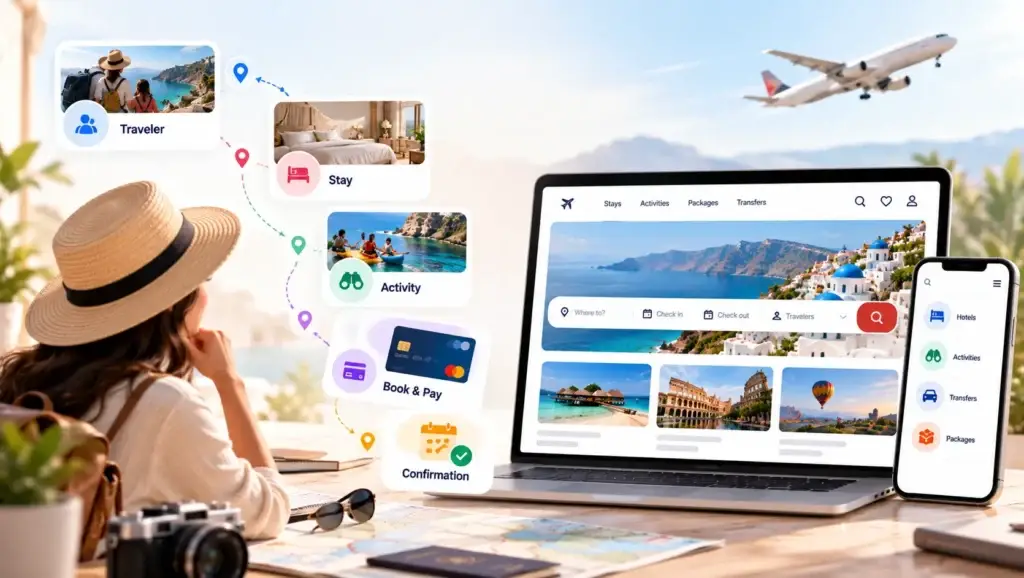
Before planning a large marketplace, write down what you expect the first genuine transaction to look like.
For example:
Traveler: A family planning a weekend trip to a regional destination
Need: Accommodation plus a local activity
Discovery: Destination content or a targeted campaign
Supply: Direct hotel partners and local tour providers
Transaction: Online reservation and payment
Revenue: Margin or supplier commission
Support: Booking confirmation plus assistance for changes or cancellation
This simple exercise forces the business model to become concrete.
If you cannot describe the first expected transaction clearly, adding more categories usually creates more complexity rather than more validation.
Your initial launch may therefore concentrate on stays and experiences instead of simultaneously enabling flights, trains, buses, car rentals, packages and every possible add-on.
Expansion becomes easier to justify once actual booking behavior shows what customers want next.
Choose a Niche You Can Actually Supply
Travel entrepreneurs frequently think about customer demand first and inventory second. In practice, both sides have to develop together.
A promising niche has three characteristics:
- Recognizable demand. Travelers already search for, ask about or purchase the experience.
- Reachable supply. Your business can realistically obtain inventory from hotels, tour operators, transport companies, activity providers or other suppliers.
- A reason to choose you. Your platform provides stronger curation, convenience, regional expertise, service, packaging or customer experience than the alternatives available to your target traveler.
Potential starting positions include regional tourism, adventure trips, religious travel, corporate travel, wellness retreats, destination experiences, family holidays, luxury stays or specialist tours.
The question is not which niche sounds most exciting. It is which niche gives your team a realistic path to useful supply and paying customers.
Secure Supply Before You Spend Heavily on Demand
A marketplace with visitors but nothing compelling to reserve has an acquisition problem disguised as a marketing problem.
Before launch, determine where the inventory will originate.
Depending on the business, supply may come through direct agreements with hotels and operators, supplier integrations, aggregators, locally managed listings or a combination of these approaches.
For every important supplier relationship, clarify:
- What inventory will be available?
- How frequently does availability change?
- Who controls rates?
- What margin or commission applies?
- What are the cancellation conditions?
- How is a confirmed reservation communicated?
- What happens if the supplier cannot fulfil it?
- Who handles disputes and refunds?
- How and when does the supplier get paid?
These are operational questions, but they directly affect customer experience.
The first booking is valuable only if the business can fulfil it correctly.
Validate the Economics of One Reservation
You do not need an elaborate financial model to start thinking commercially. You do need to understand what happens to the money from one transaction.
Suppose a traveler completes a reservation. Work backward from the amount paid.
Account for the supplier amount, your margin or commission, payment-processing costs, applicable promotions, refund exposure, customer-support costs and any partner or agent commissions involved.
The objective is to answer a basic question:
If this exact transaction happened repeatedly, would the economics make sense?
Founders can explore more sophisticated revenue structures later. During launch preparation, clarity around the primary transaction is more useful than trying to activate every possible revenue stream at once.
A simple model also makes early results easier to interpret. When bookings begin, you can see whether the assumptions behind pricing, conversion and margins are holding up.
Decide What Must Be Ready for Day One
Early-stage founders often confuse a large product with a launch-ready business.
They are not the same thing.
Your first release needs enough functionality to support the transaction you have defined reliably. Everything else should earn its place by solving a genuine launch requirement.
Think in terms of customer and operational outcomes:
| Launch Requirement | Question to Answer |
|---|---|
| Discovery | Can travelers find relevant inventory quickly? |
| Availability | Can they see options that can genuinely be reserved? |
| Decision | Is pricing and essential booking information clear? |
| Checkout | Can the traveler complete the transaction confidently? |
| Confirmation | Does the customer know the reservation succeeded? |
| Operations | Can your team identify and manage the reservation? |
| Cancellation | Is there a defined process when plans change? |
| Support | Can the traveler reach someone when something goes wrong? |
| Supplier coordination | Can partners fulfil and track what was sold? |
This keeps product planning connected to the business outcome.
A long list of impressive functions is less important than making the first transaction dependable.
Decide Whether to Build the Foundation or Configure One
Once the business model and initial booking journey are clear, the technology decision becomes easier.
A custom build gives a team control over how the system is designed from the beginning, which can be appropriate when the business relies on genuinely unusual workflows or proprietary technology.
But many new travel businesses initially need standard foundations: customer accounts, inventory, search, reservation handling, payments, supplier workflows, administrative control and post-booking operations.
Rebuilding those foundations before testing the commercial idea can push market learning further into the future.
A white-label approach changes the sequence.
Instead of beginning with months of foundational development, the founder can begin with an existing system and concentrate implementation effort on branding, supply, business rules, integrations and market-specific requirements.
That does not remove the need for product thinking. It moves more of that thinking toward the areas customers and suppliers actually experience.
For founders who want to examine the underlying Miracuves system rather than recreate its product details inside this guide, the dedicated platform page is the appropriate next step.
Build a Launch Scope Around the Business You Have Today
The strongest launch scope is usually based on what the business can operate now—not everything it might become later.
Imagine a regional tour operator that already has relationships with 25 hotels and 15 activity providers.
Its immediate opportunity may be:
Phase 1: stays and local experiences
Phase 2: airport transfers and packaged itineraries
Phase 3: additional destinations and partner distribution
Phase 4: broader transport or other categories where demand justifies them
This staged approach has an important advantage: every expansion is tied to observed customer behavior or supply opportunity.
The alternative is activating numerous categories before the business has sufficient inventory, operational processes or customer demand to make them useful.
A smaller platform with credible supply can be more valuable than a broad marketplace full of empty categories.
Prepare Your Brand for Trust, Not Just Recognition
Travel transactions require trust.
Customers may be paying weeks or months before they consume what they purchased. That makes the credibility of a new travel brand especially important.
Before acquisition begins, make sure travelers can understand:
- Who operates the business
- What exactly they are reserving
- What the price includes
- How confirmation works
- Cancellation and refund conditions
- How customer support can be reached
- What happens if plans change
Branding therefore goes beyond a logo, color palette and app icon.
Clear policies, accurate inventory, useful destination information, transparent prices and responsive support all contribute to brand trust.
For a new operator, those details can influence the first conversion more than sophisticated visual effects.
Set Your Commercial Rules Before Customers Arrive
Many decisions that look administrative become urgent once real money starts moving.
Before launch, document how the business will handle:
- Pricing: What margin or commission applies to each initial category?
- Promotions: Who can issue discounts, and how much discounting can the margin support?
- Cancellations: Which conditions come from suppliers, and which policies are controlled by your business?
- Refunds: Who approves them, and what information does the customer receive?
- Supplier payouts: When and under what conditions are partners paid?
- Customer support: Who owns a problem before, during and after travel?
- Escalation: What happens when a supplier and traveler disagree?
Even if the software supports these workflows, the founder still needs business rules.
Technology can execute a policy. It cannot decide what your policy should be.
Prepare External Accounts Early
A technically ready platform does not automatically mean every external dependency is ready.
Payment gateways, supplier relationships, messaging services, domains and app-store accounts may involve separate onboarding or approval processes.
Start these tasks in parallel rather than waiting until the product is otherwise ready.
Create a launch dependency list containing:
- Domain and branded email
- Payment gateway account
- Supplier or inventory accounts
- Required API credentials
- Email and messaging setup
- Mobile app publisher accounts, where applicable
- Customer-service channels
- Business and legal documentation relevant to your operating market
Regulatory, licensing and consumer-protection requirements differ by jurisdiction and business model, so founders should obtain appropriate local professional advice rather than assuming software deployment itself satisfies those obligations.
Use the 6-Day Delivery Window to Prepare the Business, Not Wait for the Software
Where the standard ready-made scope is appropriate, Miracuves offers deployment in six working days. External approvals—including supplier, gateway and app-store processes—can follow their own timelines, so founders should treat the deployment period as an operational sprint rather than six days of waiting.
While the technology is being branded and configured, the founder’s team can work in parallel.
Days 1–2: Finalize Positioning and Supply
Confirm the launch niche, initial categories, priority destinations, supplier relationships and customer promise.
Prepare brand assets and decide which inventory genuinely needs to be available at launch.
Days 3–4: Prepare the Commercial Layer
Finalize margins, cancellation policies, support ownership, promotional rules and initial destination content.
Complete the external accounts and credentials needed for launch wherever approvals allow.
Day 5: Populate and Inspect
Review inventory quality, listing information, images, policies and pricing.
Check the experience as a first-time traveler rather than as the person who helped configure it.
Day 6: Run the Business Before Opening It
Do not merely check whether pages load.
Run realistic booking scenarios from beginning to end. Then test what happens when something changes.
The objective is not to say, “The website is live.”
The objective is to say, “We are operationally capable of accepting the first customer.”
Run a First-Booking Drill Before the First Customer
A launch checklist becomes much more useful when converted into an actual transaction.
Have someone who was not closely involved in setup behave like a customer.
Ask them to:
- Arrive on the platform without instructions.
- Find a relevant option.
- Understand the offer and terms.
- Complete the reservation journey.
- Receive confirmation.
- Find the reservation afterward.
- Contact support with a question.
- Request a change or cancellation in a controlled test environment.
Then have your operations team follow the same reservation from their side.
Can they locate it? Can they understand what was purchased? Do they know what to do when the customer asks for help? Is the supplier information sufficient? Are internal responsibilities obvious?
A successful test is not simply a technically completed payment.
It is evidence that customer experience and business operations connect.
Plan How the First Real Customer Will Find You
Launching software without a customer-acquisition plan simply replaces development uncertainty with marketing uncertainty.
Your first acquisition channel should match your niche.
A destination-focused business might begin with search-oriented destination content and local partnerships. A specialist tour operator may benefit more from communities, creators or referral relationships. An established offline agency can begin by migrating existing customers toward online self-service. A hotel or regional operator may already have direct traffic that can be routed toward online reservations.
Avoid trying every marketing channel at once.
Choose one or two channels where your target traveler is already making decisions.
Early acquisition is less about maximizing traffic and more about generating useful learning.
Ten qualified visitors can teach you more than hundreds of poorly targeted clicks if you understand why they did or did not reserve.
Measure the Journey to the First Booking
Before launch, decide which signals matter.
At minimum, watch how prospective customers move through:
Visit → Search → View option → Begin checkout → Complete reservation
A drop between two stages gives you something specific to investigate.
If visitors never search, the proposition or landing experience may be unclear.
If they search but do not inspect options, inventory or relevance may be weak.
If they inspect options but avoid checkout, pricing, trust or terms may be creating friction.
If they begin checkout but abandon it, payment experience or unexpected information requirements deserve attention.
The first reservation matters, but the behavior of people who did not reserve may contain even more useful information.
What the First Booking Actually Validates
Your first customer does not prove that you have built a scalable company.
It proves something smaller—and extremely useful.
Someone outside the founding team understood the proposition, trusted the brand enough to transact, found acceptable inventory and completed the journey.
Now you have evidence to work with.
After the first few reservations, ask:
- Which inventory receives the most attention?
- Where are customers coming from?
- Which questions appear before purchase?
- Which support requests occur after booking?
- Which suppliers are easiest to work with?
- Are expected margins surviving real transactions?
- Which additional category are customers actually asking for?
- Where does the reservation journey create hesitation?
Those answers should influence the next stage of the product.
Read More: What Mistakes Should Startups Avoid When Launching a Regional Travel Booking Platform?
Mistakes That Delay the First Booking
Trying to Launch Every Category
Breadth creates little value when supply is shallow. Start with categories your business can operate well.
Treating Technology as the Business Model
Software facilitates transactions. It does not determine your niche, acquire suppliers, establish margins or create demand.
Recruiting Customers Before Supply Is Credible
Marketing an empty or unreliable marketplace wastes acquisition spending and damages early trust.
Leaving Cancellation and Refund Decisions Until Later
Travel plans change. These workflows are part of the customer experience from the first transaction.
Building Before Clarifying the First Transaction
If the team cannot explain what the first customer should buy, technology requirements will keep expanding.
Waiting Until Launch Day to Test Operations
A successful screen flow is not enough. Customer support, supplier coordination and post-booking processes need rehearsal too.
Founder Decision Signals: Are You Actually Ready to Launch?
You are approaching launch readiness when you can answer yes to most of these questions:
- Market: Can we clearly describe the first traveler segment and the problem we solve?
- Supply: Do we have enough real inventory to make the initial proposition useful?
- Economics: Do we understand how the first transaction makes or loses money?
- Operations: Do we know who handles confirmation issues, cancellations, refunds and support?
- Technology: Can a traveler complete the intended reservation journey reliably?
- Trust: Are prices, policies and support routes understandable?
- Acquisition: Do we know where the first qualified visitors will come from?
- Learning: Have we decided which behaviors and transaction signals we will measure?
If several answers are still unclear, adding more functionality probably will not solve the underlying problem.
Where Miracuves Fits in the Travel Business Idea to First Booking Journey
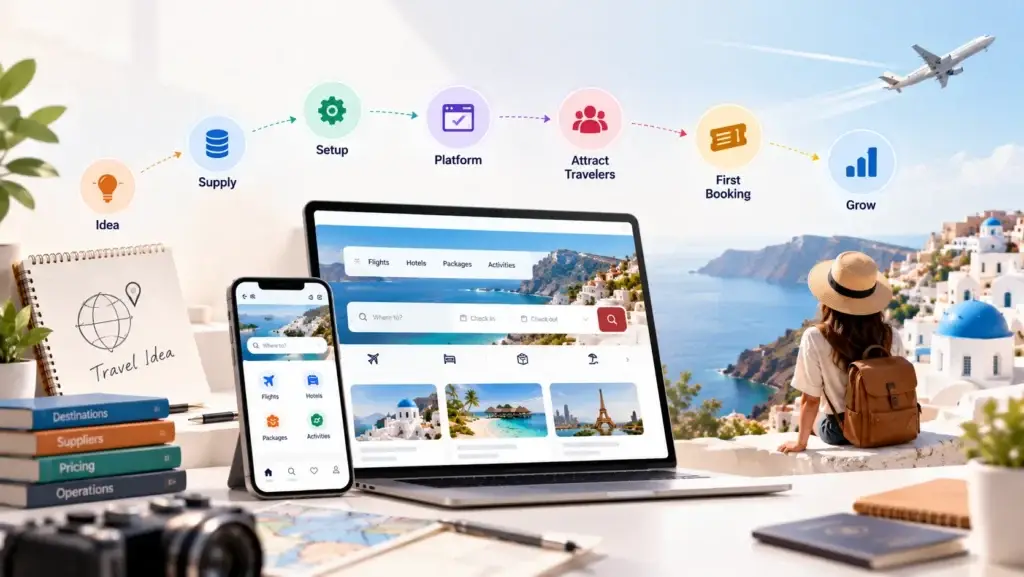
Moving from a Travel Business Idea to First Booking requires more than launching a website or app. Founders need the right suppliers, inventory, pricing, customer support, operational workflows, and technology working together.
A ready-made foundation helps reduce the time spent building standard booking infrastructure from scratch. Instead, founders can focus on supplier onboarding, branding, inventory preparation, commercial rules, and acquiring their first customers.
Miracuves provides a white-label foundation that can be branded and configured around the operator’s business model and launch requirements. For applicable ready-made solutions, deployment can be completed in six working days, helping founders move toward market validation faster.
During this period, the business can focus on the areas that directly influence its first transaction:
- Finalizing suppliers and launch inventory
- Setting margins, commissions, cancellation, and refund rules
- Preparing destination and listing content
- Configuring payment and customer-support processes
- Testing the complete reservation journey
- Planning how to attract the first qualified travelers
The goal is not simply to get the software live. It is to make the business operationally ready to accept and fulfil a real reservation.
The Travel Business Idea to First Booking journey should therefore look like this:
Validate the niche → secure supply → define commercial rules → configure the platform → test operations → attract travelers → achieve the first booking → learn and improve.
Miracuves supports the technology layer of this journey, while founders remain focused on the market, supply, operations, and customer experience that make the business viable.
This guide answers: What should a founder prepare to move from a Travel Business Idea to First Booking?
The product page answers: What does the Miracuves platform provide when the founder is ready to evaluate the technology?
Final Thoughts: Optimize for the First Successful Transaction
The journey from a travel-business idea to a real reservation is not primarily about launching the biggest platform.
It is about connecting five things successfully:
A defined traveler.
Relevant supply.
Sustainable commercial rules.
Reliable booking operations.
A reason for the customer to trust you.
A white-label foundation can shorten the technical path, but founders still need to do the work that creates a viable travel business: choosing the market, building supplier relationships, setting commercial rules, preparing operations, creating demand and learning from customers.
Make the first successful transaction your initial milestone.
Then use what it teaches you to decide what deserves to be built, added and scaled next.
FAQs
How do I start an online travel business?
Begin by defining a target traveler, the travel products they need and the suppliers capable of providing them. Validate how a typical reservation will generate revenue, establish customer-support and cancellation processes, and then choose technology capable of supporting that transaction. Launch with focused inventory and expand using actual customer behavior.
What is a white-label OTA platform?
A white-label OTA platform is an existing online travel agency technology foundation that can be configured and branded for another business. It can reduce the amount of standard reservation infrastructure a founder needs to build before testing a travel proposition.
Should a new travel startup offer flights, hotels, tours and transfers immediately?
Not necessarily. The better starting scope depends on your target traveler and available supply. A regional startup with strong hotel and activity relationships may gain more from launching those categories well than from offering numerous categories with weak inventory.
What should be ready before accepting the first online reservation?
Your initial inventory, pricing, payment process, confirmation journey, cancellation conditions, customer-support responsibilities and supplier fulfilment process should all be understood and tested before launch.
How can a travel startup get its first booking?
Start with an acquisition channel closely connected to your niche. Options can include existing agency customers, destination content, supplier referrals, local partnerships, communities, targeted search campaigns or creator partnerships. The best initial channel is the one that reaches travelers already considering the type of trip you sell.
Do I need supplier integrations before launching?
It depends on your model. Some businesses begin with directly managed inventory or supplier relationships, while others depend on external integrations. The important question is whether the inventory shown to customers can be reliably reserved and fulfilled.
How quickly can Miracuves deploy its ready-made solution?
Miracuves states that its standard ready-made platform can be deployed in six working days. Supplier approvals, payment gateways, app-store reviews and other third-party processes can have separate timelines, so founders should start those dependencies early.
What should I do after receiving the first booking?
Review the complete journey: acquisition source, searches, inventory selected, conversion path, margin, supplier fulfilment and support interactions. Combine that transaction data with abandonment behavior and customer questions to decide what should be improved or expanded next.
Miracuves is an independent software development company. We are not affiliated with, connected to, sponsored by, or endorsed by any company or product named in this article.
Terms such as “X Clone” are used descriptively. It is how the software industry refers to building a platform with functionality comparable to a known service, and how clients search for it.
The entire design and codebase of our products is built by our own team. Our products contain no code, design, graphics, or content originating from any third-party website or applications.
All third-party names and marks referenced in this article are the property of their respective owners, referenced solely to identify the services discussed.