
Key Takeaways
- Turo and Getaround both operate in peer-to-peer car sharing, but their business models differ in booking style, access flow, technology depth, and user experience.
- Turo is closer to an Airbnb-style car marketplace where hosts list vehicles and renters book cars for trips, travel, and longer rental use cases.
- Getaround focuses more on instant, app-based car access with hourly rentals, keyless entry, and urban mobility convenience.
- Both models earn through commissions, service fees, protection plans, insurance-related charges, late fees, and marketplace transaction layers.
- For founders, the best model depends on target users, city density, fleet type, rental duration, access technology, trust requirements, and monetization strategy.
Business Model Signals
- Choose a Turo-style model when the platform focuses on trip-based rentals, host-managed vehicles, airport demand, travel users, premium cars, or longer booking windows.
- Choose a Getaround-style model when the platform focuses on urban users, short-duration rentals, instant booking, remote unlock, and high-frequency local mobility.
- Turo-style platforms need strong listing quality, host trust, booking policies, insurance support, delivery options, reviews, and damage reporting.
- Getaround-style platforms need stronger technology around keyless access, GPS tracking, telematics, hourly pricing, vehicle availability, and automated trip control.
- Development cost changes based on booking logic, user roles, vehicle access system, payment flow, GPS integration, telematics, admin dashboard, and customization depth.
Real Insights
- A Turo-style model usually wins when users care about vehicle choice, trip planning, host communication, and flexible rental duration.
- A Getaround-style model usually wins when users care about speed, nearby availability, app-based access, and short-term convenience.
- Founders should not copy both models blindly; combining daily rentals with hourly keyless access requires stronger product planning and operational control.
- Trust, insurance, verification, payments, and damage workflows matter in both models because private vehicles create higher risk than standard digital marketplaces.
- The strongest car sharing platforms combine marketplace liquidity, secure payments, vehicle protection, location intelligence, admin automation, and a clear rental use case.
Turo and Getaround are often compared as car-sharing apps, but for entrepreneurs, the more useful question is not simply “which platform is better?” The real question is: what kind of car-sharing business model should you build?
Turo and Getaround represent two different approaches to peer-to-peer mobility. Turo is closer to an Airbnb-style rental marketplace for cars, where vehicle owners list cars and guests book them for daily, weekend, travel, or longer-duration use. Getaround is closer to an urban mobility access platform, where short-term usage, keyless entry, and automation play a bigger role.
That difference matters for founders. A Turo Clone depends heavily on trust, vehicle variety, host participation, booking flow, and longer rental value. A Getaround-style model depends more on instant access, utilization, hardware integration, GPS tracking, and city-level mobility demand.
For startups exploring a Turo clone script, the goal should not be to copy Turo blindly. The stronger strategy is to understand what makes Turo work, where Getaround adds operational automation, and how a car-sharing marketplace can be customized for your local market, fleet model, rental duration, and monetization plan.
Turo vs Getaround Business Model: What Founders Need to Know First
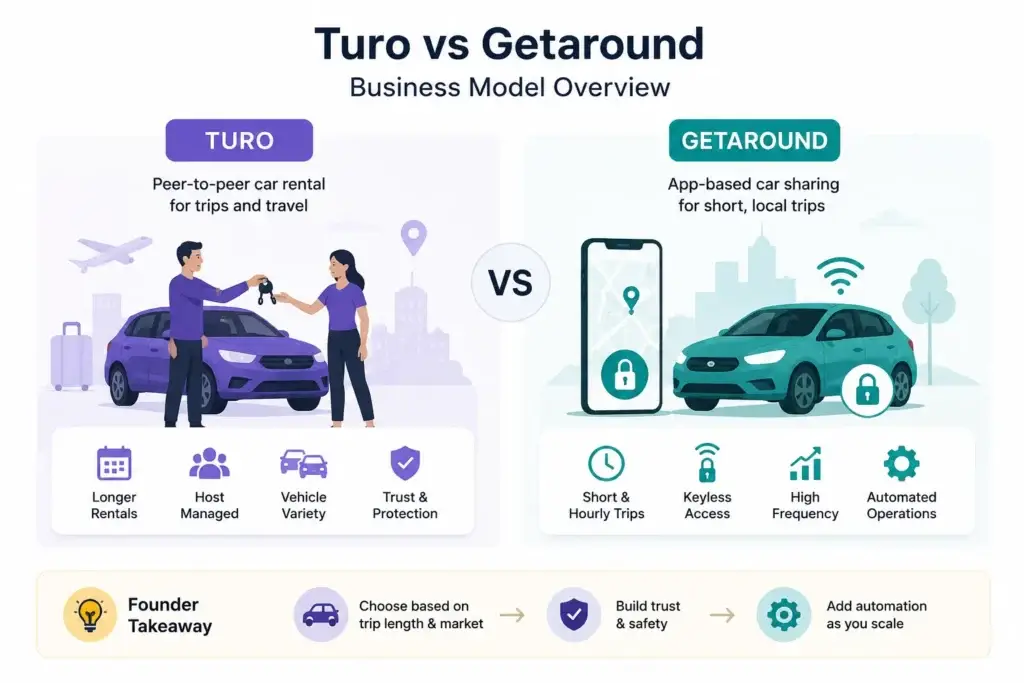
Turo and Getaround both operate in the peer-to-peer car-sharing space, but they are built around different customer behaviors. Turo works more like a car rental marketplace, where users book vehicles for daily, weekend, airport, travel, or longer-duration use. Getaround works more like an instant-access mobility platform, where users rent nearby cars for short trips through keyless app-based access.
For entrepreneurs, this difference is important. A Turo-style model is marketplace-led. Its success depends on vehicle variety, host participation, booking trust, pricing flexibility, and smooth renter-owner coordination. A Getaround-style model is automation-led. Its success depends on hourly availability, GPS tracking, remote lock/unlock, telematics, and fast urban access.
Founders planning to build a car-sharing platform should not choose a model only because one brand is popular. Choose based on how your target users rent cars. If your market needs airport rentals, weekend cars, luxury vehicles, or flexible daily bookings, a Turo-style platform may be stronger. If your market needs short local trips, hourly rentals, and contactless access, a Getaround-style model may fit better.
The strongest startup opportunity may be a hybrid model: use Turo’s marketplace depth as the foundation, then add Getaround-style automation where it improves convenience, utilization, and operational control.
Turo vs Getaround Business Model Comparison: What Founders Should Learn
| Factor | Turo | Getaround | Founder Lesson |
|---|---|---|---|
| Core Model | Peer-to-peer car rental marketplace | App-based car sharing with keyless access | Choose based on rental duration and operational control |
| Typical Use Case | Travel, weekend, daily, weekly, and longer rentals | Hourly, local, and urban short trips | Trip length changes revenue logic |
| Inventory | Host-owned vehicles and fleet hosts | Owner/fleet vehicles with connected access | Asset-light models still need strong trust systems |
| Access Flow | Host handoff, remote handoff, or delivery depending on setup | Keyless access is central to the experience | Automation reduces friction but adds tech complexity |
| Revenue Logic | Commission, protection plans, guest fees, extras, delivery, mileage, and late fees | Commission, usage fees, connected access, and short-term rental frequency | Monetization depends on frequency, risk, and operations |
| Operations | Host-managed cleaning, handoff, availability, and support | More automated access and availability workflows | Automation can improve scale but adds hardware and support layers |
| Best Fit | Travel-focused rental marketplaces and vehicle variety | Urban mobility, hourly rentals, and instant access | The right model depends on market behavior |
This comparison shows why founders should not treat Turo and Getaround as identical car rental platforms. Turo is stronger when the business depends on vehicle variety, longer bookings, and host-led marketplace growth. Getaround is stronger when the model depends on short trips, keyless access, and higher-frequency urban usage.
For a founder evaluating a Turo clone script, this table is useful because it shows what should be included in the first version and what can be added later. Core marketplace features such as listings, bookings, payments, host panels, and admin controls are essential for a Turo-style model. Automation layers like GPS, telematics, and remote unlock can be added when the business needs a more Getaround-style experience.
What Is Turo’s Business Model?
Turo’s business model is based on a peer-to-peer car rental marketplace. Vehicle owners, often called hosts, list their cars on the platform. Guests search for available vehicles, compare prices, check pickup options, review rules, and book the car through the app or website.
The platform does not need to own the cars. Instead, it creates a marketplace where supply comes from individual car owners, small fleet operators, and professional hosts. This makes the model asset-light compared with traditional car rental companies, but it also makes trust, verification, host quality, and damage management extremely important.
Turo earns revenue through marketplace fees and related booking charges. Hosts earn a share of the trip price depending on their selected protection plan or earning structure. The platform can also monetize through guest fees, delivery fees, additional distance charges, late return charges, protection-related fees, and other marketplace controls.
For entrepreneurs, the Turo business model is attractive because it allows a startup to create value without buying a fleet. The marketplace operator builds the technology, sets the rules, manages payments, supports trust and safety, and helps connect car owners with renters.
A Turo-style model works especially well when the market has:
- Underused personal vehicles
- High travel or tourism demand
- Airport rental demand
- Expensive traditional rental options
- Hosts interested in vehicle income
- Customers looking for flexible or unique cars
- Local gaps in car rental availability
This is why many founders exploring a Turo clone script are not just trying to build a car rental app. They are trying to create a marketplace where vehicle supply, renter demand, trust systems, and payments work together.
What Is Getaround’s Business Model?
Getaround’s business model is also based on car sharing, but its operating logic is different from Turo. Getaround is more focused on app-based access, short-term rentals, and keyless usage. The platform allows users to find nearby cars, book them, and unlock them through the app where connected access is available.
This keyless-access layer changes the business model. Instead of depending heavily on owner-renter handoffs, Getaround-style platforms can support faster local bookings. That makes the model more suitable for urban mobility, hourly trips, errands, short local travel, and users who need access to a car quickly.
The advantage is convenience. The challenge is operational complexity.
A Getaround-style platform may need:
- Keyless access integration
- Vehicle compatibility checks
- GPS tracking
- Telematics support
- Remote lock and unlock workflows
- Short-term booking logic
- Vehicle availability monitoring
- Strong customer support
- Clear rules for damage, fuel, cleaning, and returns
For founders, Getaround’s model shows how automation can reduce friction. But automation is not free. It usually adds hardware costs, installation workflows, connectivity issues, maintenance support, and more complex operational controls.
That is the key founder lesson: Getaround’s model may create a smoother renter experience, but it needs stronger backend control.
Turo vs Getaround: The Real Difference for Entrepreneurs
The simplest way to understand the difference is this:
Turo is closer to Airbnb for cars.
Getaround is closer to automated urban mobility access.
Turo’s model is marketplace-led. It focuses on listings, hosts, booking value, trust, vehicle variety, and longer rental use cases. The platform succeeds when it attracts enough high-quality vehicles and enough renters who trust the platform for daily, weekend, airport, or travel rentals.
Getaround’s model is access-led. It focuses on convenience, speed, keyless pickup, short-term usage, and local mobility. The platform succeeds when users can reliably find cars nearby, unlock them easily, complete the trip, and return them without human friction.
For entrepreneurs, this difference affects nearly every business decision.
A Turo-style platform needs strong listing quality, host onboarding, booking calendars, protection workflows, host dashboards, and guest experience controls.
A Getaround-style platform needs all of that plus deeper automation around keyless access, GPS, telematics, hourly pricing, short-trip support, and remote vehicle control.
This is why a founder should choose the model based on the market, not based on which brand is more famous.
If your target users are travelers, tourists, weekend renters, airport customers, or people who want car variety, a Turo-style model may be stronger.
If your target users are urban commuters, local residents, students, delivery workers, or people who need a car for a few hours, a Getaround-style model may be stronger.
If your target market includes both, a hybrid model can work. But it should be designed carefully from the beginning.
2026 Market Reality: Why Getaround’s U.S. Exit Matters for Founders
Getaround’s business model is still useful to study, but founders should understand the current market context before copying it directly. In 2025, Getaround announced the wind-down of its U.S. operations while continuing its European business. This makes the comparison more important for entrepreneurs because it shows that keyless car sharing depends heavily on city density, vehicle availability, utilization, operational control, and financial discipline.
This does not mean the Getaround-style model is weak. It means automation-heavy car sharing needs the right market conditions. Hourly rentals, app-based unlock, GPS tracking, and remote access can create a smooth user experience, but they also add hardware cost, support pressure, maintenance complexity, and risk management needs.
For new founders, the lesson is simple: do not start with the most complex version of the model unless the market already supports it. A Turo-style marketplace is often easier to validate first because it focuses on vehicle listings, bookings, payments, host dashboards, renter verification, deposits, reviews, damage reporting, and admin control.
Once the marketplace has enough demand, founders can add Getaround-style features such as hourly booking, remote access, GPS tracking, telematics, fleet dashboards, and utilization analytics. This staged approach reduces risk and helps the business grow with real demand instead of building expensive automation too early.
Revenue Model Comparison: How Turo and Getaround Make Money
A car-sharing marketplace does not depend on one revenue stream. The strongest platforms combine booking revenue, service fees, owner-side monetization, renter-side charges, and operational fees.
Here are the revenue streams founders should study.
| Revenue Stream | Turo-Style Model | Getaround-Style Model | Startup Opportunity |
|---|---|---|---|
| Booking Commission | Platform takes a percentage from completed trips | Platform earns from completed rentals | Core marketplace revenue |
| Guest Service Fees | Guest may pay platform fees during booking | Renter may pay usage or service fees | Helps monetize demand side |
| Host Protection / Plan Logic | Host earnings can vary based on selected plan | Owner-side terms may vary by region/model | Can be used to balance risk and payout |
| Delivery Charges | Hosts may offer car delivery or airport pickup | Less central if app-based nearby access is the focus | Useful for airport and tourism markets |
| Extra Mileage Fees | Applies when guests exceed mileage limits | Can apply based on trip rules | Protects vehicle owners |
| Late Return Charges | Important for daily rental schedules | Very important for hourly bookings | Prevents availability conflicts |
| Fuel / EV Charging Fees | Applied when vehicle is returned below agreed level | Important for short-use and EV fleets | Supports operational fairness |
| Cancellation Fees | Protects hosts and platform from last-minute cancellations | Protects utilization and availability | Reduces booking abuse |
| Damage Claim Processing | Important for vehicle trust and claims handling | Critical because trips may be shorter and more frequent | Requires evidence and admin workflows |
| Featured Listings | Vehicle owners can pay for more visibility | Can support fleet or high-demand cars | Useful marketplace monetization |
| Fleet Management Add-ons | Useful for professional hosts | Very useful for multi-car operators | Adds B2B revenue potential |
| Subscription Plans | Optional for hosts or fleet owners | Strong fit for professional owners | Creates recurring revenue |
| B2B Partnerships | Airports, hotels, travel operators, local rental brands | Campuses, cities, mobility operators, delivery networks | Expands beyond consumer rentals |
The main difference is revenue frequency versus rental value.
Turo-style platforms often benefit from higher-value trips because daily or multi-day rentals create larger booking amounts. Getaround-style platforms can benefit from higher trip frequency because hourly rentals may happen more often in dense urban areas.
For founders, this creates an important decision: do you want fewer, higher-value bookings or more frequent, shorter bookings?
The answer depends on your city, user behavior, vehicle supply, parking availability, tourism demand, and operational support capacity.
Read More : Key Security Integrations for Peer-to-Peer Car Sharing Apps in 2026
Turo Clone Script vs Getaround-Style App Features: What Founders Need to Build
A car-sharing marketplace is not just a booking app. It needs separate workflows for renters, vehicle owners, fleet operators, and platform admins. The right feature set depends on whether the founder wants a Turo-style daily rental marketplace, a Getaround-style keyless access platform, or a hybrid model that supports both.
| Feature | Turo-Style Platform | Getaround-Style Platform |
|---|---|---|
| Vehicle Listing | Required | Required |
| Vehicle Photos and Documents | Required | Required |
| Booking Calendar | Required | Required |
| Daily / Weekly Booking | Core | Optional or secondary |
| Hourly Booking | Optional | Core |
| Keyless Access | Optional or advanced | Core |
| GPS Tracking | Important | Very important |
| Telematics Integration | Advanced | Important |
| Host Dashboard | Required | Required |
| Fleet Dashboard | Advanced | Important |
| Admin Commission Control | Required | Required |
| Insurance / Deposit Workflow | Required | Required |
| Cancellation Policy Engine | Required | Required |
| Damage Reporting | Required | Required |
| Payment Gateway | Required | Required |
| Wallet and Payouts | Required | Required |
| User Verification | Required | Required |
| Reviews and Ratings | Required | Required |
| Dispute Management | Required | Required |
| Push Notifications | Required | Required |
| Analytics Dashboard | Important | Important |
| Support Ticketing | Important | Important |
| Vehicle Availability Monitoring | Important | Very important |
This is where many founders underestimate the product. A Turo clone script should not only recreate the visible app screens. It should include the marketplace logic that keeps bookings, payments, vehicle availability, host earnings, and user disputes manageable after launch.
For a Turo-style platform, the priority is vehicle listings, booking calendars, host dashboards, renter verification, payments, reviews, deposits, and damage reporting. These features support daily, weekend, airport, and longer-duration rentals where trust and coordination matter most.
For a Getaround-style platform, the product needs deeper automation. Hourly booking, GPS tracking, telematics, vehicle status monitoring, and keyless access become more important because users expect quick, contactless car access without meeting the vehicle owner.
The admin dashboard is the control layer behind both models. It should help the platform operator manage users, vehicles, bookings, commissions, payouts, cancellations, refunds, disputes, reports, and platform-wide rules. Without strong backend control, even a well-designed car rental app can become difficult to operate as bookings grow.
Founder Decision Signals: Choosing Between Turo-Style and Getaround-Style Models
A founder should choose the model based on market reality, not personal preference.
A Turo-style model may be better when:
- Your market has tourism, airport, or weekend rental demand
- Users prefer daily or multi-day rentals
- Vehicle variety matters
- Hosts are willing to manage pickup and cleaning
- You want to start with fewer hardware dependencies
- You are launching in a market where keyless infrastructure is not essential at the beginning
A Getaround-style model may be better when:
- Your market has dense urban neighborhoods
- Users need cars for short local trips
- Hourly bookings are common
- Parking availability can be managed
- You can support keyless access or telematics
- You have fleet partners or professional car owners
- You want to build around automation from the start
A hybrid model may be better when:
- You want daily and hourly rentals
- You serve both travelers and local users
- You work with individual hosts and fleets
- You want to add keyless access as an advanced feature
- You need flexibility across cities, airports, campuses, or business zones
For many early-stage founders, a Turo-style model is easier to validate first because it can begin with core marketplace flows: listings, bookings, payments, host dashboards, admin control, and renter verification. Once demand is proven, the founder can add more automation such as GPS, remote access, smart locks, or fleet tools.
That is where a ready-made Turo clone script can become useful. It gives the founder a faster product foundation instead of forcing the team to build every workflow from zero.
Mistakes Founders Should Avoid
Copying Turo or Getaround Without Market Research
Founders should not copy a famous app blindly. A travel-heavy market may need a Turo-style model, while a dense urban market may need Getaround-style hourly access and automation.
Ignoring Damage, Deposits, and Disputes
Car-sharing platforms involve real assets. Without check-in photos, deposit workflows, damage reporting, and admin review tools, disputes can quickly damage trust.
Launching Without Strong Admin Control
The admin dashboard should control users, vehicles, bookings, payouts, commissions, cancellations, support tickets, and platform rules. Without this layer, operations become difficult to scale.
Biggest Risks in Both Turo and Getaround-Style Models
Car-sharing marketplaces involve real assets, real users, and real operational risk. Founders should not focus only on bookings and revenue. They should also design for trust, safety, verification, and dispute control from the beginning.
1. Vehicle Damage
Damage is one of the biggest risks in any car rental marketplace. The platform needs clear check-in photos, check-out photos, damage reports, time-stamped records, claims workflows, and admin review tools.
Without this, disputes between vehicle owners and renters can quickly damage platform trust.
2. Weak User Verification
A car-sharing platform should verify renters before giving them access to vehicles. This may include driver license checks, identity verification, phone/email verification, payment verification, and risk scoring depending on the market.
Final verification and compliance requirements depend on jurisdiction, legal review, integrations, and the operating model.
3. Double Bookings and Availability Errors
Availability mistakes can break the user experience. A vehicle should not be booked if it is under maintenance, already reserved, blocked by the host, or unavailable after a late return.
A strong booking calendar and availability engine are essential.
4. Insurance and Deposit Confusion
Founders must clearly define how deposits, protection plans, damage responsibility, claim handling, and refunds work. Confusing policies create support overload and user frustration.
5. Low Vehicle Utilization
A marketplace fails if vehicles sit idle. Turo-style platforms need enough renter demand. Getaround-style platforms need enough trip frequency to justify automation and hardware costs.
Utilization should be monitored by vehicle, location, category, price, and booking duration.
6. Cleaning and Maintenance Delays
In daily rentals, cleaning gaps affect guest satisfaction. In hourly rentals, cleaning and turnaround become even harder. A platform should support maintenance blocks, cleaning status, owner reminders, and late-return alerts.
7. Payment Disputes
Payments are not just about collecting booking fees. The platform must handle deposits, refunds, cancellations, late charges, extra mileage, fuel fees, EV charging, damage claims, and owner payouts.
8. Regulatory Issues
Car-sharing rules can vary by city, state, country, airport, insurance structure, and vehicle category. Founders should treat legal and compliance review as part of the business setup, not an afterthought.
9. Host Churn
Vehicle owners leave when earnings are unclear, claims are difficult, support is slow, or renters misuse vehicles. Strong host dashboards, transparent payouts, clear rules, and fast dispute handling help reduce churn.
10. Trust and Safety Failures
Car-sharing marketplaces depend on trust. Abuse reporting, activity logs, admin review queues, user ratings, verified documents, and support workflows should be part of the platform foundation.
Read More: Best Turo Clone Script in 2025: Features & Pricing Compared
Technology Behind a Turo or Getaround-Like Platform
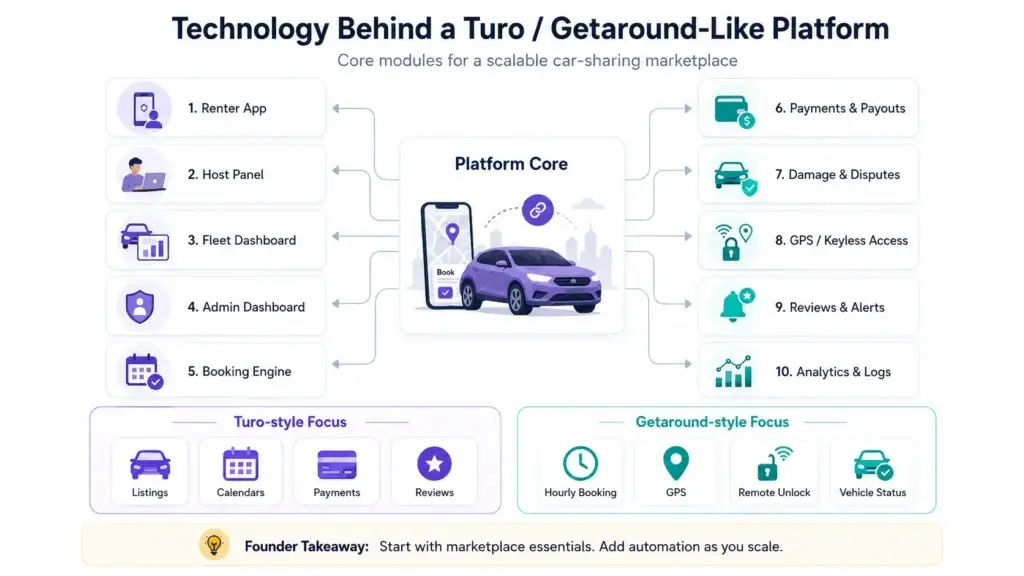
A Turo clone script or Getaround-style platform needs more than a booking app. It needs a connected system that manages vehicles, users, bookings, payments, deposits, access, disputes, and admin control.
For founders, this matters because car sharing is a high-trust marketplace. If a vehicle is double-booked, a payout is delayed, or a renter cannot access the car, the platform can quickly lose trust.
A scalable car-sharing platform should include:
| Module | Purpose | Founder Value |
|---|---|---|
| Renter App | Search, book, pay, upload documents, and manage trips | Drives bookings and user experience |
| Host Panel | List vehicles, manage pricing, availability, bookings, and earnings | Helps retain vehicle owners |
| Fleet Dashboard | Manage multiple cars from one place | Useful for professional hosts and rental fleets |
| Admin Dashboard | Control users, vehicles, bookings, payments, commissions, and disputes | Gives full operational control |
| Booking Engine | Handles trip dates, time slots, confirmations, and changes | Prevents double bookings |
| Availability Calendar | Shows available, booked, blocked, or maintenance slots | Keeps vehicle inventory accurate |
| Pricing Engine | Supports hourly, daily, weekly, seasonal, or location-based pricing | Helps test revenue models |
| Payment and Payout System | Manages payments, refunds, host earnings, deposits, and commissions | Builds trust on both sides |
| Damage and Dispute Management | Tracks photos, reports, claims, refunds, and complaints | Protects owners and renters |
| GPS / Keyless Access | Supports tracking, remote unlock, and vehicle status where needed | Essential for Getaround-style automation |
| Reviews and Notifications | Manages ratings, alerts, reminders, and trip updates | Improves trust and engagement |
| Analytics and Audit Logs | Tracks revenue, bookings, utilization, admin actions, and user activity | Helps founders make better decisions |
For a Turo-style marketplace, the priority is listings, booking calendars, host dashboards, renter verification, payments, deposits, reviews, damage reports, and admin controls. This model works well for daily, weekend, airport, and longer-duration rentals.
For a Getaround-style marketplace, the platform needs stronger automation, including hourly booking, GPS tracking, telematics, remote lock/unlock, vehicle status monitoring, and fast support workflows.
The founder decision is simple: start with a Turo-style marketplace if your focus is peer-to-peer rentals and vehicle variety. Choose a Getaround-style model if your market needs short-term, keyless urban access. A hybrid platform can combine both, but the backend must be planned carefully.
Security should be built into the foundation with encrypted data transfer, secure payments, user verification, role-based admin access, activity logs, dispute management, and privacy-conscious data handling.
Read More: How to Start a Car Rental Business in 2026: Complete Founder’s Guide
Build vs Buy: Custom Development, SaaS, or Turo Clone Script?
Founders usually have three development paths.
| Build Option | What It Means | Best For | Founder Tradeoff |
|---|---|---|---|
| Custom Development | Build the entire platform from scratch | Complex, highly unique business models | More control, but longer planning and development effort |
| SaaS Marketplace Tool | Use a hosted platform with limited customization | Testing simple marketplace demand | Faster setup, but less ownership and flexibility |
| Turo Clone Script | Start with a ready-made car rental marketplace foundation | Founders who want faster launch with customization | Faster validation with more control than generic SaaS |
A Turo clone script is useful when a founder wants the core platform logic already in place. This can include vehicle listings, renter booking flows, host dashboards, payment flows, admin controls, commissions, user management, and marketplace workflows.
The advantage is speed. Instead of spending months building the basic product foundation, founders can focus on market adaptation, branding, pricing logic, insurance workflow, local regulations, vehicle onboarding, and growth.
This does not mean every startup should copy Turo exactly. The better approach is to use a Turo-style foundation and customize it for your business model.
For example, your platform may focus on:
- Airport car rentals
- Luxury car rentals
- EV rentals
- Student car sharing
- Local city rentals
- Fleet-based rentals
- Peer-to-peer car sharing
- Corporate mobility
- Tourism-focused rentals
- Hourly and daily hybrid bookings
Founders planning to launch faster can explore a white-label Turo clone app from Miracuves.
How Miracuves Helps Founders Launch a Turo-Style Car Sharing Platform
Miracuves helps founders build ready-made and white-label app solutions with source-code ownership, branded design, admin control, and scalable marketplace workflows.
For car-sharing entrepreneurs, a Turo-style platform can include user apps, host panels, vehicle listings, booking management, payment flows, commission controls, admin dashboards, and marketplace operations.
The platform can be customized for peer-to-peer rentals, fleet-based rentals, hourly bookings, airport rentals, EV rentals, local rentals, or luxury car rental niches.
Instead of building every marketplace workflow from scratch, Miracuves gives startups a faster foundation to validate, launch, and scale their car-sharing business. Founders can then adapt the platform around their local market, pricing rules, insurance logic, deposit workflows, and brand positioning.
Final Verdict: Turo vs Getaround Business Model
Turo and Getaround both prove that peer-to-peer car sharing can create value, but they do it in different ways.
Turo is stronger for longer rentals, travel use cases, host-led marketplace growth, airport rentals, and vehicle variety. It is a strong reference model for founders who want to build a marketplace where owners list vehicles and renters book them for daily or multi-day use.
Getaround is stronger for short-term, automated, keyless urban mobility. It is a strong reference model for founders targeting hourly rentals, local city trips, and high-frequency car access.
Entrepreneurs should not copy either platform blindly. The better strategy is to study the business logic, identify the local market gap, and build a platform that fits the target users.
For many startups, the best model may combine Turo’s marketplace depth with Getaround’s automation layer. Start with the marketplace foundation, validate demand, onboard vehicle owners, build trust, and then add automation where it improves the user experience.
A Turo clone script can help founders move faster by providing the core product foundation. But long-term success depends on much more than the script. It depends on the business model, host quality, renter trust, pricing logic, claims workflows, admin control, and market execution.
Miracuves helps founders move from idea to launch faster with ready-made, white-label, source-code-owned app solutions built for branding, monetization, and scalable marketplace operations.
FAQs
What is a Turo clone script?
A Turo clone script is a ready-made software foundation for launching a peer-to-peer car rental marketplace. It usually includes vehicle listings, renter booking flows, host dashboards, payments, admin controls, commissions, reviews, and user management. Founders can customize it for local rental rules, branding, pricing, and marketplace operations.
How does Turo’s business model work?
Turo works as a peer-to-peer car rental marketplace. Vehicle owners list cars, guests book them, and the platform earns through marketplace fees, protection-plan-linked revenue, guest charges, delivery fees, extra mileage, late returns, and other booking-related fees. The platform does not need to own the vehicles.
How does Getaround’s business model work?
Getaround works as an app-based car-sharing marketplace with a stronger focus on short-term and keyless access. Users can book nearby vehicles and unlock them through the app where connected technology is installed. This makes the model useful for hourly rentals, local trips, and urban mobility use cases.
What is the biggest difference between Turo and Getaround?
The biggest difference is operating style. Turo is more marketplace-led and works well for daily, weekend, airport, and longer rentals. Getaround is more automation-led and works well for short-term, hourly, local, and keyless car access.
Which model is better for startup founders?
A Turo-style model is usually better for founders targeting travel rentals, daily bookings, host-led marketplaces, and vehicle variety. A Getaround-style model is better for dense urban markets where users need cars for short trips. A hybrid model can work when the market supports both daily and hourly rentals.
What features should a Turo-like app include?
A Turo-like app should include vehicle listings, search filters, booking calendars, host dashboards, renter profiles, payment gateway, wallet and payouts, deposit workflow, damage reporting, reviews, cancellation rules, admin dashboard, notifications, and dispute management.
Can a Turo clone script support hourly bookings like Getaround?
Yes, a Turo clone script can be customized to support hourly bookings if the booking engine, pricing rules, availability calendar, and admin controls are designed for short-duration rentals. For full Getaround-style automation, founders may also need GPS, telematics, or keyless access integrations.
How much does it cost to build a Turo-like app?
The cost depends on features, integrations, technology stack, design, customization, payment workflows, GPS needs, keyless access requirements, and launch scope. Founders should ask Miracuves for the latest quote based on the selected modules and business model.
Miracuves is an independent software development company. We are not affiliated with, connected to, sponsored by, or endorsed by any company or product named in this article.
Terms such as “X Clone” are used descriptively. It is how the software industry refers to building a platform with functionality comparable to a known service, and how clients search for it.
The entire design and codebase of our products is built by our own team. Our products contain no code, design, graphics, or content originating from any third-party website or applications.
All third-party names and marks referenced in this article are the property of their respective owners, referenced solely to identify the services discussed.