


Key Takeaways
- Food delivery marketplace revenue can come from restaurant commissions, customer delivery fees, subscription plans, promoted listings, advertising, service charges, and other transaction-based models.
- Each revenue stream depends on different marketplace activity: commissions monetize orders, delivery fees support fulfillment, subscriptions encourage recurring usage, and promotions monetize restaurant visibility.
- A balanced model should improve platform revenue without making restaurant economics unattractive, delivery prices too high, or the customer ordering experience overly dependent on fees.
Revenue Model Signals
- Restaurant commissions can be structured as a percentage of order value, tiered rates, category-based pricing, or different plans based on delivery and promotional support.
- Delivery and service fees can vary by distance, order size, demand, delivery zone, time, logistics cost, and the level of fulfillment provided by the marketplace.
- Subscription plans may offer customers reduced delivery charges or exclusive benefits, while restaurant plans can bundle lower commission rates, analytics, marketing tools, or enhanced platform visibility.
Marketplace Monetization Insights
- Promoted listings, sponsored placements, featured restaurants, campaign tools, and targeted offers can generate additional revenue while helping restaurants compete for customer attention.
- Operators should monitor commission revenue, delivery margin, subscription conversion, promotional spend, average order value, order frequency, restaurant retention, and contribution margin by order.
- Miracuves develops customizable food delivery marketplaces with commission management, delivery fees, subscriptions, promotions, restaurant tools, payments, payouts, analytics, and admin controls.
A food delivery marketplace does not survive on order volume alone. The real business depends on how every order is priced, how restaurants are charged, how delivery costs are recovered, how customers are retained, and how promotions are controlled without damaging margins.
For founders, this is where the revenue model becomes more important than the app idea itself. A delivery platform may look simple from the customer side: browse restaurants, add food to cart, pay, track the rider, and receive the order. But behind that experience, the platform operator needs multiple income streams working together.
Founders planning a delivery platform should first understand the complete food delivery marketplace business model, because commissions, delivery fees, subscriptions, and promotions all affect how the platform earns, scales, and protects margins.
The strongest food delivery marketplaces usually combine restaurant commissions, delivery fees, service charges, subscriptions, sponsored placements, loyalty programs, and merchant tools. Each stream plays a different role. Some create direct revenue per order. Some improve repeat usage. Some help restaurants get more visibility. Some protect the platform during peak demand or low-margin delivery zones.
This guide explains how food delivery marketplaces generate revenue, what each model means for founders, and how to think about monetization before launching your own branded delivery platform.
Why Food Delivery Marketplaces Need Multiple Revenue Streams
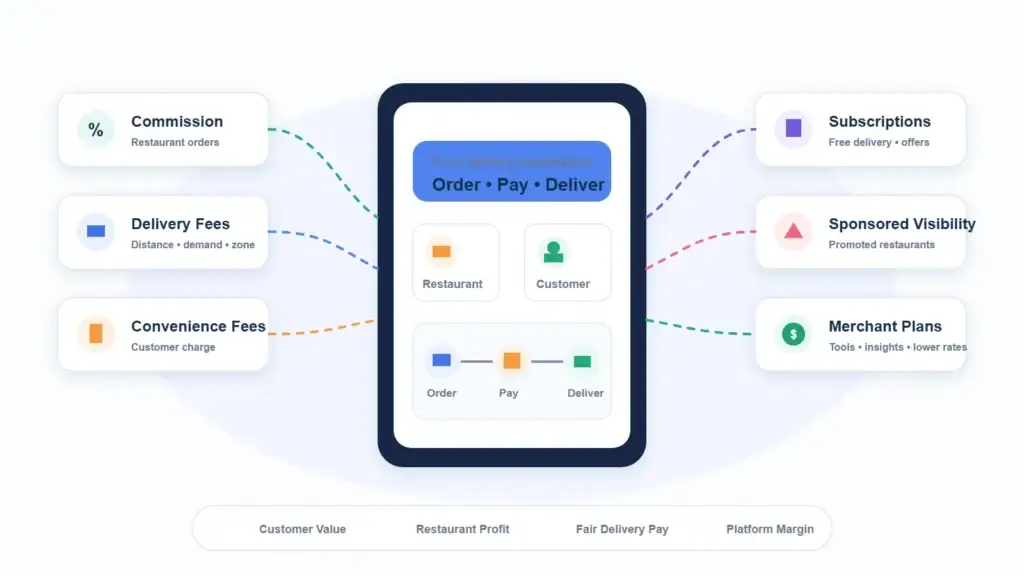
Food delivery is a low-margin, high-frequency marketplace. Every order involves several moving parts: the customer, restaurant, delivery partner, payment gateway, support team, coupon engine, and admin system. If the platform depends only on restaurant commission, it may struggle when restaurants negotiate lower rates or when delivery costs increase.
A multi-stream revenue model gives the platform more flexibility. Instead of forcing one party to carry the full cost, the business can distribute revenue across different layers:
- Customers may pay delivery fees or convenience charges.
- Restaurants may pay commissions or subscription fees.
- Delivery pricing may adjust by distance, demand, or zone.
- Merchants may pay for sponsored visibility.
- Loyal customers may subscribe for free delivery or special offers.
The goal is not to add random charges everywhere. The goal is to design a balanced revenue model where customers still find value, restaurants still earn profit, delivery partners are paid fairly, and the platform keeps enough margin to grow.
The Core Revenue Streams in a Food Delivery Marketplace
A food delivery marketplace usually earns from a mix of order-based revenue, customer-side fees, restaurant-side plans, and marketing-based monetization.
| Revenue Stream | Who Pays | How It Works | Founder Impact |
|---|---|---|---|
| Restaurant commission | Restaurant or merchant | Platform takes a percentage or fixed fee per completed order | Creates predictable revenue from transaction volume |
| Delivery fee | Customer | Customer pays based on distance, location, order value, or demand | Helps recover delivery and logistics costs |
| Service charge | Customer | Small platform fee added during checkout | Supports platform operations and support costs |
| Subscription plan | Customer or restaurant | Recurring fee for benefits, visibility, or lower charges | Builds predictable recurring revenue |
| Sponsored listing | Restaurant or merchant | Paid placement inside search, category, or homepage sections | Monetizes platform traffic and merchant competition |
| Promotion fee | Restaurant or platform-funded | Discounts, coupons, bundles, or campaign participation | Drives demand but needs strict margin control |
| Small order fee | Customer | Fee applied when order value is below a set threshold | Encourages higher basket size |
| Priority delivery fee | Customer | Optional fee for faster or preferred fulfilment | Adds premium monetization without forcing every customer to pay |
The strongest model is rarely “charge everyone more.” The stronger model is to give each participant a reason to pay. Restaurants pay for orders and visibility. Customers pay for convenience and reliability. Power users pay for membership benefits. The platform earns because it controls the transaction, delivery, discovery, and loyalty layer.
For a deeper strategic view of how restaurant supply, customer demand, delivery operations, and platform monetization connect, you can also read this guide on the food delivery marketplace revenue model.
Restaurant Commissions: The Foundation of Marketplace Revenue
Restaurant commission is one of the most common revenue streams in food delivery. In this model, the platform takes a percentage or fixed amount from every successful order generated through the marketplace.
For founders, the commission model is attractive because it grows with order volume. If more restaurants join and more customers order, marketplace revenue increases naturally.
But commission must be handled carefully. If the rate is too high, restaurants may increase menu prices, reduce offer participation, or leave the platform. If the rate is too low, the platform may not cover acquisition, support, delivery coordination, and technology costs.
A flexible commission engine should allow the platform operator to set different commission rules based on:
- Restaurant category
- Order value
- Delivery zone
- Restaurant plan
- Cuisine type
- Promotional campaign
- Pickup or delivery order
- High-volume restaurant agreements
This is why admin control matters. A founder should not need developer support every time they want to adjust restaurant commissions. The admin dashboard should allow marketplace operators to test rates, manage partner agreements, and protect margins by city, zone, or restaurant segment.
Delivery Fees: Recovering Logistics Cost Without Hurting Conversion
Delivery fees help the platform recover the cost of moving orders from restaurants to customers. This fee can be fixed, distance-based, time-based, zone-based, or demand-based.
A flat delivery fee is simple, but it may not work for every market. A short-distance order and a long-distance order do not create the same fulfilment cost. A delivery during normal hours and a delivery during peak demand may also require different pricing logic.
Food delivery marketplaces commonly use delivery fee rules based on:
- Distance between restaurant and customer
- Delivery zone
- Weather or peak-hour demand
- Order value
- Delivery partner availability
- Membership status
- Restaurant-funded free delivery campaigns
The founder’s challenge is to avoid two extremes. If delivery fees are too high, checkout abandonment increases. If delivery fees are too low, the platform quietly loses money on every order.
This is why food delivery platform cost planning should include delivery zones, rider payouts, payment workflows, admin controls, commission settings, and promotion logic from the beginning.
A smart delivery fee model should be visible, fair, and configurable. Customers should understand what they are paying for, while the operator should have enough control to adjust delivery economics based on real operating conditions.
Service Charges and Platform Fees: Small Fees With Big Operational Value
Service charges are usually added during checkout as a platform fee. They help cover operational costs such as support, payment processing workflows, technology maintenance, refunds, dispute handling, and marketplace administration.
For a founder, service charges can be useful because they create revenue without directly increasing restaurant commission. But they must be used carefully. Customers are sensitive to surprise fees at checkout. If the checkout total feels much higher than expected, conversion can drop.
A better approach is to keep service fees transparent and consistent. The platform can apply them as:
- A percentage of order value
- A small fixed fee per order
- A fee only above or below certain basket thresholds
- A fee waived for subscribers
- A fee adjusted by city or operating zone
Service charges work best when the overall customer experience feels worth paying for: reliable delivery, live tracking, accurate restaurant information, smooth refunds, and responsive support.
Subscriptions: Turning Repeat Orders Into Predictable Revenue
Subscription plans help food delivery marketplaces build recurring revenue and improve customer retention. Instead of earning only when a customer places an order, the platform earns a recurring fee in exchange for benefits.
A customer subscription may include:
- Free delivery on eligible orders
- Lower service charges
- Exclusive restaurant offers
- Priority support
- Loyalty points
- Early access to deals
- Reduced small order fees
These monetization layers work better when the platform includes the right subscription and loyalty features for delivery apps, such as coupon eligibility, recurring membership rules, wallet credits, free-delivery limits, and admin-controlled offer settings.
Restaurant subscriptions can also work. A restaurant may pay a monthly fee for lower commission, featured placement, analytics, campaign tools, or premium support.
The key is to avoid building subscriptions as simple discount machines. If the platform gives away too many benefits without controlling order value, frequency, and delivery cost, subscriptions can reduce margins instead of improving them.
A well-designed subscription plan should answer three questions:
- Will the subscriber order often enough to justify the benefit?
- Can the platform control delivery cost on subscription orders?
- Does the plan increase loyalty without damaging restaurant economics?
For founders, subscriptions are powerful because they shift part of the business from purely transactional revenue to predictable recurring revenue. But they need strong admin rules, eligibility controls, and reporting.
Promotions and Sponsored Listings: Monetizing Marketplace Attention
Once a food delivery marketplace has enough restaurants and customer activity, visibility becomes valuable. Restaurants want more orders. Customers need help discovering where to order. The platform can monetize this attention through sponsored listings, promotional placements, and campaign tools.
Promotional revenue may include:
- Sponsored restaurant placement
- Featured cuisine sections
- Homepage banners
- Search result boosts
- Limited-time deal campaigns
- Restaurant-funded coupons
- Festival or weekend campaign slots
- Push notification campaigns
This revenue stream works because restaurants are not only buying software access. They are buying demand. If the platform can help them increase orders, sponsored visibility becomes a business tool.
However, promotions must not damage customer trust. If every visible restaurant is paid placement, users may feel the marketplace is not helping them discover the most relevant options. A healthy promotion system balances paid visibility with quality signals such as ratings, delivery time, cuisine match, availability, and repeat customer behavior.
For founders, the best promotion engine is measurable. Restaurants should be able to see campaign performance, order lift, spend, and return from sponsored placements. The platform operator should be able to control campaign pricing, placement rules, approval workflows, and reporting from the admin panel.
To connect promotional revenue with customer acquisition, repeat orders, push campaigns, and restaurant visibility, this food delivery app marketing strategy guide can support the next layer of growth planning.
Small Order Fees: Encouraging Higher Basket Value
Small order fees are used when the basket value is below a minimum threshold. This helps the platform protect margins because small orders often create the same delivery effort as larger orders but generate less commission.
For example, a low-value order may still require restaurant preparation, rider assignment, support availability, payment processing, and delivery tracking. If the platform earns very little from the order, the economics may not work.
A small order fee can encourage customers to add more items before checkout. It can also help the platform avoid loss-making orders.
But this fee must be communicated clearly. A better experience is to show customers how much more they need to add to avoid the fee. This turns a charge into a basket-building nudge.
Priority Delivery and Premium Convenience Fees
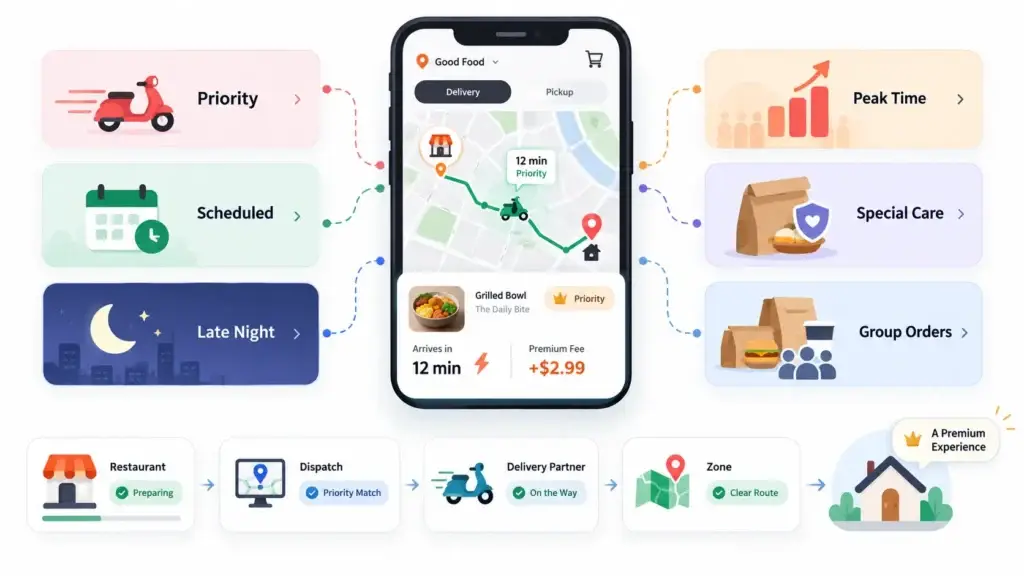
Some customers are willing to pay more for faster delivery, priority handling, or premium convenience. This creates another revenue opportunity for food delivery marketplaces.
Priority delivery should not promise something the platform cannot operationally deliver. It should be connected to real dispatch logic, delivery partner availability, restaurant preparation time, and zone conditions.
Premium convenience fees may apply to:
- Faster delivery slots
- Scheduled delivery
- Late-night delivery
- High-demand periods
- Special handling
- Corporate meal orders
- Group ordering
The founder’s decision here is simple: charge premium fees only where the platform can provide a premium experience. Otherwise, the fee may create dissatisfaction and support issues.
Merchant Tools and Value-Added Services
As restaurants become more dependent on a delivery marketplace, they often need tools beyond order acceptance. This creates opportunities for value-added merchant services.
A platform can offer paid tools such as:
- Advanced sales analytics
- Menu performance reports
- Customer behavior insights
- Inventory visibility
- Loyalty campaign tools
- Automated coupon creation
- Featured restaurant branding
- Multi-branch controls
- Payout reports
- POS or billing integrations
These tools can be offered as part of a restaurant subscription or as add-on modules. For founders, this matters because merchant tools deepen restaurant relationships. The more useful the platform becomes for daily restaurant operations, the harder it is for merchants to treat it as just another listing channel.
Founder Decision Signals: Which Revenue Model Should You Prioritize?
Early Launch
Start with commissions, delivery fees, and basic promo controls. These are easier to explain and directly connected to order activity.
Growing Supply
Once more restaurants join, add sponsored listings, category boosts, and restaurant campaign tools.
Repeat Customers
When customers order frequently, introduce subscriptions, loyalty plans, and free-delivery thresholds.
Multi-Zone Operations
When delivery costs vary by area, use zone-based delivery fees, peak pricing, and admin-controlled fee rules.
How Admin Controls Shape Food Delivery Revenue
Revenue strategy is only useful when the platform operator can control it. A founder should look beyond the customer app and study the backend revenue layer.
The admin panel should allow the operator to manage:
- Restaurant commission rates
- Delivery fee rules
- Service charge settings
- Subscription plans
- Promo codes and coupons
- Sponsored listing packages
- Restaurant payout cycles
- Refunds and disputes
- Tax and invoice records
- Zone-based delivery pricing
- Loyalty and wallet rules
Without these controls, every monetization change becomes a development request. That slows down experimentation and makes the business less responsive to market conditions.
For example, a founder may want to reduce commission for a high-volume restaurant, increase delivery fees in a far zone, run free delivery for first-time users, or create a paid restaurant visibility campaign during weekends. These changes should be manageable from the dashboard, not hardcoded into the system.
Common Monetization Mistakes Founders Should Avoid
Mistake 1: Depending Only on Restaurant Commission
Commission is important, but it should not be the only revenue stream. If restaurants push back or order margins shrink, the platform needs other ways to earn.
A balanced model includes customer-side fees, subscription plans, promotional tools, and delivery margin controls.
Mistake 2: Using Discounts Without Tracking Margin
Discounts can increase orders, but they can also hide losses. Founders should know who is funding the promotion: the platform, the restaurant, or both.
Every campaign should be tracked against order volume, average basket size, repeat purchase, and margin impact.
Discounts, refunds, wallet credits, and payment disputes should also be supported by secure payment and delivery platform controls, especially when order volume increases and more restaurants, customers, and delivery partners start using the platform.
Mistake 3: Charging High Fees Before Trust Is Built
A new marketplace must earn customer trust first. If fees feel excessive before the platform proves convenience, selection, and reliability, users may not return.
Start with simple pricing. Add advanced monetization once the platform has stronger order frequency and merchant supply.
Mistake 4: Ignoring Delivery Partner Economics
A food delivery marketplace cannot grow if delivery partners are underpaid or poorly managed. Delivery pricing should account for distance, time, rider availability, incentives, and payout cycles.
The customer may see only one delivery fee, but the operator must manage the entire fulfilment cost behind it.
Mistake 5: Building Without Revenue Flexibility
A fixed monetization setup can limit growth. Founders need the ability to test commission tiers, subscription pricing, delivery rules, restaurant promotions, and customer loyalty offers.
Revenue flexibility is not a future feature. It should be part of the platform foundation.
Revenue Model by Business Stage
| Business Stage | Best Revenue Focus | Why It Works |
|---|---|---|
| Launch stage | Commission, delivery fee, service charge | Simple to manage and tied directly to orders |
| Restaurant onboarding stage | Lower commission plans, promotional credits, featured onboarding | Helps attract supply without heavy friction |
| Growth stage | Sponsored listings, subscriptions, loyalty offers | Monetizes repeat customers and marketplace traffic |
| Multi-city stage | Zone pricing, merchant plans, delivery margin controls | Helps manage different cost structures by location |
| Mature stage | Advanced merchant tools, analytics, ad placements, premium plans | Builds higher-value revenue beyond basic order commission |
How Miracuves Helps Founders Build Monetization-Ready Delivery Platforms
Miracuves helps founders launch branded food delivery platforms with the revenue controls needed to test and scale a marketplace. Instead of waiting months to build customer ordering, restaurant dashboards, delivery workflows, payment flows, and admin controls from scratch, founders can start with a ready-made platform foundation and customize it around their business model.
A reliable food delivery app development partner should help founders connect monetization logic with real platform modules, including restaurant commissions, delivery fee rules, promotional controls, subscription plans, payout workflows, and admin reporting.
A monetization-ready delivery platform should include:
- Customer app and web ordering
- Restaurant management panel
- Delivery partner app
- Admin dashboard
- Commission settings
- Delivery fee controls
- Coupon and promotion engine
- Subscription options
- Wallet and payment gateway integration
- Payout management
- Ratings and dispute workflows
- Reporting and analytics
For founders who want faster execution, Miracuves’ 6-day solution delivery can help reduce launch delays where the selected ready-made scope fits. This is especially useful when the goal is to test a food delivery marketplace, onboard restaurants, configure revenue rules, and enter the market without rebuilding the same foundation from zero.
Final Thoughts
A food delivery marketplace becomes stronger when its revenue model is designed before launch, not after the first few months of operations. Commissions may create the foundation, but delivery fees, service charges, subscriptions, promotions, sponsored listings, and merchant tools create the flexibility needed for growth.
For founders, the key is not to copy fee structures blindly. The smarter decision is to understand how each revenue stream affects customers, restaurants, delivery partners, and platform margins.
A well-built delivery platform should let you test these revenue rules from the admin dashboard, adjust them by market, and improve them as real order data comes in. That is where the business model and the technology foundation must work together.
FAQs
How do food delivery marketplaces make money?
Food delivery marketplaces make money through restaurant commissions, delivery fees, service charges, subscriptions, sponsored listings, promotional campaigns, merchant tools, and premium convenience fees. The strongest platforms usually combine multiple revenue streams instead of depending on only one.
What is the most important revenue stream for a food delivery platform?
Restaurant commission is often the foundation because it connects revenue directly to order volume. However, delivery fees, subscriptions, and promotions become important as the platform grows and needs better margin control.
Are delivery fees profitable for marketplace operators?
Delivery fees can support profitability, but only when they are aligned with distance, rider payouts, delivery time, zone cost, and customer willingness to pay. If delivery fees are too low, the platform may lose money on fulfilment. If they are too high, customers may abandon checkout.
How do restaurant subscriptions work in food delivery apps?
Restaurant subscriptions allow merchants to pay a recurring fee for benefits such as lower commission, better visibility, campaign tools, analytics, premium support, or featured placement. This can create predictable revenue for the platform while giving restaurants more control over growth.
Why are sponsored listings useful in food delivery marketplaces?
Sponsored listings help restaurants pay for better visibility inside search results, categories, homepage sections, or promotional campaigns. This creates advertising revenue for the platform and gives restaurants a way to attract more orders.
Should a new food delivery platform offer customer subscriptions?
Customer subscriptions can work when users order frequently and the platform can control delivery costs. New platforms should usually validate order frequency first before offering heavy free-delivery benefits.
What features are needed to manage food delivery revenue?
A food delivery platform should include commission settings, delivery fee controls, coupon management, subscription plans, sponsored listing tools, payout tracking, refund workflows, restaurant analytics, and admin reporting.
How can Miracuves help with food delivery marketplace monetization?
Miracuves helps founders launch white-label food delivery platforms with ordering workflows, restaurant panels, delivery partner apps, admin dashboards, payment integrations, and revenue controls. The platform can be configured for commissions, delivery fees, subscriptions, promotions, and merchant monetization.
Miracuves is an independent software development company. We are not affiliated with, connected to, sponsored by, or endorsed by any company or product named in this article.
Terms such as “X Clone” are used descriptively. It is how the software industry refers to building a platform with functionality comparable to a known service, and how clients search for it.
The entire design and codebase of our products is built by our own team. Our products contain no code, design, graphics, or content originating from any third-party website or applications.
All third-party names and marks referenced in this article are the property of their respective owners, referenced solely to identify the services discussed.